🎯 نواتج التعلم
🎯 Learning Outcomes
بعد دراسة هذا الدرس ستكون قادرًا على أن:
After this lesson you will be able to:
- تحلّل وزن جسم على مستوى مائل إلى مركّبة موازية للمستوى وأخرى عمودية عليه.Resolve the weight of a body on an incline into a component parallel to the plane and one perpendicular to it.
- تحسب القوة العمودية وتسارع الجسم على مستوى مائل أملس \(a=g\sin\theta\).Calculate the normal force and the acceleration of a body on a smooth incline \(a=g\sin\theta\).
- تحسب تسارع الجسم على مستوى خشن بمعرفة معامل الاحتكاك الحركي.Calculate the acceleration on a rough incline from the kinetic friction coefficient.
- تحدد متى يتحرك الجسم وبأي حال (سكون، سرعة ثابتة، تسارع) من المقارنة بين \(\tan\theta\) و\(\mu\).Decide when the body moves and in what way (rest, constant speed, acceleration) by comparing \(\tan\theta\) with \(\mu\).
- تطبّق معادلات الحركة لإيجاد السرعة والزمن عند أسفل المستوى.Apply the equations of motion to find the speed and the time at the bottom of the plane.
📐 تحليل القوى على المستوى المائل
📐 Resolving the Forces on an Incline
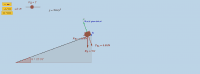
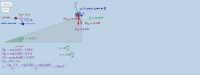
يؤثّر في الجسم الموضوع على مستوى مائل بزاوية \(\theta\) عن الأفقي: وزنه \(mg\) رأسيًا إلى أسفل، والقوة العمودية \(N\) التي يؤثر بها المستوى عموديًا عليه، وقوة الاحتكاك \(f\) إن كان المستوى خشنًا موازيةً للمستوى وعكس الحركة. ولتسهيل التحليل نختار محورين: \(x\) موازٍ للمستوى (نحو الأسفل موجب) و\(y\) عمودي عليه، ثم نحلّل الوزن (الزاوية بين الوزن والعمودي على المستوى تساوي زاوية الميل \(\theta\)):
The forces acting on a body placed on an incline at an angle \(\theta\) to the horizontal are: its weight \(mg\) vertically downward, the normal force \(N\) exerted perpendicular to the plane, and the friction force \(f\) if the plane is rough, parallel to the plane and opposite to the motion. To simplify the analysis we choose two axes: \(x\) parallel to the plane (down the plane positive) and \(y\) perpendicular to it, then resolve the weight (the angle between the weight and the perpendicular to the plane equals the angle of incline \(\theta\)):
📌 مركّبتا الوزن
📌 The two components of the weight
\[F_{g\parallel}=mg\sin\theta\ \ (\text{along the plane})\]
\[F_{g\perp}=mg\cos\theta\ \ (\text{perpendicular to the plane})\]
\[N=mg\cos\theta\]
تنبيه: يسمّي المصدر المركّبتين «أفقية» و«رأسية» نسبةً إلى المحورين المائلين، والصحيح أنهما موازية للمستوى وعمودية عليه.
Note: the source calls the components “horizontal” and “vertical” relative to the tilted axes; the correct names are parallel to the plane and perpendicular to it.
🟢 أولًا: المستوى المائل الأملس
🟢 1. The Smooth Inclined Plane
على المستوى الأملس لا يوجد احتكاك، فتكون القوة المحصلة الموازية للمستوى هي مركّبة الوزن فقط، ومن القانون الثاني لنيوتن:
On a smooth plane there is no friction, so the net force parallel to the plane is only the component of the weight, and from Newton’s second law:
📌 التسارع على مستوى أملس
📌 Acceleration on a smooth plane
\[mg\sin\theta=ma\ \Rightarrow\ a=g\sin\theta\]
📌 نتائج مهمة
📌 Important results
- يتأثر الجسم بقوتين فقط: الوزن والقوة العمودية.The body is acted on by two forces only: the weight and the normal force.
- الكتلة لا تؤثر في التسارع: تُحذف من طرفي المعادلة (\(a=g\sin\theta\)).The mass does not affect the acceleration: it cancels from both sides (\(a=g\sin\theta\)).
- عند \(\theta=0\) يكون \(a=0\)، وعند \(\theta=90^\circ\) يكون \(a=g\) (سقوط حر).At \(\theta=0\) \(a=0\), and at \(\theta=90^\circ\) \(a=g\) (free fall).
وإذا بدأ الجسم من السكون وانزلق مسافة \(L\) على المستوى فمن معادلات الحركة: \(v^2=2aL\) و\(t=\sqrt{2L/a}\).
If the body starts from rest and slides a distance \(L\) along the plane then from the equations of motion: \(v^2=2aL\) and \(t=\sqrt{2L/a}\).
جسم كتلته \(5\ \mathrm{kg}\) ينزلق من السكون على مستوى مائل أملس بزاوية \(30^\circ\) وطوله \(5\ \mathrm m\) (\(g=10\)). أوجد تسارعه وسرعته وزمنه عند أسفل المستوى.
A \(5\ \mathrm{kg}\) body slides from rest on a smooth incline at \(30^\circ\) of length \(5\ \mathrm m\) (\(g=10\)). Find its acceleration, its speed and its time at the bottom.
ما القوة العمودية على جسم كتلته \(6\ \mathrm{kg}\) موضوع على مستوى مائل بزاوية \(30^\circ\) (\(g=10\))؟
What is the normal force on a \(6\ \mathrm{kg}\) body placed on an incline at \(30^\circ\) (\(g=10\))?
🧪 جرّب بنفسك: الانزلاق على المستوى المائل
🧪 Try It Yourself: Sliding on an Incline
🧪 تجربة 1: انزلاق جسم على مستوى مائل أملس وخشن
🧪 Experiment 1: A Body Sliding on a Smooth and a Rough Incline
اضبط زاوية الميل والكتلة ومعاملي الاحتكاك (صفر للسطح الأملس) وطول المستوى ثم اضغط «ابدأ الانزلاق»؛ وراقب مركّبتي الوزن والقوة العمودية والاحتكاك والتسارع والسرعة عند الأسفل.
Set the angle of the incline, the mass, the two friction coefficients (zero for a smooth surface) and the length of the plane then press “Start sliding”; watch the two weight components, the normal force, the friction, the acceleration and the speed at the bottom.
🟠 ثانيًا: المستوى المائل الخشن
🟠 2. The Rough Inclined Plane
ينتج الاحتكاك عن حركة سطح فوق آخر وهو ناتج عن تجاذب كهرومغناطيسي بين الجسيمات المشحونة في السطحين. الاحتكاك السكوني قوة تبقي الجسم ساكنًا إلى أن تتجاوز القوة المؤثرة أقصى قيمة له \(f_{s,max}=\mu_sN\). والاحتكاك الحركي يظهر بعد بدء الانزلاق وهو أقل شدةً من السكوني (\(\mu_k\lt \mu_s\)):
Friction results from one surface moving over another and arises from electromagnetic attraction between the charged particles of the two surfaces. Static friction is a force that keeps the body at rest until the acting force exceeds its maximum value \(f_{s,max}=\mu_sN\). Kinetic friction appears after sliding starts and is weaker than the static one (\(\mu_k\lt \mu_s\)):
📌 التسارع على مستوى خشن
📌 Acceleration on a rough plane
\[f_k=\mu_kN=\mu_kmg\cos\theta\]
\[mg\sin\theta-\mu_kmg\cos\theta=ma\ \Rightarrow\ a=g\left(\sin\theta-\mu_k\cos\theta\right)\]
| الحالةCase | الشرطCondition | النتيجةResult |
|---|---|---|
| ينزلق بتسارعSlides with acceleration | \(\tan\theta\gt \mu\) | \(a=g(\sin\theta-\mu_k\cos\theta)\)\(a=g(\sin\theta-\mu_k\cos\theta)\) |
| سرعة ثابتة (إذا كان يتحرك)Constant speed (if moving) | \(\tan\theta=\mu_k\) | \(a=0\) |
| لا يتحركDoes not move | \(\tan\theta\le\mu_s\) | \(f=mg\sin\theta\) (احتكاك سكوني)\(f=mg\sin\theta\) (static friction) |
📌 نتائج مهمة
📌 Important results
- على المستوى الخشن تؤثر ثلاث قوى: القوة العمودية والوزن والاحتكاك.On a rough plane three forces act: the normal force, the weight and the friction.
- الكتلة لا تؤثر في التسارع في الحالتين؛ يعتمد على \(g\) و\(\theta\) و\(\mu_k\) فقط.The mass does not affect the acceleration in both cases; it depends on \(g\), \(\theta\) and \(\mu_k\) only.
- الزاوية الحرجة \(\theta_c=\tan^{-1}\mu_s\): الجسم ساكن عند الزوايا الأصغر منها وينزلق عند الأكبر.The critical angle \(\theta_c=\tan^{-1}\mu_s\): the body is at rest at smaller angles and slides at larger ones.
جسم كتلته \(10\ \mathrm{kg}\) على مستوى خشن بزاوية \(45^\circ\) ومعامل احتكاك حركي \(0.3\) (\(g=10\)). أوجد تسارعه.
A \(10\ \mathrm{kg}\) body on a rough plane at \(45^\circ\) with kinetic friction coefficient \(0.3\) (\(g=10\)). Find its acceleration.
جسم كتلته \(4\ \mathrm{kg}\) على مستوى خشن بزاوية \(37^\circ\) ومعامل احتكاك حركي \(0.4\) (\(\sin37^\circ=0.6,\ \cos37^\circ=0.8,\ g=10\)). أوجد تسارعه وقوة الاحتكاك.
A \(4\ \mathrm{kg}\) body on a rough plane at \(37^\circ\) with kinetic friction coefficient \(0.4\) (\(\sin37^\circ=0.6,\ \cos37^\circ=0.8,\ g=10\)). Find its acceleration and the friction force.
جسم على مستوى خشن زاويته \(30^\circ\) ومعامل الاحتكاك السكوني \(0.6\). هل يتحرك؟
A body on a rough plane at \(30^\circ\) with a static friction coefficient of \(0.6\). Does it move?
🧪 جرّب بنفسك: الزاوية الحرجة
🧪 Try It Yourself: the Critical Angle
🧪 تجربة 2: التسارع مع زاوية الميل والزاوية الحرجة
🧪 Experiment 2: Acceleration against the Angle and the Critical Angle
غيّر \(\mu_s\) و\(\mu_k\) وزاوية الميل وراقب منحنى التسارع: الجسم ساكن حتى الزاوية الحرجة \(\theta_c=\tan^{-1}\mu_s\) ثم يتسارع (الخط المنقّط للسطح الأملس).
Change \(\mu_s\), \(\mu_k\) and the angle of the incline and watch the acceleration curve: the body stays at rest up to the critical angle \(\theta_c=\tan^{-1}\mu_s\) then accelerates (the dotted line is for a smooth surface).
🔗 مثال إضافي: جسمان بينهما بكرة
🔗 Extra Example: Two Bodies over a Pulley
جسم كتلته \(m_1=5\ \mathrm{kg}\) على مستوى مائل أملس بزاوية \(45^\circ\) موصول بخيط يمر على بكرة ملساء بجسم معلّق كتلته \(m_2=3\ \mathrm{kg}\) (\(g=10\)). أوجد تسارع الجملة واتجاه حركتها.
A body of mass \(m_1=5\ \mathrm{kg}\) on a smooth incline at \(45^\circ\) is connected by a string over a smooth pulley to a hanging body of mass \(m_2=3\ \mathrm{kg}\) (\(g=10\)). Find the acceleration of the system and the direction of its motion.
⚠️ أخطاء شائعة
⚠️ Common Mistakes
تجنّب هذه الأخطاء
Avoid these mistakes
- الخلط بين \(\sin\theta\) و\(\cos\theta\): الموازية للمستوى تأخذ \(\sin\theta\) والعمودية تأخذ \(\cos\theta\).Mixing \(\sin\theta\) and \(\cos\theta\): the parallel component takes \(\sin\theta\) and the perpendicular one \(\cos\theta\).
- كتابة \(N=mg\) على المستوى المائل، والصحيح \(N=mg\cos\theta\).Writing \(N=mg\) on an incline; the correct is \(N=mg\cos\theta\).
- الظن أن الجسم الأثقل ينزلق أسرع على المستوى الأملس أو الخشن.Thinking that a heavier body slides faster on a smooth or rough plane.
- حساب التسارع قبل التأكد من أن \(\tan\theta\gt \mu_s\) أي أن الجسم يتحرك فعلًا.Calculating the acceleration before checking that \(\tan\theta\gt \mu_s\), i.e. that the body actually moves.
📋 ملخص القوانين
📋 Summary of the Laws
| الكميةQuantity | المستوى الأملسSmooth plane | المستوى الخشنRough plane |
|---|---|---|
| مركّبة الوزن الموازيةParallel weight component | \(mg\sin\theta\) | \(mg\sin\theta\) |
| مركّبة الوزن العموديةPerpendicular weight component | \(mg\cos\theta\) | \(mg\cos\theta\) |
| القوة العموديةNormal force | \(N=mg\cos\theta\) | \(N=mg\cos\theta\) |
| قوة الاحتكاكFriction force | \(0\) | \(\mu_kmg\cos\theta\) |
| التسارعAcceleration | \(a=g\sin\theta\) | \(a=g(\sin\theta-\mu_k\cos\theta)\) |
🎲 تدرّب على المسائل
🎲 Practice Problems
🧪 تجربة 3: تدرّب: مسائل المستوى المائل
🧪 Experiment 3: Practice: Inclined Plane Problems
مسائل عشوائية بأرقام مختلفة (g = 10). احسب واكتب الجواب ثم اضغط «تحقّق».
Random problems with different numbers (g = 10). Work it out, enter the answer and press “Check”.
✅ قيّم نفسك
✅ Self-Check
جسم كتلته \(5\ \mathrm{kg}\) ينزلق على مستوى مائل أملس بزاوية \(30^\circ\) (\(g=10\)). تسارعه:
A \(5\ \mathrm{kg}\) body slides on a smooth incline at \(30^\circ\) (\(g=10\)). Its acceleration:
إذا تضاعفت كتلة جسم ينزلق على مستوى مائل أملس فإن تسارعه:
If the mass of a body sliding on a smooth incline is doubled its acceleration:
يتحرك جسم على مستوى مائل خشن بسرعة ثابتة عندما:
A body moves at constant speed on a rough incline when:
القوة العمودية على جسم على مستوى مائل بزاوية \(\theta\):
The normal force on a body on an incline of angle \(\theta\):
🧪 اختبر نفسك: امتحان من 20 سؤالاً
🧪 Test Yourself: a 20-Question Exam
أنهِ الدرس بالاختبار التفاعلي التالي؛ أسئلته تجمع بين الفهم والحساب وتغطي جميع أقسام الدرس.
Finish with the interactive exam below; its questions mix understanding with calculation and cover every section of the lesson.
اختبار الحركة على مستوى مائل Motion on an Inclined Plane Quiz
20 سؤالاً - مركبات الوزن، المستوى الأملس والخشن، الاحتكاك، الزاوية الحرجة 20 Questions - weight components, smooth and rough planes, friction, the critical angle
• عدد الأسئلة: 20 سؤالاً
• مدة الاختبار: 30 دقيقة
• لا يمكنك تغيير إجاباتك أو إعادة الاختبار إلا بعد 24 ساعة من التسليم.
• تأكد من إجاباتك قبل التسليم! 📌 Important Instructions:
• Number of questions: 20 questions
• Quiz duration: 30 minutes
• You cannot change your answers or retake the quiz for 24 hours after submission.
• Make sure of your answers before submitting!
🔗 محاكيات GeoGebra للاستعانة بها عند اللزوم
🔗 GeoGebra Simulations to Use When Needed
اضغط «تشغيل» لتعمل المحاكاة هنا داخل الدرس؛ ويمكن للطالب الرجوع إليها لتجربة الفكرة بطريقة أخرى.
Press “Run” to run the simulation right here inside the lesson; the student can use it to try the idea in another way.