📐 الإزاحة الزاوية
📐 Angular Displacement
تذكر: الإزاحة الخطية = الموقع النهائي − الموقع الابتدائي \(\Delta X = X_2 - X_1\). وبالمثل، الإزاحة الزاوية = الزاوية النهائية − الزاوية الابتدائية:
Remember: linear displacement = final position − initial position \(\Delta X = X_2 - X_1\). Similarly, angular displacement = final angle − initial angle:
إذا تحرك جسم من نقطة إلى أخرى وقطع قوسًا طوله \(S\) على محيط دائرة نصف قطرها \(r\)، فإن الزاوية التي يقابلها القوس تسمى الإزاحة الزاوية ويرمز لها بالرمز \(\theta\):
If a body moves from one point to another and sweeps an arc of length \(S\) on the circumference of a circle of radius \(r\), the angle subtended by the arc is called the angular displacement, denoted \(\theta\):
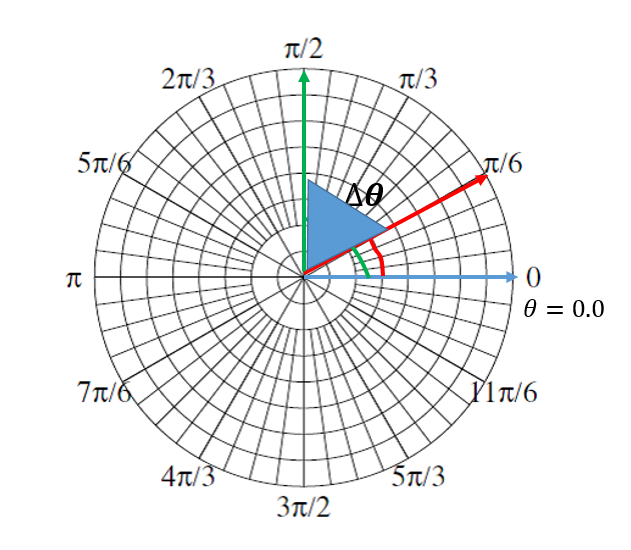
الإزاحة الزاوية كمية متجهة: إذا كان الدوران عكس عقارب الساعة تأخذ إشارة موجبة، وإذا كان الدوران مع عقارب الساعة تأخذ إشارة سالبة.
Angular displacement is a vector quantity: counterclockwise rotation is positive, clockwise rotation is negative.
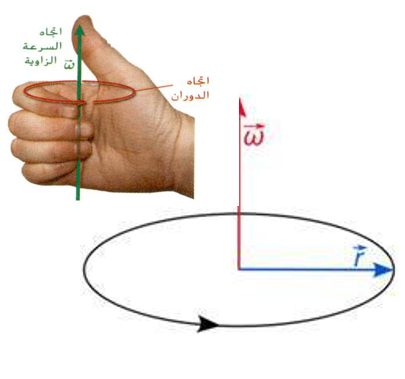
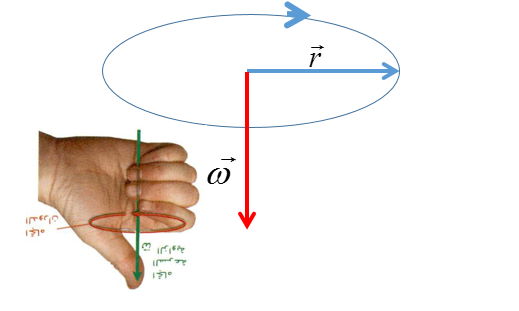
يمثّل الراديان وحدة قياس الإحداثيات الزاوية في النظام الدولي:
The radian is the SI unit for measuring angular coordinates:
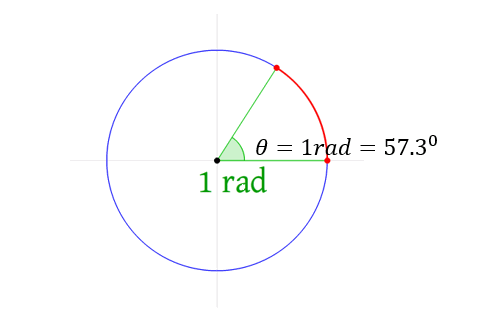
(rev) قد تجد الإزاحة الزاوية بوحدة الدرجات أو بوحدة الدورات؛ ويتم تحويلها إلى الراديان حسب معاملَي التحويل التاليين:
(rev) You may find angular displacement in degrees or revolutions; convert to radians using these conversion factors:
| من الدورات إلى الراديانRevolutions to radians | من الدرجات إلى الراديانDegrees to radians |
|---|---|
| \(2\pi\,(rad) = 1\,rev\) | \(\pi\,(rad) = 180^\circ\) |
| مثال: جسم قطع إزاحة زاوية قدرها 2.25 دورة، فكم يعادل بالراديان؟Example: A body sweeps 2.25 revolutions. How much is that in radians? | مثال: جسم قطع إزاحة زاوية 120 درجة، فكم يعادل بالراديان؟Example: A body sweeps 120°. How much is that in radians? |
| \(\theta = 2.25 \times 2\pi = 14.13\,rad\) | \(\theta = 120^\circ \times \dfrac{\pi}{180} = 2.1\,rad\) |
🌀 السرعة الزاوية
🌀 Angular Velocity
تذكر: السرعة المتجهة الخطية لجسم ما هي تغيّر الإحداثي الخطي للجسم بالنسبة للزمن. وبالمثل، السرعة الزاوية لجسم ما هي تغيّر الإحداثي الزاوي للجسم مع الزمن:
Remember: the linear velocity of a body is the change in its linear coordinate with respect to time. Similarly, the angular velocity of a body is the change in its angular coordinate with time:
📐 التجربة الأولى: السرعة الزاوية المتوسطة
📐 Experiment 1: Average Angular Velocity
| Δt (s) | θ₁ (rad) | θ₂ (rad) | ω (rad/s) | الاتجاهDirection |
|---|---|---|---|---|
| -- اضغط "حساب" ---- Click "Calculate" -- | ||||
| السرعة الزاويةAngular velocity | اتجاه السرعة الزاويةDirection of angular velocity |
|---|---|
| \[\omega = \dfrac{\theta_2-\theta_1}{t_2-t_1}\] السرعة الزاوية هي معدل تغيّر الزاوية خلال الزمن\[\omega = \dfrac{\theta_2-\theta_1}{t_2-t_1}\] Angular velocity is the rate of change of angle over time | موجب إذا كان الدوران عكس عقارب الساعة، وسالب إذا كان مع عقارب الساعة (نفس قاعدة اليد اليمنى الموضحة أعلاه).Positive for counterclockwise rotation, negative for clockwise (same right-hand rule shown above). |
يتحرك جسم حركة دائرية منتظمة بحيث يُكمل دورة واحدة كل ثانية. فما سرعته الزاوية بوحدة \(rad/s\)؟
A body moves in uniform circular motion, completing one revolution every second. What is its angular velocity in \(rad/s\)?
مروحة تدور بسرعة زاوية قدرها \(60\pi\,rad/s\). فما الزاوية التي تقطعها إحدى شفراتها خلال زمن قدره \(t=3\,s\)؟
A fan rotates with angular velocity \(60\pi\,rad/s\). What angle does one of its blades sweep in \(t=3\,s\)?
⚡ التسارع الزاوي
⚡ Angular Acceleration
التسارع الزاوي المتوسط هو معدل تغيّر السرعة الزاوية، ويرمز له بالرمز \(\alpha\)، ويُقاس بوحدة \(rad/s^2\). يحدث التسارع الزاوي عندما يتحرك الجسم حركة دائرية بسرعة غير ثابتة:
Average angular acceleration is the rate of change of angular velocity, denoted \(\alpha\), measured in \(rad/s^2\). Angular acceleration occurs when a body moves in a circle with non-constant speed:
⚙️ التجربة الثانية: التسارع الزاوي المتوسط
⚙️ Experiment 2: Average Angular Acceleration
🟢 موجب = تزايد السرعة 🔴 سالب = تناقص السرعة🟢 Positive = speeding up 🔴 Negative = slowing down
| Δt (s) | ω₁ (rad/s) | ω₂ (rad/s) | α (rad/s²) |
|---|---|---|---|
| 🔘 اضغط "حساب التسارع الزاوي"🔘 Click "Calculate α" | |||
دولاب سيارة يتحرك بسرعة زاوية \(\omega=10\,rad/s\)، فتغيّرت سرعته لتصبح \(\omega=15\,rad/s\) خلال زمن قدره \(t=10\,s\). أوجد التسارع الزاوي للدولاب.
A car wheel moves at angular velocity \(\omega=10\,rad/s\), changing to \(\omega=15\,rad/s\) over \(t=10\,s\). Find the wheel's angular acceleration.
🔗 نتائج مهمة: العلاقة بين الحركة الخطية والحركة الدائرية
🔗 Important Results: Linear vs. Circular Motion
| الكميةQuantity | الحركة الخطيةLinear Motion | الحركة الدائريةCircular Motion |
|---|---|---|
| الإزاحةDisplacement | \(s\) | \(\theta\) |
| السرعةVelocity | \(v\) | \(\omega\) |
| التسارعAcceleration | \(a\) | \(\alpha\) |
في الحركة الخطية يقطع الجسم إزاحة خطية \(s\)، بينما في الحركة الدائرية يقطع إزاحة زاوية \(\theta\). وفي الحركة الخطية يتحرك الجسم بسرعة خطية \(v\)، بينما في الحركة الدائرية يتحرك بسرعة زاوية \(\omega\). وفي الحركة الخطية يتحرك الجسم بتسارع خطي \(a\)، بينما في الحركة الدائرية يتحرك بتسارع زاوي \(\alpha\).
In linear motion the body covers a linear displacement \(s\), while in circular motion it covers an angular displacement \(\theta\). In linear motion the body moves with linear velocity \(v\), while in circular motion with angular velocity \(\omega\). In linear motion the body moves with linear acceleration \(a\), while in circular motion with angular acceleration \(\alpha\).
🔧 عزم القوة
🔧 Torque
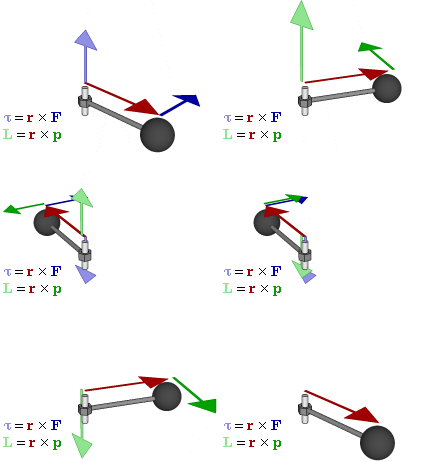
نقول إن لقوة عزمًا إذا كانت قادرة على إحداث حركة دورانية لجسم حول محور الدوران. وهو كمية متجهة تقيس مدى قدرة القوة على تدوير الجسم حول محور ما، ويُعرَّف بأنه حاصل ضرب القوة بطول الذراع. يُرمز لعزم الدوران بالحرف الإغريقي "تاو"، ووحدته في النظام الدولي نيوتن·متر:
A force has torque if it can cause rotational motion of a body about an axis. It is a vector quantity measuring a force's ability to rotate a body about an axis, defined as the product of the force and the lever arm. Torque is denoted by the Greek letter "tau", with SI unit newton·meter:
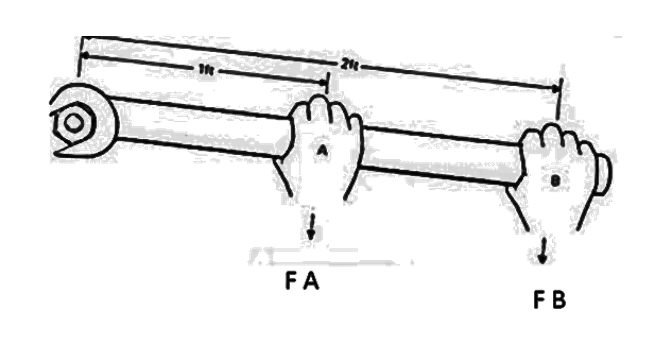
في الشكل أدناه، قوتان متساويتان أثّرتا على مفتاح ربط (مفكّ صواميل) قابل للدوران، عند نقطتين مختلفتي البعد عن محور الدوران (نقطة A على بعد قدم واحد، ونقطة B على بعد قدمين). أي من الإجابات التالية صحيحة؟
In the figure below, two equal forces act on a rotatable wrench, at two different distances from the pivot (point A at 1 ft, point B at 2 ft). Which of the following is correct?
➕ محصلة العزوم
➕ Net Torque
قد تؤثر أكثر من قوة واحدة على جسم ما، كل قوة منها من نقطة مختلفة. وكل قوة من هذه القوى تولّد عزم دوران على الجسم، ويكون عزم الدوران الكلي مجموع عزوم الدوران الفردية. ويكون اتجاه الدوران باتجاه العزم الأكبر.
More than one force may act on a body, each from a different point. Each generates a torque, and the net torque is the sum of the individual torques. The body rotates in the direction of the larger torque.
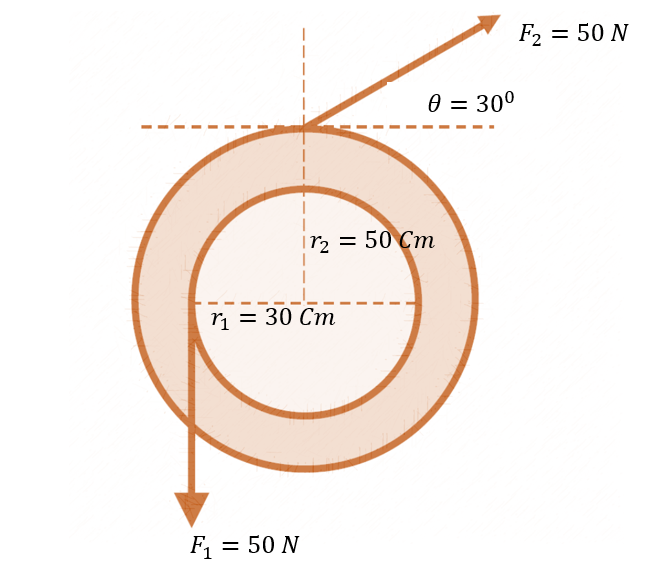
جسم قابل للدوران حول محور يقع في مركزه، متأثر بقوتين: \(F_1=F_2=50\,N\)، عند نصفَي قطر \(r_1=30\,cm\) و\(r_2=50\,cm\) على التوالي.
A body free to rotate about an axis at its center is acted on by two forces: \(F_1=F_2=50\,N\), at radii \(r_1=30\,cm\) and \(r_2=50\,cm\) respectively.
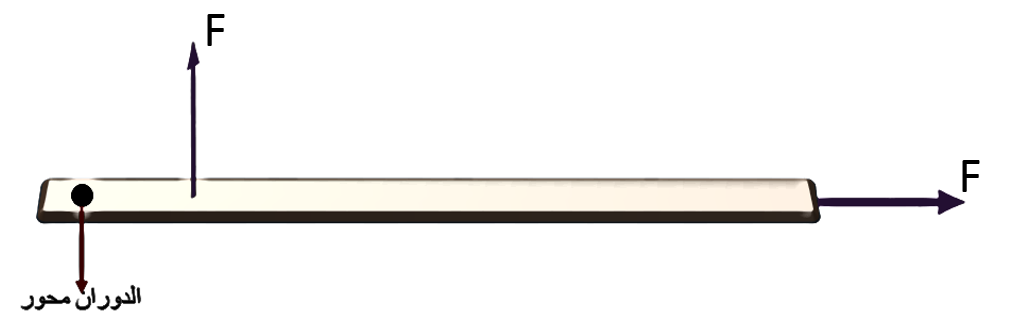
في هذه المحاكاة، توجد أوزان مختلفة على لعبة الميزان، ولكل منها عزم دوران. أكمل بيانات الجدول التالي، وفي كل مرة طبّق على المحاكاة للتأكد من نتيجتك:
In this simulation, different weights sit on a balance toy, each with its own torque. Complete the table below, checking each row against the simulation:
| \(\tau_{net}=\tau_1+\tau_0\) | عزم القوة يسار الوتد \(\tau_0=r_0 F_0 \sin(90^\circ)\)Torque left of pivot \(\tau_0=r_0 F_0 \sin(90^\circ)\) | عزم القوة يمين الوتد \(\tau_1=r_1 F_1 \sin(90^\circ)\)Torque right of pivot \(\tau_1=r_1 F_1 \sin(90^\circ)\) |
|---|---|---|
| \(\tau_{net}=........\) | \(m_0=5\,Kg, r_0=10\,m\) | \(m_1=8\,Kg, r_1=6\,m\) |
| \(\tau_{net}=........\) | \(m_0=7\,Kg, r_0=3\,m\) | \(m_1=9\,Kg, r_1=3\,m\) |
| \(\tau_{net}=........\) | \(m_0=3\,Kg, r_0=8\,m\) | \(m_1=8\,Kg, r_1=3\,m\) |
| \(\tau_{net}=........\) | \(m_0=5\,Kg, r_0=10\,m\) | \(m_1=2\,Kg, r_1=2\,m\) |
⚖️ مركز الكتلة
⚖️ Center of Mass
مركز الكتلة: نقطة على الجسم تتركّز فيها كتلة هذا الجسم كلها. إذا خضع جسم صلب لقوى متوازنة، توجد دومًا نقطة وحيدة من الجسم تكون حركتها مستقيمة منتظمة، وتُسمّى هذه النقطة مركز ثقل الجسم.
Center of mass: the point where a body's entire mass is considered concentrated. If a rigid body is subject to balanced forces, there is always a single point whose motion is straight and uniform — called the body's center of gravity.
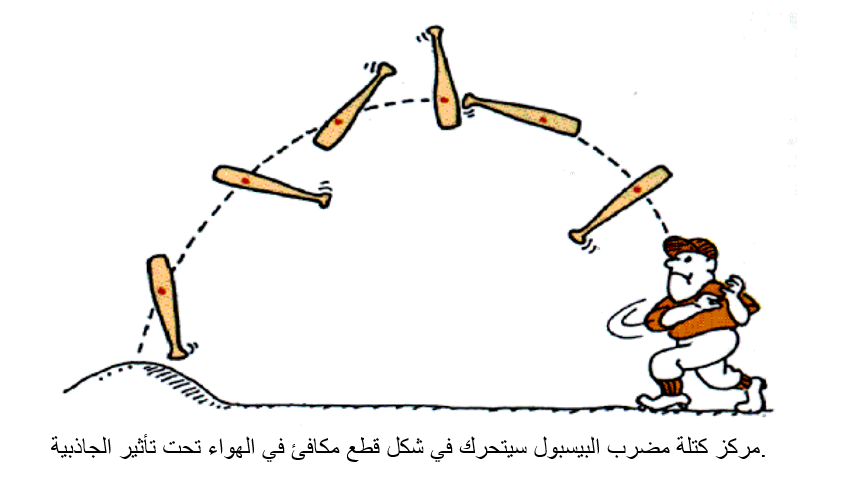
متى يكون الجسم أكثر اتزانًا واستقرارًا؟
When is a body more balanced and stable?
في هذه المحاكاة، غيّر قاعدة كل جسم وموضع مركز كتلته، وغيّر ميل المستوى عبر المجرى الموجود على اليسار، حتى تصبح قوة الوزن قادرة على تدوير الجسم وقلبه. لاحظ: كلما كانت قاعدة الجسم أكبر ومركز الكتلة أقرب إلى القاعدة، زاد استقرار الجسم.
In this simulation, change each object's base and the position of its center of mass, and change the incline's slope using the slider on the left, until gravity can tip the object over. Notice: the larger the base and the closer the center of mass to it, the more stable the object.
⚖️ الاتزان الدوراني
⚖️ Rotational Equilibrium
ليتحقق اتزان جسم لا بد من توافر شرطين أساسيين:
For a body to be in equilibrium, two basic conditions must hold:
- أن تكون محصلة عزوم القوى تساوي صفرًا — ويُسمّى الاتزان الدوراني.The net torque equals zero — called rotational equilibrium.
- أن تكون محصلة القوى المؤثرة على الجسم تساوي صفرًا — ويُسمّى الاتزان الانتقالي.The net force acting on the body equals zero — called translational equilibrium.
في هذه المحاكاة، علّق كتلًا مختلفة على أبعاد مختلفة من محور الدوران لتحقيق الاتزان الدوراني، وتحقق من ذلك بالنتائج. توقّع كيف يمكن استخدام أجسام مختلفة لموازنة اللوح الخشبي، وكيف يؤثر تغيير موضع الأجسام على حركة اللوح، ثم اكتب قاعدتك الخاصة لتتنبأ بأي جانب سيميل، واستخدمها لحل ألغاز الاتزان في المحاكاة:
In this simulation, hang different masses at different distances from the pivot to achieve rotational equilibrium, and verify with the results. Predict how different objects can balance the wooden board, how changing their position affects its motion, then write your own rule to predict which side will tilt, and use it to solve the simulation's balance puzzles: