🎯 نواتج التعلم
🎯 Learning Outcomes
بعد دراسة هذا الدرس ستكون قادرًا على أن:
After this lesson you will be able to:
- تعرّف التسارع الزاوي المتوسط واللحظي \(\alpha=d\omega/dt\) وتحسبه ووحدته \(\mathrm{rad/s^2}\).Define the average and the instantaneous angular acceleration \(\alpha=d\omega/dt\), calculate it and give its unit \(\mathrm{rad/s^2}\).
- تربط بين التسارع الزاوي والتسارع المماسي بالعلاقة \(a_t=\alpha r\).Relate the angular acceleration to the tangential acceleration by \(a_t=\alpha r\).
- تحسب التسارع المركزي \(a_c=v^2/r=\omega^2 r\) وتحدد اتجاهه.Calculate the centripetal acceleration \(a_c=v^2/r=\omega^2 r\) and state its direction.
- تحسب التسارع الكلي \(a=\sqrt{a_t^2+a_c^2}\) وزاوية اتجاهه، وتفرّق بين الحركة الدائرية المنتظمة وغير المنتظمة.Calculate the total acceleration \(a=\sqrt{a_t^2+a_c^2}\) and its direction, and distinguish uniform from non-uniform circular motion.
- تحدد متى تتزايد السرعة ومتى تتناقص من إشارتي \(\omega\) و\(\alpha\).Decide when the speed increases or decreases from the signs of \(\omega\) and \(\alpha\).
- تطبّق معادلات التسارع الزاوي الثابت في حل المسائل.Apply the equations of constant angular acceleration to solve problems.
🔄 تذكير سريع من القسم الأول
🔄 Quick Review from Part 1
في الحركة الدائرية يتحرك الجسم على مسار دائري نصف قطره \(r\). نصف بها الحركة بما يلي:
In circular motion the body moves along a circular path of radius \(r\). We describe it by:
| الكميةQuantity | العلاقةRelation | الوحدةUnit |
|---|---|---|
| الموضع الزاويAngular position | \(\theta=\dfrac{s}{r}\)\(\theta=\dfrac{s}{r}\) | radrad |
| السرعة الزاويةAngular velocity | \(\omega=\dfrac{d\theta}{dt}\)\(\omega=\dfrac{d\theta}{dt}\) | \(\mathrm{rad/s}\)\(\mathrm{rad/s}\) |
| السرعة الخطية (المماسية)Linear (tangential) speed | \(v=\omega r\)\(v=\omega r\) | \(\mathrm{m/s}\)\(\mathrm{m/s}\) |
| الدور والترددPeriod and frequency | \(\omega=\dfrac{2\pi}{T}=2\pi f\)\(\omega=\dfrac{2\pi}{T}=2\pi f\) | s ، Hzs , Hz |
💡 شرح إضافي: إشارة السرعة الزاوية
💡 Extra explanation: the sign of the angular velocity
نتفق عادةً أن الدوران عكس عقارب الساعة موجب وأن الدوران مع عقارب الساعة سالب. لذلك تكون السرعة الزاوية لعقرب الساعة سالبة، لكن السرعة الخطية \(v=|\omega| r\) مقدارٌ موجب دائمًا. وإشارة \(\omega\) تدل على اتجاه الدوران فقط.
We usually take rotation counter-clockwise as positive and clockwise as negative. So the angular velocity of a clock hand is negative, but the speed \(v=|\omega| r\) is always a positive magnitude. The sign of \(\omega\) only tells the direction of rotation.
احسب السرعة الزاوية لعقرب الدقائق في ساعة عادية.
Find the angular velocity of the minute hand of an ordinary clock.
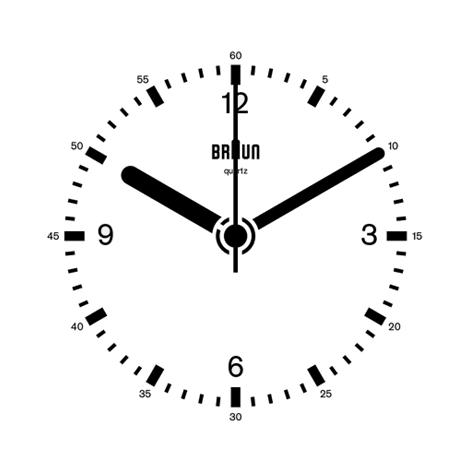
ساعة عقاربها تدور مع عقارب الساعة، فالسرعة الزاوية لكل عقرب سالبة.
The hands of a clock turn clockwise, so the angular velocity of each hand is negative.
أي القيم التالية تمثل السرعة الزاوية لعقرب الثواني (الدوران مع عقارب الساعة)؟
Which value represents the angular velocity of a second hand (clockwise rotation)?
🌀 التسارع الزاوي
🌀 Angular Acceleration
عندما يتحرك الجسم على دائرة بسرعة غير ثابتة (يسرع أو يبطئ) تتغير سرعته الزاوية مع الزمن، ويقيس التسارع الزاوي مقدار هذا التغير في كل ثانية.
When a body moves on a circle with a speed that is not constant (it speeds up or slows down) its angular velocity changes with time, and the angular acceleration measures how much it changes each second.
📘 التسارع الزاوي
📘 Angular acceleration
التسارع الزاوي المتوسط هو معدل تغير السرعة الزاوية خلال فترة زمنية:
The average angular acceleration is the rate of change of the angular velocity over a time interval:
\[\alpha_{avg}=\dfrac{\omega_2-\omega_1}{t_2-t_1}=\dfrac{\Delta\omega}{\Delta t}\]
والتسارع الزاوي اللحظي هو نهاية هذه النسبة عندما تؤول الفترة إلى الصفر:
and the instantaneous angular acceleration is the limit of this ratio as the interval tends to zero:
\[\alpha=\lim_{\Delta t\to0}\dfrac{\Delta\omega}{\Delta t}=\dfrac{d\omega}{dt}=\dfrac{d^2\theta}{dt^2}\]
وحدته \(\mathrm{rad/s^2}\).
Its unit is \(\mathrm{rad/s^2}\).
💡 شرح إضافي: معنى إشارة \(\alpha\)
💡 Extra explanation: the meaning of the sign of \(\alpha\)
إشارة \(\alpha\) وحدها لا تكفي لمعرفة هل الجسم يسرع أم يبطئ؛ يجب مقارنتها بإشارة \(\omega\):
The sign of \(\alpha\) alone does not tell whether the body speeds up or slows down; it must be compared with the sign of \(\omega\):
- \(\omega\) و\(\alpha\) بالإشارة نفسها: السرعة تتزايد (يدور الجسم أسرع).\(\omega\) and \(\alpha\) with the same sign: the speed increases (the body turns faster).
- \(\omega\) و\(\alpha\) بإشارتين مختلفتين: السرعة تتناقص (يدور الجسم أبطأ).\(\omega\) and \(\alpha\) with opposite signs: the speed decreases (the body turns slower).
- \(\alpha=0\): السرعة الزاوية ثابتة وهي الحركة الدائرية المنتظمة.\(\alpha=0\): the angular velocity is constant, which is uniform circular motion.
تغيرت السرعة الزاوية لعجلة من \(2.0\ \mathrm{rad/s}\) إلى \(8.0\ \mathrm{rad/s}\) خلال \(3.0\ \mathrm{s}\). احسب التسارع الزاوي المتوسط.
The angular velocity of a wheel changed from \(2.0\ \mathrm{rad/s}\) to \(8.0\ \mathrm{rad/s}\) in \(3.0\ \mathrm{s}\). Find the average angular acceleration.
معادلات التسارع الزاوي الثابت
Equations of constant angular acceleration
إذا كان \(\alpha\) ثابتًا فإن معادلات الحركة تشبه معادلات الحركة الخطية تمامًا (نستبدل \(x,v,a\) بـ \(\theta,\omega,\alpha\)):
If \(\alpha\) is constant the equations of motion are exactly like those of linear motion (replace \(x,v,a\) by \(\theta,\omega,\alpha\)):
📘 معادلات الحركة الدائرية بتسارع زاوي ثابت
📘 Equations of circular motion with constant angular acceleration
\[\omega=\omega_0+\alpha t\]
\[\Delta\theta=\omega_0 t+\tfrac12\alpha t^2\]
\[\omega^2=\omega_0^2+2\alpha\,\Delta\theta\]
تبدأ عجلة من السكون بتسارع زاوي ثابت \(0.50\ \mathrm{rad/s^2}\). احسب سرعتها الزاوية وإزاحتها الزاوية بعد \(4.0\ \mathrm{s}\).
A wheel starts from rest with a constant angular acceleration of \(0.50\ \mathrm{rad/s^2}\). Find its angular velocity and angular displacement after \(4.0\ \mathrm{s}\).
وحدة التسارع الزاوي هي:
The unit of the angular acceleration is:
تغيّرت السرعة الزاوية لمروحة من \(3\ \mathrm{rad/s}\) إلى \(9\ \mathrm{rad/s}\) خلال \(2\ \mathrm{s}\). التسارع الزاوي المتوسط:
The angular velocity of a fan changed from \(3\ \mathrm{rad/s}\) to \(9\ \mathrm{rad/s}\) in \(2\ \mathrm{s}\). The average angular acceleration is:
جسم سرعته الزاوية \(+4\ \mathrm{rad/s}\) وتسارعه الزاوي \(-2\ \mathrm{rad/s^2}\). سرعته:
A body has an angular velocity of \(+4\ \mathrm{rad/s}\) and an angular acceleration of \(-2\ \mathrm{rad/s^2}\). Its speed is:
➡️ التسارع المماسي
➡️ Tangential Acceleration
السرعة الخطية لجسم على دائرة هي \(v=\omega r\)، فإذا تغيّر \(\omega\) تغيّر مقدار \(v\). معدل تغير مقدار السرعة الخطية هو التسارع المماسي (أو الخطي):
The linear speed of a body on a circle is \(v=\omega r\), so if \(\omega\) changes the magnitude of \(v\) changes. The rate of change of the magnitude of the linear velocity is the tangential (or linear) acceleration:
📘 العلاقة بين التسارع الزاوي والمماسي
📘 Relation between angular and tangential acceleration
\[a_t=\dfrac{dv}{dt}=\dfrac{d(\omega r)}{dt}=r\dfrac{d\omega}{dt}=\alpha r\]
يكون \(a_t\) مماسًّا للدائرة دائمًا، وفي اتجاه السرعة إذا كانت السرعة تتزايد وعكسها إذا كانت تتناقص.
\(a_t\) is always tangent to the circle, along the velocity if the speed increases and opposite to it if the speed decreases.
💡 شرح إضافي: ماذا يغيّر التسارع المماسي؟
💡 Extra explanation: what does the tangential acceleration change?
التسارع المماسي يغيّر مقدار السرعة فقط، ولا علاقة له بتغير اتجاهها. وعلى الدائرة نفسها: النقطة الأبعد عن المركز لها \(a_t\) أكبر لأن \(a_t=\alpha r\)، رغم أن \(\alpha\) واحد لكل نقاط الجسم الجاسئ الدوّار.
The tangential acceleration changes only the magnitude of the velocity, not its direction. At the same instant a point farther from the centre has a larger \(a_t\) because \(a_t=\alpha r\), although \(\alpha\) is the same for all points of a rotating rigid body.
🧪 تجربة 1: قياس التسارع الزاوي والتسارع المماسي
🧪 Experiment 1: Measuring the angular and the tangential acceleration
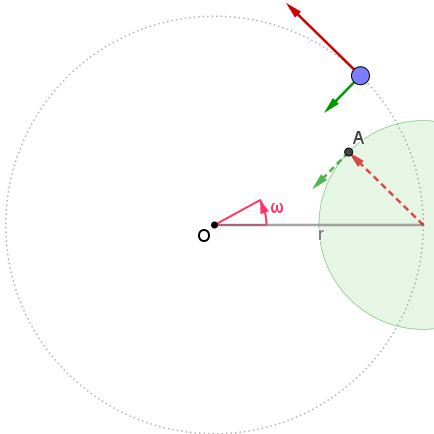
جسم يتحرك على دائرة بحركة غير منتظمة (تسارعه الزاوي ثابت لكنه مجهول). اضغط «ابدأ» فيسجَّل الزمن والسرعة الزاوية الابتدائية \(\omega_0\)، ثم اضغط «إيقاف» فتظهر السرعة الزاوية النهائية \(\omega_f\) والزمن \(t\). احسب \(\alpha=\dfrac{\omega_f-\omega_0}{t}\) ثم \(a_t=\alpha r\) وتحقق من الإجابتين. السهم الأزرق هو السرعة والأخضر هو التسارع المماسي.
A body moves on a circle with non-uniform motion (its angular acceleration is constant but unknown). Press “Start” to record the time and the initial angular velocity \(\omega_0\), then press “Stop” to get the final angular velocity \(\omega_f\) and the time \(t\). Calculate \(\alpha=\dfrac{\omega_f-\omega_0}{t}\) and then \(a_t=\alpha r\) and check both answers. The blue arrow is the velocity and the green one is the tangential acceleration.
يدور قرص نصف قطره \(0.50\ \mathrm{m}\) بتسارع زاوي \(2.0\ \mathrm{rad/s^2}\). ما التسارع المماسي لنقطة على حافته؟
A disc of radius \(0.50\ \mathrm{m}\) turns with an angular acceleration of \(2.0\ \mathrm{rad/s^2}\). What is the tangential acceleration of a point on its rim?
نقطة على حافة عجلة نصف قطرها \(0.25\ \mathrm{m}\) وتسارعها الزاوي \(4\ \mathrm{rad/s^2}\). تسارعها المماسي:
A point on the rim of a wheel of radius \(0.25\ \mathrm{m}\) with angular acceleration \(4\ \mathrm{rad/s^2}\) has a tangential acceleration of:
ماذا يغيّر التسارع المماسي في سرعة الجسم على الدائرة؟
What does the tangential acceleration change in the velocity of a body on a circle?
🎯 التسارع المركزي
🎯 Centripetal Acceleration
حتى لو بقي مقدار السرعة ثابتًا فإن اتجاه السرعة يتغير كل لحظة لأن المسار منحنٍ، وأي تغير في السرعة (مقدارًا أو اتجاهًا) يعني تسارعًا. هذا التسارع الناتج عن تغير الاتجاه هو التسارع المركزي (القطري) \(a_c\):
Even if the magnitude of the velocity stays constant, its direction changes every moment because the path is curved, and any change in velocity (in magnitude or direction) means an acceleration. This acceleration due to the change of direction is the centripetal (radial) acceleration \(a_c\):
📘 التسارع المركزي
📘 Centripetal acceleration
\[a_c=\dfrac{v^2}{r}=\omega^2 r\]
اتجاهه دائمًا نحو مركز الدائرة (عموديّ على السرعة)، ووحدته \(\mathrm{m/s^2}\).
Its direction is always toward the centre of the circle (perpendicular to the velocity) and its unit is \(\mathrm{m/s^2}\).
💡 شرح إضافي: لماذا يكبر \(a_c\) بسرعة؟
💡 Extra explanation: why does \(a_c\) grow so quickly?
لأن \(a_c=\omega^2 r\) يعتمد على مربع السرعة الزاوية: إذا تضاعفت \(\omega\) تضاعف \(a_c\) أربع مرات. ولذلك في الحركة الدائرية المتسارعة يظل \(a_t=\alpha r\) ثابتًا بينما \(a_c\) يتزايد بسرعة مع الزمن ويصبح هو المسيطر على التسارع الكلي. ولو كانت الحركة منتظمة (\(\alpha=0\)) لانعدم \(a_t\) وبقي \(a_c\) وحده بقيمة ثابتة.
Because \(a_c=\omega^2 r\) depends on the square of the angular velocity: if \(\omega\) doubles, \(a_c\) becomes four times larger. So in accelerated circular motion \(a_t=\alpha r\) stays constant while \(a_c\) grows rapidly with time and becomes dominant in the total acceleration. If the motion were uniform (\(\alpha=0\)), \(a_t\) would vanish and \(a_c\) alone would remain with a constant value.
جسم يدور على دائرة نصف قطرها \(2.0\ \mathrm{m}\) بسرعة زاوية \(3.0\ \mathrm{rad/s}\). احسب سرعته الخطية وتسارعه المركزي.
A body moves on a circle of radius \(2.0\ \mathrm{m}\) with an angular velocity of \(3.0\ \mathrm{rad/s}\). Find its linear speed and its centripetal acceleration.
اتجاه التسارع المركزي دائمًا:
The direction of the centripetal acceleration is always:
جسم يدور على دائرة نصف قطرها \(3\ \mathrm{m}\) بسرعة خطية \(6\ \mathrm{m/s}\). تسارعه المركزي:
A body moves on a circle of radius \(3\ \mathrm{m}\) with a linear speed of \(6\ \mathrm{m/s}\). Its centripetal acceleration is:
إذا تضاعفت السرعة الزاوية لجسم يدور على الدائرة نفسها فإن تسارعه المركزي:
If the angular velocity of a body moving on the same circle is doubled, its centripetal acceleration:
🧭 التسارع الكلي
🧭 Total Acceleration
عندما يتحرك الجسم على دائرة بسرعة متغيرة يكون له تسارعان متعامدان: مماسي \(a_t\) (يغيّر مقدار السرعة) ومركزي \(a_c\) (يغيّر اتجاهها). والتسارع الكلي هو محصلتهما:
When a body moves on a circle with a changing speed it has two perpendicular accelerations: the tangential \(a_t\) (changes the magnitude of the velocity) and the centripetal \(a_c\) (changes its direction). The total acceleration is their resultant:
📘 التسارع الكلي
📘 Total acceleration
\[a=\sqrt{a_t^2+a_c^2}=\sqrt{(\alpha r)^2+(\omega^2 r)^2}=r\sqrt{\alpha^2+\omega^4}\]
ويصنع اتجاه التسارع الكلي مع نصف القطر (نحو المركز) زاوية \(\varphi\) تُعطى بالعلاقة:
The direction of the total acceleration makes an angle \(\varphi\) with the radius (toward the centre) given by:
\[\tan\varphi=\dfrac{a_t}{a_c}=\dfrac{\alpha}{\omega^2}\]
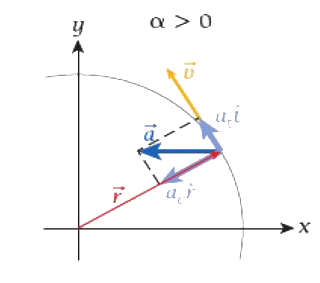
جسم يدور عكس عقارب الساعة وتتزايد سرعته (\(\alpha\gt 0\)): \(\vec a\) هي مجموع \(a_t\hat\imath\) المماسي و\(a_c\hat r\) المركزي.
A body moving counter-clockwise with increasing speed (\(\alpha\gt 0\)): \(\vec a\) is the sum of the tangential \(a_t\hat\imath\) and the centripetal \(a_c\hat r\).
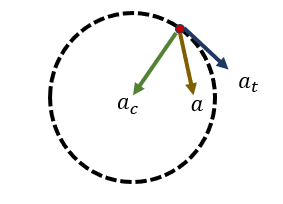
المركبتان \(a_c\) (نحو المركز) و\(a_t\) (مماسي) والمحصلة \(a\) على مسار دائري.
The components \(a_c\) (toward the centre) and \(a_t\) (tangential) and the resultant \(a\) on a circular path.
💡 شرح إضافي: متى يكون التسارع الكلي مركزيًا فقط؟
💡 Extra explanation: when is the total acceleration purely centripetal?
في الحركة الدائرية المنتظمة يكون \(\alpha=0\) فينعدم \(a_t\) ويصبح \(a=a_c\) نحو المركز. أما في الحركة غير المنتظمة فيميل التسارع الكلي عن نصف القطر بزاوية \(\varphi\) نحو اتجاه السرعة (إذا تزايدت) أو عكسه (إذا تناقصت)، وتصغر هذه الزاوية كلما كبرت السرعة الزاوية لأن \(\tan\varphi=\alpha/\omega^2\).
In uniform circular motion \(\alpha=0\), so \(a_t\) vanishes and \(a=a_c\) toward the centre. In non-uniform motion the total acceleration is tilted away from the radius by the angle \(\varphi\) toward the velocity (if the speed increases) or opposite to it (if it decreases), and this angle gets smaller as the angular velocity grows because \(\tan\varphi=\alpha/\omega^2\).
🧪 تجربة 2: التسارع المركزي والتسارع الكلي
🧪 Experiment 2: Centripetal and total acceleration
الحركة الدائرية غير المنتظمة هنا بتسارع زاوي ثابت مجهول. أثناء الحركة يظهر التسارع المماسي \(a_t\) (أخضر) والتسارع المركزي \(a_c\) (برتقالي) والتسارع الكلي \(a\) (أحمر). اضغط «ابدأ» ثم «إيقاف»، واحسب \(\alpha\) و\(a_t\) و\(a_c=\omega_f^2 r\) و\(a=\sqrt{a_t^2+a_c^2}\) ثم تحقق. لاحظ كيف يكبر \(a_c\) بسرعة مع الزمن بينما يبقى \(a_t\) ثابتًا.
The non-uniform circular motion here has a constant but unknown angular acceleration. While it moves you see the tangential acceleration \(a_t\) (green), the centripetal acceleration \(a_c\) (orange) and the total acceleration \(a\) (red). Press “Start” then “Stop”, and calculate \(\alpha\), \(a_t\), \(a_c=\omega_f^2 r\) and \(a=\sqrt{a_t^2+a_c^2}\), then check. Notice how \(a_c\) grows quickly with time while \(a_t\) stays constant.
🧪 تجربة 3: متجهات التسارع في الحركة الدائرية
🧪 Experiment 3: The acceleration vectors in circular motion
غيّر نصف القطر والسرعة الزاوية \(\omega\) والتسارع الزاوي \(\alpha\) وموضع الجسم. (الاتجاه الموجب عكس عقارب الساعة.) السهم الأزرق السرعة، والأخضر \(a_t\) مماسّ للدائرة، والبرتقالي \(a_c\) نحو المركز دائمًا، والأحمر محصلتهما \(a\). عندما يكون \(\omega\) و\(\alpha\) بالإشارة نفسها تتزايد السرعة. احسب التسارع الكلي من القيم المعروضة وتحقق.
Change the radius, the angular velocity \(\omega\), the angular acceleration \(\alpha\) and the position of the body. (The positive direction is counter-clockwise.) The blue arrow is the velocity, the green \(a_t\) is tangent to the circle, the orange \(a_c\) always points to the centre and the red one is their resultant \(a\). When \(\omega\) and \(\alpha\) have the same sign the speed increases. Calculate the total acceleration from the displayed values and check.
| وجه المقارنةComparison | الحركة الدائرية المنتظمةUniform circular motion | الحركة الدائرية غير المنتظمةNon-uniform circular motion |
|---|---|---|
| السرعة الزاويةAngular velocity | ثابتةconstant | متغيرةchanging |
| التسارع الزاويAngular acceleration | \(\alpha=0\)\(\alpha=0\) | \(\alpha\neq0\)\(\alpha\neq0\) |
| التسارع المماسيTangential acceleration | \(a_t=0\)\(a_t=0\) | \(a_t=\alpha r\)\(a_t=\alpha r\) |
| التسارع المركزيCentripetal acceleration | ثابت المقدار نحو المركزconstant in magnitude, toward the centre | متغير المقدار نحو المركزchanging in magnitude, toward the centre |
| التسارع الكليTotal acceleration | \(a=a_c\)\(a=a_c\) | \(a=\sqrt{a_t^2+a_c^2}\)\(a=\sqrt{a_t^2+a_c^2}\) |
جسيم يتحرك حركة دائرية مع عقارب الساعة نصف قطرها \(r=0.4\ \mathrm{m}\). في لحظة ما كانت سرعته الخطية \(v=0.6\ \mathrm{m/s}\) وتسارعه الكلي \(a=1.2\ \mathrm{m/s^2}\). احسب التسارع المماسي عند تلك اللحظة.
A particle moves clockwise on a circle of radius \(r=0.4\ \mathrm{m}\). At a certain instant its linear speed is \(v=0.6\ \mathrm{m/s}\) and its total acceleration is \(a=1.2\ \mathrm{m/s^2}\). Find the tangential acceleration at that instant.
عجلة نصف قطرها \(0.30\ \mathrm{m}\) تدور بسرعة زاوية لحظية \(5.0\ \mathrm{rad/s}\) وتسارع زاوي \(2.0\ \mathrm{rad/s^2}\). احسب لنقطة على حافتها: \(a_t\) و\(a_c\) و\(a\) والزاوية \(\varphi\).
A wheel of radius \(0.30\ \mathrm{m}\) turns with an instantaneous angular velocity of \(5.0\ \mathrm{rad/s}\) and an angular acceleration of \(2.0\ \mathrm{rad/s^2}\). For a point on its rim find \(a_t\), \(a_c\), \(a\) and the angle \(\varphi\).
استكمل المثال 3: تبدأ عجلة نصف قطرها \(2.0\ \mathrm{m}\) من السكون بتسارع زاوي \(0.50\ \mathrm{rad/s^2}\). احسب \(a_t\) و\(a_c\) والتسارع الكلي بعد \(4.0\ \mathrm{s}\).
Continue Example 3: a wheel of radius \(2.0\ \mathrm{m}\) starts from rest with an angular acceleration of \(0.50\ \mathrm{rad/s^2}\). Find \(a_t\), \(a_c\) and the total acceleration after \(4.0\ \mathrm{s}\).
في لحظة ما \(a_t=3\ \mathrm{m/s^2}\) و\(a_c=4\ \mathrm{m/s^2}\). مقدار التسارع الكلي:
At a certain instant \(a_t=3\ \mathrm{m/s^2}\) and \(a_c=4\ \mathrm{m/s^2}\). The magnitude of the total acceleration is:
أي العبارات صحيحة للحركة الدائرية المنتظمة؟
Which statement is correct for uniform circular motion?
جسم يسرع على دائرة (تتزايد سرعته). التسارع المماسي بالنسبة لاتجاه السرعة:
A body speeds up on a circle (its speed increases). The tangential acceleration relative to the direction of the velocity is:
أي علاقة صحيحة لحساب التسارع الكلي لجسم على الدائرة؟
Which relation correctly gives the total acceleration of a body on a circle?
📚 ملخص الدرس
📚 Lesson Summary
| المفهومConcept | العلاقةRelation |
|---|---|
| التسارع الزاويAngular acceleration | \(\alpha=\dfrac{d\omega}{dt}=\dfrac{d^2\theta}{dt^2}\ ;\ \alpha_{avg}=\dfrac{\Delta\omega}{\Delta t}\ ;\ \mathrm{rad/s^2}\)\(\alpha=\dfrac{d\omega}{dt}=\dfrac{d^2\theta}{dt^2}\ ;\ \alpha_{avg}=\dfrac{\Delta\omega}{\Delta t}\ ;\ \mathrm{rad/s^2}\) |
| معادلات \(\alpha\) ثابتConstant \(\alpha\) | \(\omega=\omega_0+\alpha t\ ;\ \Delta\theta=\omega_0t+\tfrac12\alpha t^2\ ;\ \omega^2=\omega_0^2+2\alpha\Delta\theta\)\(\omega=\omega_0+\alpha t\ ;\ \Delta\theta=\omega_0t+\tfrac12\alpha t^2\ ;\ \omega^2=\omega_0^2+2\alpha\Delta\theta\) |
| التسارع المماسيTangential acceleration | \(a_t=\alpha r\)\(a_t=\alpha r\) |
| التسارع المركزيCentripetal acceleration | \(a_c=\dfrac{v^2}{r}=\omega^2r\)\(a_c=\dfrac{v^2}{r}=\omega^2r\) |
| التسارع الكليTotal acceleration | \(a=\sqrt{a_t^2+a_c^2}=r\sqrt{\alpha^2+\omega^4}\ ;\ \tan\varphi=\dfrac{a_t}{a_c}\)\(a=\sqrt{a_t^2+a_c^2}=r\sqrt{\alpha^2+\omega^4}\ ;\ \tan\varphi=\dfrac{a_t}{a_c}\) |
⚠️ أخطاء شائعة
⚠️ Common mistakes
- جمع \(a_t\) و\(a_c\) جمعًا حسابيًا؛ الصحيح جمعهما كمتجهين متعامدين \(a=\sqrt{a_t^2+a_c^2}\).Adding \(a_t\) and \(a_c\) arithmetically; they must be added as perpendicular vectors, \(a=\sqrt{a_t^2+a_c^2}\).
- الظن أن التسارع المركزي ينعدم عندما تكون السرعة الخطية ثابتة؛ هو موجود دائمًا لأن الاتجاه يتغير.Thinking that the centripetal acceleration vanishes when the speed is constant; it is always present because the direction changes.
- استعمال \(a_c=\alpha r\) أو \(a_t=\omega^2 r\) بالخلط بين المركزي والمماسي.Using \(a_c=\alpha r\) or \(a_t=\omega^2 r\), confusing the centripetal and tangential accelerations.
- نسيان إشارة \(\omega\) (مع عقارب الساعة سالبة) عند الحكم هل السرعة تتزايد أم تتناقص.Forgetting the sign of \(\omega\) (clockwise is negative) when deciding whether the speed increases or decreases.
- استعمال السرعة الزاوية الابتدائية بدل اللحظية عند حساب \(a_c\) في لحظة معينة.Using the initial angular velocity instead of the instantaneous one when calculating \(a_c\) at a given instant.
🧪 اختبر نفسك: امتحان من 20 سؤالاً
🧪 Test Yourself: a 20-Question Exam
أنهِ الدرس بالاختبار التفاعلي التالي؛ أسئلته تجمع بين الفهم والحساب وتغطي جميع أقسام الدرس.
Finish with the interactive exam below; its questions mix understanding with calculation and cover every section of the lesson.
اختبار الحركة الدائرية (القسم 2) Circular Motion (Part 2) Quiz
20 سؤالاً - التسارع الزاوي والمماسي والمركزي والكلي 20 Questions - Angular, Tangential, Centripetal and Total Acceleration
• عدد الأسئلة: 20 سؤالاً
• مدة الاختبار: 30 دقيقة
• لا يمكنك تغيير إجاباتك أو إعادة الاختبار إلا بعد 24 ساعة من التسليم.
• تأكد من إجاباتك قبل التسليم! 📌 Important Instructions:
• Number of questions: 20 questions
• Quiz duration: 30 minutes
• You cannot change your answers or retake the quiz for 24 hours after submission.
• Make sure of your answers before submitting!
🔗 محاكيات GeoGebra للاستعانة بها عند اللزوم
🔗 GeoGebra Simulations to Use When Needed
اضغط «تشغيل» لتعمل المحاكاة هنا داخل الدرس؛ ويمكن للطالب الرجوع إليها لتجربة الفكرة بطريقة أخرى.
Press “Run” to run the simulation right here inside the lesson; the student can use it to try the idea in another way.