🎯 نواتج التعلم
🎯 Learning Outcomes
بعد دراسة هذا الدرس ستكون قادرًا على أن:
After this lesson you will be able to:
- تحدد موضع جسم بالإحداثيات القطبية \((r,\theta)\) والديكارتية \((x,y)\) وتحوّل بينهما.Locate a body by its polar \((r,\theta)\) and Cartesian \((x,y)\) coordinates and convert between them.
- تعرّف الإزاحة الزاوية \(\theta=s/r\) وتحوّل بين الدرجات والراديان والدورات.Define the angular displacement \(\theta=s/r\) and convert between degrees, radians and revolutions.
- تحدد إشارة الإزاحة الزاوية واتجاه الدوران بقاعدة اليد اليمنى.Decide the sign of the angular displacement and the direction of rotation using the right-hand rule.
- تحسب السرعة الزاوية \(\omega=\Delta\theta/\Delta t=2\pi/T=2\pi f\) والتردد والزمن الدوري.Calculate the angular velocity \(\omega=\Delta\theta/\Delta t=2\pi/T=2\pi f\), the frequency and the period.
- تربط السرعة الخطية بالسرعة الزاوية \(v=r\omega\) وتحدد اتجاهها.Relate the linear speed to the angular velocity \(v=r\omega\) and state its direction.
📍 الإحداثيات القطبية والديكارتية
📍 Polar and Cartesian Coordinates
لتحديد موضع جسم في مستوى نحتاج عددين. ولدراسة الحركة الدائرية نستخدم غالبًا الإحداثيات القطبية لأنها تناسب الدوران حول نقطة.
To locate a body in a plane we need two numbers. To study circular motion we often use polar coordinates, which suit rotation about a point.
الإحداثيات الديكارتية
Cartesian coordinates
نحدد النقطة \(P\) برقمين: \(x\) المسافة على طول المحور الأفقي، و\(y\) المسافة على طول المحور الرأسي.
The point \(P\) is given by two numbers: \(x\), the distance along the horizontal axis, and \(y\), the distance along the vertical axis.
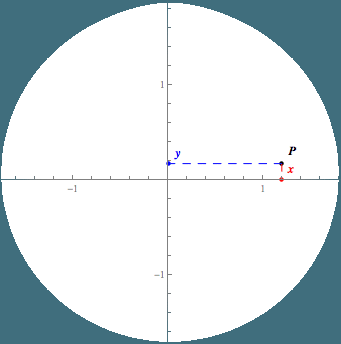
الإحداثيات الديكارتية \((x,y)\) لنقطة \(P\).
The Cartesian coordinates \((x,y)\) of a point \(P\).
الإحداثيات القطبية
Polar coordinates
📘 الإحداثيات القطبية
📘 Polar coordinates
نستعمل الزوج \((r,\theta)\) حيث:
We use the pair \((r,\theta)\) where:
- نقطة الأصل تسمى القطب، والمحور \(x\) الموجب هو المحور القطبي.The origin is called the pole and the positive \(x\)-axis is the polar axis.
- \(r\): بُعد الجسم عن القطب.\(r\): the distance of the body from the pole.
- \(\theta\): الزاوية التي يصنعها هذا البعد مع المحور القطبي بدوران عكس عقارب الساعة.\(\theta\): the angle the line makes with the polar axis, measured counter-clockwise.
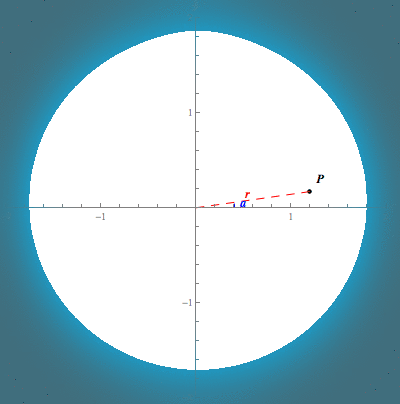
الإحداثيات القطبية \((r,\theta)\) للنقطة \(P\).
The polar coordinates \((r,\theta)\) of the point \(P\).
التحويل بين النوعين
Converting between the two systems
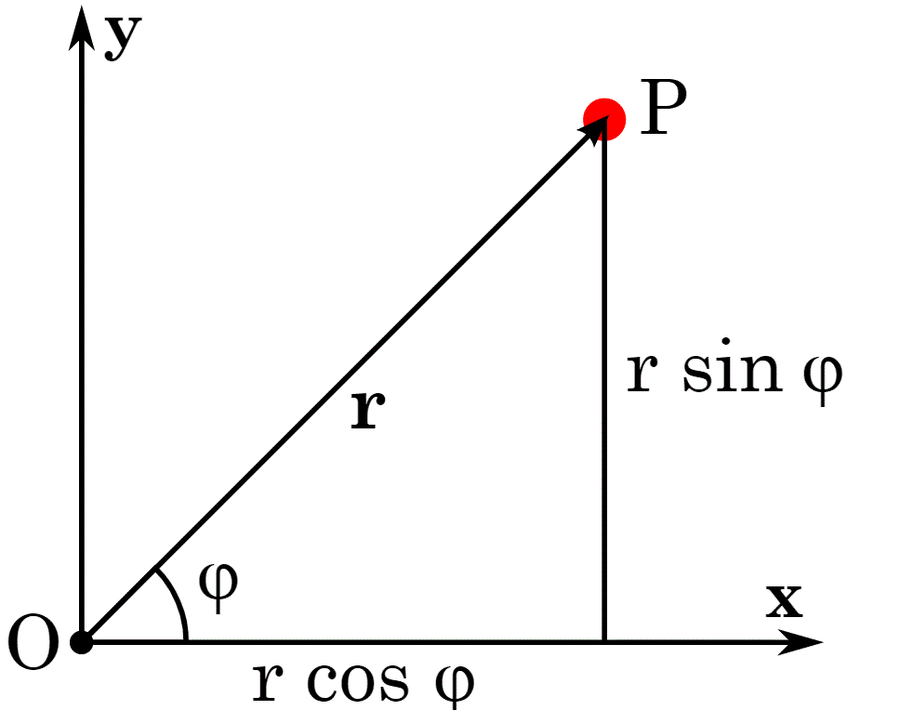
المثلث القائم الذي يربط \(x,y\) بـ \(r,\theta\) (تُكتب الزاوية هنا \(\varphi\)، وهي نفسها \(\theta\)).
The right triangle linking \(x,y\) with \(r,\theta\) (the angle is written \(\varphi\) here and is the same as \(\theta\)).
📘 قوانين التحويل
📘 Conversion formulas
من القطبية إلى الديكارتية (المعلوم \(r,\theta\)):
Polar to Cartesian (given \(r,\theta\)):
\[x=r\cos\theta\qquad y=r\sin\theta\]
من الديكارتية إلى القطبية (المعلوم \(x,y\)):
Cartesian to polar (given \(x,y\)):
\[r=\sqrt{x^2+y^2}\qquad \theta=\tan^{-1}\!\left(\dfrac{y}{x}\right)\]
💡 شرح إضافي: انتبه للربع عند حساب الزاوية
💡 Extra explanation: watch the quadrant when finding the angle
الآلة الحاسبة تعطي \(\tan^{-1}(y/x)\) بين \(-90^\circ\) و\(90^\circ\) فقط، فلا تعرف في أي ربع تقع النقطة. لذلك:
The calculator gives \(\tan^{-1}(y/x)\) only between \(-90^\circ\) and \(90^\circ\), so it does not know in which quadrant the point lies. Therefore:
- الربع الأول (\(x\gt 0,y\gt 0\)): \(\theta\) كما تعطيها الآلة.First quadrant (\(x\gt 0,y\gt 0\)): \(\theta\) as the calculator gives it.
- الربعان الثاني والثالث (\(x\lt 0\)): أضف \(180^\circ\) إلى ناتج الآلة.Second and third quadrants (\(x\lt 0\)): add \(180^\circ\) to the calculator result.
- الربع الرابع (\(x\gt 0,y\lt 0\)): أضف \(360^\circ\) إلى الناتج السالب.Fourth quadrant (\(x\gt 0,y\lt 0\)): add \(360^\circ\) to the negative result.
أسهل طريقة أن ترسم النقطة أولًا وتحسب الزاوية المرجعية \(\tan^{-1}|y/x|\) ثم تجد \(\theta\) من الرسم.
The easiest way is to sketch the point first, find the reference angle \(\tan^{-1}|y/x|\) and then get \(\theta\) from the sketch.
الإحداثيات الديكارتية لجسم \((-3,\ 10)\). أوجد إحداثياته القطبية.
The Cartesian coordinates of a body are \((-3,\ 10)\). Find its polar coordinates.
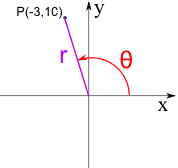
النقطة \(P(-3,10)\) في الربع الثاني، و\(\theta\) تُقاس من المحور \(x\) الموجب.
The point \(P(-3,10)\) in the second quadrant; \(\theta\) is measured from the positive \(x\)-axis.
الإحداثيات القطبية لجسم \((13,\ 22.6^\circ)\). أوجد إحداثياته الديكارتية.
The polar coordinates of a body are \((13,\ 22.6^\circ)\). Find its Cartesian coordinates.
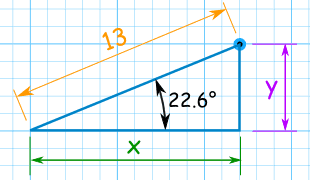
المثلث القائم للمثال: الوتر \(r=13\) والزاوية \(22.6^\circ\) ومنه \(x\) و\(y\).
The right triangle of the example: hypotenuse \(r=13\) and angle \(22.6^\circ\), giving \(x\) and \(y\).
🧪 تجربة 1: التحويل بين الإحداثيات القطبية والديكارتية
🧪 Experiment 1: Converting between polar and Cartesian coordinates
حرّك الشريطين لتغيير الإحداثيات القطبية للنقطة \(P\): البعد \(r\) والزاوية \(\theta\) (تُقاس من المحور \(x\) الموجب عكس عقارب الساعة). احسب بنفسك الإحداثيين الديكارتيين \(x=r\cos\theta\) و\(y=r\sin\theta\) ثم تحقق، وراقب الربع الذي تقع فيه النقطة وإشارتي \(x\) و\(y\).
Move the sliders to change the polar coordinates of the point \(P\): the distance \(r\) and the angle \(\theta\) (measured from the positive \(x\)-axis, counter-clockwise). Calculate the Cartesian coordinates \(x=r\cos\theta\) and \(y=r\sin\theta\) yourself and check, and watch the quadrant of the point and the signs of \(x\) and \(y\).
ما معنى \(\theta\) في الإحداثيات القطبية؟
What does \(\theta\) mean in polar coordinates?
النقطة \((x,y)=(3,4)\). قيمة \(r\) لها:
For the point \((x,y)=(3,4)\), the value of \(r\) is:
نقطة \(r=10\) و\(\theta=60^\circ\). قيمة \(x\) لها:
A point has \(r=10\) and \(\theta=60^\circ\). Its \(x\) is:
النقطة \((x,y)=(-2,-2)\) تقع في الربع الثالث، وزاويتها القطبية:
The point \((x,y)=(-2,-2)\) lies in the third quadrant and its polar angle is:
📐 الإزاحة الزاوية والراديان
📐 Angular Displacement and the Radian
📘 الإزاحة الزاوية
📘 Angular displacement
إذا قطع جسم قوسًا طوله \(s\) على محيط دائرة نصف قطرها \(r\) فإن الزاوية التي تقابل القوس تسمى الإزاحة الزاوية \(\theta\):
If a body covers an arc of length \(s\) on the circumference of a circle of radius \(r\), the angle subtended by the arc is the angular displacement \(\theta\):
\[\theta=\dfrac{s}{r}\qquad\Longleftrightarrow\qquad s=r\theta\]
وحدتها الراديان (rad). الراديان الواحد هو الزاوية التي يقابلها قوس طوله يساوي نصف القطر.
Its unit is the radian (rad). One radian is the angle subtended by an arc whose length equals the radius.
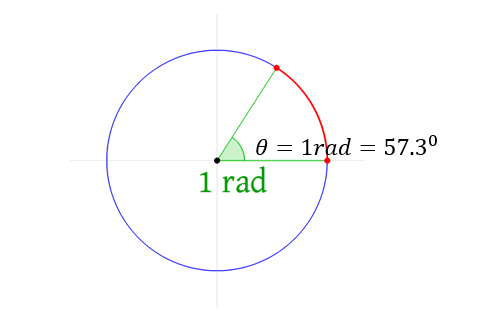
1 راديان \(\approx57.3^\circ\): القوس الأحمر طوله يساوي نصف القطر.
1 radian \(\approx57.3^\circ\): the red arc has a length equal to the radius.
💡 شرح إضافي: لماذا الراديان بلا وحدة حقيقية؟
💡 Extra explanation: why is the radian really unit-less?
\(\theta=s/r\) نسبة بين طولين فهي عدد بلا بُعد، ولذلك نكتب «rad» للتوضيح فقط ويمكن حذفها في الحسابات (مثل \(v=r\omega\) تعطي m/s وليس m·rad/s). الدورة الكاملة تقابل محيط الدائرة \(s=2\pi r\) أي \(\theta=2\pi\) rad.
\(\theta=s/r\) is a ratio of two lengths, so it is a dimensionless number; we write “rad” only for clarity and it can be dropped in calculations (for example \(v=r\omega\) gives m/s, not m·rad/s). A full turn corresponds to the circumference \(s=2\pi r\), i.e. \(\theta=2\pi\) rad.
إشارة الإزاحة الزاوية
The sign of the angular displacement
الإزاحة الزاوية كمية متجهة: إذا كان الدوران عكس عقارب الساعة فإشارتها موجبة، وإذا كان مع عقارب الساعة فإشارتها سالبة.
The angular displacement is a vector quantity: if the rotation is counter-clockwise its sign is positive, and if it is clockwise its sign is negative.
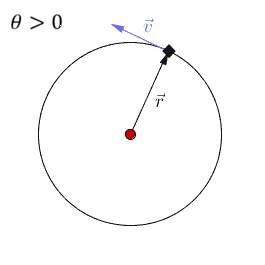
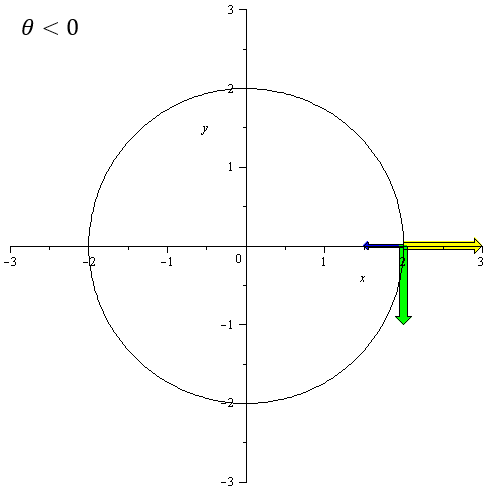
يمين: \(\theta\gt 0\) دوران عكس عقارب الساعة. يسار: \(\theta\lt 0\) دوران مع عقارب الساعة.
Left: \(\theta\gt 0\), counter-clockwise rotation. Right: \(\theta\lt 0\), clockwise rotation.
التحويل بين الدرجات والدورات والراديان
Converting between degrees, revolutions and radians
| منFrom | إلى الراديانTo radians | مثالExample |
|---|---|---|
| دورات (rev)revolutions (rev) | \(2\pi\ \mathrm{rad}=1\ \mathrm{rev}\)\(2\pi\ \mathrm{rad}=1\ \mathrm{rev}\) | \(2.25\ \mathrm{rev}=2.25\times2\pi\approx14.14\ \mathrm{rad}\)\(2.25\ \mathrm{rev}=2.25\times2\pi\approx14.14\ \mathrm{rad}\) |
| درجات (°)degrees (°) | \(\pi\ \mathrm{rad}=180^\circ\)\(\pi\ \mathrm{rad}=180^\circ\) | \(120^\circ=120\times\dfrac{\pi}{180}=\dfrac{2\pi}{3}\approx2.09\ \mathrm{rad}\)\(120^\circ=120\times\dfrac{\pi}{180}=\dfrac{2\pi}{3}\approx2.09\ \mathrm{rad}\) |
تحرك جسم حركة دائرية فقطع إزاحة زاوية \(2.25\) دورة. كم تعادل بالراديان؟ وكم تعادل \(120^\circ\) بالراديان؟
A body in circular motion made an angular displacement of \(2.25\) revolutions. How many radians is this? And how many radians is \(120^\circ\)?
جسم يتحرك على دائرة نصف قطرها \(2.0\ \mathrm{m}\) فقطع إزاحة زاوية \(1.5\ \mathrm{rad}\). ما طول القوس الذي قطعه؟
A body moves on a circle of radius \(2.0\ \mathrm{m}\) through an angular displacement of \(1.5\ \mathrm{rad}\). What is the length of the arc it covered?
🧪 تجربة 2: الإزاحة الزاوية والراديان وطول القوس
🧪 Experiment 2: Angular displacement, the radian and the arc length
غيّر نصف القطر والزاوية. القوس الأحمر هو المسافة \(s\) التي يقطعها الجسم على المحيط، والعلاقة \(\theta=s/r\). لاحظ كيف تُكتب الزاوية نفسها بالدرجات والراديان والدورات، ثم احسب طول القوس \(s=r\theta\) وتحقق.
Change the radius and the angle. The red arc is the distance \(s\) the body covers along the circumference, and \(\theta=s/r\). Notice how the same angle is written in degrees, radians and revolutions, then calculate the arc length \(s=r\theta\) and check.
\(180^\circ\) تعادل بالراديان:
\(180^\circ\) in radians is:
\(1.5\) دورة تعادل بالراديان:
\(1.5\) revolutions in radians is:
أي العبارات صحيحة لإشارة الإزاحة الزاوية؟
Which statement about the sign of the angular displacement is correct?
🔄 السرعة الزاوية والتردد والزمن الدوري
🔄 Angular Velocity, Frequency and Period
📘 السرعة الزاوية
📘 Angular velocity
السرعة الزاوية هي معدل تغير الإزاحة الزاوية بالنسبة للزمن:
The angular velocity is the rate of change of the angular displacement with time:
\[\omega=\dfrac{\theta_2-\theta_1}{t_2-t_1}=\dfrac{\Delta\theta}{\Delta t}\qquad(\mathrm{rad/s})\]
وفي الحركة الدائرية المنتظمة تكون \(\omega\) ثابتة. وإذا تغيّرت مع الزمن فالحركة غير منتظمة (القسم الثاني).
In uniform circular motion \(\omega\) is constant. If it changes with time the motion is non-uniform (Part 2).
الزمن الدوري والتردد
The period and the frequency
📘 الزمن الدوري والتردد
📘 Period and frequency
\(T\): الزمن الدوري وهو زمن الدورة الواحدة (s)، و\(f\): التردد وهو عدد الدورات في الثانية (Hz).
\(T\): the period, the time of one revolution (s), and \(f\): the frequency, the number of revolutions per second (Hz).
\[f=\dfrac{1}{T}\]
\[\omega=\dfrac{\theta_2-\theta_1}{t_2-t_1}=\dfrac{2\pi}{T}=2\pi f\]
💡 شرح إضافي: من أين جاءت \(\omega=2\pi/T\)؟
💡 Extra explanation: where does \(\omega=2\pi/T\) come from?
في دورة كاملة تكون الإزاحة الزاوية \(\Delta\theta=2\pi\) والزمن \(\Delta t=T\)، فيصبح \(\omega=\Delta\theta/\Delta t=2\pi/T\). وبما أن \(f=1/T\) فإن \(\omega=2\pi f\). ولا تخلط بين التردد \(f\) (Hz) والسرعة الزاوية \(\omega\) (rad/s)؛ ففي بعض الكتب تُسمّى \(\omega\) «التردد الزاوي» وتُسمّى \(f\) «التردد». ومن الوحدات الشائعة أيضًا: \(1\ \mathrm{rpm}=\dfrac{2\pi}{60}\ \mathrm{rad/s}\).
In one full turn the angular displacement is \(\Delta\theta=2\pi\) and the time is \(\Delta t=T\), so \(\omega=\Delta\theta/\Delta t=2\pi/T\). Since \(f=1/T\), \(\omega=2\pi f\). Do not mix up the frequency \(f\) (Hz) with the angular velocity \(\omega\) (rad/s); some books call \(\omega\) the “angular frequency” and \(f\) the “frequency”. Another common unit: \(1\ \mathrm{rpm}=\dfrac{2\pi}{60}\ \mathrm{rad/s}\).
اتجاه السرعة الزاوية (قاعدة اليد اليمنى)
The direction of the angular velocity (right-hand rule)
السرعة الزاوية متجه يتعامد مع مستوى الدائرة. ولتحديد اتجاهه نلفّ أصابع اليد اليمنى في اتجاه الدوران فيشير الإبهام إلى اتجاه \(\vec\omega\).
The angular velocity is a vector perpendicular to the plane of the circle. To find its direction curl the fingers of your right hand in the direction of the rotation and the thumb points along \(\vec\omega\).
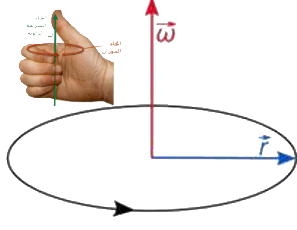
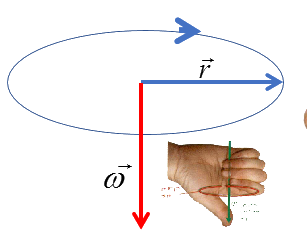
عكس عقارب الساعة: \(\vec\omega\) إلى الأعلى (خارج الصفحة، موجبة). مع عقارب الساعة: \(\vec\omega\) إلى الأسفل (داخل الصفحة، سالبة).
Counter-clockwise: \(\vec\omega\) points up (out of the page, positive). Clockwise: \(\vec\omega\) points down (into the page, negative).
🧪 تجربة 3: قياس السرعة الزاوية والتردد والزمن الدوري
🧪 Experiment 3: Measuring the angular velocity, the frequency and the period
جسم يتحرك على دائرة بسرعة زاوية ثابتة مجهولة (حركة دائرية منتظمة). اضغط «ابدأ» فتُسجَّل الإزاحة الزاوية الابتدائية \(\theta_1\) والزمن \(t_1\)، ثم «إيقاف» فتُسجَّل \(\theta_2\) و\(t_2\). احسب \(\omega=\dfrac{\theta_2-\theta_1}{t_2-t_1}\) ثم \(f=\dfrac{\omega}{2\pi}\) و\(T=\dfrac1f\) والسرعة الخطية \(v=\omega r\) وتحقق. السهم الأزرق هو السرعة الخطية: مماسّ دائمًا وعمودي على نصف القطر.
A body moves on a circle with a constant unknown angular velocity (uniform circular motion). Press “Start” to record the initial angular displacement \(\theta_1\) and the time \(t_1\), then “Stop” to record \(\theta_2\) and \(t_2\). Calculate \(\omega=\dfrac{\theta_2-\theta_1}{t_2-t_1}\) then \(f=\dfrac{\omega}{2\pi}\), \(T=\dfrac1f\) and the linear speed \(v=\omega r\) and check. The blue arrow is the linear velocity: always tangent and perpendicular to the radius.
يتحرك جسم حركة دائرية منتظمة بحيث يقطع ثلاث دورات ونصفًا عكس عقارب الساعة كل \(2\ \mathrm{s}\). احسب سرعته الزاوية.
A body moves in uniform circular motion making three and a half revolutions counter-clockwise every \(2\ \mathrm{s}\). Find its angular velocity.
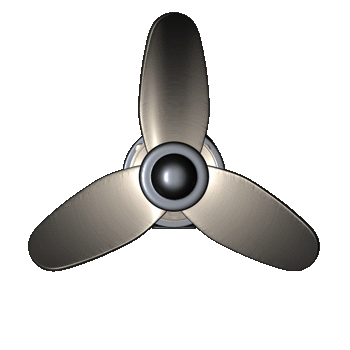
مروحة تدور بسرعة زاوية ثابتة.
A fan rotating with a constant angular velocity.
تدور مروحة بسرعة زاوية \(60\pi\ \mathrm{rad/s}\). احسب تردد المروحة وزمنها الدوري.
A fan rotates with an angular velocity of \(60\pi\ \mathrm{rad/s}\). Find its frequency and its period.
زمن دورة جسم \(T=0.5\ \mathrm{s}\). سرعته الزاوية:
A body has a period \(T=0.5\ \mathrm{s}\). Its angular velocity is:
زمن الدورة \(T=0.02\ \mathrm{s}\). التردد:
The period is \(T=0.02\ \mathrm{s}\). The frequency is:
إذا كان جسم يدور \(5\) دورات كل \(2\ \mathrm{s}\) فإن ترددَه:
If a body makes \(5\) revolutions every \(2\ \mathrm{s}\), its frequency is:
🏹 السرعة الخطية
🏹 Linear Velocity
السرعة الخطية \(\vec v\) لجسم يدور هي سرعته على المحيط، ويكون متجهها مماسًّا للدائرة دائمًا ويشير إلى اتجاه الحركة (ينطبق على متجه الوحدة المماسي \(\hat t\)). ولذلك يكون متجه السرعة عموديًّا على متجه الموضع القطري:
The linear velocity \(\vec v\) of a rotating body is its velocity along the circumference. Its vector is always tangent to the circle and points along the motion (it coincides with the tangent unit vector \(\hat t\)). Hence the velocity is perpendicular to the radial position vector:
\[\vec r\cdot\vec v=0\]
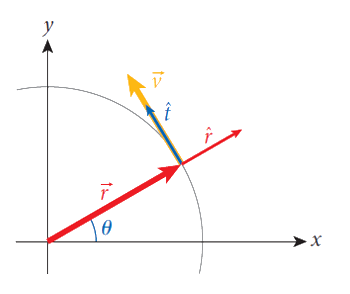
متجه الموضع \(\vec r\) (نحو الخارج \(\hat r\)) ومتجه السرعة \(\vec v\) المماسي (\(\hat t\)).
The position vector \(\vec r\) (outward direction \(\hat r\)) and the tangent velocity \(\vec v\) (\(\hat t\)).
📘 العلاقة بين السرعة الخطية والزاوية
📘 Relation between linear and angular velocity
\[v=r\omega=\dfrac{2\pi r}{T}=2\pi rf\]
إذن في الحركة الدائرية المنتظمة يكون مقدار \(v\) ثابتًا لكن اتجاهه يتغير باستمرار، لذلك للجسم تسارع (مركزي) سندرسه في القسم الثاني.
So in uniform circular motion the magnitude of \(v\) is constant but its direction changes continuously, so the body has an acceleration (centripetal) which we study in Part 2.
💡 شرح إضافي: نقطتان على القرص نفسه
💡 Extra explanation: two points on the same disc
جميع نقاط جسم جاسئ يدور تتحرك بالسرعة الزاوية \(\omega\) نفسها (والتردد والزمن الدوري نفسهما) لأنها تدور الزاوية نفسها في الزمن نفسه، لكن السرعة الخطية \(v=r\omega\) تتناسب مع البعد عن المحور: النقطة الأبعد تقطع محيطًا أكبر في الزمن نفسه فتكون أسرع. مثال: نقطتان على بعدي \(0.1\ \mathrm{m}\) و\(0.3\ \mathrm{m}\) من المحور: \(\omega\) واحدة و\(v_2=3v_1\).
All points of a rotating rigid body have the same angular velocity \(\omega\) (and the same frequency and period) because they turn through the same angle in the same time, but the linear speed \(v=r\omega\) is proportional to the distance from the axis: the farther point covers a longer circumference in the same time so it is faster. Example: two points at \(0.1\ \mathrm{m}\) and \(0.3\ \mathrm{m}\) from the axis have the same \(\omega\) and \(v_2=3v_1\).
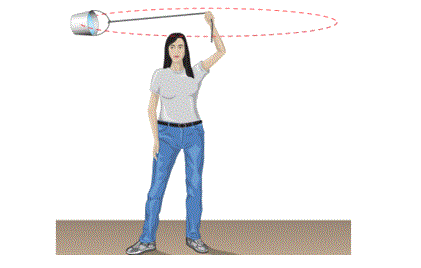
دلو يدور على دائرة أفقية: سرعته مماسية وعمودية على الحبل (نصف القطر).
A bucket whirled in a horizontal circle: its velocity is tangent and perpendicular to the rope (the radius).
يتحرك جسم في مسار دائري منتظم نصف قطره \(100\ \mathrm{cm}\) وزمنه الدوري \(2\ \mathrm{s}\). احسب سرعته الخطية بوحدة \(\mathrm{m/s}\).
A body moves in a uniform circular path of radius \(100\ \mathrm{cm}\) with a period of \(2\ \mathrm{s}\). Find its linear speed in \(\mathrm{m/s}\).
تدور عجلة بمعدل \(300\) دورة في الدقيقة، ونصف قطرها \(0.40\ \mathrm{m}\). احسب \(\omega\) و\(f\) و\(T\) والسرعة الخطية لنقطة على حافتها.
A wheel turns at \(300\) revolutions per minute and has a radius of \(0.40\ \mathrm{m}\). Find \(\omega\), \(f\), \(T\) and the linear speed of a point on its rim.
اتجاه السرعة الخطية لجسم يدور على دائرة:
The direction of the linear velocity of a body on a circle is:
جسم يدور بسرعة زاوية \(6\ \mathrm{rad/s}\) على دائرة نصف قطرها \(0.5\ \mathrm{m}\). سرعته الخطية:
A body rotates with an angular velocity of \(6\ \mathrm{rad/s}\) on a circle of radius \(0.5\ \mathrm{m}\). Its linear speed is:
نقطتان على قرص يدور: الأولى على بعد \(0.1\ \mathrm{m}\) من المحور والثانية على بعد \(0.3\ \mathrm{m}\). أيهما صحيح؟
Two points on a rotating disc: the first at \(0.1\ \mathrm{m}\) from the axis and the second at \(0.3\ \mathrm{m}\). Which is correct?
📚 ملخص الدرس
📚 Lesson Summary
| المفهومConcept | العلاقةRelation |
|---|---|
| قطبي ← ديكارتيPolar → Cartesian | \(x=r\cos\theta\ ,\ y=r\sin\theta\)\(x=r\cos\theta\ ,\ y=r\sin\theta\) |
| ديكارتي ← قطبيCartesian → polar | \(r=\sqrt{x^2+y^2}\ ,\ \theta=\tan^{-1}(y/x)\ (\text{check the quadrant})\)\(r=\sqrt{x^2+y^2}\ ,\ \theta=\tan^{-1}(y/x)\ (\text{check the quadrant})\) |
| الإزاحة الزاويةAngular displacement | \(\theta=\dfrac{s}{r}\ ;\ \pi\ \mathrm{rad}=180^\circ\ ;\ 2\pi\ \mathrm{rad}=1\ \mathrm{rev}\)\(\theta=\dfrac{s}{r}\ ;\ \pi\ \mathrm{rad}=180^\circ\ ;\ 2\pi\ \mathrm{rad}=1\ \mathrm{rev}\) |
| السرعة الزاويةAngular velocity | \(\omega=\dfrac{\Delta\theta}{\Delta t}=\dfrac{2\pi}{T}=2\pi f\)\(\omega=\dfrac{\Delta\theta}{\Delta t}=\dfrac{2\pi}{T}=2\pi f\) |
| التردد والزمن الدوريFrequency and period | \(f=\dfrac1T\)\(f=\dfrac1T\) |
| السرعة الخطيةLinear velocity | \(v=r\omega=\dfrac{2\pi r}{T}\ ,\ \vec v\perp\vec r\ (\text{tangent})\)\(v=r\omega=\dfrac{2\pi r}{T}\ ,\ \vec v\perp\vec r\ (\text{tangent})\) |
⚠️ أخطاء شائعة
⚠️ Common mistakes
- استعمال الدرجات في العلاقة \(s=r\theta\) بدل الراديان.Using degrees in \(s=r\theta\) instead of radians.
- أخذ \(\theta=\tan^{-1}(y/x)\) كما تعطيها الآلة دون التحقق من الربع.Taking \(\theta=\tan^{-1}(y/x)\) as the calculator gives it without checking the quadrant.
- نسيان تحويل نصف القطر من سنتيمتر إلى متر قبل استعمال \(v=r\omega\).Forgetting to convert the radius from centimetres to metres before using \(v=r\omega\).
- الخلط بين التردد \(f\) (Hz) والسرعة الزاوية \(\omega\) (rad/s)؛ \(\omega=2\pi f\).Confusing the frequency \(f\) (Hz) with the angular velocity \(\omega\) (rad/s); \(\omega=2\pi f\).
- الظن أن السرعة الخطية ثابتة في الحركة المنتظمة؛ مقدارها ثابت واتجاهها يتغير.Thinking that the linear velocity is constant in uniform motion; its magnitude is constant but its direction changes.
🧪 اختبر نفسك: امتحان من 20 سؤالاً
🧪 Test Yourself: a 20-Question Exam
أنهِ الدرس بالاختبار التفاعلي التالي؛ أسئلته تجمع بين الفهم والحساب وتغطي جميع أقسام الدرس.
Finish with the interactive exam below; its questions mix understanding with calculation and cover every section of the lesson.
اختبار الحركة الدائرية (القسم 1) Circular Motion (Part 1) Quiz
20 سؤالاً - الإحداثيات والإزاحة الزاوية والسرعتان الزاوية والخطية 20 Questions - Coordinates, Angular Displacement, Angular and Linear Velocity
• عدد الأسئلة: 20 سؤالاً
• مدة الاختبار: 30 دقيقة
• لا يمكنك تغيير إجاباتك أو إعادة الاختبار إلا بعد 24 ساعة من التسليم.
• تأكد من إجاباتك قبل التسليم! 📌 Important Instructions:
• Number of questions: 20 questions
• Quiz duration: 30 minutes
• You cannot change your answers or retake the quiz for 24 hours after submission.
• Make sure of your answers before submitting!