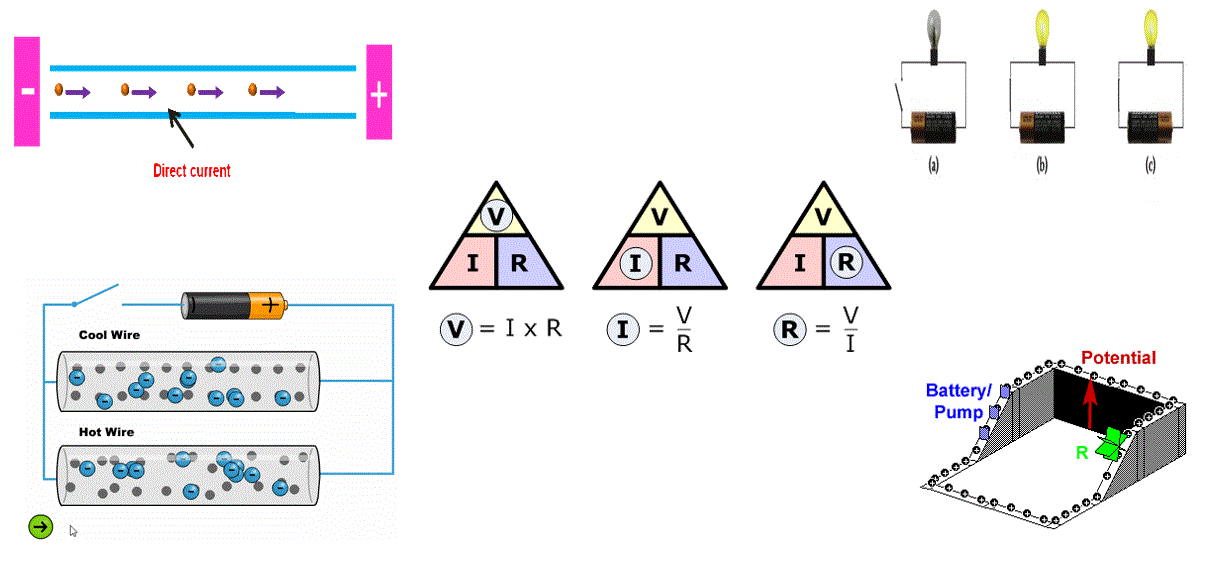
🎯 نواتج التعلم
🎯 Learning Outcomes
بعد دراسة هذا الدرس ستكون قادرًا على أن:
After this lesson you will be able to:
- تجري تجارب لاستنتاج قانون أوم وعوامل المقاومة وقانون جهد البطارية، وتقرأ الرسوم البيانية.Carry out experiments to deduce Ohm's law, the factors of resistance and the battery law, and read the graphs.
- تحسب شدة التيار وكثافته وسرعة الانسياق \(i=neAv_d\).Calculate the current, current density and drift velocity \(i=neAv_d\).
- تحسب المقاومة المكافئة للتوالي والتوازي، والقدرة الكهربائية، وتفسّر سطوع المصابيح.Compute equivalent resistance in series and parallel, electric power, and explain lamp brightness.
⚡ التيار الكهربائي
⚡ Electric Current
التيار الكهربائي هو تدفّق للشحنات الكهربائية داخل موصل، والحامل للشحنة في المعادن هو الإلكترون. شدته هي الشحنة المارة عبر مقطع في وحدة الزمن، ووحدته الأمبير.
Electric current is the flow of charge through a conductor; in metals the carriers are electrons. Its strength is the charge crossing a section per unit time, measured in amperes.
📌 شدة التيار
📌 Electric current
\[i=\frac{dq}{dt}\qquad[\mathrm{A}=\mathrm{C/s}]\]
🔀 التيار الاصطلاحي وتيار الإلكترونات
🔀 Conventional current and electron current
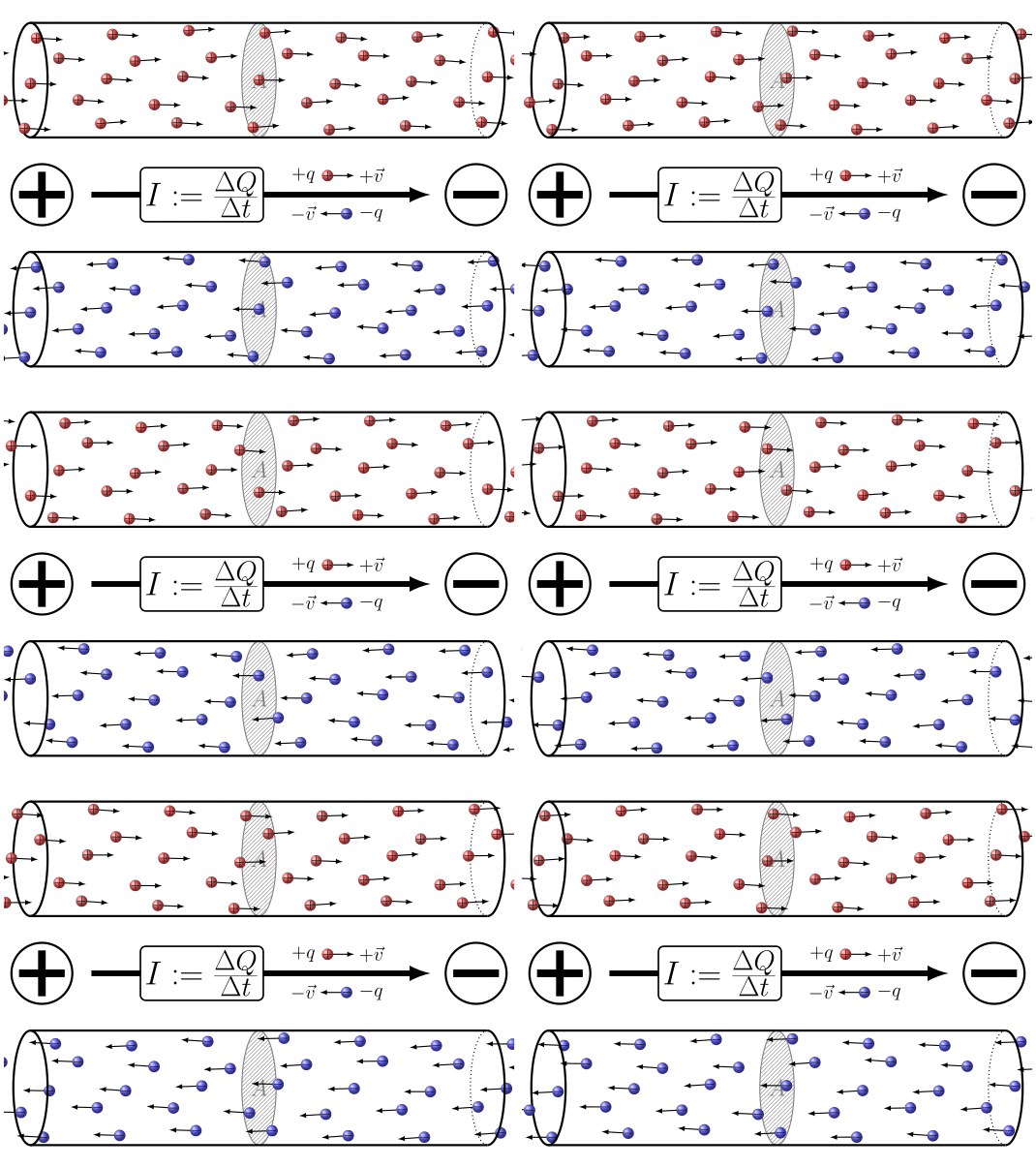
التيار الاصطلاحي: اتجاه حركة الشحنات الموجبة، أي من القطب الموجب إلى القطب السالب خارج المصدر. هذا الاتجاه معتمد في الحسابات والرسوم.
Conventional current: the direction of positive charge motion, from the positive terminal to the negative terminal outside the source. This is the direction used in calculations and diagrams.
تيار الإلكترونات: الحركة الفعلية للإلكترونات السالبة في السلك، من القطب السالب إلى القطب الموجب، وهي عكس التيار الاصطلاحي.
Electron current: the actual motion of negative electrons in the wire, from the negative terminal to the positive terminal; it is opposite to conventional current.
مرّت شحنة \(12\,C\) عبر مقطع سلك خلال \(4\,s\). احسب شدة التيار.
A charge of \(12\,C\) passes a cross-section of a wire in \(4\,s\). Find the current.
وحدة شدة التيار في النظام الدولي:
The SI unit of current is:
🌊 كثافة التيار وسرعة الانسياق
🌊 Current Density and Drift Velocity
كثافة التيار \(j\) هي التيار المار في وحدة المساحة، وهي متجه اتجاهه اتجاه حركة الشحنات الموجبة.
Current density \(j\) is the current per unit area; it is a vector pointing along the motion of positive charges.
📌 كثافة التيار
📌 Current density
\[j=\frac{i}{A}\qquad\left[\frac{A}{m^2}\right]\]
في الموصل تتحرك الإلكترونات بسرعة عشوائية كبيرة، وعند تطبيق فرق جهد تكتسب حركة منتظمة بطيئة تسمى سرعة الانسياق \(v_d\)، وهي من رتبة \(10^{-4}\,m/s\).
Electrons move randomly at high speed in a conductor. When a voltage is applied they acquire a slow steady motion, the drift velocity \(v_d\), of order \(10^{-4}\,m/s\).
🔎 اشتقاق العلاقة بين التيار وسرعة الانسياق
🔎 Deriving the relation between current and drift velocity
خلال زمن \(dt\) تقطع الإلكترونات مسافة \(v_d\,dt\)، فيعبر المقطع حجم \(A\,v_d\,dt\)، أي عدد \(n\,A\,v_d\,dt\) من الإلكترونات، وشحنتها \(dq=n\,e\,A\,v_d\,dt\). إذن \(i=neAv_d\).
During \(dt\) the electrons move \(v_d\,dt\), so the volume \(A\,v_d\,dt\) crosses the section, containing \(n\,A\,v_d\,dt\) electrons with charge \(dq=n\,e\,A\,v_d\,dt\). Hence \(i=neAv_d\).
📌 التيار وسرعة الانسياق
📌 Current and drift velocity
\[i=neAv_d\qquad j=nev_d\]
سلك نحاس مساحة مقطعه \(A=5.2\times10^{-6}\,m^2\) يمر فيه تيار \(2\,A\)، كثافته \(8960\,kg/m^3\)، الكتلة المولية \(63.5\,g/mol\)، إلكترون حر واحد لكل ذرة. احسب سرعة الانسياق.
A copper wire has \(A=5.2\times10^{-6}\,m^2\) and carries \(2\,A\). Density \(8960\,kg/m^3\), molar mass \(63.5\,g/mol\), one free electron per atom. Find the drift velocity.
اتجاه كثافة التيار هو اتجاه حركة:
The direction of current density is the direction of motion of:
📏 قانون أوم
📏 Ohm's Law
الآن نجري التجربة بأنفسنا: نغيّر الجهد ونقيس التيار، ثم نرسم النتائج ونستنتج القانون.
Now we run the experiment ourselves: change the voltage, measure the current, plot the results, and deduce the law.
🧪 تجربة 1: العلاقة بين الجهد والتيار
🧪 Experiment 1: the relation between voltage and current
الهدف: نقيس التيار عند قيم مختلفة للجهد ونبحث عن العلاقة بينهما.
Goal: Measure the current at different voltages and find the relation between them.
- اختر مقاومة من القائمة (مثلاً 4 Ω) ولا تغيّرها خلال التجربة.Choose one resistor (e.g. 4 Ω) and keep it fixed.
- حرّك منزلق الجهد V إلى قيمة، واقرأ شدة التيار I على الأميتر.Move the voltage slider to a value and read the current I on the ammeter.
- اضغط «سجّل القراءة». كرر الخطوتين 5 مرات بقيم مختلفة للجهد.Press “Record”. Repeat the two steps 5 times with different voltages.
- لاحظ الرسم البياني الذي يظهر بعد تسجيل 3 قراءات، ثم استنتج القانون منه.Look at the graph that appears after three readings, then deduce the law from it.
- Choose one resistor (e.g. 4 Ω) and keep it fixed.
- Move the voltage slider to a value and read the current I on the ammeter.
- Press “Record”. Repeat the two steps 5 times with different voltages.
- Look at the graph that appears after three readings, then deduce the law from it.
| V (V) | I (A) |
|---|
📌 قانون أوم: ما الذي يظهره الرسم؟
📌 Ohm's law: what the graph shows
\[V=IR\qquad\Rightarrow\qquad R=\frac{V}{I}=\frac{1}{\text{slope of }I\text{–}V}\]
مرّ تيار \(0.5\,A\) في مقاوم عند فرق جهد \(6\,V\). احسب المقاومة.
A current of \(0.5\,A\) flows through a resistor at \(6\,V\). Find the resistance.
🧱 المقاومة النوعية والمقاومة
🧱 Resistivity and Resistance
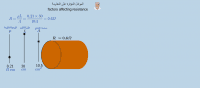
نجري تجربة لنعرف كيف تعتمد مقاومة السلك على طوله ومساحة مقطعه ومادته، ثم نستنتج القانون \(R=\rho L/A\).
We run an experiment to see how a wire's resistance depends on its length, cross-section and material, then deduce \(R=\rho L/A\).
🧪 تجربة 2: العوامل المؤثرة على المقاومة
🧪 Experiment 2: factors affecting resistance
الهدف: نجد كيف تتغير المقاومة مع الطول، ثم مع مساحة المقطع.
Goal: Find how resistance changes with length, then with cross-sectional area.
- اختر وضع «تغيير الطول». اجعل المساحة ثابتة (مثلاً 2 mm²).Choose “change length”. Keep the area fixed (e.g. 2 mm²).
- غيّر الطول L بالمنزلق، واقرأ المقاومة R، واضغط «سجّل».Change L with the slider, read R, and press “Record”.
- بعد 3 قراءات أو أكثر، لاحظ الخط البياني R–L.After 3 or more readings, look at the R–L graph.
- غيّر الوضع إلى «تغيير المساحة»، واجعل الطول ثابتًا، ثم كرر.Switch to “change area”, keep the length fixed, and repeat.
- Choose “change length”. Keep the area fixed (e.g. 2 mm²).
- Change L with the slider, read R, and press “Record”.
- After 3 or more readings, look at the R–L graph.
- Switch to “change area”, keep the length fixed, and repeat.
| L (m) | A (mm²) | R (Ω) |
|---|
📌 من التجربة: R ∝ L و R ∝ 1/A
📌 From the experiment: R ∝ L and R ∝ 1/A
\[R=\rho\frac{L}{A}\qquad[\Omega\cdot m]\]
🧮 المقاومة النوعية ومعامل درجة الحرارة لبعض المواد
🧮 Resistivity and temperature coefficient for some materials
| المادةMaterial | المقاومة النوعية (×10⁻⁸ Ω·m)Resistivity (×10⁻⁸ Ω·m) | معامل الحرارة α (×10⁻³ K⁻¹)Coefficient α (×10⁻³ K⁻¹) |
|---|---|---|
| الفضةSilver | 1.6 | 3.8 |
| النحاسCopper | 1.72 | 3.9 |
| الذهبGold | 2.44 | 3.4 |
| الألمنيومAluminum | 2.82 | 3.9 |
| النحاس الأصفرBrass | 3.9 | 2 |
| التنجستنTungsten | 5.51 | 4.5 |
| الحديدIron | 9.7 | 5 |
سلك نحاس طوله \(10\,m\) ومساحة مقطعه \(1\,mm^2\). احسب مقاومته عند \(20^\circ C\).
A copper wire is \(10\,m\) long with cross-section \(1\,mm^2\). Find its resistance at \(20^\circ C\).
عند ارتفاع حرارة سلك معدني تكون مقاومته:
When a metal wire is heated, its resistance:
🔋 القوة الدافعة الكهربائية والمقاومة الداخلية
🔋 EMF and Internal Resistance
البطارية تبذل شغلًا على الشحنات داخلها، وتسمى قوتها الدافعة \(\varepsilon\). كل بطارية لها مقاومة داخلية \(r\) تظهر عند مرور التيار. ندرس ذلك بالتجربة الآتية.
A battery does work on charges inside it; its emf is \(\varepsilon\). Every battery has an internal resistance \(r\) that appears when current flows. We study this with the next experiment.
🧪 تجربة 3: المقاومة الداخلية للبطارية
🧪 Experiment 3: internal resistance of a battery
الهدف: نقيس جهد الأطراف عند تيارات مختلفة، ونستنتج العلاقة بين الجهد والتيار.
Goal: Measure the terminal voltage at different currents and find the relation between them.
- اختر المقاومة الداخلية r من القائمة، وهي ثابتة للبطارية.Choose the internal resistance r; it stays fixed for the battery.
- غيّر المقاومة الخارجية R بالمنزلق. لاحظ التيار I وجهد الأطراف V.Change the external resistance R with the slider. Note the current I and the terminal voltage V.
- اضغط «سجّل» بعد كل تغيير، واحصل على 5 قراءات على الأقل.Press “Record” after each change, getting at least 5 readings.
- لاحظ الرسم V–I: هل هو مستقيم؟ وما ميله؟ وأين يقطع المحور الرأسي؟Look at the V–I graph: is it straight? What is its slope? Where does it cut the vertical axis?
- Choose the internal resistance r; it stays fixed for the battery.
- Change the external resistance R with the slider. Note the current I and the terminal voltage V.
- Press “Record” after each change, getting at least 5 readings.
- Look at the V–I graph: is it straight? What is its slope? Where does it cut the vertical axis?
| R (Ω) | I (A) | V (V) |
|---|
📌 جهد البطارية
📌 Battery voltage
\[V=\varepsilon-Ir\]
وُصّل فولتميتر ببطارية: قرأ \(12\,V\) والدائرة مفتوحة، و\(10\,V\) والدائرة مغلقة على مقاوم \(4\,\Omega\). احسب المقاومة الداخلية.
A voltmeter reads \(12\,V\) with the circuit open and \(10\,V\) with the circuit closed through a \(4\,\Omega\) resistor. Find the internal resistance.
لماذا تعطي البطارية فرق جهد ثابتًا تقريبًا لكن ليس تيارًا ثابتًا؟
Why does a battery give an almost constant voltage but not a constant current?
القوة الدافعة الكهربائية للبطارية تساوي فرق الجهد بين طرفيها عندما:
The emf equals the terminal voltage when:
🔗 التوالي والتوازي
🔗 Series and Parallel
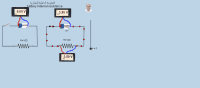
نجري تجربة نقيس فيها التيارات والفولتيات في التوصيلين، ثم نستنتج قاعدة كل توصيل.
We measure currents and voltages in both connections, then deduce the rule for each.
🧪 تجربة 4: التوالي مقابل التوازي
🧪 Experiment 4: series vs. parallel
الهدف: نقيس التيارات والفولتيات في التوصيلين، ونقارن بينهما.
Goal: Measure the currents and voltages in both connections and compare them.
- اختر «على التوالي»، واضبط R1، R2، R3 والجهد V، ثم اضغط «سجّل القياس».Choose series, set R1, R2, R3 and V, then press “Record”.
- لاحظ التيار في كل مقاوم، والجهد على كل مقاوم، وقارن مجموعهما بالكلي.Note the current and voltage in each resistor and compare their sums with the totals.
- بدّل إلى «على التوازي» بالقيم نفسها، وسجّل القياس.Switch to parallel with the same values and record.
- قارن بين الحالتين في التيار والجهد والمقاومة المكافئة.Compare the two cases in current, voltage and equivalent resistance.
- Choose series, set R1, R2, R3 and V, then press “Record”.
- Note the current and voltage in each resistor and compare their sums with the totals.
- Switch to parallel with the same values and record.
- Compare the two cases in current, voltage and equivalent resistance.
📌 على التوالي
📌 In series
\[I_{tot}=I_1=I_2=I_3\qquad V_{tot}=V_1+V_2+V_3\qquad R_{eq}=R_1+R_2+R_3\]
ثلاث مقاومات على التوالي: \(R_1=10\,\Omega\)، \(R_2=5\,\Omega\)، \(R_3=?\)، موصولة ببطارية \(V=20\,V\)، ويمر تيار \(I=0.5\,A\). أوجد \(R_3\).
Three resistors in series: \(R_1=10\,\Omega\), \(R_2=5\,\Omega\), \(R_3=?\), connected to \(20\,V\) with \(I=0.5\,A\). Find \(R_3\).
في التوصيل على التوالي، المقاوم الأكبر يبدد:
In series, the larger resistor dissipates:
📌 على التوازي
📌 In parallel
\[V_{tot}=V_1=V_2=V_3\qquad I_{tot}=I_1+I_2+I_3\qquad \frac{1}{R_{eq}}=\frac{1}{R_1}+\frac{1}{R_2}+\frac{1}{R_3}\]
ثلاث مقاومات على التوازي: \(R_1=3\,\Omega\)، \(R_2=9\,\Omega\)، \(R_3=?\)، موصولة ببطارية \(V=10\,V\)، والتيار الكلي \(I=5\,A\). أوجد \(R_3\).
Three resistors in parallel: \(R_1=3\,\Omega\), \(R_2=9\,\Omega\), \(R_3=?\), with \(V=10\,V\) and total current \(I=5\,A\). Find \(R_3\).
⚡ القدرة والطاقة الكهربائية
⚡ Electric Power and Energy
القدرة هي معدل استهلاك الطاقة: \(P=VI\). وباستخدام قانون أوم تصبح \(P=I^2R=V^2/R\).
Power is the rate of energy use: \(P=VI\). Using Ohm's law, \(P=I^2R=V^2/R\).
📌 القدرة والطاقة
📌 Power and energy
\[P=VI=I^2R=\frac{V^2}{R}\qquad E=Pt\qquad 1\,kWh=3.6\times10^6\,J\]
مقاوم \(10\,\Omega\) يمر فيه تيار \(2\,A\). احسب القدرة المبددة فيه.
A \(10\,\Omega\) resistor carries \(2\,A\). Find the power dissipated.
مصباح مكتوب عليه \((60\,W,\ 220\,V)\) يعمل مدة \(10\) دقائق. احسب مقاومته والطاقة التي يستهلكها.
A lamp is marked \((60\,W,\ 220\,V)\) and runs for \(10\) minutes. Find its resistance and the energy used.
بطارية قابلة للشحن مكتوب عليها \(2500\,mAh\). ما مقدار الشحنة التي توفرها؟
A rechargeable battery is rated \(2500\,mAh\). How much charge can it supply?
💡 سطوع المصابيح
💡 Brightness of Lamps
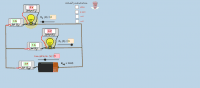
نقارن سطوع المصابيح بقياس القدرة التي يستهلكها كل مصباح في حالات التوصيل المختلفة.
We compare lamp brightness by measuring the power each lamp uses in different connections.
🧪 تجربة 5: سطوع المصابيح
🧪 Experiment 5: brightness of lamps
الهدف: نقارن قدرة المصباح في ثلاث حالات: مصباح واحد، مصباحان على التوالي، مصباحان على التوازي.
Goal: Compare the power of a lamp in three cases: one lamp, two in series, two in parallel.
- اختر «مصباح واحد» واضغط «سجّل القياس».Choose “One lamp” and press “Record”.
- اختر «مصباحان على التوالي» وسجّل، ثم «مصباحان على التوازي» وسجّل.Choose “Two in series”, record, then “Two in parallel”, and record.
- قارن ارتفاع الأعمدة، واحكم على السطوع من القدرة لكل مصباح.Compare the bar heights and judge brightness from the power per lamp.
- Choose “One lamp” and press “Record”.
- Choose “Two in series”, record, then “Two in parallel”, and record.
- Compare the bar heights and judge brightness from the power per lamp.
📌 السطوع والقدرة
📌 Brightness and power
\[P=\frac{V^2}{R}\qquad \text{series: }P'=\frac{P}{4}\qquad \text{parallel: }P'=P\]
مصباحان متماثلان على التوالي مقارنة بمصباح واحد على البطارية نفسها يكونان:
Two identical lamps in series, compared with one lamp, are:
📌 ملخص الدرس
📌 Lesson Summary
- \(i=\dfrac{dq}{dt}\)، والأمبير وحدته. كثافة التيار \(j=i/A=nev_d\).
- قانون أوم \(V=IR\) عند ثبات درجة الحرارة. المقاومة \(R=\rho L/A\).
- البطارية \(V=\varepsilon-Ir\)، والمقاومة الداخلية تخفض جهد الأطراف.
- التوالي \(R_{eq}=\sum R_i\)، والتوازي \(\dfrac{1}{R_{eq}}=\sum\dfrac{1}{R_i}\).
- القدرة \(P=VI=I^2R=V^2/R\)، والطاقة \(E=Pt\).
- \(i=\dfrac{dq}{dt}\), in amperes. Current density \(j=i/A=nev_d\).
- Ohm's law \(V=IR\) at constant temperature. Resistance \(R=\rho L/A\).
- Battery \(V=\varepsilon-Ir\); internal resistance lowers the terminal voltage.
- Series \(R_{eq}=\sum R_i\); parallel \(\dfrac{1}{R_{eq}}=\sum\dfrac{1}{R_i}\).
- Power \(P=VI=I^2R=V^2/R\); energy \(E=Pt\).
🧪 اختبر نفسك: امتحان من 20 سؤالًا
🧪 Test Yourself: a 20-Question Exam
أنهِ الدرس بالاختبار التفاعلي التالي؛ أسئلته تجمع بين الفهم والحساب وتغطي جميع أقسام الدرس.
Finish with the interactive exam below; its questions mix understanding with calculation and cover every section of the lesson.
اختبار التيار المتردد الجزء الأول (12A) Alternating Current Part I (12A) Quiz
20 سؤالاً - التيار المتردد الجزء الأول (12A) وطرق انتقال الحرارة 20 Questions - the Oscillation Circuit, the Resistor, the Inductor and the Capacitor
• عدد الأسئلة: 20 سؤالاً
• مدة الاختبار: 30 دقيقة
• لا يمكنك تغيير إجاباتك أو إعادة الاختبار إلا بعد 24 ساعة من التسليم.
• تأكد من إجاباتك قبل التسليم! 📌 Important Instructions:
• Number of questions: 20 questions
• Quiz duration: 30 minutes
• You cannot change your answers or retake the quiz for 24 hours after submission.
• Make sure of your answers before submitting!
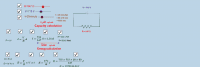
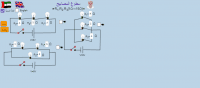
🔗 محاكيات GeoGebra للاستعانة بها عند اللزوم
🔗 GeoGebra Simulations to Use When Needed
اضغط «تشغيل» لتعمل المحاكاة هنا داخل الدرس؛ ويمكن للطالب الرجوع إليها لتجربة الفكرة بطريقة أخرى.
Press “Run” to run the simulation right here inside the lesson; the student can use it to try the idea in another way.
تم بحمد الله شرح التيار الكهربائي والمقاومة وقانون أوم والمقاومة النوعية والقوة الدافعة الكهربائية والمقاومة الداخلية، وتوصيل المقاومات على التوالي والتوازي، والقدرة الكهربائية وسطوع المصابيح.
Praise be to Allah, we have covered electric current, resistance, Ohm's law, resistivity, EMF and internal resistance, series and parallel connections, electric power, and brightness of lamps.