🎯 نواتج التعلم
🎯 Learning Outcomes
بعد دراسة هذا الدرس ستكون قادرًا على أن:
After this lesson you will be able to:
- تفسّر نشوء القوة الدافعة المستحثة في سلك يقطع خطوط المجال وتحسبها بالعلاقة \(\varepsilon=BLv\sin\theta\).Explain how an induced EMF arises in a wire cutting field lines and calculate it with \(\varepsilon=BLv\sin\theta\).
- تحدّد اتجاه التيار المستحث بقاعدة الكف اليمنى وبقاعدة لنز.Find the direction of the induced current with the right-hand palm rule and with Lenz’s law.
- تشرح عمل المولد الكهربائي والميكروفون، وتميّز بين القيمة العظمى والقيمة الفعالة وتحسب القدرة المتوسطة.Explain how the generator and the microphone work, distinguish the peak and the effective value and calculate the average power.
- تفسّر التيارات الدوامية والحث الذاتي وتذكر تطبيقاتهما.Explain eddy currents and self-induction and give their applications.
- تحسب جهد وتيار المحول المثالي وتميّز بين الرافع والخافض ومحول العزل.Calculate the voltage and current of an ideal transformer and tell step-up, step-down and isolation transformers apart.
🌐 ظاهرة الحث الكهرومغناطيسي
🌐 The Phenomenon of Electromagnetic Induction
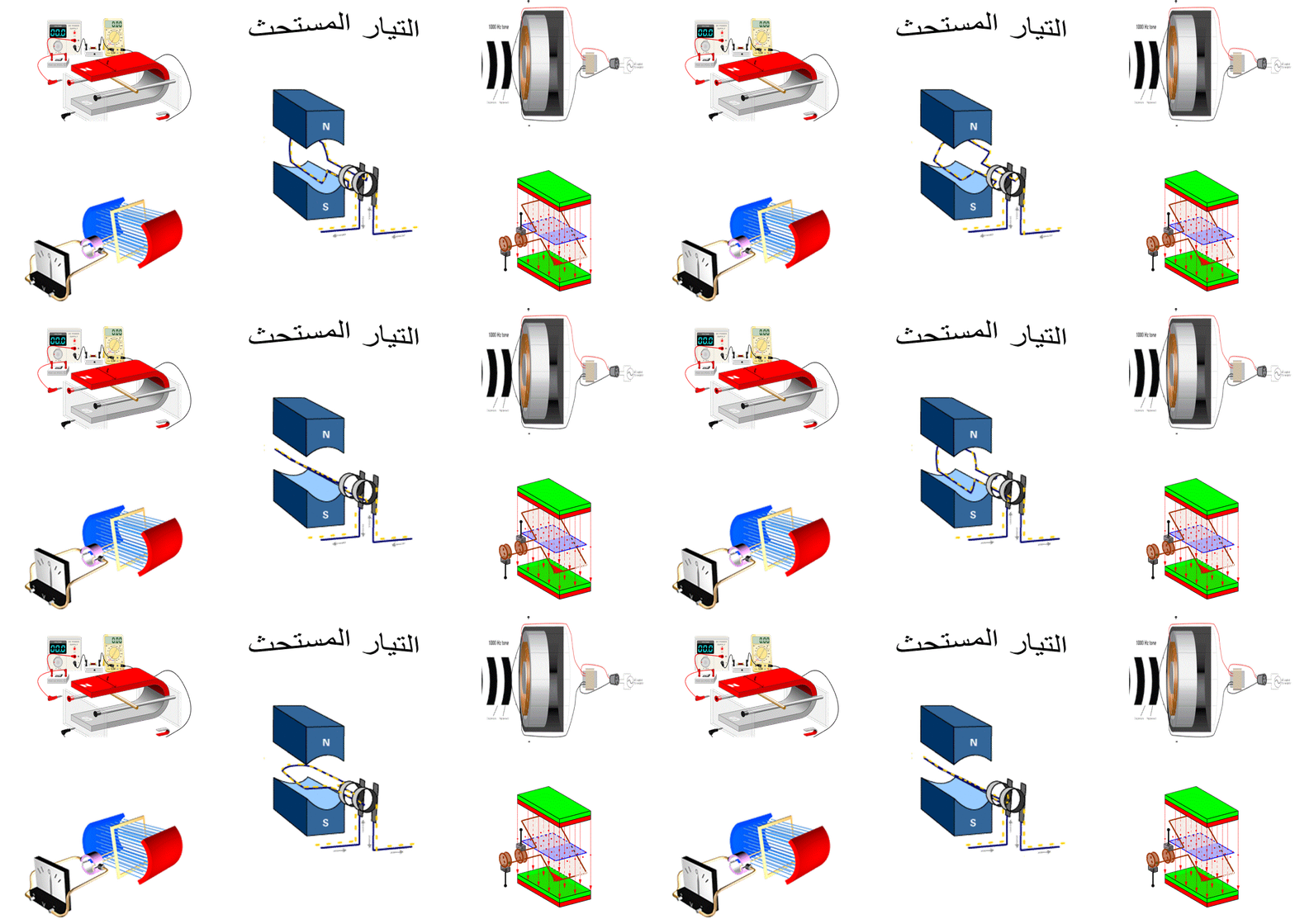
تطبيقات التيارات المستحثة: المولد والمحول والميكروفون والتيارات الدوامية.
Applications of induced currents: the generator, the transformer, the microphone and eddy currents.
عند حركة سلك موصل بحيث يقطع خطوط المجال المغناطيسي وهو جزء من دائرة مغلقة، تتولد بين طرفيه قوة دافعة مستحثة (EMF) ويمر في الدائرة تيار مستحث. ما سبب ذلك؟
When a conducting wire moves so that it cuts magnetic field lines and is part of a closed circuit, an induced EMF appears between its ends and an induced current flows in the circuit. What is the reason?
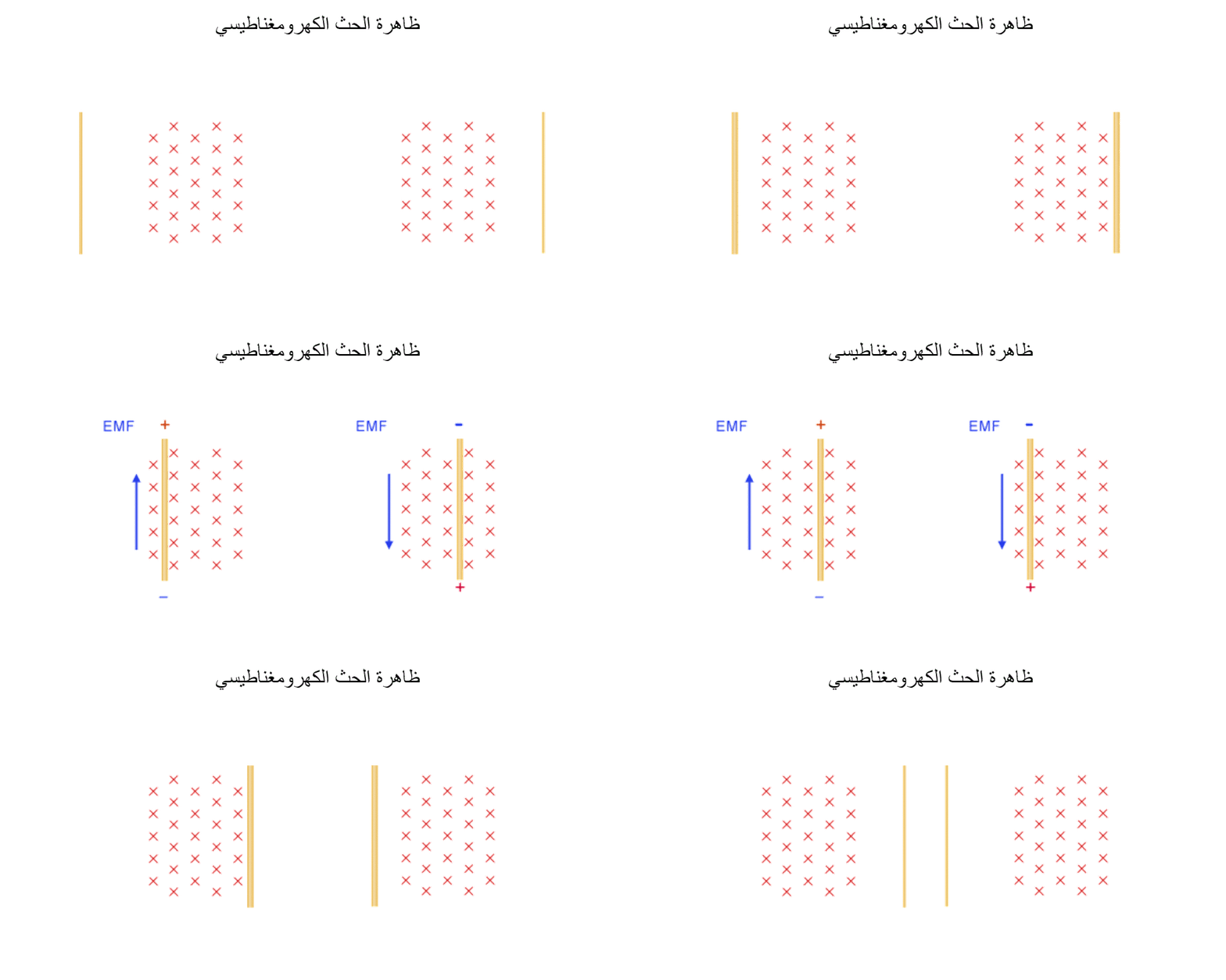
سلك يتحرك داخل منطقة مجال مغناطيسي (×× تعني مجالًا إلى داخل الصفحة).
A wire moving inside a magnetic field region (×× means a field into the page).
داخل السلك إلكترونات حرة؛ وعندما يتحرك السلك بسرعة \(\vec v\) تتحرك هذه الإلكترونات معه، فيؤثر عليها المجال بقوة مغناطيسية \(\vec F=q\vec v\times\vec B\). تدفع هذه القوة الإلكترونات نحو أحد طرفي السلك، فيتراكم عليه شحنة سالبة ويبقى الطرف الآخر موجبًا. هكذا يصير السلك مصدرًا للطاقة (كالبطارية) بين طرفيه فرق جهد.
Inside the wire there are free electrons; when the wire moves with velocity \(\vec v\) the electrons move with it and the field exerts a magnetic force \(\vec F=q\vec v\times\vec B\) on them. This force pushes the electrons towards one end of the wire, which collects negative charge and leaves the other end positive. The wire thus becomes a source of energy (like a battery) with a potential difference between its ends.
🔎 من أين جاءت العلاقة \(\varepsilon=BLv\)؟
🔎 Where does \(\varepsilon=BLv\) come from?
1) القوة المغناطيسية على إلكترون: \(F=evB\) نحو أحد الطرفين.
2) تتراكم الشحنات فينشأ داخل السلك مجال كهربائي \(E\) يدفع الإلكترونات في الاتجاه المعاكس.
3) يتوقف التراكم حين تتساوى القوتان: \(eE=evB\Rightarrow E=vB\).
4) فرق الجهد بين الطرفين \(\varepsilon=EL=vBL\).
1) The magnetic force on an electron is \(F=evB\) towards one end.
2) Charges pile up and an electric field \(E\) builds up inside the wire pushing the electrons the other way.
3) The pile-up stops when the forces are equal: \(eE=evB\Rightarrow E=vB\).
4) The potential difference between the ends is \(\varepsilon=EL=vBL\).
إذا وُصل السلك في دائرة مغلقة مرّ التيار داخل السلك من الطرف السالب إلى الموجب (فالسلك هو المصدر)، وفي الدائرة الخارجية من القطب الموجب إلى السالب كما في أي بطارية.
If the wire is connected in a closed circuit the current flows inside the wire from the negative end to the positive end (the wire is the source) and in the external circuit from the positive to the negative, as with any battery.
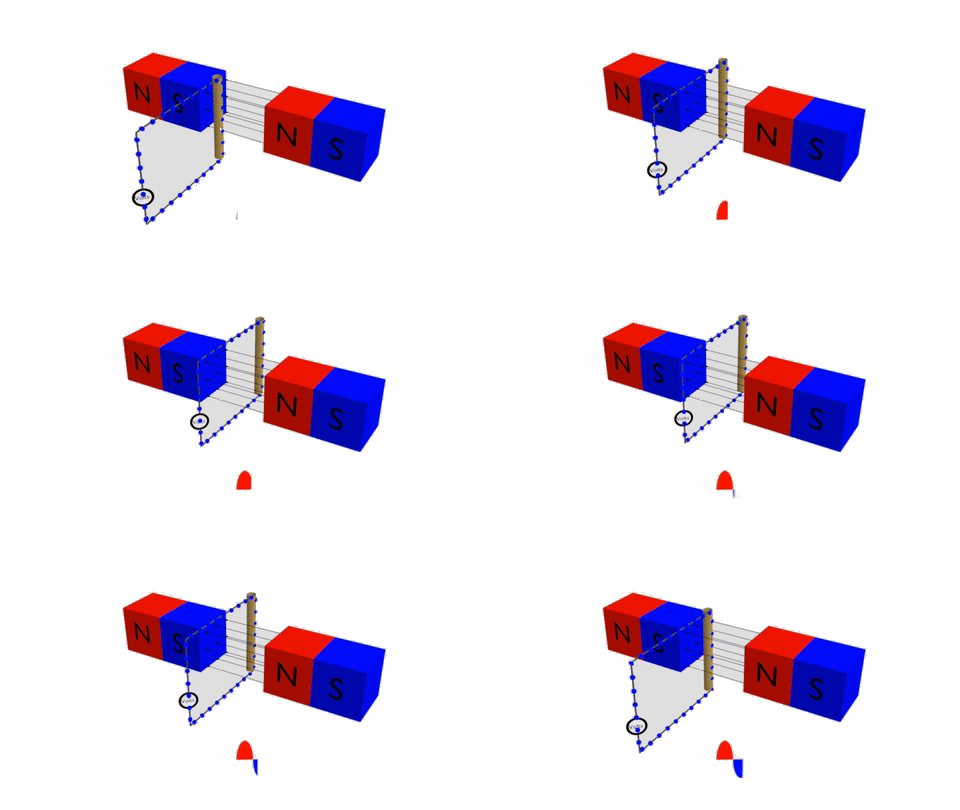
ملف يدور بين قطبي مغناطيسين: مثال على سلك يقطع خطوط المجال باستمرار.
A coil rotating between the poles of two magnets: an example of wires continually cutting field lines.
📐 القوة الدافعة المستحثة في سلك
📐 The Induced EMF in a Wire
📌 قانون القوة الدافعة المستحثة
📌 The induced EMF law
سلك طوله \(L\) يتحرك بسرعة \(v\) في مجال مغناطيسي منتظم \(B\):
A wire of length \(L\) moving with speed \(v\) in a uniform magnetic field \(B\):
\[\varepsilon=B\,L\,v\,\sin\theta\]
\(\theta\) هي الزاوية بين سرعة السلك واتجاه المجال. وحدة \(\varepsilon\) الفولت \((\mathrm{V})\)، وإذا كان السلك والسرعة والمجال متعامدة معًا (\(\theta=90^\circ\)) صارت \(\varepsilon=BLv\). التيار المار في دائرة مقاومتها \(R\) هو \(I=\varepsilon/R\).
\(\theta\) is the angle between the wire’s velocity and the field direction. The unit of \(\varepsilon\) is the volt \((\mathrm{V})\), and if the wire, the velocity and the field are mutually perpendicular (\(\theta=90^\circ\)) it becomes \(\varepsilon=BLv\). The current in a circuit of resistance \(R\) is \(I=\varepsilon/R\).
| كيف نحرّك السلك؟How do we move the wire? | الزاوية \(\theta\)Angle \(\theta\) | القوة الدافعة المستحثةInduced EMF |
|---|---|---|
| عموديًا على خطوط المجال (يقطعها)Perpendicular to the field lines (cutting them) | \(90^\circ\)\(90^\circ\) | أكبر قيمة \(BLv\)Maximum \(BLv\) |
| موازيًا لخطوط المجال (لا يقطعها)Parallel to the field lines (not cutting them) | \(0^\circ\) أو \(180^\circ\)\(0^\circ\) or \(180^\circ\) | صفرzero |
| بزاوية مائلةAt a slant | بين الصفر و\(90^\circ\)between \(0\) and \(90^\circ\) | \(BLv\sin\theta\) أي بمركّبة السرعة العمودية فقط\(BLv\sin\theta\), i.e. only the perpendicular part of the speed |
| بتدوير السلك في المجالBy rotating the wire in the field | تتغير كل لحظةchanges every moment | قوة دافعة متغيرة (متناوبة)a changing (alternating) EMF |
الاتجاه: قاعدة الكف اليمنى
The Direction: the Right-Hand Palm Rule
لتحديد اتجاه التيار داخل السلك نطبّق قاعدة الكف اليمنى: الأصابع باتجاه المجال \(\vec B\)، الإبهام باتجاه حركة السلك \(\vec v\)، فيكون العمود الخارج من راحة الكف هو اتجاه القوة على الشحنات الموجبة أي اتجاه التيار داخل السلك.
To find the direction of the current inside the wire use the right-hand palm rule: fingers along the field \(\vec B\), thumb along the wire’s motion \(\vec v\); then the normal coming out of the palm is the force on positive charges, i.e. the current direction inside the wire.
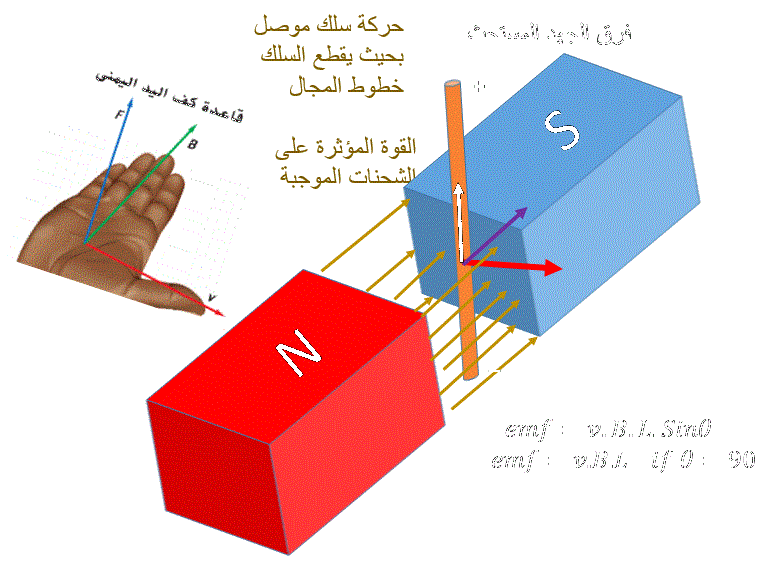
قاعدة الكف اليمنى: الأصابع \(B\)، الإبهام \(v\)، العمود على الراحة \(I\).
The palm rule: fingers \(B\), thumb \(v\), normal to the palm \(I\).
💡 نصيحة عملية
💡 A practical tip
إذا عكستَ اتجاه حركة السلك أو اتجاه المجال انعكس اتجاه التيار؛ وإذا عكستهما معًا بقي كما هو. وإذا توقف السلك (\(v=0\)) انعدمت القوة الدافعة تمامًا لأن التدفق لا يتغير.
If you reverse the wire’s motion or the field direction the current reverses; if you reverse both it stays the same. If the wire stops (\(v=0\)) the EMF vanishes completely because the flux is no longer changing.
🧪 تجربة 1: سلك يتحرك على سكتين في مجال مغناطيسي
🧪 Experiment 1: A rod moving on rails in a magnetic field
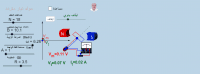
سلك موصل (برتقالي) يتزحلق على سكتين فيه مقاوم \(R\) داخل مجال \(B\). اختر \(B\) و\(L\) و\(v\) ثم اضغط «حرّك السلك»: يزداد التدفق فتتولد \(\varepsilon=BLv\) ويمر تيار \(I=\varepsilon/R\). لاحظ السهم الأحمر: القوة المغناطيسية \(F_m=BIL\) تعاكس الحركة. جرّب «اعكس الاتجاه» وبدّل اتجاه المجال لترى انعكاس التيار.
A conducting rod (orange) slides on rails containing a resistor \(R\) in a field \(B\). Choose \(B\), \(L\) and \(v\) then press “Move the rod”: the flux grows so \(\varepsilon=BLv\) appears and a current \(I=\varepsilon/R\) flows. Notice the red arrow: the magnetic force \(F_m=BIL\) opposes the motion. Try “Reverse the direction” and switch the field direction to see the current reverse.
سلك طوله \(0.5\ \mathrm{m}\) يتحرك عموديًا على مجال شدته \(2\ \mathrm{T}\) بسرعة \(4\ \mathrm{m/s}\). القوة الدافعة المستحثة:
A \(0.5\ \mathrm{m}\) wire moves perpendicular to a \(2\ \mathrm{T}\) field at \(4\ \mathrm{m/s}\). The induced EMF is:
🧪 تجربة 2: تأثير الزاوية: \(\varepsilon=BLv\sin\theta\)
🧪 Experiment 2: The effect of the angle: \(\varepsilon=BLv\sin\theta\)
السلك (النقطة في المركز) عمودي على الصفحة وسرعته \(\vec v\) تصنع الزاوية \(\theta\) مع خطوط المجال \(B\). الذي يقطع الخطوط هو المركبة العمودية \(v\sin\theta\) فقط. حرّك شريط الزاوية أو اضغط «امسح الزاوية» لتتحرك النقطة على منحنى الجيب: أكبر قيمة عند \(90^\circ\) وصفر عند \(0^\circ\) و\(180^\circ\).
The wire (the dot at the centre) is perpendicular to the page and its velocity \(\vec v\) makes the angle \(\theta\) with the field lines \(B\). Only the perpendicular component \(v\sin\theta\) cuts the lines. Move the angle slider or press “Sweep the angle” to move the point along the sine curve: maximum at \(90^\circ\) and zero at \(0^\circ\) and \(180^\circ\).
يتحرك سلك داخل مجال بحيث تكون سرعته موازية لخطوط المجال. القوة الدافعة المستحثة:
A wire moves in a field with its velocity parallel to the field lines. The induced EMF is:
أمثلة محلولة
Worked Examples
سلك موصل طوله \(0.3\ \mathrm{m}\) موجود في مجال مغناطيسي منتظم شدته \(0.5\ \mathrm{T}\) ويتحرك عموديًا على المجال بسرعة \(10\ \mathrm{m/s}\) كما في الشكل. ما فرق الجهد المستحث بين طرفيه؟
A conducting wire of length \(0.3\ \mathrm{m}\) lies in a uniform magnetic field of \(0.5\ \mathrm{T}\) and moves perpendicular to it at \(10\ \mathrm{m/s}\) as shown. What potential difference is induced between its ends?
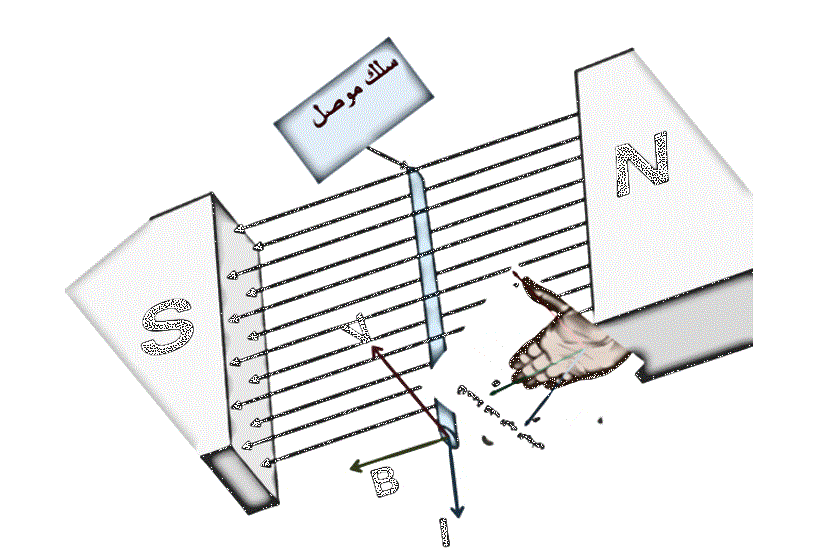
شكل المثال 1: السلك يقطع الخطوط عموديًا.
Figure of example 1: the wire cuts the lines perpendicularly.
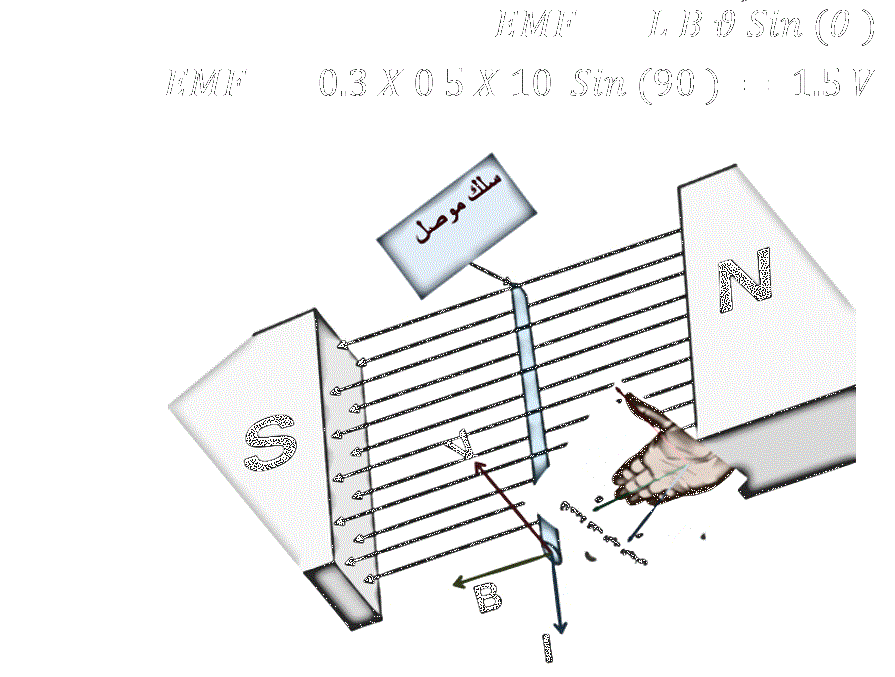
الحل المصوّر للمثال 1: \(\varepsilon=1.5\ \mathrm{V}\).
The illustrated solution of example 1: \(\varepsilon=1.5\ \mathrm{V}\).
ما السرعة التي يجب أن يتحرك بها قضيب طوله \(0.5\ \mathrm{m}\) عموديًا على مجال منتظم شدته \(2.5\ \mathrm{T}\) لينتج تيارًا شدته \(0.5\ \mathrm{A}\) في مقاوم \(R=10\ \Omega\) كما في الشكل؟
At what speed must a rod of length \(0.5\ \mathrm{m}\) move perpendicular to a uniform \(2.5\ \mathrm{T}\) field to produce a current of \(0.5\ \mathrm{A}\) in a resistor \(R=10\ \Omega\) as shown?
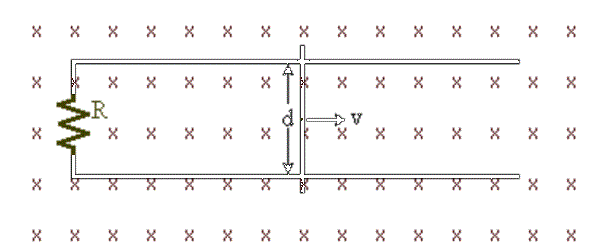
شكل المثال 2: قضيب على سكتين مع مقاوم.
Figure of example 2: a rod on rails with a resistor.
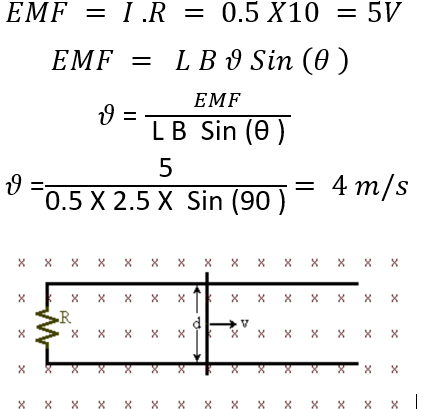
الحل المصوّر للمثال 2: \(v=4\ \mathrm{m/s}\).
The illustrated solution of example 2: \(v=4\ \mathrm{m/s}\).
⚙️ المولد الكهربائي والتيار المتردد
⚙️ The Electric Generator and Alternating Current
يتكوّن المولد من ملف (أسلاك عديدة) يدور في مجال مغناطيسي. في كل لفة يوجد ضلعان يقطعان خطوط المجال وضلعان يتحركان موازيين لها فلا يسهمان. وتتغير الزاوية بين سرعة السلك والمجال كل لحظة، فتتغير القوة الدافعة بتغيرها.
The generator consists of a coil (many wires) rotating in a magnetic field. In each turn two sides cut the field lines and two sides move parallel to them so they do not contribute. The angle between the wire’s velocity and the field changes every moment, so the EMF changes with it.
📌 القوة الدافعة في المولد
📌 The EMF of the generator
لملف من \(N\) لفة مساحته \(A\) يدور بسرعة زاوية \(\omega\) في مجال \(B\):
For a coil of \(N\) turns and area \(A\) rotating at angular speed \(\omega\) in a field \(B\):
\[\varepsilon=NBA\omega\sin\omega t=\varepsilon_{max}\sin\omega t\qquad(\omega=2\pi f)\]
تُشتق من \(\varepsilon=BLv\sin\theta\) لضلعين طول كلٍّ \(L\) وسرعة كلٍّ \(v=\omega r\) فتصير \(2BL\cdot\omega\dfrac{w}{2}\sin\theta=BA\omega\sin\theta\) للفة الواحدة.
It follows from \(\varepsilon=BLv\sin\theta\) for two sides of length \(L\) each moving at \(v=\omega r\), giving \(2BL\cdot\omega\dfrac{w}{2}\sin\theta=BA\omega\sin\theta\) per turn.
أكبر قوة دافعة تتولد عندما تكون السرعة عمودية على المجال (مستوى الملف موازٍ للمجال)، وتنعدم عندما تكون السرعة موازية للمجال (مستوى الملف عموديًا على المجال). وفي كل نصف دورة نصل إلى الحالة نفسها لكن يتغير اتجاه حركة الضلع فينعكس اتجاه التيار؛ لذلك يسمى التيار الناتج تيارًا مترددًا والقوة الدافعة قوة دافعة مترددة.
The largest EMF appears when the velocity is perpendicular to the field (the plane of the coil parallel to the field) and it vanishes when the velocity is parallel to the field (the coil plane perpendicular to the field). Every half turn the same state is reached but the direction of the side’s motion changes so the current reverses; hence the current is called an alternating current and the EMF an alternating EMF.
🧪 تجربة 3: المولد الكهربائي: ملف يدور في مجال
🧪 Experiment 3: The electric generator: a coil rotating in a field
اضغط «أدِر الملف» (أو حرّك شريط الزاوية) ليدور ملف مستطيل في مجال مغناطيسي. \(\varepsilon=NBA\omega\sin\theta\): أعظم قيمة حين تقطع الأسلاك الخطوط (90° و270°) وصفر حين تكون موازية لها (0° و180°)، وتتغير الإشارة كل نصف دورة فالتيار متردد. عند وصل حمل يتولد عزم يعاكس الدوران (قاعدة لنز).
Press “Rotate the coil” (or move the angle slider) to turn a rectangular coil in a magnetic field. \(\varepsilon=NBA\omega\sin\theta\): it is maximum when the wires cut the lines (90° and 270°) and zero when they move along them (0° and 180°), and it changes sign every half turn so the current is alternating. With a load connected a torque opposing the rotation appears (Lenz’s law).
في المولد الكهربائي تكون القوة الدافعة المستحثة صفرًا عندما:
In an electric generator the induced EMF is zero when:
القيم الفعالة والقدرة المتوسطة
Effective Values and Average Power
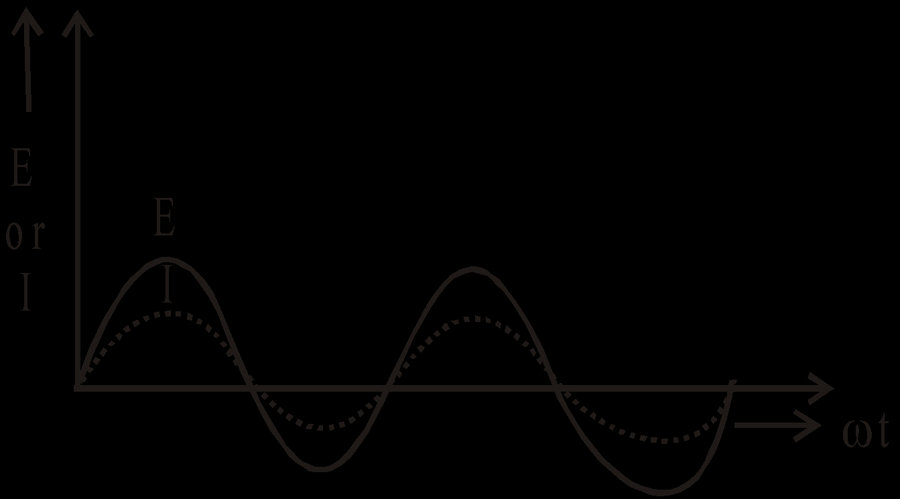
الجهد والتيار المتناوبان يتغيران كل لحظة بين قيمة عظمى وقيمة سالبة.
The alternating voltage and current change every moment between a maximum and a negative value.
الجهد والتيار المتناوبان متغيران كل لحظة، فلا نستعمل القيمة اللحظية لأنها قد تساوي صفرًا، ولا القيمة العظمى لأنهما لا يبقيان عندها. لذلك نستعمل القيمة الفعالة: وهي شدة التيار المستمر الذي يولّد في المقاوم نفسه الطاقة الحرارية نفسها.
The alternating voltage and current change every moment, so we cannot use the instantaneous value (it may be zero) nor the maximum (they do not stay there). We therefore use the effective value: the DC current that produces the same heat energy in the same resistor.
📌 القيم الفعالة والقدرة
📌 Effective values and power
\[I_{rms}=\dfrac{I_{max}}{\sqrt2}\approx0.707\,I_{max},\qquad V_{rms}=\dfrac{V_{max}}{\sqrt2}\approx0.707\,V_{max}\]
\[P_{avg}=I_{rms}V_{rms}=\dfrac{I_{max}V_{max}}{2}=\tfrac12P_{max}=I_{rms}^2R\]
القدرة اللحظية \(p=vi=P_{max}\sin^2\omega t\) تتأرجح بين \(0\) و\(P_{max}\)، ومتوسطها نصف القيمة العظمى تمامًا. والأجهزة (الفولتميتر والأميتر) تقرأ القيمة الفعالة؛ فجهد المنزل \(220\ \mathrm{V}\) هو قيمة فعالة وقيمته العظمى \(220\sqrt2\approx311\ \mathrm{V}\).
The instantaneous power \(p=vi=P_{max}\sin^2\omega t\) swings between \(0\) and \(P_{max}\) and its average is exactly half of the maximum. Meters (voltmeter and ammeter) read the effective value; the \(220\ \mathrm{V}\) of a home is an effective value and its peak is \(220\sqrt2\approx311\ \mathrm{V}\).
🧪 تجربة 4: القيم الفعالة والقدرة المتوسطة في التيار المتردد
🧪 Experiment 4: Effective values and average power in AC
يمر تيار متردد شدته العظمى \(I_{max}\) في مقاوم \(R\). اضغط «ارسم الموجة»: يرسم المنحنى الأزرق الجهد \(v(t)\) والمنحنى البنفسجي القدرة اللحظية \(p=vi\) (لا تنزل عن الصفر لأن \(\sin^2\) موجبة)، والخط الأحمر المتوسط الجاري للقدرة يقترب شيئًا فشيئًا من النصف \(\tfrac12P_{max}\) (الخط الأخضر). ولهذا تُستعمل القيم الفعالة \(I_{rms}=I_{max}/\sqrt2\).
An alternating current of maximum value \(I_{max}\) flows in a resistor \(R\). Press “Draw the wave”: the blue curve draws the voltage \(v(t)\) and the purple curve the instantaneous power \(p=vi\) (never below zero because \(\sin^2\) is positive); the red line, the running mean of the power, settles on half of \(P_{max}\) (the green line). That is why effective values \(I_{rms}=I_{max}/\sqrt2\) are used.
تيار متردد شدته العظمى \(2\ \mathrm{A}\) يمر في مقاوم \(R=6\ \Omega\). ما القدرة المتوسطة التي يصرفها المقاوم؟
An alternating current of maximum value \(2\ \mathrm{A}\) flows through a resistor \(R=6\ \Omega\). What average power does the resistor dissipate?
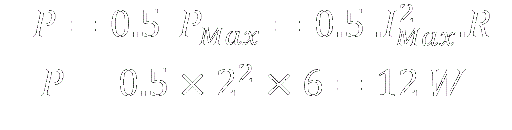
الحل المصوّر للمثال 3.
The illustrated solution of example 3.
تيار متردد شدته الفعالة \(5\ \mathrm{A}\) يمر في مقاوم فرق الجهد الفعال بين طرفيه \(20\ \mathrm{V}\). ما القدرة العظمى المستهلكة في المقاوم؟
An alternating current of effective value \(5\ \mathrm{A}\) flows through a resistor with an effective voltage of \(20\ \mathrm{V}\) across it. What is the maximum power consumed in the resistor?
القيمة العظمى لجهد المنزل الذي قيمته الفعالة \(220\ \mathrm{V}\) تساوي تقريبًا:
The peak value of the home voltage whose effective value is \(220\ \mathrm{V}\) is about:
🎤 الميكروفون
🎤 The Microphone
يتكوّن الميكروفون من مجال مغناطيسي وملف متصل بغشاء رقيق. الصوت تضاغط وتخلخل لجزيئات الهواء؛ فعندما نتكلم أمام الغشاء يهتز، فيهتز معه الملف داخل المجال فتتولد فيه قوة دافعة مستحثة متغيرة الشدة تتبع شكل الموجة الصوتية. هكذا يحوّل الميكروفون الموجات الصوتية إلى تيار متردد.
The microphone consists of a magnetic field and a coil attached to a thin diaphragm. Sound is a compression and rarefaction of air particles; when we speak in front of the diaphragm it vibrates and so does the coil in the field, which generates an induced EMF of varying strength that follows the shape of the sound wave. So the microphone converts sound waves into an alternating current.
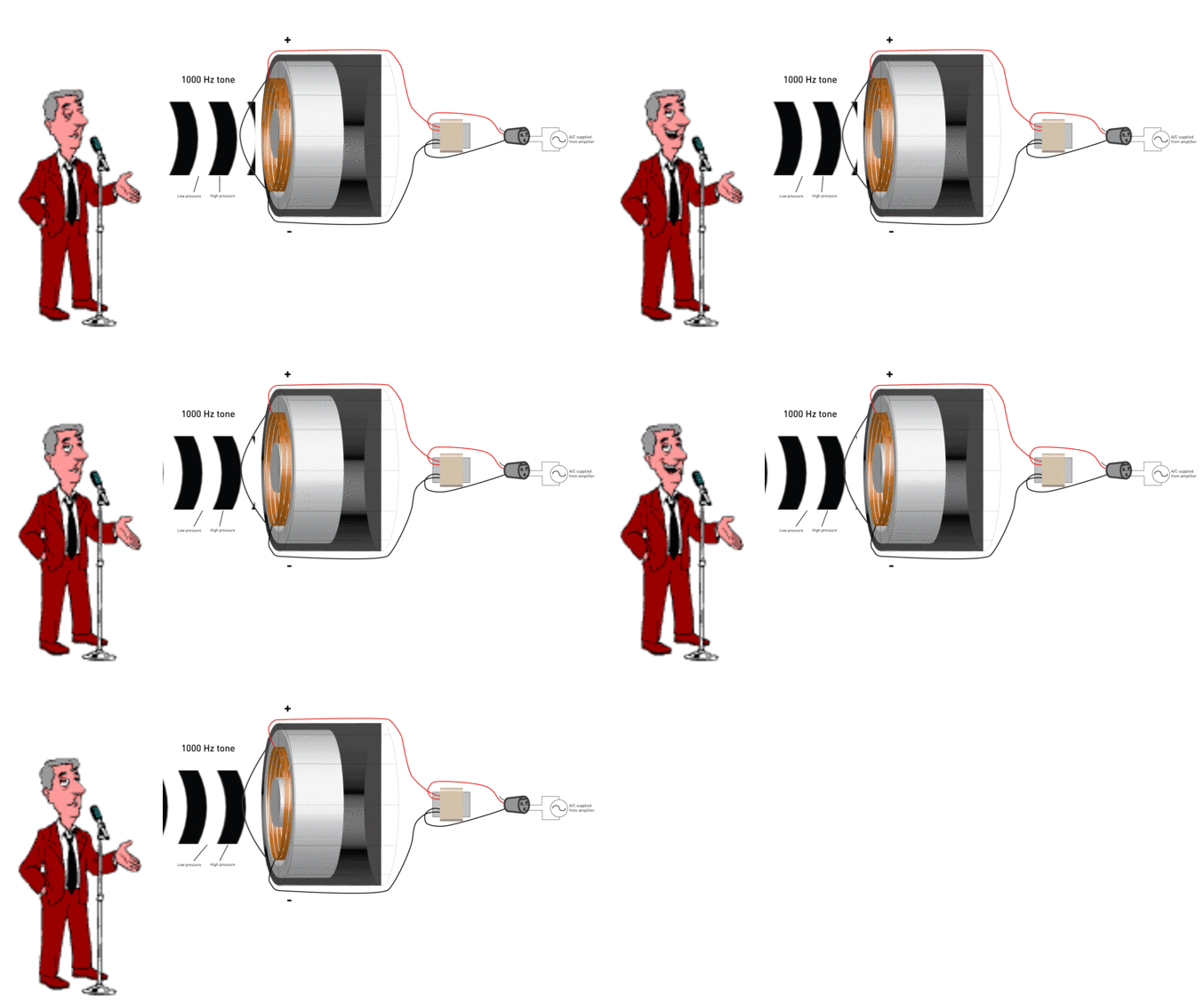
رسم متحرك للميكروفون: الصوت يهز الغشاء فيتحرك الملف.
A moving drawing of the microphone: the sound shakes the diaphragm and the coil moves.
🧪 تجربة 5: الميكروفون: من الصوت إلى تيار متردد
🧪 Experiment 5: The microphone: from sound to alternating current
ضغط الهواء المتذبذب (الصوت) يهز غشاءً رقيقًا متصلًا بملف داخل مجال مغناطيسي، فتتولد قوة دافعة مستحثة \(\varepsilon=-Bl\,dx/dt\) تتغير بتردد الصوت نفسه. اضغط «تكلّم» وغيّر التردد والسعة وشدة المجال وعدد اللفات؛ لاحظ أن \(\varepsilon\) تكون أكبر ما يمكن عند مرور الغشاء بموضع الاتزان (أسرع نقطة).
The oscillating air pressure (sound) shakes a thin diaphragm attached to a coil in a magnetic field, so an induced EMF \(\varepsilon=-Bl\,dx/dt\) appears that varies at the same frequency as the sound. Press “Speak” and change the frequency, amplitude, field strength and number of turns; notice that \(\varepsilon\) is greatest as the diaphragm passes the equilibrium position (its fastest point).
💡 لماذا تتغير شدة الإشارة؟
💡 Why does the signal strength change?
الإشارة تتناسب مع سرعة الملف لا مع إزاحته: \(\varepsilon\propto B\,l\,\dfrac{dx}{dt}\). لذلك يزداد الجهد بزيادة التردد وسعة الاهتزاز (الصوت الأعلى) وبزيادة \(B\) وعدد اللفات. ومكبر الصوت يعمل بعكس ذلك: تيار متردد في الملف يهز الغشاء فيصدر صوتًا.
The signal is proportional to the coil’s speed not its displacement: \(\varepsilon\propto B\,l\,\dfrac{dx}{dt}\). So the voltage rises with the frequency and the amplitude of the vibration (a louder sound) and with \(B\) and the number of turns. The loudspeaker works the opposite way: an alternating current in the coil shakes the diaphragm so it produces sound.
🧭 قانون لنز
🧭 Lenz’s Law
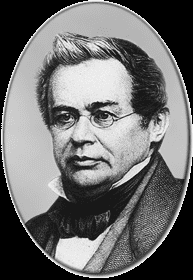
العالم هنريش لنز.
The scientist Heinrich Lenz.
لاحظ العالم هنريش لنز أنه عند تحريك سلك بحيث يقطع خطوط المجال يتولد فيه تيار مستحث، ونشأت قوة تحاول إعاقة حركة السلك.
The scientist Heinrich Lenz observed that when a wire is moved so that it cuts field lines an induced current is generated in it and a force arises that tries to hinder the wire’s motion.
📌 قانون لنز
📌 Lenz’s law
يكون اتجاه التيار المستحث بحيث يولّد مجالًا مغناطيسيًا يقاوم التغير (في التدفق أو الحركة) الذي سبّب هذا التيار.
The induced current has a direction such that it produces a magnetic field that opposes the change (of flux or of motion) that caused it.
وهو تعبير عن حفظ الطاقة: لو ساعد التيارُ التغيرَ لتضاعفت الحركة تلقائيًا ولحصلنا على طاقة من لا شيء.
It expresses conservation of energy: if the current helped the change the motion would grow by itself and we would get energy from nothing.
تجربة لنز: سلك يُسحب بقوة ثابتة
Lenz’s Experiment: A Wire Pulled by a Constant Force
🧪 ما الذي يحدث بالترتيب؟
🧪 What happens, step by step?
- نؤثر بقوة ثابتة \(F\) في السلك فيبدأ بالحركة ويقطع خطوط المجال.We apply a constant force \(F\) on the wire; it starts to move and cuts the field lines.
- يتولد فيه تيار مستحث يتحدد اتجاهه بقاعدة الكف.An induced current is generated in it, its direction given by the palm rule.
- يولّد هذا التيار قوة مغناطيسية \(F_m=BIL\) على السلك عكس القوة الثابتة.This current produces a magnetic force \(F_m=BIL\) on the wire opposite to the constant force.
- تزداد \(F_m\) بزيادة السرعة (فالتيار) حتى تتساوى مع \(F\) فتنعدم المحصلة ويتحرك السلك بسرعة ثابتة (الحدية).\(F_m\) grows with the speed (hence the current) until it equals \(F\); the net force vanishes and the wire moves at a constant (terminal) speed.
- بزوال القوة الخارجية تبقى القوة المغناطيسية فتبطئ السلك حتى يتوقف.When the external force is removed the magnetic force remains and slows the wire down until it stops.
📌 السرعة الحدية
📌 The terminal speed
عند التوازن \(F=F_m=\dfrac{B^2L^2v_T}{R}\) إذن:
At equilibrium \(F=F_m=\dfrac{B^2L^2v_T}{R}\), so:
\[v_T=\dfrac{F\,R}{B^2L^2}\]
🧪 تجربة 6: تجربة لنز: سلك يُسحب بقوة ثابتة في مجال مغناطيسي
🧪 Experiment 6: Lenz’s experiment: a rod pulled by a constant force in a magnetic field
يُسحب السلك المعدني على سكتين بقوة ثابتة \(F\) داخل مجال \(B\) (إلى داخل الصفحة). حرّك شريط الزمن لترى كيف تتولد \(\varepsilon=BLv\) والتيار \(I\) وقوة مغناطيسية \(F_m=BIL\) تعاكس الحركة فتزداد حتى تساوي \(F\) فتثبت السرعة. فعّل «أزل القوة الخارجية» لترى توقف السلك.
A metal rod is pulled along rails by a constant force \(F\) in a field \(B\) (into the page). Move the time slider to see \(\varepsilon=BLv\), the current \(I\) and a magnetic force \(F_m=BIL\) that opposes the motion and grows until it equals \(F\), so the speed becomes constant. Tick “Remove the external force” to see the rod stop.
في تجربة لنز تتوقف السرعة عن الازدياد عندما:
In Lenz’s experiment the speed stops increasing when:
سلك طوله \(0.5\ \mathrm{m}\) يُسحب على سكتين مقاومتهما \(R=2\ \Omega\) في مجال \(B=1\ \mathrm{T}\) بقوة ثابتة \(F=0.25\ \mathrm{N}\). احسب السرعة الحدية والتيار عندها.
A \(0.5\ \mathrm{m}\) wire is pulled along rails of resistance \(R=2\ \Omega\) in a field \(B=1\ \mathrm{T}\) by a constant force \(F=0.25\ \mathrm{N}\). Find the terminal speed and the current at that moment.
قاعدة لنز مع مغناطيس وملف
Lenz’s Rule with a Magnet and a Coil
عند اقتراب المغناطيس من الملف يزداد التدفق الذي يخترقه، فيتولد تيار يصنع مجالًا معاكسًا للمجال المسبب ليقلل الزيادة (يتنافر مع المغناطيس). وعند الابتعاد يقل التدفق فيتولد مجال بالاتجاه نفسه ليعوّض النقص (يتجاذب مع المغناطيس). في الحالتين القوة المستحثة تقاوم التغير في التدفق.
When the magnet approaches the coil the flux through it grows so a current produces a field opposite to the original one to reduce the increase (it repels the magnet). When the magnet moves away the flux falls so a field in the same direction appears to make up the loss (it attracts the magnet). In both cases the induced effect resists the change in flux.
🧪 تجربة 7: قاعدة لنز: مغناطيس يقترب من ملف ويبتعد
🧪 Experiment 7: Lenz’s law: a magnet approaching and leaving a coil
اسحب المغناطيس (أو اضغط «قرّب خطوة» و«أبعد خطوة») نحو الملف وبعيدًا عنه. يتغير التدفق \(\Phi\) فيتولد تيار مستحث يولّد مجالًا يقاوم هذا التغير: عند الاقتراب تنافر، وعند الابتعاد تجاذب. بدّل قطب المغناطيس لتلاحظ انعكاس اتجاه التيار.
Drag the magnet (or press “One step closer” and “One step away”) towards the coil and away from it. The flux \(\Phi\) changes so an induced current creates a field that opposes the change: repulsion on approach, attraction on leaving. Switch the magnet’s pole to see the current reverse.
عند ابتعاد القطب الشمالي لمغناطيس عن ملف فإن الوجه المقابل للمغناطيس من الملف يصبح:
When the north pole of a magnet moves away from a coil the face of the coil nearest the magnet becomes:
⚙️ المولد والمحرك وقاعدة لنز
⚙️ The generator, the motor and Lenz’s law
المولد: عند سحب تيار من المولد يمر تيار مستحث في الملف فتنشأ قوة مغناطيسية تعاكس الدوران، فنحتاج طاقة ميكانيكية كبيرة لإدارته، وهذه الطاقة هي مصدر الطاقة الكهربائية الناتجة.
The generator: when current is drawn from the generator an induced current flows in the coil and a magnetic force opposes the rotation, so large mechanical energy is needed to turn it; this energy is the source of the electrical energy produced.
المحرك: عند تشغيل محرك (كالمكيّف) يحتاج إلى تيار كبير لحظة التشغيل، لأن الملف ساكن فلا توجد قوة دافعة عكسية. وكلما زادت سرعة دوران الملف تولدت فيه قوة دافعة مستحثة عكسية (قاعدة لنز) تقاوم جهد المصدر فينخفض التيار.
The motor: when a motor (such as an air conditioner) starts it needs a large current at the first moment because the coil is at rest and there is no back-EMF. As the coil speeds up an induced back-EMF (Lenz’s law) appears which opposes the supply voltage, so the current falls.
🌀 التيارات الدوامية (تيارات فوكو)
🌀 Eddy Currents (Foucault Currents)
التيار الدوامي تيار ينشأ داخل جسم موصل (قطعة معدنية) نتيجة تغير التدفق المغناطيسي الذي يخترقه، استجابةً لقانون فاراداي: إذا تغير تدفق المجال في سلك أو ملف نشأ بين طرفيه جهد كهربائي. وفي القطعة المعدنية الصلبة تدور هذه التيارات في مسارات مغلقة (كالدوّامات).
An eddy current is a current that arises inside a conducting body (a metal piece) because of a change in the magnetic flux through it, in accordance with Faraday’s law: if the flux of a field through a wire or coil changes, a voltage appears between its ends. In a solid metal piece these currents flow along closed paths (like eddies).
وبحسب قاعدة لنز تولّد هذه التيارات مجالًا يقاوم حركة المعدن، فتُكبح الحركة وتتحول الطاقة الحركية إلى حرارة. وإذا شققنا القطعة بفتحات تقطع مسارات التيارات صغرت وقلّ الكبح والتسخين.
By Lenz’s law these currents create a field that opposes the metal’s motion so the motion is braked and the kinetic energy turns into heat. If we cut slots in the piece they break up the current paths, making them smaller and reducing the braking and the heating.
🧪 تجربة 8: التيارات الدوامية: بندول والتنهوفن
🧪 Experiment 8: Eddy currents: the Waltenhofen pendulum
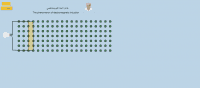
يتأرجح لوح معدني بين قطبي مغناطيس. اختر نوع اللوح وفعّل المجال، ثم اضغط «أطلق البندول» (أو حرّك شريط الزمن): في اللوح المصمت تتولد تيارات دوامية كبيرة تنتج قوة مغناطيسية فرملية فيتوقف بسرعة وتسخن اللوح؛ وفي المشقوق تقل التيارات، وفي العازل تنعدم.
A metal plate swings between the poles of a magnet. Choose the kind of plate and switch the field on, then press “Release the pendulum” (or move the time slider): in a solid plate large eddy currents form and give a magnetic braking force so it stops quickly and the plate warms; in a slotted plate the currents are weak, and in an insulator there are none.
| التطبيقApplication | الدورRole of eddy currents |
|---|---|
| الفرامل المغناطيسية (القطارات والملاهي)Magnetic brakes (trains and rides) | كبح بلا احتكاكbraking without friction |
| طباخ الحثInduction cooker | تسخين قاع الوعاء المعدني مباشرةheating the base of a metal pot directly |
| كاشف المعادنMetal detector | تولّد تيارات في القطعة فتغيّر الإشارةcurrents in the object change the signal |
| قلب المحول والمحرك (صفائح معزولة)The core of a transformer or motor (insulated sheets) | يُصنع من صفائح لتقليل التيارات والفاقد الحراريmade of sheets to reduce the currents and heat loss |
لماذا يُصنع قلب المحول من صفائح رقيقة معزولة بدل كتلة واحدة؟
Why is a transformer core made of thin insulated sheets instead of one block?
🔁 الحث الذاتي
🔁 Self-Induction
أي دائرة تحتوي على ملف، عند إغلاقها لا يصل التيار إلى قيمته العظمى فورًا: فالتيار المتزايد يغيّر التدفق في الملف نفسه فتتولد فيه قوة دافعة مستحثة تعاكس الزيادة. وعند فتح الدائرة لا يضمحل التيار فورًا لأن القوة الدافعة المستحثة تعاكس النقصان وتحاول إبقاء التيار بالاتجاه نفسه. فالحث الذاتي يؤخر نمو التيار واضمحلاله.
Any circuit that contains a coil does not reach its maximum current immediately when closed: the growing current changes the flux in the coil itself, so an induced EMF appears that opposes the increase. When the circuit is opened the current does not die away immediately because the induced EMF opposes the decrease and tries to keep the current in the same direction. Self-induction delays the growth and the decay of the current.
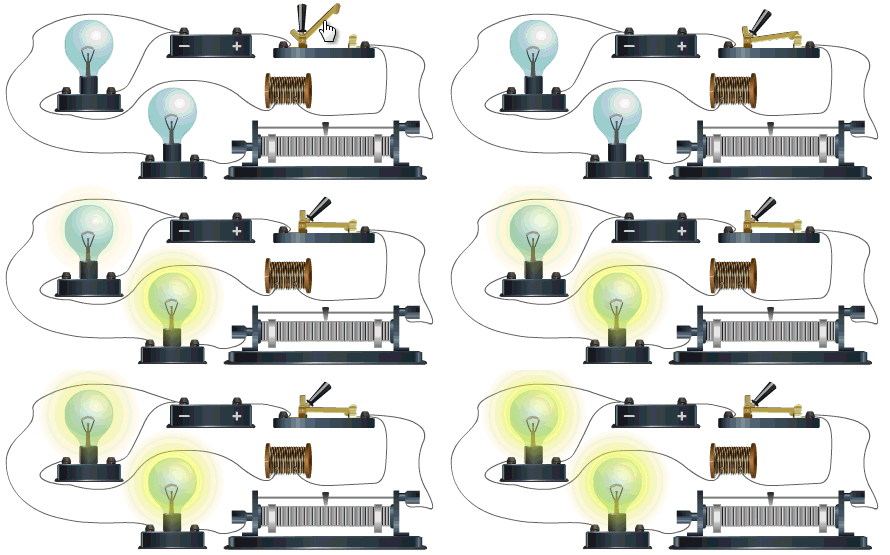
مصباحان: العلوي مع ملف والسفلي مع مقاوم؛ الملف يؤخر إضاءة مصباحه عند غلق الدائرة.
Two lamps: the upper one with a coil and the lower one with a resistor; the coil delays its lamp lighting when the circuit is closed.
📌 القوة الدافعة الذاتية والثابت الزمني
📌 The self-induced EMF and the time constant
\[\varepsilon_L=-L\dfrac{\Delta i}{\Delta t},\qquad \tau=\dfrac{L}{R},\qquad i(t)=I_0\left(1-e^{-t/\tau}\right)\]
\(L\) محاثة الملف بالهنري \((\mathrm{H})\)، والإشارة السالبة تعبّر عن قاعدة لنز. ويخزّن الملف طاقة مجال مغناطيسي \(U=\tfrac12LI^2\).
\(L\) is the inductance of the coil in henry \((\mathrm{H})\), and the minus sign expresses Lenz’s law. The coil stores magnetic field energy \(U=\tfrac12LI^2\).
🧪 تجربة 9: الحث الذاتي: دائرة حيّة بمصباحين
🧪 Experiment 9: Self-induction: a live circuit with two lamps
المصباح A موصول على التوالي مع ملف \(L\)، والمصباح B مع مقاوم، والفرعان متوازيان مع بطارية. اضغط «أغلق المفتاح» (أو انقر المفتاح في الرسم) ثم افتحه بعد ذلك، وراقب: تحرك الشحنات الزرقاء، وسطوع المصباحين، ومنحنيَي التيار والقوة الدافعة الذاتية \(\varepsilon_L=-L\,di/dt\) وهي تُرسم لحظة بلحظة.
Lamp A is in series with a coil \(L\), lamp B with a resistor, and the two branches are in parallel with a battery. Press “Close the switch” (or click the switch in the drawing) and later open it, then watch: the moving blue charges, the brightness of the two lamps, and the current and self-induced EMF \(\varepsilon_L=-L\,di/dt\) graphs drawn live.
عند غلق مفتاح دائرة تحتوي على ملف ومصباح على التوالي يضيء المصباح تدريجيًا لأن:
When the switch of a circuit with a coil and a lamp in series is closed the lamp lights up gradually because:
ملف محاثته \(L=1\ \mathrm{H}\) موصول على التوالي مع مصباح مقاومته \(R_A=10\ \Omega\). احسب الثابت الزمني عند إغلاق الدائرة.
A coil of inductance \(L=1\ \mathrm{H}\) is connected in series with a lamp of resistance \(R_A=10\ \Omega\). Find the time constant when the circuit is closed.
🔌 المحولات الكهربائية
🔌 Electric Transformers
يُستخدم المحول لرفع الجهد الكهربائي أو خفضه. يتكوّن من ملف ابتدائي متصل بمصدر تيار متردد، وملف ثانوي متصل بالجهاز، ونواة من الحديد تنقل التدفق بين الملفين. ويعتمد عمله على الحث المتبادل: يتغير التيار في الابتدائي فيتغير التدفق في الثانوي فيتولد فيه فرق جهد وتيار مستحثان. (لا يعمل المحول مع التيار المستمر لأن التدفق عندئذ لا يتغير.)
The transformer is used to step the voltage up or down. It consists of a primary coil connected to an AC source, a secondary coil connected to the device and an iron core that carries the flux between the coils. It works through mutual induction: the current in the primary changes so the flux in the secondary changes and an induced voltage and current appear in it. (A transformer does not work with DC because the flux is then not changing.)
📌 قانون المحول المثالي
📌 The ideal transformer law
\[\dfrac{V_S}{V_P}=\dfrac{N_S}{N_P}=\dfrac{I_P}{I_S},\qquad P_{in}=P_{out}\Rightarrow V_PI_P=V_SI_S\]
إذا كان \(N_S\gt N_P\) فالمحول رافع للجهد وخافض للتيار؛ وإذا كان \(N_S\lt N_P\) فهو خافض للجهد ورافع للتيار؛ وإذا تساوى عدد اللفات فهو محول عزل لا يرفع الجهد ولا يخفضه ويفصل دائرة عن أخرى حتى لا يحدث تداخل في التيارات. والقدرة لا تزداد أبدًا.
If \(N_S\gt N_P\) the transformer is step-up for voltage and step-down for current; if \(N_S\lt N_P\) it is step-down for voltage and step-up for current; if the turns are equal it is an isolation transformer that neither raises nor lowers the voltage and separates one circuit from another to avoid interference between currents. Power never increases.
| المجهولUnknown | القانونFormula |
|---|---|
| جهد الملف الثانوي \(V_S\)Secondary voltage \(V_S\) | \(V_S=\dfrac{V_P\,N_S}{N_P}\)\(V_S=\dfrac{V_P\,N_S}{N_P}\) |
| جهد الملف الابتدائي \(V_P\)Primary voltage \(V_P\) | \(V_P=\dfrac{V_S\,N_P}{N_S}\)\(V_P=\dfrac{V_S\,N_P}{N_S}\) |
| عدد لفات الثانوي \(N_S\)Secondary turns \(N_S\) | \(N_S=\dfrac{V_S\,N_P}{V_P}\)\(N_S=\dfrac{V_S\,N_P}{V_P}\) |
| عدد لفات الابتدائي \(N_P\)Primary turns \(N_P\) | \(N_P=\dfrac{V_P\,N_S}{V_S}\)\(N_P=\dfrac{V_P\,N_S}{V_S}\) |
🧪 تجربة 10: المحول الكهربائي: ارفع الجهد أو اخفضه
🧪 Experiment 10: The transformer: step the voltage up or down
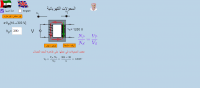
غيّر عدد لفات الملفين الابتدائي \(N_P\) والثانوي \(N_S\) وجهد المصدر والمقاومة والكفاءة. لاحظ أن \(V_S/V_P=N_S/N_P\) وأن القدرة لا تزيد: حين يرتفع الجهد ينخفض التيار. اضغط «محول عزل» لتجعل اللفات متساوية.
Change the turns of the primary \(N_P\) and secondary \(N_S\), the source voltage, the load and the efficiency. Notice that \(V_S/V_P=N_S/N_P\) and that power does not increase: when the voltage rises the current falls. Press “Isolation transformer” to make the turns equal.
محول مثالي عدد لفات ابتدائيه \(100\) وثانويه \(500\) وجهد المصدر \(24\ \mathrm{V}\) وموصول بحمل مقاومته \(100\ \Omega\). احسب جهد الثانوي وتياريه الثانوي والابتدائي.
An ideal transformer has \(100\) primary turns and \(500\) secondary turns, a source of \(24\ \mathrm{V}\) and a load of \(100\ \Omega\). Find the secondary voltage and the secondary and primary currents.
محول جهد ابتدائيه \(220\ \mathrm{V}\) وجهد ثانويه \(110\ \mathrm{V}\). النسبة \(N_P:N_S\) تساوي:
A transformer has a primary voltage of \(220\ \mathrm{V}\) and a secondary voltage of \(110\ \mathrm{V}\). The ratio \(N_P:N_S\) is:
في المحول المثالي الرافع للجهد (\(N_S\gt N_P\)):
In an ideal step-up transformer (\(N_S\gt N_P\)):
📚 ملخص الدرس
📚 Lesson Summary
| الفكرةIdea | القاعدةRule |
|---|---|
| قوة دافعة في سلك متحركEMF in a moving wire | \(\varepsilon=BLv\sin\theta,\ I=\varepsilon/R\)\(\varepsilon=BLv\sin\theta,\ I=\varepsilon/R\) |
| اتجاه التيارCurrent direction | قاعدة الكف اليمنى (الأصابع \(B\)، الإبهام \(v\)، العمود \(I\))right-hand palm rule (fingers \(B\), thumb \(v\), normal \(I\)) |
| المولدGenerator | \(\varepsilon=NBA\omega\sin\omega t\)\(\varepsilon=NBA\omega\sin\omega t\) |
| القيم الفعالةEffective values | \(I_{rms}=I_{max}/\sqrt2,\ P_{avg}=\tfrac12P_{max}\)\(I_{rms}=I_{max}/\sqrt2,\ P_{avg}=\tfrac12P_{max}\) |
| قانون لنزLenz’s law | التيار المستحث يقاوم التغير المسبب له (حفظ الطاقة)the induced current opposes the change that causes it (energy conservation) |
| السرعة الحديةTerminal speed | \(v_T=FR/(B^2L^2)\)\(v_T=FR/(B^2L^2)\) |
| الحث الذاتيSelf-induction | \(\varepsilon_L=-L\,\Delta i/\Delta t,\ \tau=L/R\)\(\varepsilon_L=-L\,\Delta i/\Delta t,\ \tau=L/R\) |
| المحول المثاليIdeal transformer | \(V_S/V_P=N_S/N_P=I_P/I_S\)\(V_S/V_P=N_S/N_P=I_P/I_S\) |
⚠️ أخطاء شائعة
⚠️ Common mistakes
- الظن أن السلك الساكن في مجال يولّد قوة دافعة؛ لا بد أن يقطع خطوط المجال (يتغير التدفق).Thinking a wire at rest in a field generates an EMF; it must cut the field lines (the flux must change).
- استعمال القيمة العظمى بدل الفعالة في حساب القدرة المتوسطة.Using the peak value instead of the effective value for the average power.
- الظن أن قاعدة لنز تعني أن التيار يعاكس المجال دائمًا؛ هي تقاوم التغير (عند الابتعاد يكون المجال المستحث بالاتجاه نفسه).Thinking Lenz’s law means the current always opposes the field; it opposes the change (when moving away the induced field is in the same direction).
- الظن أن المحول يزيد القدرة عند رفع الجهد؛ القدرة ثابتة والتيار هو الذي ينقص.Thinking a transformer raises the power when it raises the voltage; the power is constant and the current is what falls.
- محاولة تشغيل محول بتيار مستمر؛ لا يتغير التدفق فلا يتولد جهد في الثانوي.Trying to run a transformer on DC; the flux is not changing so no voltage appears in the secondary.
🧪 اختبر نفسك: امتحان من 20 سؤالاً
🧪 Test Yourself: a 20-Question Exam
أنهِ الدرس بالاختبار التفاعلي التالي؛ أسئلته تجمع بين الفهم والحساب وتغطي جميع أقسام الدرس.
Finish with the interactive exam below; its questions mix understanding with calculation and cover every section of the lesson.
اختبار التيارات المستحثة Induced Currents Quiz
20 سؤالاً - القوة الدافعة المستحثة، المولد، قانون لنز، الحث الذاتي والمحولات 20 Questions - induced EMF, the generator, Lenz’s law, self-induction and transformers
• عدد الأسئلة: 20 سؤالاً
• مدة الاختبار: 30 دقيقة
• لا يمكنك تغيير إجاباتك أو إعادة الاختبار إلا بعد 24 ساعة من التسليم.
• تأكد من إجاباتك قبل التسليم! 📌 Important Instructions:
• Number of questions: 20 questions
• Quiz duration: 30 minutes
• You cannot change your answers or retake the quiz for 24 hours after submission.
• Make sure of your answers before submitting!
🔗 محاكيات GeoGebra للاستعانة بها عند اللزوم
🔗 GeoGebra Simulations to Use When Needed
اضغط «تشغيل» لتعمل المحاكاة هنا داخل الدرس؛ ويمكن للطالب الرجوع إليها لتجربة الفكرة بطريقة أخرى.
Press “Run” to run the simulation right here inside the lesson; the student can use it to try the idea in another way.