🎯 نواتج التعلم
🎯 Learning Outcomes
بعد دراسة هذا الدرس ستكون قادرًا على أن:
After this lesson you will be able to:
- تشرح تبادل الطاقة بين المكثف والملف في دائرة الاهتزاز وتحسب تردد الاهتزاز.Explain the exchange of energy between the capacitor and the inductor in the oscillation circuit and calculate the oscillation frequency.
- تفسّر توليد الجهد المتردد \(v=V_m\sin\omega t\) في المولد.Explain the generation of the alternating voltage \(v=V_m\sin\omega t\) in the generator.
- تحلل دائرة تيار متردد فيها مقاومة أومية فقط وتكتب معادلتي الجهد والتيار.Analyse an AC circuit with only an ohmic resistor and write the voltage and current equations.
- تحلل دائرة فيها ملف حثي: \(X_L=2\pi fL\) وتأخر التيار \(90^\circ\).Analyse a circuit with an inductor: \(X_L=2\pi fL\) and the current lagging by \(90^\circ\).
- تحلل دائرة فيها مكثف: \(X_C=1/2\pi fC\) وتقدم التيار \(90^\circ\).Analyse a circuit with a capacitor: \(X_C=1/2\pi fC\) and the current leading by \(90^\circ\).
🔁 دائرة الاهتزاز: مكثف وملف حثي
🔁 The Oscillation Circuit: Capacitor and Inductor
المكثف المشحون يختزن طاقة كهربائية في مجاله الكهربائي، والملف الذي يمر فيه تيار يختزن طاقة مغناطيسية في مجاله المغناطيسي:
A charged capacitor stores electrical energy in its electric field and an inductor carrying a current stores magnetic energy in its magnetic field:
📘 الطاقتان المختزنتان
📘 The two stored energies
\[U_E=\dfrac12\dfrac{q^2}{C}\]
\[P=\Delta V_{ind}\,i=L\dfrac{di}{dt}\,i\ \Rightarrow\ U_B=\int P\,dt=\int L\,i\,di=\dfrac12L\,i^2\]
وعند وصل مكثف مشحون بملف تنشأ دائرة اهتزاز: تتحول الطاقة دوريًا من كهربائية في المكثف إلى مغناطيسية في الملف ثم تعود، فيتغير التيار والجهد جيبيًا بتردد ثابت.
When a charged capacitor is connected to an inductor an oscillation circuit arises: the energy converts periodically from electrical in the capacitor to magnetic in the inductor and back, so the current and the voltage vary sinusoidally with a fixed frequency.
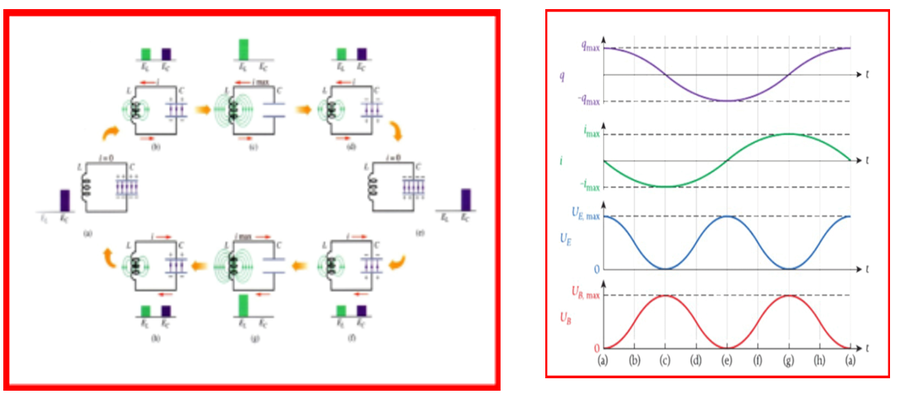
مراحل دائرة الاهتزاز (يسار) ومنحنيات الشحنة والتيار والطاقتين (يمين).
The stages of the oscillation circuit (left) and the graphs of the charge, the current and the two energies (right).
💡 شرح إضافي: مراحل الاهتزاز وتردده
💡 Extra explanation: the stages and the frequency of the oscillation
- المكثف ممتلئ: \(U_E=U_0\) و\(i=0\) (الجهد على المكثف أعظم).The capacitor is full: \(U_E=U_0\) and \(i=0\) (the voltage across the capacitor is maximum).
- يتفرغ المكثف فيزداد التيار وتنتقل الطاقة إلى الملف.The capacitor discharges so the current grows and the energy moves to the inductor.
- المكثف فارغ: \(U_E=0\) و\(U_B=U_0\) و\(i=I_{max}\).The capacitor is empty: \(U_E=0\), \(U_B=U_0\) and \(i=I_{max}\).
- يستمر التيار بفعل الملف فيشحن المكثف بالقطبية المعاكسة، وتتكرر العملية.The current continues because of the inductor and charges the capacitor with the opposite polarity, and the process repeats.
المجموع \(U_E+U_B=\dfrac{q^2}{2C}+\tfrac12Li^2\) ثابت في الدائرة المثالية (بلا مقاومة). وتردد الاهتزاز يحدده المكثف والملف فقط: \(f=\dfrac{1}{2\pi\sqrt{LC}}\) (زيادة \(L\) أو \(C\) تقلل التردد). وإذا وُجدت مقاومة تحوّلت الطاقة تدريجيًا إلى حرارة فتتناقص السعة (اهتزاز متخامد) ولا يتأثر التردد كثيرًا.
The sum \(U_E+U_B=\dfrac{q^2}{2C}+\tfrac12Li^2\) is constant in an ideal circuit (no resistance). The oscillation frequency is determined by the capacitor and the inductor only: \(f=\dfrac{1}{2\pi\sqrt{LC}}\) (increasing \(L\) or \(C\) lowers the frequency). If a resistance exists the energy is gradually converted into heat so the amplitude decreases (damped oscillation) without much change in the frequency.
🧪 تجربة 1: دائرة الاهتزاز LC وتبادل الطاقة
🧪 Experiment 1: The LC oscillation circuit and the exchange of energy
شُحن المكثف أولًا بجهد \(10\ \mathrm{V}\) ثم وُصل بالملف. تنتقل الطاقة ذهابًا وإيابًا بين المجال الكهربائي في المكثف \(U_E=\dfrac{q^2}{2C}\) والمجال المغناطيسي في الملف \(U_B=\tfrac12Li^2\)، ومجموعهما ثابت إذا كانت المقاومة صفرًا. غيّر \(L\) و\(C\) وراقب تردد الاهتزاز \(f=\dfrac{1}{2\pi\sqrt{LC}}\)، ثم أضف مقاومة \(R\) لترى تبدّد الطاقة حرارةً. (العرض مبطّأ بحيث تستغرق الدورة نحو 4 ثوانٍ.)
The capacitor is first charged to \(10\ \mathrm{V}\) and then connected to the inductor. The energy moves back and forth between the electric field in the capacitor \(U_E=\dfrac{q^2}{2C}\) and the magnetic field in the inductor \(U_B=\tfrac12Li^2\), and their sum is constant if the resistance is zero. Change \(L\) and \(C\) and watch the oscillation frequency \(f=\dfrac{1}{2\pi\sqrt{LC}}\), then add a resistance \(R\) to see the energy dissipated as heat. (The display is slowed so that one cycle takes about 4 seconds.)
دائرة اهتزاز فيها \(L=10\ \mathrm{mH}\) و\(C=100\ \mu\mathrm{F}\) شُحن مكثفها إلى \(10\ \mathrm{V}\). احسب التردد والزمن الدوري والطاقة الكلية.
An oscillation circuit has \(L=10\ \mathrm{mH}\) and \(C=100\ \mu\mathrm{F}\) and its capacitor is charged to \(10\ \mathrm{V}\). Find the frequency, the period and the total energy.
ما نوع الطاقة التي يختزنها المكثف عند شحنه؟
What type of energy does the capacitor store when charged?
عندما يكون الجهد على المكثف عند قيمته العظمى في دائرة الاهتزاز فإن التيار:
When the voltage across the capacitor is at its maximum in the oscillation circuit the current is:
عندما يكون التيار أعظم ما يمكن تتركز معظم الطاقة في:
When the current is maximum most of the energy is concentrated in:
تردد دائرة اهتزاز \(L=1\ \mathrm{mH}\) و\(C=10\ \mu\mathrm{F}\) تقريبًا:
The frequency of an oscillation circuit with \(L=1\ \mathrm{mH}\) and \(C=10\ \mu\mathrm{F}\) is about:
⚙️ توليد التيار المتردد
⚙️ Generating the Alternating Current
دوران ملف في مجال مغناطيسي منتظم يولّد فرق جهد مستحثًا (قانون فاراداي) يتغير جيبيًا بالزمن، وهذا هو مولد التيار المتردد:
Rotating a coil in a uniform magnetic field produces an induced potential difference (Faraday's law) that varies sinusoidally with time; this is the AC generator:
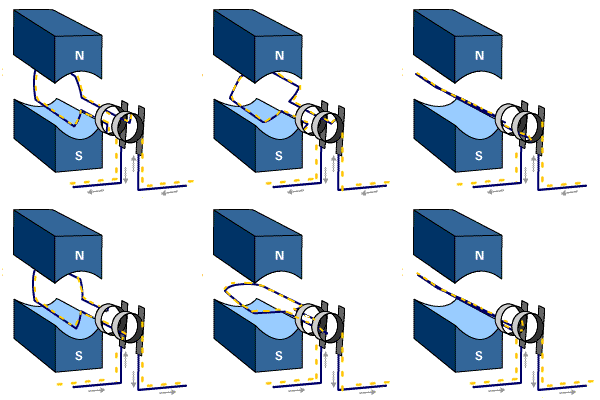
مولد التيار المتردد: ملف يدور بين قطبي مغناطيس وتلتقط الحلقتان والفرشاتان الجهد (متحرك).
The AC generator: a coil rotating between the poles of a magnet and the two rings and brushes pick up the voltage (animated).
📘 الجهد والتيار المتردد
📘 The alternating voltage and current
\[\Delta V_{emf}=N A B\omega\sin(\omega t)\ ,\qquad V_{max}=NAB\omega\ ,\qquad v=V_m\sin\omega t\]
ينتج عنه تيار مستحث يتغير قيمةً في كل لحظة واتجاهًا كل نصف دورة، ولا يشترط أن يكون متفقًا في الطور مع الجهد:
It produces an induced current whose value changes at every moment and whose direction changes every half cycle, and it is not necessarily in phase with the voltage:
\[i=I_m\sin(\omega t-\phi)\]
\(\phi\): زاوية الطور بين الجهد والتيار، و\(I_m\): أعظم قيمة للتيار وتسمى سعة التيار المتردد، و\(\omega=2\pi f\).
\(\phi\): the phase angle between the voltage and the current, \(I_m\): the maximum value of the current, called the amplitude of the alternating current, and \(\omega=2\pi f\).
💡 شرح إضافي: كيف أقرأ معادلة الجهد؟
💡 Extra explanation: how do I read the voltage equation?
من \(v=V_m\sin(\omega t)\) نقرأ مباشرة: السعة \(V_m\) والسرعة الزاوية \(\omega\) ثم التردد \(f=\omega/2\pi\) والزمن الدوري \(T=1/f\). مثلًا \(v=210\sin(60\pi t)\) فيها \(V_m=210\ \mathrm{V}\) و\(\omega=60\pi\) أي \(f=30\ \mathrm{Hz}\). وأما قيمة الجهد الفعّالة فهي \(V_{rms}=V_m/\sqrt2\) (تُقاس بها الأجهزة وتُذكر على الأدوات) وسنتوسع فيها في الجزء الثاني.
From \(v=V_m\sin(\omega t)\) we read directly: the amplitude \(V_m\) and the angular velocity \(\omega\), then the frequency \(f=\omega/2\pi\) and the period \(T=1/f\). For example \(v=210\sin(60\pi t)\) has \(V_m=210\ \mathrm{V}\) and \(\omega=60\pi\), i.e. \(f=30\ \mathrm{Hz}\). The effective value of the voltage is \(V_{rms}=V_m/\sqrt2\) (it is what meters read and what is written on appliances) and we expand on it in Part II.
معادلة الجهد \(v(t)=100\sin(314t)\). تردد التيار:
The voltage equation is \(v(t)=100\sin(314t)\). The frequency of the current is:
القيمة العظمى للجهد المتولد في ملف من \(N\) لفة مساحته \(A\) يدور بسرعة زاوية \(\omega\) في مجال \(B\):
The maximum voltage generated in a coil of \(N\) turns and area \(A\) rotating with angular velocity \(\omega\) in a field \(B\) is:
🔌 دائرة تيار متردد فيها مقاومة أومية
🔌 AC Circuit with an Ohmic Resistor
عند وصل مصدر تيار متردد بمقاومة أومية \(R\) يتغير كل من فرق الجهد والتيار في كل لحظة، ولذلك نمثلهما بمتجهين دوّارين (متجه الجهد ومتجه التيار) يدوران بالسرعة الزاوية \(\omega\) ومسقطهما على المحور الرأسي يعطي القيمة اللحظية.
When an AC source is connected to an ohmic resistor \(R\) both the potential difference and the current change at every moment, so we represent them by two rotating phasors (the voltage phasor and the current phasor) rotating with the angular velocity \(\omega\), whose projection on the vertical axis gives the instantaneous value.
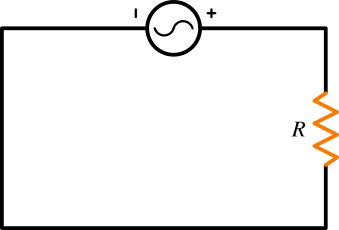
مصدر تيار متردد متصل بمقاومة \(R\).
An AC source connected to a resistor \(R\).
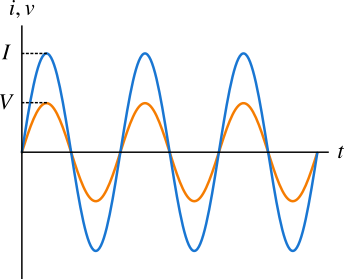
الجهد والتيار يبلغان القيمة العظمى والصفر في اللحظة نفسها (متفقان في الطور).
The voltage and the current reach the maximum and zero at the same instant (in phase).
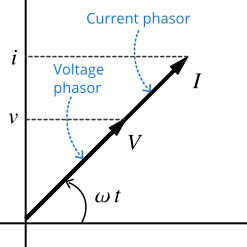
متجها الجهد والتيار منطبقان بزاوية \(\omega t\).
The voltage and current phasors coincide at the angle \(\omega t\).
📘 المقاوم في دائرة التيار المتردد
📘 The resistor in an AC circuit
\[R=\dfrac{V_{max}}{I_{max}}=\dfrac{v(t)}{i(t)}\qquad v_R=V_m\sin\omega t\qquad i=I_m\sin\omega t\qquad\phi=0\]
الجهد والتيار متفقان في الطور (\(\phi=0\)). ولا علاقة بين تغير التردد وقيمة المقاومة: \(R\) ثابتة.
The voltage and current are in phase (\(\phi=0\)). There is no relation between a change of the frequency and the value of the resistance: \(R\) is constant.
💡 شرح إضافي: «متفقان في الطور» لا تعني متساويين
💡 Extra explanation: “in phase” does not mean equal
متفقان في الطور يعني أنهما يصلان إلى القمم والأصفار معًا، لكن قيمتيهما مختلفتان (وحدة الجهد فولت ووحدة التيار أمبير). النسبة بين القيمتين اللحظيتين تساوي دائمًا \(R\) (قانون أوم يصح في كل لحظة): إذا بلغ الجهد نصف قيمته العظمى بلغ التيار نصف قيمته العظمى أيضًا.
“In phase” means they reach the peaks and the zeros together, but their values differ (the unit of the voltage is the volt and of the current the ampere). The ratio of the two instantaneous values is always \(R\) (Ohm's law holds at every instant): when the voltage is half its maximum the current is also half its maximum.
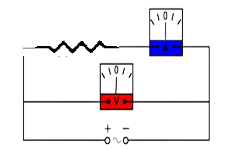
مقاوم متصل بمصدر متردد مع أمبير وفولتميتر.
A resistor connected to an AC source with an ammeter and a voltmeter.
مصدر قوة دافعة جهده \(V(t)=210\sin(60\pi t)\) وُصل بمقاوم أومي \(R=20\ \Omega\). اكتب معادلة التيار.
A source whose voltage is \(V(t)=210\sin(60\pi t)\) is connected to an ohmic resistor \(R=20\ \Omega\). Write the equation of the current.
يمر تيار \(i(t)=5\sin(120\pi t)\) في مقاومة \(10\ \Omega\). احسب الجهد على المقاومة عند \(t=1/240\ \mathrm{s}\).
A current \(i(t)=5\sin(120\pi t)\) flows in a resistor of \(10\ \Omega\). Find the voltage across the resistor at \(t=1/240\ \mathrm{s}\).
🧪 تجربة 2: دائرة تيار متردد تحتوي على مقاومة أومية
🧪 Experiment 2: AC circuit containing an ohmic resistor
يُوصل مصدر تيار متردد \(v=V_m\sin\omega t\) بمقاومة \(R\). يظهر الرسم الجهد (أحمر) والتيار (أزرق) ومتجهاتهما الدوارة: الجهد والتيار متفقان في الطور وتتحقق \(R=V_m/I_m\) دون أي علاقة بالتردد. غيّر \(V_m\) و\(f\) و\(R\) واحسب \(I_m\) وتحقق. (الأسهم والمنحنيات تتحرك بسرعة مبطّأة.)
An AC source \(v=V_m\sin\omega t\) is connected to a resistor \(R\). The drawing shows the voltage (red), the current (blue) and their rotating phasors: the voltage and the current are in phase and \(R=V_m/I_m\) holds with no dependence on the frequency. Change \(V_m\), \(f\) and \(R\) and calculate \(I_m\) and check. (The arrows and curves move at a slowed speed.)
زاوية الطور بين الجهد والتيار في دائرة تيار متردد فيها مقاومة أومية فقط:
The phase angle between the voltage and the current in an AC circuit with an ohmic resistor only is:
زيادة التردد في دائرة فيها مقاومة أومية فقط تجعل المقاومة:
Increasing the frequency in a circuit with an ohmic resistor only makes the resistance:
\(v(t)=150\sin(377t+30^\circ)\) على مقاومة \(15\ \Omega\). معادلة التيار:
\(v(t)=150\sin(377t+30^\circ)\) across a resistor of \(15\ \Omega\). The current equation is:
🌀 دائرة تيار متردد فيها ملف حثي (مقاومته مهملة)
🌀 AC Circuit with an Inductor (Negligible Resistance)
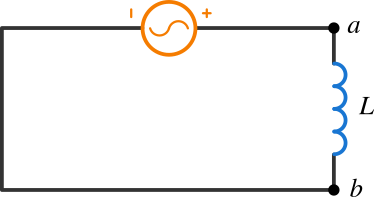
مصدر تيار متردد متصل بملف حثي \(L\).
An AC source connected to an inductor \(L\).
📘 المفاعلة الحثية
📘 The inductive reactance
\[X_L=\dfrac{V_{max}}{I_{max}}=2\pi f\,L=\omega L\]
وحدتها الأوم. وهي تتناسب طرديًا مع التردد (\(X_L\propto f\) ميل الخط البياني \(2\pi L\)): كلما ارتفع التردد زادت إعاقة الملف للتيار.
Its unit is the ohm. It is directly proportional to the frequency (\(X_L\propto f\), slope of the graph \(2\pi L\)): the higher the frequency the more the inductor opposes the current.
📘 اشتقاق معادلة التيار
📘 Deriving the current equation
\[v=L\dfrac{di}{dt}=V_m\sin\omega t\ \Rightarrow\ i=\int\dfrac{V_m}{L}\sin\omega t\,dt=-\dfrac{V_m}{\omega L}\cos\omega t=-I_m\cos\omega t\]
\[-\cos\omega t=\sin\!\left(\omega t-\dfrac\pi2\right)\ \Rightarrow\ i=I_m\sin\!\left(\omega t-\dfrac\pi2\right)\qquad I_m=\dfrac{V_m}{X_L}\]
إذن التيار يتأخر عن الجهد بمقدار \(90^\circ\) (الجهد يسبق التيار).
So the current lags the voltage by \(90^\circ\) (the voltage leads the current).
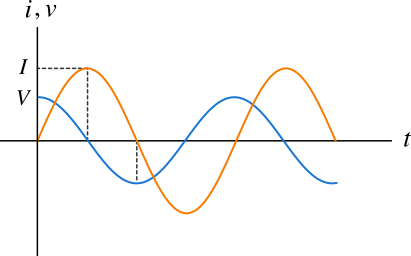
التيار (البرتقالي) يصل إلى قمته بعد الجهد (الأزرق) بربع دورة.
The current (orange) reaches its peak a quarter of a cycle after the voltage (blue).
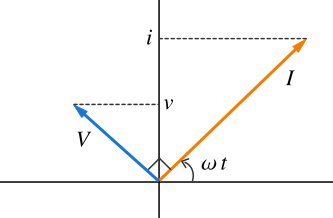
متجه التيار \(I\) يتأخر عن متجه الجهد \(V\) بزاوية \(90^\circ\).
The current phasor \(I\) lags the voltage phasor \(V\) by \(90^\circ\).
💡 شرح إضافي: لماذا يتأخر التيار في الملف؟
💡 Extra explanation: why does the current lag in an inductor?
الملف يقاوم تغير التيار بقوة دافعة مستحثة \(L\,di/dt\) (قانون لنز). فالجهد المطبق يجب أن يكون أكبر ما يمكن حين يكون معدل تغير التيار أكبر ما يمكن (عند مرور التيار بالصفر)، وأن يساوي صفرًا حين يبلغ التيار قمته (ميله صفر). لذلك يسبق الجهد التيار بربع دورة. وللتذكر: في الملف الجهد يسبق التيار، وفي المكثف التيار يسبق الجهد (الكلمتان «L» ثم «C»).
The inductor opposes a change of the current with an induced emf \(L\,di/dt\) (Lenz's law). So the applied voltage must be maximum when the rate of change of the current is maximum (when the current passes through zero) and zero when the current is at its peak (zero slope). Hence the voltage leads the current by a quarter of a cycle. To remember: in the inductor the voltage leads the current, in the capacitor the current leads the voltage.
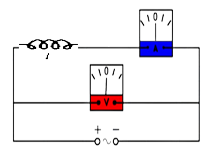
ملف حثي متصل بمصدر متردد مع أمبير وفولتميتر.
An inductor connected to an AC source with an ammeter and a voltmeter.
مصدر جهده \(V(t)=210\sin(60\pi t)\) وُصل بملف محاثته \(L=0.2\ \mathrm{H}\). اكتب معادلة التيار.
A source of voltage \(V(t)=210\sin(60\pi t)\) is connected to an inductor of inductance \(L=0.2\ \mathrm{H}\). Write the equation of the current.
🧪 تجربة 3: دائرة تيار متردد تحتوي على ملف حثي
🧪 Experiment 3: AC circuit containing an inductor
يُوصل المصدر بملف محاثته \(L\) (مقاومته مهملة). المفاعلة الحثية \(X_L=2\pi fL\) تزداد بزيادة التردد. التيار يتأخر عن الجهد بزاوية \(90^\circ\) أي إن الجهد يسبق التيار: \(i=I_m\sin(\omega t-\pi/2)\). غيّر المتغيرات وراقب أن المتجه الأزرق (التيار) يتبع الأحمر بزاوية قائمة، ثم احسب \(I_m=V_m/X_L\) وتحقق.
The source is connected to an inductor of inductance \(L\) (its resistance is negligible). The inductive reactance \(X_L=2\pi fL\) increases with the frequency. The current lags the voltage by \(90^\circ\), i.e. the voltage leads the current: \(i=I_m\sin(\omega t-\pi/2)\). Change the variables and notice that the blue arrow (the current) follows the red one at a right angle, then calculate \(I_m=V_m/X_L\) and check.
في دائرة فيها ملف حثي نقي:
In a circuit with a pure inductor:
المفاعلة الحثية لملف \(L=0.5\ \mathrm{H}\) عند التردد \(50\ \mathrm{Hz}\):
The inductive reactance of a coil \(L=0.5\ \mathrm{H}\) at \(50\ \mathrm{Hz}\) is:
🔋 دائرة تيار متردد فيها مكثف
🔋 AC Circuit with a Capacitor
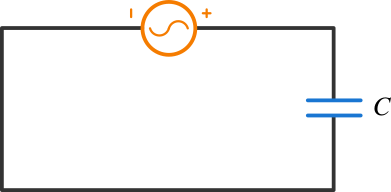
مصدر تيار متردد متصل بمكثف \(C\).
An AC source connected to a capacitor \(C\).
📘 المفاعلة السعوية
📘 The capacitive reactance
\[X_C=\dfrac{V_{max}}{I_{max}}=\dfrac{1}{2\pi f\,C}=\dfrac{1}{\omega C}\]
تتناسب عكسيًا مع التردد (\(X_C\propto1/f\)، وحاصل الضرب \(X_Cf=\dfrac{1}{2\pi C}\) ثابت): كلما ارتفع التردد قلّت إعاقة المكثف للتيار.
It is inversely proportional to the frequency (\(X_C\propto1/f\), and the product \(X_Cf=\dfrac{1}{2\pi C}\) is constant): the higher the frequency the less the capacitor opposes the current.
📘 اشتقاق معادلة التيار
📘 Deriving the current equation
\[q=Cv=CV_m\sin\omega t\ \Rightarrow\ i=\dfrac{dq}{dt}=\omega CV_m\cos\omega t=I_m\cos\omega t\]
\[\cos\omega t=\sin\!\left(\omega t+\dfrac\pi2\right)\ \Rightarrow\ i=I_m\sin\!\left(\omega t+\dfrac\pi2\right)\qquad I_m=\dfrac{V_m}{X_C}\]
إذن التيار يسبق الجهد بمقدار \(90^\circ\).
So the current leads the voltage by \(90^\circ\).
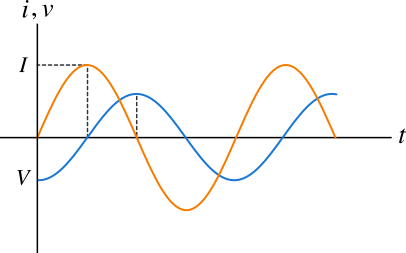
التيار (البرتقالي) يسبق الجهد (الأزرق) بربع دورة.
The current (orange) leads the voltage (blue) by a quarter of a cycle.
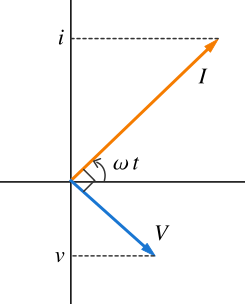
متجه التيار \(I\) يسبق متجه الجهد \(V\) بزاوية \(90^\circ\).
The current phasor \(I\) leads the voltage phasor \(V\) by \(90^\circ\).
💡 شرح إضافي: لماذا يسبق التيار الجهد في المكثف؟
💡 Extra explanation: why does the current lead in a capacitor?
الجهد على المكثف \(v=q/C\) يتناسب مع الشحنة، والتيار هو معدل تغير الشحنة \(i=dq/dt\). فالتيار أكبر ما يمكن حين تتغير الشحنة أسرع ما يمكن (عند مرور الجهد بالصفر) ويساوي صفرًا حين يبلغ الجهد قمته (المكثف ممتلئ). ولذلك يصل التيار إلى قمته قبل الجهد بربع دورة. وكلما زاد التردد أو السعة زاد التيار لنفس \(V_m\).
The voltage across the capacitor \(v=q/C\) is proportional to the charge, and the current is the rate of change of the charge \(i=dq/dt\). So the current is maximum when the charge changes fastest (when the voltage passes through zero) and it is zero when the voltage is at its peak (the capacitor is full). Therefore the current reaches its peak a quarter of a cycle before the voltage. The higher the frequency or the capacitance the larger the current for the same \(V_m\).
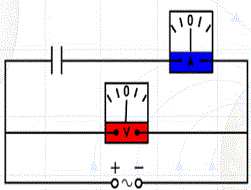
مكثف متصل بمصدر متردد مع أمبير وفولتميتر.
A capacitor connected to an AC source with an ammeter and a voltmeter.
مكثف سعته \(C=40\ \mu\mathrm{F}\) وُصل بمصدر جهده \(V_c=210\sin(60\pi t)\). اكتب معادلة التيار.
A capacitor of capacitance \(C=40\ \mu\mathrm{F}\) is connected to a source of voltage \(V_c=210\sin(60\pi t)\). Write the equation of the current.
مكثف \(C=100\ \mu\mathrm{F}\) وُصل بمصدر \(V_m=100\ \mathrm{V}\). احسب \(X_C\) و\(I_m\) عند \(50\ \mathrm{Hz}\) ثم عند \(100\ \mathrm{Hz}\).
A capacitor \(C=100\ \mu\mathrm{F}\) is connected to a source of \(V_m=100\ \mathrm{V}\). Find \(X_C\) and \(I_m\) at \(50\ \mathrm{Hz}\) and then at \(100\ \mathrm{Hz}\).
🧪 تجربة 4: دائرة تيار متردد تحتوي على مكثف
🧪 Experiment 4: AC circuit containing a capacitor
يُوصل المصدر بمكثف سعته \(C\). المفاعلة السعوية \(X_C=\dfrac{1}{2\pi fC}\) تقل بزيادة التردد. التيار يسبق الجهد بزاوية \(90^\circ\): \(i=I_m\sin(\omega t+\pi/2)\). غيّر المتغيرات وراقب أن المتجه الأزرق (التيار) يتقدم على الأحمر بزاوية قائمة، ثم احسب \(I_m=V_m/X_C\) وتحقق.
The source is connected to a capacitor of capacitance \(C\). The capacitive reactance \(X_C=\dfrac{1}{2\pi fC}\) decreases with the frequency. The current leads the voltage by \(90^\circ\): \(i=I_m\sin(\omega t+\pi/2)\). Change the variables and notice that the blue arrow (the current) is ahead of the red one by a right angle, then calculate \(I_m=V_m/X_C\) and check.
في دائرة فيها مكثف نقي:
In a circuit with a pure capacitor:
إذا تضاعف التردد فإن المفاعلة السعوية \(X_C\):
If the frequency doubles the capacitive reactance \(X_C\):
📚 ملخص الدرس
📚 Lesson Summary
| العنصرElement | الممانعةOpposition | فرق الطورPhase | معادلة التيار (\(v=V_m\sin\omega t\))Current equation (\(v=V_m\sin\omega t\)) | اعتماد على الترددFrequency dependence |
|---|---|---|---|---|
| مقاومResistor | \(R=V_m/I_m\)\(R=V_m/I_m\) | 00 | \(i=I_m\sin\omega t\)\(i=I_m\sin\omega t\) | لا يعتمدnone |
| ملفInductor | \(X_L=2\pi fL\)\(X_L=2\pi fL\) | التيار يتأخر 90°current lags 90° | \(i=I_m\sin(\omega t-\pi/2)\)\(i=I_m\sin(\omega t-\pi/2)\) | طرديdirect |
| مكثفCapacitor | \(X_C=1/2\pi fC\)\(X_C=1/2\pi fC\) | التيار يسبق 90°current leads 90° | \(i=I_m\sin(\omega t+\pi/2)\)\(i=I_m\sin(\omega t+\pi/2)\) | عكسيinverse |
⚠️ أخطاء شائعة
⚠️ Common mistakes
- الخلط بين «التيار يتأخر» و«الجهد يتأخر»؛ في الملف التيار هو المتأخر، وفي المكثف التيار هو المتقدم.Confusing “the current lags” with “the voltage lags”; in the inductor the current lags, in the capacitor the current leads.
- نسيان تحويل \(\mu\mathrm{F}\) إلى فاراد و\(\mathrm{mH}\) إلى هنري، أو استعمال \(f\) بدل \(\omega=2\pi f\).Forgetting to convert \(\mu\mathrm{F}\) to farads and \(\mathrm{mH}\) to henries, or using \(f\) instead of \(\omega=2\pi f\).
- الظن أن المفاعلتين مقاومتان تبددان طاقة؛ هما تخزنان الطاقة وتعيدانها (لا تبدد قدرة في الملف والمكثف النقيين).Thinking the reactances are resistors that dissipate energy; they store and return the energy (no power is dissipated in a pure inductor or capacitor).
- قراءة \(\omega\) من معادلة الجهد على أنها التردد \(f\) (يجب القسمة على \(2\pi\)).Reading \(\omega\) from the voltage equation as the frequency \(f\) (one must divide by \(2\pi\)).
🧪 اختبر نفسك: امتحان من 20 سؤالاً
🧪 Test Yourself: a 20-Question Exam
أنهِ الدرس بالاختبار التفاعلي التالي؛ أسئلته تجمع بين الفهم والحساب وتغطي جميع أقسام الدرس.
Finish with the interactive exam below; its questions mix understanding with calculation and cover every section of the lesson.
اختبار التيار المتردد الجزء الأول (12A) Alternating Current Part I (12A) Quiz
20 سؤالاً - التيار المتردد الجزء الأول (12A) وطرق انتقال الحرارة 20 Questions - the Oscillation Circuit, the Resistor, the Inductor and the Capacitor
• عدد الأسئلة: 20 سؤالاً
• مدة الاختبار: 30 دقيقة
• لا يمكنك تغيير إجاباتك أو إعادة الاختبار إلا بعد 24 ساعة من التسليم.
• تأكد من إجاباتك قبل التسليم! 📌 Important Instructions:
• Number of questions: 20 questions
• Quiz duration: 30 minutes
• You cannot change your answers or retake the quiz for 24 hours after submission.
• Make sure of your answers before submitting!
🔗 محاكيات GeoGebra للاستعانة بها عند اللزوم
🔗 GeoGebra Simulations to Use When Needed
اضغط «تشغيل» لتعمل المحاكاة هنا داخل الدرس؛ ويمكن للطالب الرجوع إليها لتجربة الفكرة بطريقة أخرى.
Press “Run” to run the simulation right here inside the lesson; the student can use it to try the idea in another way.