🎯 نواتج التعلم
🎯 Learning Outcomes
بعد دراسة هذا الدرس ستكون قادرًا على أن:
After this lesson you will be able to:
- تعرّف التصادم وتفرّق بين المرن واللامرن واللامرن تمامًا.Define a collision and distinguish elastic, inelastic and perfectly inelastic collisions.
- تطبّق حفظ كمية الحركة \(\sum m\vec v_i=\sum m\vec v_f\) في أي تصادم في بعد واحد.Apply conservation of momentum \(\sum m\vec v_i=\sum m\vec v_f\) in any one-dimensional collision.
- تحسب السرعتين بعد التصادم المرن وتستعمل الحالات الخاصة.Calculate the two velocities after an elastic collision and use the special cases.
- تحسب السرعة المشتركة والطاقة الحركية الضائعة عند الالتحام.Calculate the common velocity and the lost kinetic energy when the bodies stick.
- تحلّل بيانات تصادم لتحديد نوعه أو اكتشاف أنه مستحيل.Analyse collision data to find its kind or to find that it is impossible.
💥 ما التصادم؟
💥 What is a Collision?
التصادم تفاعل قصير الزمن بين جسمين تتبادل فيهما قوتان كبيرتان متساويتان ومتعاكستان (نيوتن الثالث). ونقول إن التصادم في بعد واحد إذا كانت حركة الجسمين قبل التصادم وبعده على خط مستقيم واحد؛ فنختار اتجاهًا موجبًا (يمينًا مثلًا) ونعطي إشارة سالبة لكل سرعة في الاتجاه المعاكس.
A collision is a short interaction between two bodies in which they exchange two large, equal and opposite forces (Newton’s third law). A collision is in one dimension if the motion of the two bodies before and after it is along one straight line; we choose a positive direction (to the right, for example) and give a negative sign to every velocity in the opposite direction.
📌 قانون حفظ كمية الحركة
📌 The law of conservation of momentum
في نظام معزول (محصلة القوى الخارجية صفر) تكون كمية الحركة الكلية قبل التصادم مساوية لها بعده في كل أنواع التصادم:
In an isolated system (zero net external force) the total momentum before the collision equals that after it in all kinds of collision:
\[\vec P_{i1}+\vec P_{i2}=\vec P_{f1}+\vec P_{f2}\;\Longleftrightarrow\;m_1\vec v_{i1}+m_2\vec v_{i2}=m_1\vec v_{f1}+m_2\vec v_{f2}\]
والذي يختلف من نوع لآخر هو مصير الطاقة الحركية: فهل تبقى محفوظة (مرن) أم يتحول جزء منها إلى حرارة وصوت وتشوّه (لا مرن)؟
What differs from one kind to another is the fate of the kinetic energy: does it stay conserved (elastic) or does part of it turn into heat, sound and deformation (inelastic)?
🏓 ١. التصادم المرن
🏓 1. The Elastic Collision
التصادم المرن هو الذي تكون فيه الطاقة الحركية الكلية بعد التصادم مساوية لها قبله؛ إذ لا يتحول أي جزء منها إلى نوع آخر. وخلال التصادم تتحول الطاقة الحركية أولًا إلى طاقة وضع (انضغاط) مصحوبة بقوة تنافر، ثم تعود فتتحول إلى طاقة حركية تتوزع على الجسمين بحسب كتلتيهما.
An elastic collision is one in which the total kinetic energy after the collision equals that before it; no part of it turns into another kind. During the collision the kinetic energy first turns into potential energy (compression) with a repulsive force, then turns back into kinetic energy shared between the two bodies according to their masses.
ملاحظة
Note
في العالم الواقعي يضيع جزء من الطاقة الحركية في معظم التصادمات (حرارة وصوت) فلا يوجد تصادم مرن تمامًا، لكن بعض الأنظمة تفقد قليلًا جدًا فيصحّ تقريبها بتصادم مرن، كاصطدام كرات البلياردو أو كرات البندول، وتصادم جزيئات الغاز المثالي.
In the real world part of the kinetic energy is lost in most collisions (heat and sound), so no collision is perfectly elastic; but some systems lose very little so they can be approximated as elastic, such as billiard balls or pendulum balls and the collisions of ideal gas molecules.
📌 شرطا التصادم المرن
📌 The two conditions of an elastic collision
\[m_1v_{i1}+m_2v_{i2}=m_1v_{f1}+m_2v_{f2}\]
\[\tfrac12m_1v_{i1}^2+\tfrac12m_2v_{i2}^2=\tfrac12m_1v_{f1}^2+\tfrac12m_2v_{f2}^2\]
بحل المعادلتين معًا نحصل على السرعتين بعد التصادم، ونتيجة مفيدة هي أن سرعة الاقتراب = سرعة الابتعاد: \(v_{i1}-v_{i2}=-(v_{f1}-v_{f2})\).
Solving the two equations together gives the velocities after the collision, and a useful result is that the speed of approach = the speed of separation: \(v_{i1}-v_{i2}=-(v_{f1}-v_{f2})\).
📌 السرعتان بعد التصادم المرن
📌 The velocities after an elastic collision
\[v_{f1}=\dfrac{m_1-m_2}{m_1+m_2}\,v_{i1}+\dfrac{2m_2}{m_1+m_2}\,v_{i2}\]
\[v_{f2}=\dfrac{2m_1}{m_1+m_2}\,v_{i1}+\dfrac{m_2-m_1}{m_1+m_2}\,v_{i2}\]
| الحالة الخاصةSpecial case | النتيجةResult |
|---|---|
| كتلتان متساويتان \(m_1=m_2\)Equal masses \(m_1=m_2\) | يتبادلان السرعتين: \(v_{f1}=v_{i2}\) و\(v_{f2}=v_{i1}\)they exchange velocities: \(v_{f1}=v_{i2}\) and \(v_{f2}=v_{i1}\) |
| الجسم الثاني ساكن \(v_{i2}=0\)The second body at rest \(v_{i2}=0\) | \(v_{f1}=\dfrac{m_1-m_2}{m_1+m_2}v_{i1}\) و\(v_{f2}=\dfrac{2m_1}{m_1+m_2}v_{i1}\)\(v_{f1}=\dfrac{m_1-m_2}{m_1+m_2}v_{i1}\) and \(v_{f2}=\dfrac{2m_1}{m_1+m_2}v_{i1}\) |
| متساويتان والثاني ساكنEqual masses and the second at rest | يتوقف الأول ويتحرك الثاني بسرعة الأول: \(v_{f1}=0\) و\(v_{f2}=v_{i1}\) (كرتا بلياردو)the first stops and the second moves with the speed of the first: \(v_{f1}=0\) and \(v_{f2}=v_{i1}\) (billiard balls) |
| مقذوف خفيف يصطدم بهدف ثقيل ساكن \(m_1\ll m_2\)A light projectile hits a heavy target at rest \(m_1\ll m_2\) | يرتد المقذوف بسرعته تقريبًا (\(v_{f1}\approx-v_{i1}\)) ويبقى الهدف ساكنًا تقريبًاthe projectile bounces back with about its speed (\(v_{f1}\approx-v_{i1}\)) and the target stays almost at rest |
| مقذوف ثقيل يصطدم بهدف خفيف ساكن \(m_1\gg m_2\)A heavy projectile hits a light target at rest \(m_1\gg m_2\) | يستمر المقذوف تقريبًا بسرعته ويندفع الهدف بسرعة تقارب \(2v_{i1}\)the projectile continues with about its speed and the target shoots off with about \(2v_{i1}\) |
جسمان: \(m_1=1\ \mathrm{kg}\) بسرعة \(+10\ \mathrm{m/s}\) و\(m_2=2\ \mathrm{kg}\) بسرعة \(-10\ \mathrm{m/s}\) يتصادمان تصادمًا مرنًا. احسب سرعتيهما بعد التصادم وتحقق من حفظ كمية الحركة والطاقة.
Two bodies: \(m_1=1\ \mathrm{kg}\) at \(+10\ \mathrm{m/s}\) and \(m_2=2\ \mathrm{kg}\) at \(-10\ \mathrm{m/s}\) collide elastically. Find their velocities after the collision and verify the conservation of momentum and energy.
على منضدة هوائية ينزلق راكب كتلته \(0.6\ \mathrm{kg}\) نحو اليسار بسرعة \(10\ \mathrm{m/s}\) وآخر كتلته \(0.4\ \mathrm{kg}\) نحو اليمين بسرعة \(20\ \mathrm{m/s}\). يتصادمان بمرونة. احسب سرعة كل منهما بعد التصادم.
On an air table a glider of mass \(0.6\ \mathrm{kg}\) slides to the left at \(10\ \mathrm{m/s}\) and another of mass \(0.4\ \mathrm{kg}\) to the right at \(20\ \mathrm{m/s}\). They collide elastically. Find the velocity of each after the collision.
كرة كتلتها \(2\ \mathrm{kg}\) بسرعة \(6\ \mathrm{m/s}\) تصطدم مرنًا بكرة مماثلة ساكنة. سرعة الأولى بعد التصادم:
A \(2\ \mathrm{kg}\) ball at \(6\ \mathrm{m/s}\) collides elastically with an identical ball at rest. The velocity of the first after the collision:
🧱 ٢. التصادم اللامرن
🧱 2. The Inelastic Collision
التصادم اللامرن هو الذي لا تُحفظ فيه الطاقة الحركية: يتحول جزء منها إلى حرارة وصوت وتشوّه في الجسمين، لكن كمية الحركة الكلية تبقى محفوظة. ولا تكفي معادلة حفظ كمية الحركة وحدها لإيجاد السرعتين المجهولتين؛ لذلك نحتاج إلى معطى آخر مثل معامل الارتداد \(e\) أو إحدى السرعتين بعد التصادم.
An inelastic collision is one in which the kinetic energy is not conserved: part of it turns into heat, sound and deformation of the two bodies, but the total momentum remains conserved. The momentum equation alone cannot give the two unknown velocities; so we need another datum such as the coefficient of restitution \(e\) or one of the velocities after the collision.
📌 التصادم اللامرن
📌 The inelastic collision
\[K_{i1}+K_{i2}\gt K_{f1}+K_{f2}\]
\[m_1v_{i1}+m_2v_{i2}=m_1v_{f1}+m_2v_{f2}\]
\[e=\dfrac{v_{f2}-v_{f1}}{v_{i1}-v_{i2}}\quad(0\le e\le1)\]
ويقيس معامل الارتداد \(e\) مدى مرونة التصادم: \(e=1\) مرن، و\(e=0\) لا مرن تمامًا، وما بينهما لا مرن. ومن أمثلته تصادم السيارات (يتشوّه الهيكل) وارتطام كرة من الطين بالأرض.
The coefficient of restitution \(e\) measures how elastic the collision is: \(e=1\) is elastic, \(e=0\) is perfectly inelastic and in between it is inelastic. Examples are car collisions (the body deforms) and a ball of clay hitting the ground.
جسم \(2\ \mathrm{kg}\) بسرعة \(+6\ \mathrm{m/s}\) يتصادم بجسم \(1\ \mathrm{kg}\) ساكن فصارت سرعة الأول بعد التصادم \(+2\ \mathrm{m/s}\). أوجد سرعة الثاني والطاقة الضائعة.
A \(2\ \mathrm{kg}\) body at \(+6\ \mathrm{m/s}\) hits a \(1\ \mathrm{kg}\) body at rest and the velocity of the first becomes \(+2\ \mathrm{m/s}\). Find the velocity of the second and the lost energy.
🔗 ٣. التصادم اللامرن تمامًا
🔗 3. The Perfectly Inelastic Collision
التصادم اللامرن تمامًا حالة خاصة يلتحم فيها الجسمان ويتحركان بعد التصادم بسرعة واحدة مشتركة كجسم واحد. تُحفظ كمية الحركة، ويكون فقد الطاقة الحركية أكبر ما يمكن (يتبدد بالتشوّه والحرارة).
A perfectly inelastic collision is a special case in which the two bodies stick together and move after the collision with one common velocity as a single body. Momentum is conserved and the loss of kinetic energy is the greatest possible (dissipated as deformation and heat).
📌 التصادم اللامرن تمامًا
📌 The perfectly inelastic collision
\[m_1v_{i1}+m_2v_{i2}=(m_1+m_2)\,v_f\quad\Rightarrow\quad v_f=\dfrac{m_1v_{i1}+m_2v_{i2}}{m_1+m_2}\]
\[\Delta K=K_i-K_f=\tfrac12\,\dfrac{m_1m_2}{m_1+m_2}\,(v_{i1}-v_{i2})^2\]
جسمان كتلة كل منهما \(1\ \mathrm{kg}\): الأول بسرعة \(+10\ \mathrm{m/s}\) والثاني بسرعة \(-30\ \mathrm{m/s}\). يتصادمان ويلتحمان. أوجد السرعة المشتركة والطاقة الحركية الضائعة.
Two bodies of mass \(1\ \mathrm{kg}\) each: the first at \(+10\ \mathrm{m/s}\) and the second at \(-30\ \mathrm{m/s}\). They collide and stick together. Find the common velocity and the lost kinetic energy.
رصاصة كتلتها \(0.01\ \mathrm{kg}\) بسرعة \(400\ \mathrm{m/s}\) تخترق كتلة خشب ساكنة كتلتها \(0.99\ \mathrm{kg}\) على سطح أملس وتبقى فيها. احسب سرعة المجموعة.
A bullet of mass \(0.01\ \mathrm{kg}\) at \(400\ \mathrm{m/s}\) enters a block of wood of mass \(0.99\ \mathrm{kg}\) at rest on a smooth surface and stays in it. Find the velocity of the system.
📊 جدول المقارنة
📊 The Comparison Table
| المعيارCriterion | التصادم المرنElastic | التصادم اللامرنInelastic | اللامرن تمامًاPerfectly inelastic |
|---|---|---|---|
| حفظ كمية الحركةConservation of momentum | ✔️✔️ | ✔️✔️ | ✔️✔️ |
| حفظ الطاقة الحركيةConservation of kinetic energy | ✔️✔️ | ❌❌ | ❌❌ |
| معامل الارتداد \(e\)Coefficient \(e\) | \(1\)\(1\) | \(0\lt e\lt 1\)\(0\lt e\lt 1\) | \(0\)\(0\) |
| السرعة النهائيةFinal velocities | مختلفةdifferent | مختلفةdifferent | متساوية (يلتحمان)equal (they stick) |
| أمثلةExamples | كرات البلياردوbilliard balls | اصطدام سيارةa car crash | رصاصة في خشبa bullet in wood |
🧪 جرّب بنفسك: التصادم في بعد واحد
🧪 Try It Yourself: a One-Dimensional Collision
🧪 تجربة 1: تصادم في بعد واحد: كمية الحركة والطاقة
🧪 Experiment 1: A One-Dimensional Collision: Momentum and Energy
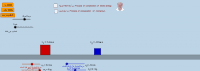
اختر كتلتي الجسمين وسرعتيهما (الإشارة هي الاتجاه) ومعامل الارتداد \(e\): \(e=1\) تصادم مرن و\(e=0\) لا مرن تمامًا (يلتحمان). اضغط «شغّل التصادم» أو حرّك شريط الزمن بنفسك، وقارن أعمدة كمية الحركة والطاقة الحركية قبل التصادم وبعده.
Choose the masses and the velocities of the two bodies (the sign is the direction) and the coefficient of restitution \(e\): \(e=1\) is elastic and \(e=0\) is perfectly inelastic (they stick). Press “Run the collision” or move the time bar yourself, and compare the bars of momentum and kinetic energy before and after.
🔍 حلّل التصادم
🔍 Analyse the Collision
في تحليل أي تصادم نسأل بالترتيب: هل كمية الحركة محفوظة؟ إن لم تُحفظ فالقيم مستحيلة لنظام معزول. ثم هل الطاقة الحركية محفوظة (مرن) أم قلّت (لا مرن) أم ازدادت (مستحيلة في تصادم).
To analyse any collision we ask in order: is momentum conserved? If not, the values are impossible for an isolated system. Then is the kinetic energy conserved (elastic), decreased (inelastic) or increased (impossible in a collision).
🧪 تجربة 2: حلّل التصادم: ما نوعه؟
🧪 Experiment 2: Analyse the Collision: What Kind Is It?
أدخل كتلتي الجسمين وسرعتيهما قبل التصادم وبعده (الإشارة هي الاتجاه) ثم اضغط «حلّل التصادم»: تُحسب كمية الحركة والطاقة الحركية قبل وبعد ويُحدَّد هل التصادم مرن أم لا مرن أم لا مرن تمامًا أم مستحيل.
Enter the masses and the velocities of the two bodies before and after the collision (the sign is the direction) then press “Analyse the collision”: the momentum and the kinetic energy before and after are calculated and the collision is decided to be elastic, inelastic, perfectly inelastic or impossible.
جسمان كتلتاهما \(2\) و\(3\ \mathrm{kg}\) بسرعتين \(+3\) و\(-2\ \mathrm{m/s}\) وبعد التصادم \(-3.6\) و\(+1.6\ \mathrm{m/s}\). ما الحكم؟
Two bodies of masses \(2\) and \(3\ \mathrm{kg}\) with velocities \(+3\) and \(-2\ \mathrm{m/s}\) and after the collision \(-3.6\) and \(+1.6\ \mathrm{m/s}\). What is the verdict?
🔫 تطبيق: البندول البالستي
🔫 Application: the Ballistic Pendulum
نقيس بالبندول البالستي سرعة رصاصة لا تُقاس مباشرة: تستقر الرصاصة في كتلة معلّقة (تصادم لا مرن تمامًا) فنحفظ كمية الحركة في الاصطدام \(mv=(M+m)V\)، ثم تصعد المجموعة وتُحفظ الطاقة الميكانيكية \(\tfrac12(M+m)V^2=(M+m)gh\). فإذا قسنا \(h\) وجدنا \(v\).
With the ballistic pendulum we measure the speed of a bullet that cannot be measured directly: the bullet lodges in a hanging mass (a perfectly inelastic collision) so we conserve the momentum in the impact \(mv=(M+m)V\), then the system rises and the mechanical energy is conserved \(\tfrac12(M+m)V^2=(M+m)gh\). So if we measure \(h\) we find \(v\).
📌 البندول البالستي
📌 The ballistic pendulum
\[v=\dfrac{M+m}{m}\sqrt{2gh}\]
🧪 تجربة 3: البندول البالستي: قياس سرعة رصاصة
🧪 Experiment 3: The Ballistic Pendulum: Measuring the Speed of a Bullet
تصطدم رصاصة كتلتها \(m\) بسرعة \(v\) بكتلة معلّقة \(M\) وتستقر فيها (تصادم لا مرن تمامًا) فتصعد المجموعة ارتفاعًا \(h\). غيّر القيم ثم اضغط «أطلق الرصاصة» وراقب كيف تُحفظ كمية الحركة في الاصطدام ثم الطاقة الميكانيكية في الصعود.
A bullet of mass \(m\) and speed \(v\) hits a hanging mass \(M\) and lodges in it (a perfectly inelastic collision) so the system rises a height \(h\). Change the values then press “Fire the bullet” and watch how momentum is conserved in the impact and then mechanical energy in the rise.
⚠️ أخطاء شائعة
⚠️ Common Mistakes
تجنّب هذه الأخطاء
Avoid these mistakes
- نسيان إشارة السرعة في الاتجاه المعاكس عند حفظ كمية الحركة.Forgetting the sign of a velocity in the opposite direction when conserving momentum.
- استعمال حفظ الطاقة الحركية في تصادم لا مرن؛ تُحفظ فقط كمية الحركة.Using conservation of kinetic energy in an inelastic collision; only momentum is conserved.
- تطبيق معادلتي المرن عندما يلتحم الجسمان.Applying the elastic formulas when the bodies stick together.
- الظن أن الطاقة «تختفي»: هي تتحول إلى حرارة وصوت وتشوّه.Thinking the energy “disappears”: it turns into heat, sound and deformation.
- الخلط بين سرعة الاقتراب (فرق السرعتين قبل) وسرعة كل جسم.Confusing the speed of approach (the difference of the velocities before) with the speed of each body.
📚 ملخص الدرس
📚 Lesson Summary
| الفكرةIdea | القاعدةRule |
|---|---|
| الحفظ في أي تصادمConservation in any collision | \(\sum m\vec v_i=\sum m\vec v_f\)\(\sum m\vec v_i=\sum m\vec v_f\) |
| مرنElastic | \(K_i=K_f,\ v_{i1}-v_{i2}=-(v_{f1}-v_{f2})\)\(K_i=K_f,\ v_{i1}-v_{i2}=-(v_{f1}-v_{f2})\) |
| لا مرنInelastic | \(K_f\lt K_i,\ 0\lt e\lt 1\)\(K_f\lt K_i,\ 0\lt e\lt 1\) |
| لا مرن تمامًاPerfectly inelastic | \(v_f=\dfrac{m_1v_{i1}+m_2v_{i2}}{m_1+m_2},\ \Delta K=\tfrac12\mu(\Delta v)^2\)\(v_f=\dfrac{m_1v_{i1}+m_2v_{i2}}{m_1+m_2},\ \Delta K=\tfrac12\mu(\Delta v)^2\) |
🎲 تدرّب على المسائل
🎲 Practice Problems
🧪 تجربة 0: تدرّب: مسائل التصادم في بعد واحد
🧪 Experiment 0: Practice: One-Dimensional Collision Problems
مسائل عشوائية بأرقام مختلفة (الموجب نحو اليمين). احسب واكتب الجواب ثم اضغط «تحقّق».
Random problems with different numbers (positive to the right). Work it out, enter the answer and press “Check”.
✅ قيّم نفسك
✅ Self-Check
في أي تصادم بين جسمين في نظام معزول تبقى محفوظة:
In any collision between two bodies in an isolated system the following is conserved:
جسمان كتلة كل منهما \(2\ \mathrm{kg}\) بسرعتين \(+4\) و\(0\); يلتحمان. السرعة المشتركة:
Two bodies of mass \(2\ \mathrm{kg}\) each with velocities \(+4\) and \(0\) stick together. The common velocity:
معامل الارتداد في التصادم اللامرن تمامًا يساوي:
The coefficient of restitution in a perfectly inelastic collision equals:
🧪 اختبر نفسك: امتحان من 20 سؤالاً
🧪 Test Yourself: a 20-Question Exam
أنهِ الدرس بالاختبار التفاعلي التالي؛ أسئلته تجمع بين الفهم والحساب وتغطي جميع أقسام الدرس.
Finish with the interactive exam below; its questions mix understanding with calculation and cover every section of the lesson.
اختبار التصادم في بعد واحد Collisions in One Dimension Quiz
20 سؤالاً - التصادم المرن واللامرن واللامرن تمامًا في بعد واحد 20 Questions - elastic, inelastic and perfectly inelastic collisions in one dimension
• عدد الأسئلة: 20 سؤالاً
• مدة الاختبار: 30 دقيقة
• لا يمكنك تغيير إجاباتك أو إعادة الاختبار إلا بعد 24 ساعة من التسليم.
• تأكد من إجاباتك قبل التسليم! 📌 Important Instructions:
• Number of questions: 20 questions
• Quiz duration: 30 minutes
• You cannot change your answers or retake the quiz for 24 hours after submission.
• Make sure of your answers before submitting!
🔗 محاكيات GeoGebra للاستعانة بها عند اللزوم
🔗 GeoGebra Simulations to Use When Needed
اضغط «تشغيل» لتعمل المحاكاة هنا داخل الدرس؛ ويمكن للطالب الرجوع إليها لتجربة الفكرة بطريقة أخرى.
Press “Run” to run the simulation right here inside the lesson; the student can use it to try the idea in another way.