🎯 نواتج التعلم
🎯 Learning Outcomes
بعد دراسة هذا الدرس ستكون قادرًا على أن:
After this lesson you will be able to:
- تميّز الكميات القياسية من المتجهة وتفرّق بين القوى في بعد واحد وفي بعدين.Distinguish scalars from vectors and forces in one dimension from forces in two dimensions.
- تجد محصلة متجهين بالرسم وبفيثاغورس وبقانوني جيب التمام والجيب.Find the resultant of two vectors graphically, by Pythagoras, and by the laws of cosines and sines.
- تحلّل المتجه إلى مركبتين وتحدد إشارتيهما في كل ربع، وتجد محصلة عدة متجهات بالتحليل.Resolve a vector into components with the signs in each quadrant and find the resultant of several vectors by resolution.
- تفسّر الاحتكاك السكوني والحركي ومعاملاتهما وتحسبهما.Explain and calculate static and kinetic friction and their coefficients.
- تحلّ مسائل اتزان القوى المتلاقية والحركة على مستوى مائل أملس وخشن.Solve problems on the equilibrium of concurrent forces and motion on smooth and rough inclined planes.
🧭 القوى في بعد واحد وفي بعدين
🧭 Forces in One and in Two Dimensions
إذا أثّرنا بقوتين في جسم وكانت كلتاهما على محور واحد (\(x\) أو \(y\)) فالقوتان في بعد واحد. وإذا كانت إحداهما على المحور \(x\) والأخرى على \(y\) فالقوتان في بعدين.
If we apply two forces to a body and both lie on one axis (\(x\) or \(y\)) the forces are in one dimension. If one lies on the \(x\) axis and the other on \(y\) the forces are in two dimensions.
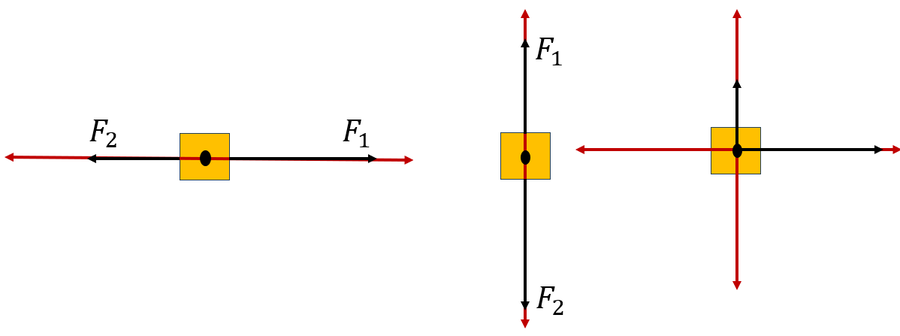
قوتان في بعد واحد (يسار) وقوتان في بعدين (يمين).
Two forces in one dimension (left) and two forces in two dimensions (right).
| كميات قياسيةScalars | كميات متجهةVectors |
|---|---|
| الزمن، الكتلة، المساحةTime, mass, area | القوة، السرعة، الإزاحة، التسارعForce, velocity, displacement, acceleration |
📐 محصلة المتجهات في بعدين بالرسم
📐 The Resultant in Two Dimensions: Graphically
ننقل أحد المتجهين حتى ينطبق ذيله على رأس المتجه الأول (مع المحافظة على المقدار والاتجاه) ثم نصل من ذيل المتجه الأول إلى رأس المتجه الثاني فتكون المحصلة. وتصلح الطريقة لأكثر من متجهين ولا يهم أيهما ننقل أولًا.
Move one vector until its tail coincides with the head of the first (keeping magnitude and direction) then join the tail of the first vector to the head of the second to get the resultant. The method works for more than two vectors and it does not matter which is moved first.
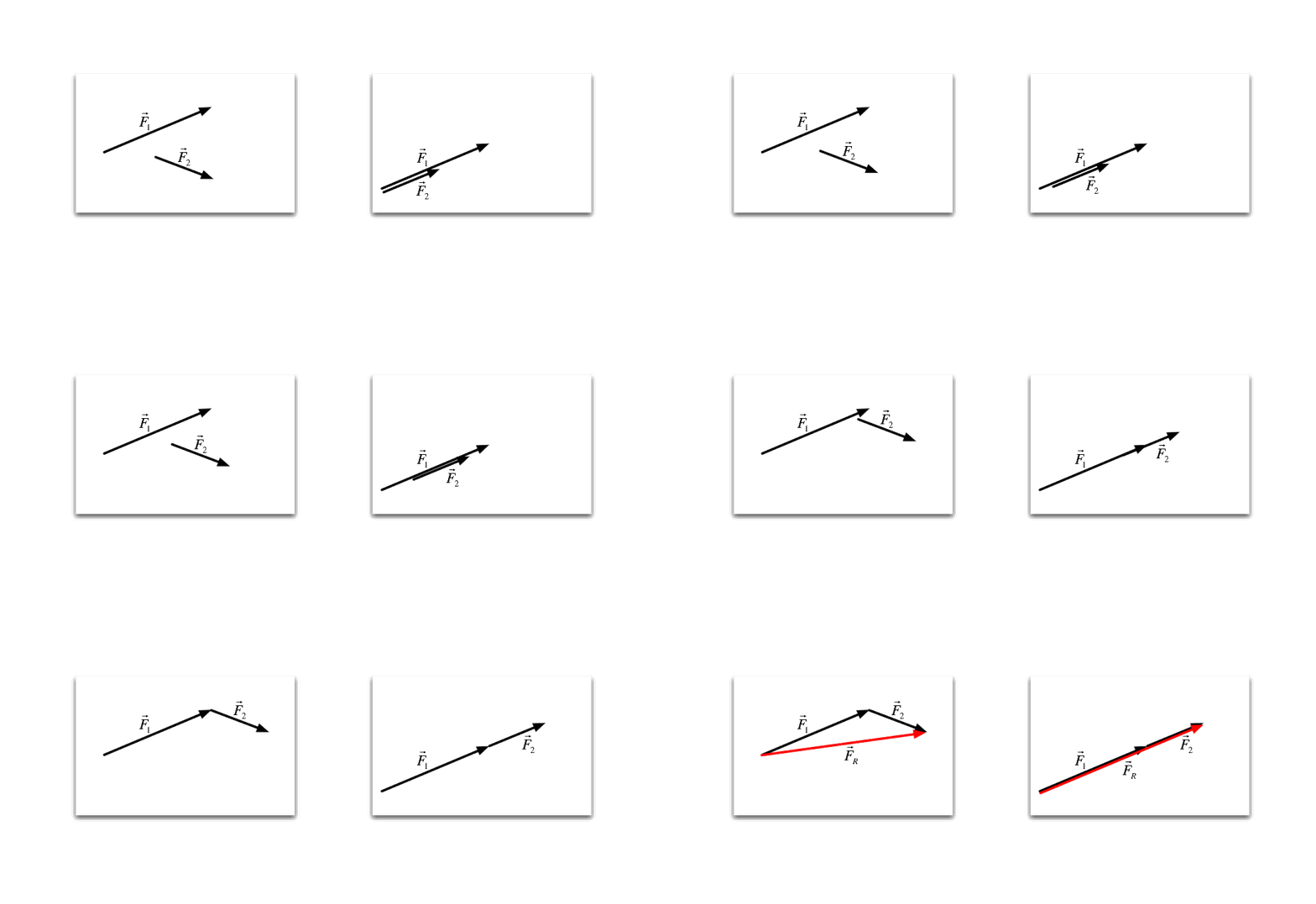
جمع المتجهات بيانيًا: المحصلة من ذيل الأول إلى رأس الأخير.
Graphical addition: the resultant runs from the tail of the first to the head of the last.
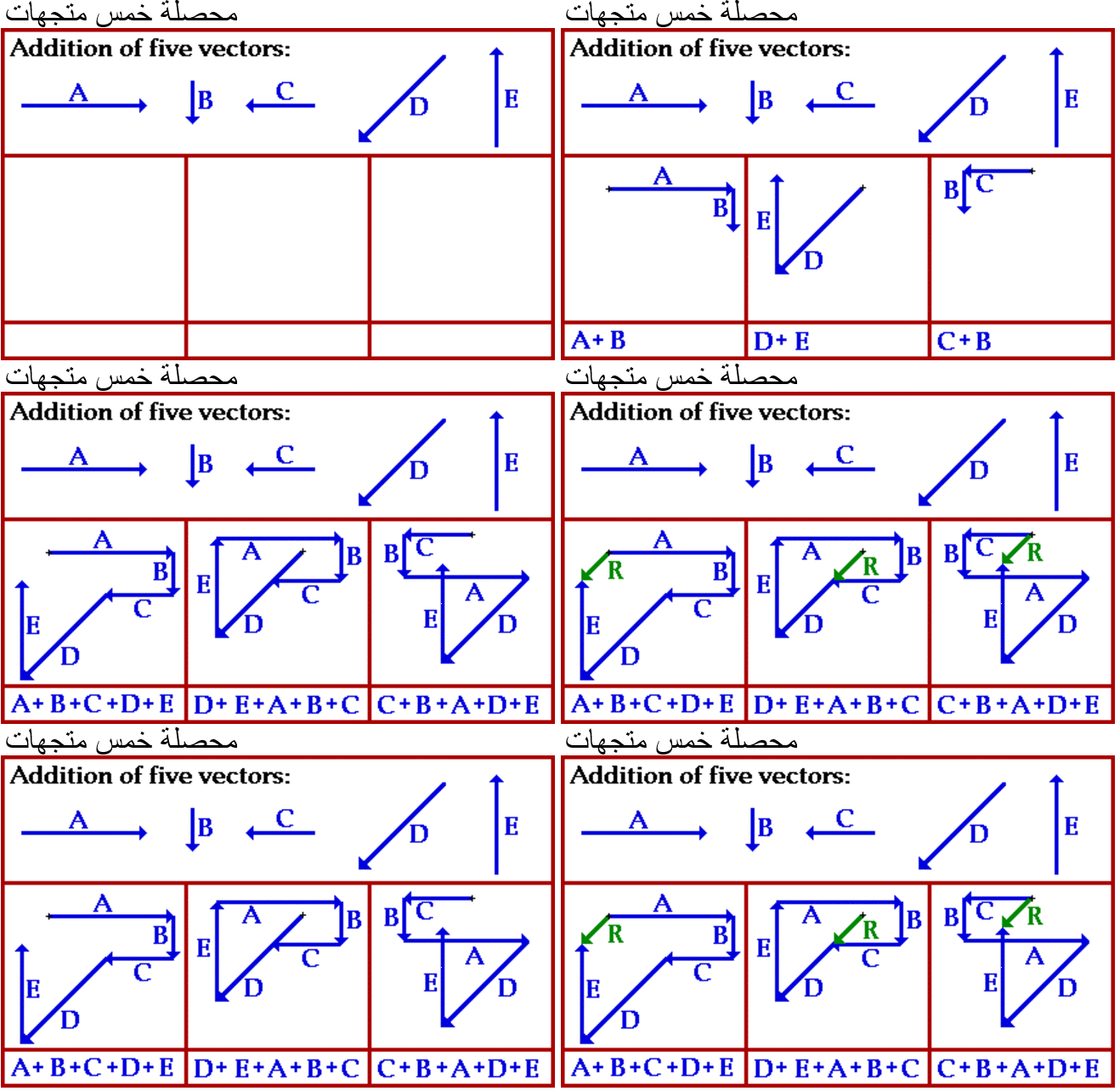
جمع خمسة متجهات بالطريقة نفسها.
Adding five vectors by the same method.
📏 محصلة متجهين متعامدين
📏 The Resultant of Two Perpendicular Vectors
إذا تعامد المتجهان فبوضعهما رأسًا لذيل يتكوّن مثلث قائم الزاوية تكون المحصلة وتره، فنحسب المقدار بفيثاغورس والاتجاه بالظل:
If the vectors are perpendicular, placing them head to tail forms a right triangle whose hypotenuse is the resultant, so Pythagoras gives the magnitude and the tangent the direction:
📌 المحصلة للمتجهين المتعامدين
📌 Resultant of perpendicular vectors
\[R^2=A^2+B^2\]
\[\theta=\tan^{-1}\frac{B}{A}\ \ (\text{with }A),\qquad \theta=\tan^{-1}\frac{A}{B}\ \ (\text{with }B)\]
🧪 جرّب بنفسك: المتجهان المتعامدان
🧪 Try It Yourself: Perpendicular Vectors
🧪 تجربة 1: محصلة متجهين متعامدين
🧪 Experiment 1: The Resultant of Two Perpendicular Vectors
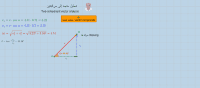
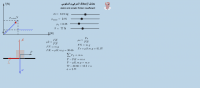
غيّر مقداري القوتين (شرقًا وشمالًا أو جنوبًا) وراقب المحصلة كوتر مثلث قائم الزاوية والزاوية التي تصنعها مع الشرق.
Change the two magnitudes (east and north or south) and watch the resultant as the hypotenuse of a right triangle and the angle it makes with east.
قوتان \(F_1=10\ \mathrm N\) نحو الشرق و\(F_2=5\ \mathrm N\) نحو الشمال. أوجد المحصلة واتجاهها.
Two forces \(F_1=10\ \mathrm N\) east and \(F_2=5\ \mathrm N\) north. Find the resultant and its direction.
يتحرك أحمد \(30\ \mathrm m\) نحو الشرق ثم يغيّر اتجاهه ويتحرك \(40\ \mathrm m\) نحو الجنوب. أوجد محصلة الإزاحة.
Ahmed moves \(30\ \mathrm m\) east then changes direction and moves \(40\ \mathrm m\) south. Find the resultant displacement.
🔺 محصلة متجهين بينهما زاوية
🔺 Two Vectors at an Angle
إذا لم يكن المتجهان متعامدين نستخدم قانون جيب التمام للمقدار وقانون الجيب للاتجاه، حيث \(\theta\) هي الزاوية الداخلية للمثلث عند وضع المتجهين رأسًا لذيل. وإذا قيست الزاوية بين المتجهين من نقطة واحدة (ذيل مع ذيل) فهي \(\varphi=180^\circ-\theta\) ويتحول الإشارة إلى \(+2AB\cos\varphi\).
If the vectors are not perpendicular we use the law of cosines for the magnitude and the law of sines for the direction, where \(\theta\) is the interior angle of the triangle when the vectors are placed head to tail. If the angle between the vectors is measured from one point (tail to tail) it is \(\varphi=180^\circ-\theta\) and the sign becomes \(+2AB\cos\varphi\).
📌 قانونا جيب التمام والجيب
📌 The laws of cosines and sines
\[\vec R=\vec A+\vec B,\qquad R^2=A^2+B^2-2AB\cos\theta\]
\[\frac{R}{\sin\theta}=\frac{A}{\sin\alpha}=\frac{B}{\sin\beta}\]
🧪 جرّب بنفسك: قانون جيب التمام
🧪 Try It Yourself: the Law of Cosines
🧪 تجربة 2: محصلة متجهين بينهما زاوية: قانون جيب التمام
🧪 Experiment 2: Two Vectors at an Angle: the Law of Cosines
ضع المتجهين رأسًا لذيل وغيّر الزاوية الداخلية \(\theta\) للمثلث وراقب المحصلة \(R\) والزاوية \(\alpha\) بقانوني جيب التمام والجيب.
Place the vectors head to tail and change the interior angle \(\theta\) of the triangle; watch the resultant \(R\) and the angle \(\alpha\) from the laws of cosines and sines.
إزاحتان \(A=3\ \mathrm m\) و\(B=5\ \mathrm m\) كما في الشكل (الزاوية الداخلية \(127^\circ\)). أوجد محصلة الإزاحة والزاوية بينها وبين \(A\).
Two displacements \(A=3\ \mathrm m\) and \(B=5\ \mathrm m\) as in the figure (interior angle \(127^\circ\)). Find the resultant displacement and its angle with \(A\).
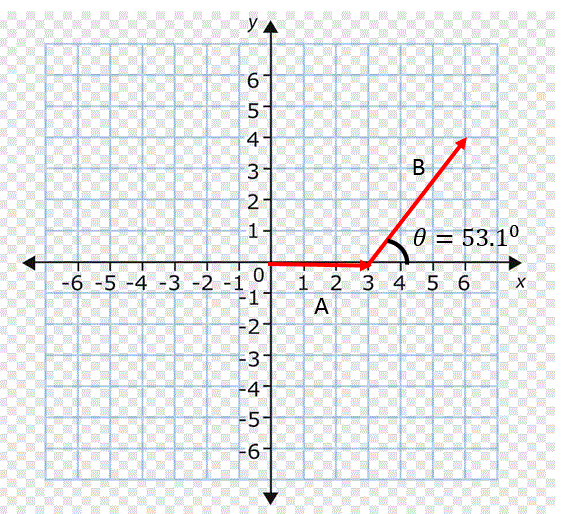
الإزاحتان \(A=3\ \mathrm m\) و\(B=5\ \mathrm m\).
The displacements \(A=3\ \mathrm m\) and \(B=5\ \mathrm m\).
✂️ مركبات المتجه (التحليل)
✂️ Components of a Vector (Resolution)
التحليل هو إسقاط المتجه على محورين متعامدين وتحويل المتجه الواحد إلى مركبتين تكافئانه. وفي الأرباع المختلفة تتغير إشارتا المركبتين بحسب الجهة (شرق/غرب وشمال/جنوب):
Resolution is projecting a vector onto two perpendicular axes and converting it into two equivalent components. In different quadrants the signs of the components change with the side (east/west and north/south):
📌 المركبتان
📌 The components
\[A_x=A\cos\theta,\qquad A_y=A\sin\theta\]
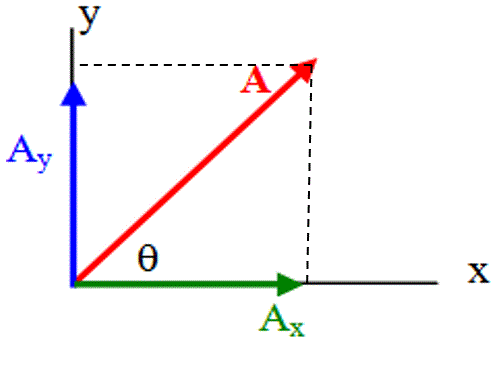
المتجه \(A\) ومركبتاه \(A_x\) و\(A_y\).
The vector \(A\) and its components \(A_x\) and \(A_y\).
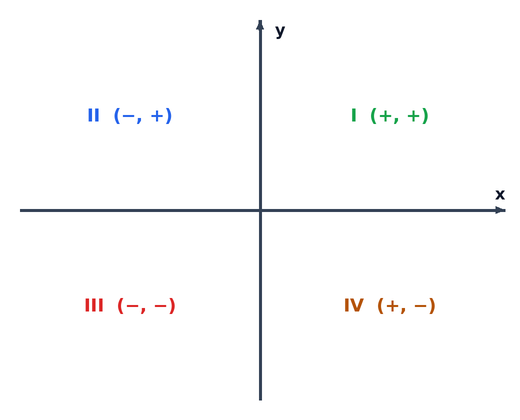
إشارتا المركبتين في كل ربع.
Signs of the two components in each quadrant.
🧪 جرّب بنفسك: المركبات والأرباع
🧪 Try It Yourself: Components and Quadrants
🧪 تجربة 3: تحليل المتجه وإشارات المركبتين في الأرباع
🧪 Experiment 3: Resolving a Vector and the Signs in Each Quadrant
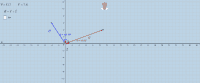
اختر مقدار القوة وزاويتها عن المحور الأفقي والربع (شمال/جنوب الشرق/الغرب) وراقب المركبتين \(F_x\) و\(F_y\) وإشارتيهما.
Choose the force, its angle from the horizontal axis and the quadrant (north/south east/west) and watch the components \(F_x\) and \(F_y\) and their signs.
متجه قوة \(F=60\ \mathrm N\) يصنع زاوية \(30^\circ\) جنوب الغرب. أوجد مركبتيه على المحورين المتعامدين.
A force \(F=60\ \mathrm N\) makes an angle of \(30^\circ\) south of west. Find its components on the perpendicular axes.
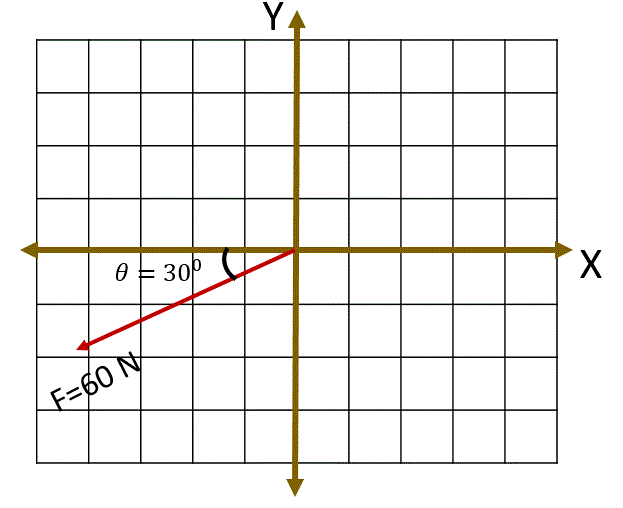
قوة \(60\ \mathrm N\) بزاوية \(30^\circ\) جنوب الغرب.
A \(60\ \mathrm N\) force at \(30^\circ\) south of west.
🎯 الغاية من تحليل المتجهات
🎯 The Purpose of Resolution
إذا كان لدينا عدة متجهات بينها زوايا وطُلبت المحصلة
If we have several vectors at angles and the resultant is required
- نحلّل كل متجه إلى مركبتين مع الانتباه إلى الإشارات.Resolve each vector into two components, watching the signs.
- نجمع المركبات على كل محور: \(R_x=\sum A_x\) و\(R_y=\sum A_y\).Add the components on each axis: \(R_x=\sum A_x\) and \(R_y=\sum A_y\).
- نحصل على متجهين متعامدين فنطبّق فيثاغورس: \(R=\sqrt{R_x^2+R_y^2}\) و\(\theta=\tan^{-1}\dfrac{R_y}{R_x}\).We get two perpendicular vectors and apply Pythagoras: \(R=\sqrt{R_x^2+R_y^2}\) and \(\theta=\tan^{-1}\dfrac{R_y}{R_x}\).
🧪 جرّب بنفسك: المحصلة بالتحليل
🧪 Try It Yourself: the Resultant by Resolution
🧪 تجربة 4: محصلة متجهين بطريقة التحليل
🧪 Experiment 4: The Resultant of Two Vectors by Resolution
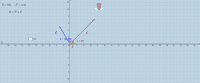
اضبط متجهين بمقدارين وزاويتين واتجاهين (الأرباع)، وراقب جدول المركبات والمحصلة \(R\) واتجاهها (مثال ماجد).
Set two vectors with magnitudes, angles and quadrants and watch the components table and the resultant \(R\) with its direction (Majid’s example).
تحرك ماجد \(60\ \mathrm m\) بزاوية \(30^\circ\) شمال الشرق ثم غيّر اتجاهه وقطع \(40\ \mathrm m\) بزاوية \(40^\circ\) شمال الغرب. احسب الإزاحة المقطوعة.
Majid moves \(60\ \mathrm m\) at \(30^\circ\) north of east then changes direction and covers \(40\ \mathrm m\) at \(40^\circ\) north of west. Find his total displacement.
📌 ملخص محصلة المتجهات في بعدين
📌 Summary of the resultant in two dimensions
\[R_x=A_x+B_x,\qquad R_y=A_y+B_y\]
\[|R|=\sqrt{R_x^2+R_y^2},\qquad \theta=\tan^{-1}\frac{R_y}{R_x}\]
العوامل المؤثرة في المحصلة: مقدار كل متجه واتجاهه والزاوية بين المتجهين. وتطبيقاتها: حساب القوى في الأنظمة الميكانيكية وملاحة الطائرات مع الرياح وتحليل الإجهادات في الإنشاءات.
The factors affecting the resultant: the magnitude and direction of each vector and the angle between them. Applications: forces in mechanical systems, aircraft navigation with wind and stress analysis in structures.
🧱 قوة الاحتكاك: السكوني والحركي
🧱 Friction Force: Static and Kinetic
قوة الاحتكاك مقاومة تعيق حركة جسم على سطح جسم آخر؛ وليست قوة أساسية كالجاذبية، بل تنتج عن التجاذب الكهرومغناطيسي بين جسيمات السطحين المتلامسين. اتجاهها دائمًا عكس حركة الجسم (أو عكس ميله للحركة) وموازٍ للسطح.
Friction is a resistance that opposes the motion of a body on the surface of another; it is not a fundamental force like gravity but results from electromagnetic attraction between the particles of the two surfaces in contact. Its direction is always opposite to the motion (or to the tendency to move) and parallel to the surface.
نوعا الاحتكاك
The two kinds of friction
- سكوني: يظهر عند التأثير بقوة شد والجسم ساكن، ويتغير مع القوة حتى يبلغ أقصى قيمة \(f_s\le\mu_sN\).Static: appears when a pulling force acts and the body is at rest; it changes with the force up to a maximum \(f_s\le\mu_sN\).
- حركي: يظهر والجسم يتحرك، وقيمته ثابتة تقريبًا \(f_k=\mu_kN\) وهو عادةً أقل من السكوني.Kinetic: appears while the body moves; its value is roughly constant \(f_k=\mu_kN\) and usually less than the static one.
📌 معاملا الاحتكاك
📌 The coefficients of friction
\[\mu_s=\frac{f_s}{F_N},\qquad \mu_k=\frac{f_k}{F_N}\]
العوامل المؤثرة: القوة العمودية \(N\) وطبيعة السطحين (المواد والخشونة). ولا يعتمد المعامل عادةً على مساحة التلامس، وقد يقل الاحتكاك الحركي قليلًا مع السرعة.
The factors: the normal force \(N\) and the nature of the two surfaces (materials and roughness). The coefficient usually does not depend on the contact area, and kinetic friction may fall slightly with speed.
🧪 جرّب بنفسك: الاحتكاك
🧪 Try It Yourself: Friction
🧪 تجربة 5: الاحتكاك السكوني والحركي
🧪 Experiment 5: Static and Kinetic Friction
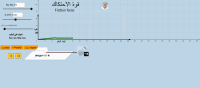
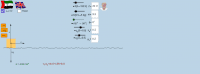
اسحب جسمًا على سطح أفقي خشن: زِد قوة الشد تدريجيًا (أو اضغط «تشغيل») وراقب أين يبدأ الجسم بالحركة وكيف يتغير الاحتكاك على الرسم البياني.
Pull a body on a rough horizontal surface: increase the pulling force gradually (or press “Start”) and watch where the body starts to move and how friction changes on the graph.
جسم كتلته \(10\ \mathrm{kg}\) على سطح أفقي خشن، معامل الاحتكاك السكوني \(0.5\) والحركي \(0.3\). أوجد أصغر قوة أفقية تحرّكه والاحتكاك الحركي (\(g=9.81\)).
A \(10\ \mathrm{kg}\) body on a rough horizontal surface, static coefficient \(0.5\) and kinetic \(0.3\). Find the smallest horizontal force that moves it and the kinetic friction (\(g=9.81\)).
من التجارب السابقة، ما العاملان اللذان يغيّران قوة الاحتكاك؟
From the previous experiments, which two factors change the friction force?
تحديد القوى المؤثرة
Identifying the Forces
| الحالةCase | القوى المؤثرةForces acting |
|---|---|
| قوة شد أفقية والجسم ساكن على سطح خشنHorizontal pull, body at rest on a rough surface | الوزن \(W\) والعمودية \(N\) والشد \(F\) والاحتكاك السكوني \(f_s=F\)Weight \(W\), normal \(N\), pull \(F\) and static friction \(f_s=F\) |
| قوة شد مائلة والجسم يتحرك على سطح أفقي خشنInclined pull, body moving on a rough horizontal surface | \(W\) و\(N\) والشد \(F\) (له مركبتان) والاحتكاك الحركي \(f_k\)\(W\), \(N\), the pull \(F\) (two components) and kinetic friction \(f_k\) |
| رفع الجسم بقوة موازية للمستوى المائل الخشنPulling the body up a rough incline with a parallel force | \(W\) (مركبتان) و\(N\) والشد \(F\) والاحتكاك \(f_k\) نحو أسفل المستوى\(W\) (two components), \(N\), the pull \(F\) and friction \(f_k\) down the incline |
| جسم ينزلق على مستوى مائل خشنA body sliding down a rough incline | \(W\) (مركبتان) و\(N\) والاحتكاك \(f_k\) نحو أعلى المستوى\(W\) (two components), \(N\) and friction \(f_k\) up the incline |
⚖️ اتزان جسم تحت قوى متلاقية
⚖️ Equilibrium under Concurrent Forces
يكون الجسم في حالة اتزان إذا انعدمت محصلة القوى المؤثرة فيه: \(\sum F_x=0\) و\(\sum F_y=0\). وقد يكون الجسم عندئذ ساكنًا (\(v=0,\ a=0\)) أو متحركًا بسرعة ثابتة (\(v=\text{const},\ a=0\)).
A body is in equilibrium if the resultant of the forces on it vanishes: \(\sum F_x=0\) and \(\sum F_y=0\). The body may then be at rest (\(v=0,\ a=0\)) or moving with constant velocity (\(v=\text{const},\ a=0\)).
🧪 جرّب بنفسك: الاتزان
🧪 Try It Yourself: Equilibrium
🧪 تجربة 6: اتزان جسم تحت تأثير ثلاث قوى متلاقية
🧪 Experiment 6: Equilibrium of a Body under Three Concurrent Forces
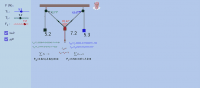
غيّر \(F_1\) وزاويتها و\(F_3\) لتحصل على القوة \(F_2\) التي تحقق الاتزان، وراقب مثلث القوى المغلق.
Change \(F_1\), its angle and \(F_3\) to get the force \(F_2\) that gives equilibrium, and watch the closed force triangle.
تؤثر ثلاث قوى متلاقية في جسم فيصبح متزنًا: \(F_1=50\ \mathrm N\) بزاوية \(36.8^\circ\) فوق الأفقي و\(F_3=40\ \mathrm N\) إلى الأسفل. أوجد مقدار واتجاه \(F_2\).
Three concurrent forces act on a body and keep it in equilibrium: \(F_1=50\ \mathrm N\) at \(36.8^\circ\) above the horizontal and \(F_3=40\ \mathrm N\) downward. Find the magnitude and direction of \(F_2\).
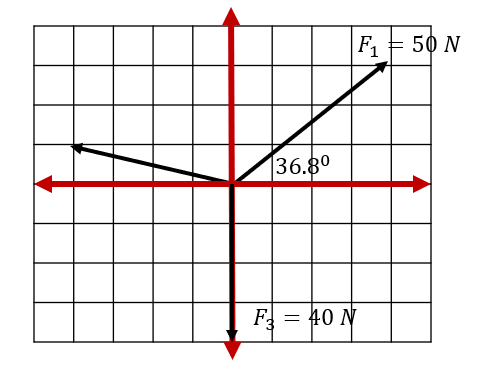
القوى \(F_1=50\ \mathrm N\) و\(F_3=40\ \mathrm N\) و\(F_2\) المجهولة.
The forces \(F_1=50\ \mathrm N\), \(F_3=40\ \mathrm N\) and the unknown \(F_2\).
📉 حركة جسم على مستوى مائل
📉 Motion on an Inclined Plane
المستوى المائل الأملس
The smooth inclined plane
يتأثر الجسم بقوتين: العمودية \(F_N\) والوزن \(F_g\). نرسم المحور الأفقي موازيًا للمستوى ونحلّل الوزن: \(F_{gx}=mg\sin\theta\) و\(F_{gy}=mg\cos\theta\). ومن القانون الثاني \(mg\sin\theta=ma\) فيكون \(a=g\sin\theta\)، والكتلة لا تؤثر في التسارع.
The body is acted on by two forces: the normal force \(F_N\) and the weight \(F_g\). Take the horizontal axis parallel to the plane and resolve the weight: \(F_{gx}=mg\sin\theta\) and \(F_{gy}=mg\cos\theta\). From the second law \(mg\sin\theta=ma\) so \(a=g\sin\theta\); the mass does not affect the acceleration.
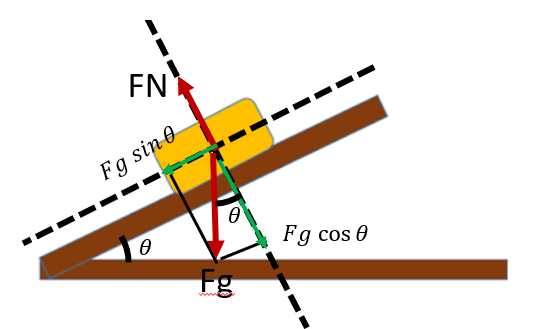
تحليل الوزن إلى مركبتين على المستوى المائل.
Resolving the weight into two components on an incline.
المستوى المائل الخشن
The rough inclined plane
لا يتحرك الجسم حتى تصبح مركبة الوزن الموازية للمستوى أكبر من الاحتكاك. وعند الحركة: \(mg\sin\theta-f_k=ma\) مع \(f_k=\mu_kN=\mu_kmg\cos\theta\) فنحصل على:
The body does not move until the component of the weight parallel to the plane exceeds friction. When moving: \(mg\sin\theta-f_k=ma\) with \(f_k=\mu_kN=\mu_kmg\cos\theta\), which gives:
📌 المستوى المائل الخشن
📌 The rough incline
\[a=g\sin\theta-\mu_k\,g\cos\theta\]
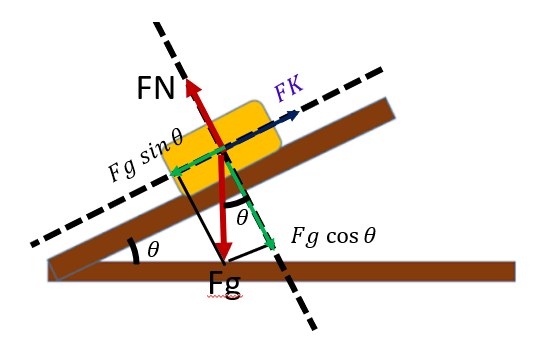
القوى المؤثرة على جسم على مستوى مائل خشن.
The forces on a body on a rough inclined plane.
🧪 جرّب بنفسك: المستوى المائل
🧪 Try It Yourself: the Inclined Plane
🧪 تجربة 7: حركة جسم على مستوى مائل
🧪 Experiment 7: Motion on an Inclined Plane
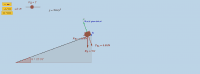
غيّر زاوية الميل والكتلة ومعامل الاحتكاك وراقب المركبتين \(mg\sin\theta\) و\(mg\cos\theta\) والتسارع.
Change the angle of the incline, the mass and the friction coefficient and watch the components \(mg\sin\theta\) and \(mg\cos\theta\) and the acceleration.
ينزلق جسم على مستوى مائل زاويته \(30^\circ\): (أ) أملس، (ب) خشن معامل احتكاكه الحركي \(0.2\). أوجد التسارع في كل حالة (\(g=9.81\)).
A body slides on a plane inclined at \(30^\circ\): (a) smooth, (b) rough with kinetic coefficient \(0.2\). Find the acceleration in each case (\(g=9.81\)).
جسم يتحرك على مستوى مائل أملس: يزداد تسارعه إذا:
A body moving on a smooth incline accelerates more if:
🎲 تدرّب
🎲 Practice
🧪 تجربة 8: تدرّب: مسائل الإزاحة والقوة في بعدين
🧪 Experiment 8: Practice: Displacement and Force in 2D Problems
مسائل عشوائية بأرقام مختلفة. احسب واكتب الجواب ثم اضغط «تحقّق».
Random problems with different numbers. Work it out, enter the answer and press “Check”.
📊 جدول ملخص
📊 Summary
| الموضوعTopic | العلاقةRelation |
|---|---|
| متجهان متعامدانPerpendicular vectors | \(R=\sqrt{A^2+B^2},\ \theta=\tan^{-1}(B/A)\)\(R=\sqrt{A^2+B^2},\ \theta=\tan^{-1}(B/A)\) |
| قانون جيب التمامLaw of cosines | \(R^2=A^2+B^2-2AB\cos\theta\)\(R^2=A^2+B^2-2AB\cos\theta\) |
| المركبتانComponents | \(A_x=A\cos\theta,\ A_y=A\sin\theta\)\(A_x=A\cos\theta,\ A_y=A\sin\theta\) |
| المحصلة بالتحليلResolution | \(R_x=\sum A_x,\ R_y=\sum A_y\)\(R_x=\sum A_x,\ R_y=\sum A_y\) |
| الاحتكاكFriction | \(f_s\le\mu_sN,\ f_k=\mu_kN\)\(f_s\le\mu_sN,\ f_k=\mu_kN\) |
| الاتزانEquilibrium | \(\sum F_x=0,\ \sum F_y=0\)\(\sum F_x=0,\ \sum F_y=0\) |
| مستوى مائلInclined plane | \(a=g(\sin\theta-\mu_k\cos\theta)\)\(a=g(\sin\theta-\mu_k\cos\theta)\) |
🧪 اختبر نفسك: امتحان من 20 سؤالاً
🧪 Test Yourself: a 20-Question Exam
أنهِ الدرس بالاختبار التفاعلي التالي؛ أسئلته تجمع بين الفهم والحساب وتغطي جميع أقسام الدرس.
Finish with the interactive exam below; its questions mix understanding with calculation and cover every section of the lesson.
اختبار الإزاحة والقوة في بعدين Displacement and Force in Two Dimensions Quiz
20 سؤالاً - الكميات المتجهة والقياسية، فيثاغورس، قانون جيب التمام، تحليل المتجهات والمحصلة بالمركبات 20 Questions - vector and scalar quantities, Pythagoras, the law of cosines, resolving vectors and the resultant by components
• عدد الأسئلة: 20 سؤالاً
• مدة الاختبار: 30 دقيقة
• لا يمكنك تغيير إجاباتك أو إعادة الاختبار إلا بعد 24 ساعة من التسليم.
• تأكد من إجاباتك قبل التسليم! 📌 Important Instructions:
• Number of questions: 20 questions
• Quiz duration: 30 minutes
• You cannot change your answers or retake the quiz for 24 hours after submission.
• Make sure of your answers before submitting!
🔗 محاكيات GeoGebra للاستعانة بها عند اللزوم
🔗 GeoGebra Simulations to Use When Needed
اضغط «تشغيل» لتعمل المحاكاة هنا داخل الدرس؛ ويمكن للطالب الرجوع إليها لتجربة الفكرة بطريقة أخرى.
Press “Run” to run the simulation right here inside the lesson; the student can use it to try the idea in another way.