🎯 نواتج التعلم
🎯 Learning Outcomes
بعد هذه التجربة ستكون قادرًا على أن:
After this experiment you will be able to:
- تفسّر أن المكثف يسمح بمرور التيار المتردد بالشحن والتفريغ المتكررين، وتحسب مفاعله السعوي \(X_C=\dfrac{1}{2\pi fC}\).Explain that a capacitor passes alternating current through repeated charging and discharging, and calculate its capacitive reactance \(X_C=\dfrac{1}{2\pi fC}\).
- تحسب التيار الفعال \(I_{rms}=\dfrac{V_{rms}}{X_C}\) والقيم القصوى للجهد والتيار.Calculate the RMS current \(I_{rms}=\dfrac{V_{rms}}{X_C}\) and the peak values of the voltage and the current.
- تبيّن أن التيار يسبق الجهد بالزاوية \(90^\circ\) في المكثف الصافي.Show that the current leads the voltage by \(90^\circ\) in a pure capacitor.
- تفسّر لماذا تكون القدرة المتوسطة صفرًا في المكثف الصافي، وأن المكثف يخزن الطاقة في مجاله الكهربائي ثم يعيدها للمصدر.Explain why the average power is zero in a pure capacitor, and that the capacitor stores energy in its electric field and returns it to the source.
- تتوقع أثر تغيير التردد والسعة على التيار، وتتحقق من توقعك بالمحاكاة.Predict how changing the frequency and the capacitance affects the current, and check your prediction with the simulation.
💡 فكرة التجربة
💡 The Idea of the Experiment
عند وصل مكثف سعته \(C\) بمصدر تيار متردد، يشحن المصدر لوحيه ثم يفرّغهما بالتناوب. لا تعبر الشحنات الفجوة بين اللوحين، لكن تغيّر الشحنة على اللوحين يعني مرور تيار في السلك. وكلما زاد معدل تغيّر الجهد زاد التيار، لذلك يسبق التيار الجهد بربع دورة. ولأن المكثف لا يستهلك طاقة بل يخزنها في مجاله الكهربائي في ربع الدورة ثم يعيدها في الربع التالي، فالقدرة المتوسطة تساوي صفرًا.
When a capacitor of capacitance \(C\) is connected to an AC source, the source charges its plates and then discharges them alternately. Charges do not cross the gap between the plates, but a change of charge on the plates means a current flows in the wire. The faster the voltage changes, the larger the current, so the current leads the voltage by a quarter cycle. Because the capacitor does not consume energy, but stores it in its electric field during one quarter cycle and returns it during the next, the average power is zero.
📘 المفاعلة السعوية والتيار في المكثف
📘 Capacitive reactance and the current in a capacitor
\[X_C=\dfrac{1}{2\pi fC}\qquad I_{rms}=\dfrac{V_{rms}}{X_C}=2\pi fCV_{rms}\]
\[V_{max}=\sqrt{2}\,V_{rms}\qquad I_{max}=\sqrt{2}\,I_{rms}\qquad \varphi=+90^\circ\]
الإشارة الموجبة في \(\varphi\) تعني أن التيار يسبق الجهد. ومتوسط القدرة \(P=V_{rms}I_{rms}\cos 90^\circ=0\). وتذكّر أن \(C\) تقاس بالفاراد، فإذا كانت بالميكروفاراد فحوّلها: \(1\,\mu\mathrm{F}=10^{-6}\,\mathrm{F}\).
The positive sign in \(\varphi\) means the current leads the voltage. The average power is \(P=V_{rms}I_{rms}\cos 90^\circ=0\). Remember that \(C\) is measured in farads; if it is given in microfarads, convert it: \(1\,\mu\mathrm{F}=10^{-6}\,\mathrm{F}\).
💡 شرح إضافي: لماذا يقل \(X_C\) بزيادة التردد؟
💡 Extra explanation: why does \(X_C\) decrease as the frequency increases?
كلما زاد التردد صار المكثف يشحن ويفرّغ بسرعة أكبر، فتمر شحنات أكثر في السلك في الثانية الواحدة، أي يزداد التيار. وعند التيار المستمر (\(f=0\)) تصبح \(X_C\) لا نهائية، فالمكثف يمنع مرور التيار المستمر.
The higher the frequency, the faster the capacitor charges and discharges, so more charge moves in the wire each second and the current increases. With direct current (\(f=0\)) \(X_C\) is infinite, so a capacitor blocks direct current.
| الكميةQuantity | العلاقةRelation | في المكثف الصافيIn a pure capacitor |
|---|---|---|
| الجهد والتيارVoltage and current | \(\varphi\) | التيار يسبق بـ \(90^\circ\)Current leads by \(90^\circ\) |
| المعاوقةImpedance | \(Z=X_C=\dfrac{1}{2\pi fC}\) | تقل بزيادة الترددDecreases with frequency |
| القدرة المتوسطةAverage power | \(P=V_{rms}I_{rms}\cos\varphi\) | \(0\) |
🧪 التجربة: مكثف متصل بمصدر تيار متردد
🧪 The Experiment: A Capacitor Connected to an AC Source
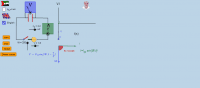
في التجربة التفاعلية أدناه دائرة بسيطة: مصدر تيار متردد، ومفتاح، وأميتر على التوالي، ومكثف، وفولتميتر على طرفيه. أغلق المفتاح، ثم اتبع الخطوات:
The interactive experiment below is a simple circuit: an AC source, a switch, an ammeter in series, a capacitor, and a voltmeter across it. Close the switch, then follow the steps:
خطوات التجربة
Steps of the experiment
- توقّع أولًا: احسب \(X_C\) و\(I_{rms}\) قبل تغيير أي قيمة، وتذكّر تحويل السعة من ميكروفاراد إلى فاراد.Predict first: before changing any value, calculate \(X_C\) and \(I_{rms}\), and remember to convert the capacitance from microfarads to farads.
- لاحظ الطور: التيار يصل إلى قمته قبل الجهد بربع دورة.Watch the phase: the current reaches its peak a quarter cycle before the voltage.
- غيّر التردد مع ثبات \(V\) و\(C\): لاحظ أن \(X_C\) تقل ويزداد التيار الفعال.Change the frequency while keeping \(V\) and \(C\) fixed: notice that \(X_C\) decreases and the RMS current increases.
- غيّر السعة \(C\): لاحظ أن زيادتها تزيد التيار، كما يفعل التردد الأكبر.Change the capacitance \(C\): notice that increasing it increases the current, just as a higher frequency does.
🧪 تجربة تفاعلية: مكثف متصل بمصدر تيار متردد
🧪 Interactive Experiment: A Capacitor Connected to an AC Source
أغلق المفتاح بالزر أو بالنقر عليه في الرسم. الأميتر والفولتميتر يعرضان القيم اللحظية، والجدول يعرض القيم الفعالة والقصوى. لاحظ لوحي المكثف يتغيران لونهما مع الجهد، وفي الموجات أن التيار يسبق الجهد بربع دورة دائمًا.
Close the switch with the button or by clicking it in the drawing. The ammeter and the voltmeter show instantaneous values, and the table shows the RMS and peak values. The capacitor plates change colour with the voltage, and in the waves the current always leads the voltage by a quarter cycle.
✍️ مثال محلول
✍️ Worked Example
المعطيات: \(C=50\,\mu\mathrm{F},\quad f=50\,\mathrm{Hz},\quad V_{rms}=120\,\mathrm{V}\)
Given: \(C=50\,\mu\mathrm{F},\quad f=50\,\mathrm{Hz},\quad V_{rms}=120\,\mathrm{V}\)
- المفاعلة السعوية: \(X_C=\dfrac{1}{2\pi(50)(50\times10^{-6})}\approx 63.7\,\Omega\)Capacitive reactance: \(X_C=\dfrac{1}{2\pi(50)(50\times10^{-6})}\approx 63.7\,\Omega\)
- التيار الفعال: \(I_{rms}=\dfrac{120}{63.7}\approx 1.88\,\mathrm{A}\)RMS current: \(I_{rms}=\dfrac{120}{63.7}\approx 1.88\,\mathrm{A}\)
- القيم القصوى: \(V_{max}=\sqrt2(120)\approx 169.7\,\mathrm{V}\)، \(I_{max}=\sqrt2(1.88)\approx 2.67\,\mathrm{A}\)Peak values: \(V_{max}=\sqrt2(120)\approx 169.7\,\mathrm{V}\), \(I_{max}=\sqrt2(1.88)\approx 2.67\,\mathrm{A}\)
- فرق الطور: \(\varphi=+90^\circ\)، أي أن التيار يسبق الجهد بربع دورة.Phase: \(\varphi=+90^\circ\), so the current leads the voltage by a quarter cycle.
- القدرة المتوسطة: \(P=V_{rms}I_{rms}\cos 90^\circ=0\)Average power: \(P=V_{rms}I_{rms}\cos 90^\circ=0\)
🧠 اختبر نفسك
🧠 Test Yourself
مكثف \(50\,\mu\mathrm{F}\) متصل بمصدر فعاله \(120\,\mathrm{V}\) وتردده \(100\,\mathrm{Hz}\). احسب \(X_C\) والتيار الفعال.A \(50\,\mu\mathrm{F}\) capacitor is connected to a \(120\,\mathrm{V}\) RMS source at \(100\,\mathrm{Hz}\). Calculate \(X_C\) and the RMS current.
مكثف متصل بمصدر \(100\,\mathrm{V}\) وتردده \(50\,\mathrm{Hz}\)، والتيار الفعال \(2\,\mathrm{A}\). احسب \(X_C\) ثم السعة \(C\).A capacitor is connected to a \(100\,\mathrm{V}\) source at \(50\,\mathrm{Hz}\), and the RMS current is \(2\,\mathrm{A}\). Calculate \(X_C\) and then the capacitance \(C\).
📚 ملخص
📚 Summary
| المفهومConcept | القانونLaw |
|---|---|
| المفاعلة السعويةCapacitive reactance | \(X_C=\dfrac{1}{2\pi fC}\) |
| التيار الفعالRMS current | \(I_{rms}=V_{rms}/X_C\) |
| فرق الطورPhase difference | \(\varphi=+90^\circ\) |
| القدرة المتوسطةAverage power | \(P=0\) |
⚠️ أخطاء شائعة
⚠️ Common mistakes
- كتابة \(X_C=2\pi fC\) بدل \(X_C=\dfrac{1}{2\pi fC}\)؛ فالمفاعلة السعوية تقل بزيادة التردد.Writing \(X_C=2\pi fC\) instead of \(X_C=\dfrac{1}{2\pi fC}\); the capacitive reactance decreases as the frequency increases.
- القول إن التيار يتأخر عن الجهد في المكثف؛ الصحيح أنه يسبق الجهد بربع دورة.Saying the current lags the voltage in a capacitor; the correct statement is that it leads the voltage by a quarter cycle.
- الظن أن المكثف يستهلك القدرة؛ القدرة المتوسطة صفر لأن المكثف يعيد الطاقة للمصدر.Thinking the capacitor consumes power; the average power is zero because the capacitor returns the energy to the source.
- نسيان تحويل الميكروفاراد إلى فاراد قبل حساب \(X_C\).Forgetting to convert microfarads to farads before calculating \(X_C\).
🔗 محاكيات GeoGebra للاستعانة بها عند اللزوم
🔗 GeoGebra Simulations to Use When Needed
اضغط «تشغيل» لتعمل المحاكاة هنا داخل الدرس؛ ويمكن للطالب الرجوع إليها لتجربة الفكرة بطريقة أخرى.
Press “Run” to run the simulation right here inside the lesson; the student can use it to try the idea in another way.