🎯 نواتج التعلم
🎯 Learning Outcomes
بعد هذه التجربة ستكون قادرًا على أن:
After this experiment you will be able to:
- تطبّق قانون أوم على المقاومة في التيار المتردد: \(v=iR\) لحظيًا، و\(I_{rms}=\dfrac{V_{rms}}{R}\) بالقيم الفعالة.Apply Ohm’s law to a resistor in AC: \(v=iR\) at every instant, and \(I_{rms}=\dfrac{V_{rms}}{R}\) for the RMS values.
- تبيّن أن الجهد والتيار في طور واحد عبر المقاومة، فيبلغان قيمتيهما القصوى والصفرية معًا.Show that the voltage and the current are in phase across a resistor, so they reach their maximum and zero values together.
- تحسب القيم القصوى \(V_{max}=\sqrt{2}\,V_{rms}\) و\(I_{max}=\sqrt{2}\,I_{rms}\)، وتميّز بينها وبين القيم الفعالة.Calculate the peak values \(V_{max}=\sqrt{2}\,V_{rms}\) and \(I_{max}=\sqrt{2}\,I_{rms}\), and distinguish them from the RMS values.
- تحسب القدرة المتوسطة المستهلكة \(P=I_{rms}^2R=\dfrac{V_{rms}^2}{R}\)، وتفسر لماذا لا تنعدم القدرة في أي لحظة.Calculate the average power dissipated \(P=I_{rms}^2R=\dfrac{V_{rms}^2}{R}\), and explain why the power is never zero at any instant.
- تتوقع أن التردد لا يغيّر قيمة \(R\) ولا التيار الفعال، وتتحقق من ذلك بالمحاكاة.Predict that the frequency does not change the value of \(R\) or the RMS current, and check this with the simulation.
💡 فكرة التجربة
💡 The Idea of the Experiment
عند وصل مقاومة \(R\) بمصدر تيار متردد، يتغير الجهد بين القيم الموجبة والسالبة، ويتغير التيار معه تبعًا لقانون أوم في كل لحظة. لا تحتوي المقاومة على ملف ولا مكثف، فلا تتولد فيها ق.د.ك. مستحثة ولا تشحن ولا تفرغ، لذلك يكون الجهد والتيار متفقين في الطور تمامًا.
When a resistor \(R\) is connected to an AC source, the voltage changes between positive and negative values, and the current changes with it at every instant according to Ohm’s law. A resistor contains no coil and no capacitor, so no induced emf appears and nothing charges or discharges. Therefore the voltage and the current are exactly in phase.
📘 قانون أوم والقيم الفعالة
📘 Ohm’s law and the RMS values
\[v=iR\qquad I_{rms}=\dfrac{V_{rms}}{R}\]
\[V_{max}=\sqrt{2}\,V_{rms}\qquad I_{max}=\sqrt{2}\,I_{rms}\]
\[P=I_{rms}^2R=\dfrac{V_{rms}^2}{R}\]
القيمة الفعالة \(V_{rms}\) هي القيمة التي تعطي القدرة نفسها لتيار مستمر. وأجهزة التيار المتردد تقيس القيم الفعالة. القدرة اللحظية \(p=i^2R\) لا تنعدم أبدًا، ومتوسطها هو \(P\) أعلاه.
The RMS value \(V_{rms}\) is the value that gives the same power as a direct current. AC meters measure RMS values. The instantaneous power \(p=i^2R\) is never zero, and its average is \(P\) above.
💡 شرح إضافي: لماذا لا نعطي القيمة القصوى مباشرة؟
💡 Extra explanation: why don’t we use the peak value directly?
الجهد الجيبي يتغير بين \(+V_{max}\) و\(-V_{max}\)، فمتوسطه صفر ولا يصلح لقياس القدرة. لذلك نستخدم القيمة الفعالة، وهي تساوي القيمة القصوى مقسومة على \(\sqrt{2}\). فإذا قيل إن الكهرباء المنزلية \(220\,\mathrm{V}\) فالمقصود قيمة فعالة، وقيمتها القصوى نحو \(311\,\mathrm{V}\).
The sinusoidal voltage swings between \(+V_{max}\) and \(-V_{max}\), so its average is zero and cannot measure power. We therefore use the RMS value, which is the peak value divided by \(\sqrt{2}\). When household supply is quoted as \(220\,\mathrm{V}\), this is an RMS value, and its peak is about \(311\,\mathrm{V}\).
| الكميةQuantity | العلاقةRelation | عند المقاومة وحدهاFor a resistor alone |
|---|---|---|
| الجهد والتيارVoltage and current | \(v=iR\) | في طور واحدIn phase |
| المعاوقةImpedance | \(Z=R\) | لا تعتمد على الترددIndependent of frequency |
| القدرة المتوسطةAverage power | \(P=I_{rms}^2R\) | موجبة دائمًاAlways positive |
🧪 التجربة: مقاوم متصل بمصدر تيار متردد
🧪 The Experiment: A Resistor Connected to an AC Source
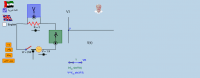
في التجربة التفاعلية أدناه دائرة بسيطة: مصدر تيار متردد، ومفتاح، وأميتر على التوالي، ومقاومة، وفولتميتر على طرفيها. أغلق المفتاح، ثم اتبع الخطوات:
The interactive experiment below is a simple circuit: an AC source, a switch, an ammeter in series, a resistor, and a voltmeter across it. Close the switch, then follow the steps:
خطوات التجربة
Steps of the experiment
- توقّع أولًا: احسب \(I_{rms}\) و\(P\) قبل تغيير أي قيمة، وقارن قراءات الأميتر بقيمك.Predict first: before changing any value, calculate \(I_{rms}\) and \(P\), and compare the ammeter reading with your value.
- لاحظ الطور: الجهد والتيار يبلغان قمتيهما ويصلان للصفر معًا، ولا يوجد فرق طور بينهما.Watch the phase: the voltage and the current reach their peaks and zero values together, with no phase difference between them.
- غيّر التردد مع ثبات \(R\) و\(V\): لاحظ أن \(I_{rms}\) لا يتغير، بينما يزداد عدد الدورات في الثانية.Change the frequency while keeping \(R\) and \(V\) fixed: notice that \(I_{rms}\) does not change, while the number of cycles per second increases.
- غيّر المقاومة: لاحظ أن التيار يقل كلما زادت \(R\)، وأن القدرة تقل معه.Change the resistance: notice that the current decreases as \(R\) increases, and the power decreases with it.
🧪 تجربة تفاعلية: مقاوم متصل بمصدر تيار متردد
🧪 Interactive Experiment: A Resistor Connected to an AC Source
أغلق المفتاح بالزر أو بالنقر عليه في الرسم. الأميتر والفولتميتر يعرضان القيم اللحظية، والجدول يعرض القيم الفعالة والقصوى والقدرة. لاحظ في الموجات أن الجهد والتيار في طور واحد دائمًا.
Close the switch with the button or by clicking it in the drawing. The ammeter and the voltmeter show instantaneous values, and the table shows the RMS and peak values and the power. In the waves, notice that the voltage and the current are always in phase.
✍️ مثال محلول
✍️ Worked Example
المعطيات: \(R=40\,\Omega,\quad V_{rms}=120\,\mathrm{V},\quad f=50\,\mathrm{Hz}\)
Given: \(R=40\,\Omega,\quad V_{rms}=120\,\mathrm{V},\quad f=50\,\mathrm{Hz}\)
- التيار الفعال: \(I_{rms}=\dfrac{120}{40}=3.00\,\mathrm{A}\)RMS current: \(I_{rms}=\dfrac{120}{40}=3.00\,\mathrm{A}\)
- القيم القصوى: \(V_{max}=\sqrt{2}(120)\approx 169.7\,\mathrm{V}\)، \(I_{max}=\sqrt{2}(3.00)\approx 4.24\,\mathrm{A}\)Peak values: \(V_{max}=\sqrt{2}(120)\approx 169.7\,\mathrm{V}\), \(I_{max}=\sqrt{2}(3.00)\approx 4.24\,\mathrm{A}\)
- القدرة المتوسطة: \(P=I_{rms}^2R=(3.00)^2(40)=360\,\mathrm{W}\)Average power: \(P=I_{rms}^2R=(3.00)^2(40)=360\,\mathrm{W}\)
- التحقق: \(\dfrac{V_{rms}^2}{R}=\dfrac{120^2}{40}=360\,\mathrm{W}\) ✓Check: \(\dfrac{V_{rms}^2}{R}=\dfrac{120^2}{40}=360\,\mathrm{W}\) ✓
- تغيير التردد إلى \(100\,\mathrm{Hz}\) لا يغيّر \(I_{rms}\) ولا \(P\) لأن \(R\) لا تعتمد على التردد.Changing the frequency to \(100\,\mathrm{Hz}\) does not change \(I_{rms}\) or \(P\), because \(R\) does not depend on the frequency.
🧠 اختبر نفسك
🧠 Test Yourself
مقاومة \(20\,\Omega\) متصلة بمصدر فعال \(60\,\mathrm{V}\). احسب التيار الفعال والقدرة المتوسطة.A \(20\,\Omega\) resistor is connected to a \(60\,\mathrm{V}\) RMS source. Calculate the RMS current and the average power.
جهد قمة مصدر جيبي \(170\,\mathrm{V}\)، ومقاومة \(50\,\Omega\). احسب الجهد الفعال، والتيار الفعال، والقدرة المتوسطة.A sinusoidal source has a peak voltage of \(170\,\mathrm{V}\), and the resistor is \(50\,\Omega\). Calculate the RMS voltage, the RMS current, and the average power.
📚 ملخص
📚 Summary
| المفهومConcept | القانونLaw |
|---|---|
| التيار الفعالRMS current | \(I_{rms}=V_{rms}/R\) |
| القيمة القصوى للجهدPeak voltage | \(V_{max}=\sqrt{2}\,V_{rms}\) |
| القيمة القصوى للتيارPeak current | \(I_{max}=\sqrt{2}\,I_{rms}\) |
| القدرة المتوسطةAverage power | \(P=I_{rms}^2R=V_{rms}^2/R\) |
| فرق الطورPhase difference | \(\varphi=0\) |
⚠️ أخطاء شائعة
⚠️ Common mistakes
- استخدام القيمة القصوى مع قوانين القدرة؛ القدرة المتوسطة تحسب بالقيم الفعالة.Using the peak value in power formulas; the average power is calculated with RMS values.
- الظن أن التردد يغيّر قيمة المقاومة أو التيار الفعال عبر المقاومة وحدها.Thinking the frequency changes the resistance or the RMS current through a resistor alone.
- الظن أن القدرة تنعدم عندما يكون الجهد صفرًا؛ القدرة اللحظية \(p=i^2R\) لا تنعدم إلا إذا انعدم التيار، والمتوسط موجب دائمًا.Thinking the power is zero when the voltage is zero; the instantaneous power \(p=i^2R\) is zero only when the current is zero, and the average is always positive.
- نسيان \(\sqrt{2}\) عند تحويل القيمة القصوى إلى فعالة أو العكس.Forgetting \(\sqrt{2}\) when converting between peak and RMS values.
🔗 محاكيات GeoGebra للاستعانة بها عند اللزوم
🔗 GeoGebra Simulations to Use When Needed
اضغط «تشغيل» لتعمل المحاكاة هنا داخل الدرس؛ ويمكن للطالب الرجوع إليها لتجربة الفكرة بطريقة أخرى.
Press “Run” to run the simulation right here inside the lesson; the student can use it to try the idea in another way.