🎯 نواتج التعلم
🎯 Learning Outcomes
بعد هذه التجربة ستكون قادرًا على أن:
After this experiment you will be able to:
- تفسّر لماذا يتساوى التيار في كل نقطة من دائرة التوالي.Explain why the current is equal at every point of a series circuit.
- تحسب المقاومة المكافئة \(R_{eq}=R_1+R_2\) والتيار وفرق الجهد على كل مقاومة.Calculate the equivalent resistance \(R_{eq}=R_1+R_2\), the current and the voltage across each resistor.
- تقرأ مخطط الجهد على امتداد الدائرة وتفسّر هبوط الجهد على كل مقاومة.Read the potential profile along the circuit and explain the voltage drop across each resistor.
🎬 شاهد الفيديو
🎬 Watch the Video
🔗 مقاومتان على التوالي
🔗 Two Resistors in Series
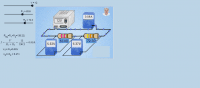
عند توصيل مقاومتين \(R_1\) و\(R_2\) على التوالي يكون للتيار مسار واحد، فيمر التيار نفسه في الاثنتين. ينخفض الجهد تدريجيًا من القطب الموجب للبطارية حتى القطب السالب، فيتوزع فرق جهد البطارية بين المقاومتين بنسبة قيمتيهما.
When two resistors \(R_1\) and \(R_2\) are connected in series the current has a single path, so the same current passes through both. The potential falls step by step from the battery’s positive terminal to the negative one, so the battery voltage is shared between the two resistors in the ratio of their values.
📘 القوانين
📘 The laws
\[R_{eq}=R_1+R_2\qquad I=\dfrac{V}{R_1+R_2}\]
\[V_1=IR_1\qquad V_2=IR_2\qquad V=V_1+V_2\qquad \dfrac{V_1}{V_2}=\dfrac{R_1}{R_2}\]
💡 ملاحظات
💡 Notes
- التيار \(I\) واحد في كل نقطة، فيقرأ الأميتر القيمة نفسها في أي مكان من الدائرة.The current \(I\) is the same at every point, so the ammeter reads the same value anywhere in the circuit.
- المقاومة الأكبر يقع عليها فرق جهد أكبر وتصرف قدرة أكبر.The larger resistor takes the larger voltage and dissipates more power.
- فرق الجهد بين نقطتين على سلك التوصيل صفر لأن مقاومة السلك مهملة.The potential difference between two points on a connecting wire is zero because the wire’s resistance is negligible.
🧪 تجربة 1: دائرة التوالي: قِس بنفسك
🧪 Experiment 1: Series circuit: measure it yourself
1) اضغط على المفتاح (أو زرّه) لتغلق الدائرة فتتحرك الشحنات. 2) اسحب مسباري الفولتميتر (الأحمر + والأسود −) إلى أي نقطتين من النقاط A و B و C و H واقرأ فرق الجهد. 3) لاحظ أن الأميترات الثلاثة تقرأ القيمة نفسها. 4) غيّر البطارية والمقاومتين وراقب مخطط الجهد أسفل الدائرة.
1) Click the switch (or use its button) to close the circuit and the charges move. 2) Drag the two voltmeter probes (red + and black −) to any two of the points A, B, C and H and read the potential difference. 3) Notice that the three ammeters read the same value. 4) Change the battery and the two resistors and watch the potential profile under the circuit.
🧪 تجربة 2: حاسبة: مقاومتان على التوالي
🧪 Experiment 2: Calculator: two resistors in series
مسألة جديدة في كل مرة. احسب التيار وفرق الجهد على كل مقاومة.
A new problem every time. Calculate the current and the voltage across each resistor.
✍️ أمثلة محلولة
✍️ Worked Examples
\(R_1=10\ \Omega\) و\(R_2=20\ \Omega\) على التوالي مع بطارية \(12\ \mathrm{V}\). احسب \(I\) و\(V_1\) و\(V_2\).
\(R_1=10\ \Omega\) and \(R_2=20\ \Omega\) in series with a \(12\ \mathrm{V}\) battery. Find \(I\), \(V_1\) and \(V_2\).
مقاومتان متساويتان \(15\ \Omega\) على التوالي مع بطارية \(9\ \mathrm{V}\). احسب التيار وفرق الجهد على كل مقاومة.
Two equal resistors of \(15\ \Omega\) in series with a \(9\ \mathrm{V}\) battery. Find the current and the voltage across each.
بطارية \(10\ \mathrm{V}\) ومقاومة \(R_1=8\ \Omega\) والتيار \(0.5\ \mathrm{A}\). احسب \(R_2\).
A \(10\ \mathrm{V}\) battery, \(R_1=8\ \Omega\) and a current of \(0.5\ \mathrm{A}\). Find \(R_2\).
\(R_1=2\ \Omega\) و\(R_2=6\ \Omega\) على التوالي. ما نسبة \(V_1:V_2\)؟
\(R_1=2\ \Omega\) and \(R_2=6\ \Omega\) in series. What is the ratio \(V_1:V_2\)?
في دائرة التوالي تتساوى:
In a series circuit the following are equal:
\(R_1=4\ \Omega\) و\(R_2=6\ \Omega\) على التوالي، المقاومة المكافئة:
\(R_1=4\ \Omega\) and \(R_2=6\ \Omega\) in series, the equivalent resistance:
إذا زادت \(R_2\) مع بقاء الباقي ثابتًا فإن التيار:
If \(R_2\) increases with the rest constant the current:
مجموع فرقي الجهد على المقاومتين يساوي:
The sum of the two voltages equals:
📚 ملخص
📚 Summary
| الكميةQuantity | القانونLaw |
|---|---|
| المقاومة المكافئةEquivalent resistance | \(R_1+R_2\)\(R_1+R_2\) |
| التيارCurrent | \(I=V/R_{eq}\)\(I=V/R_{eq}\) |
| فرق الجهدVoltage | \(V_i=IR_i,\ V=\sum V_i\)\(V_i=IR_i,\ V=\sum V_i\) |
⚠️ أخطاء شائعة
⚠️ Common mistakes
- الظن أن التيار ينقص بعد المقاومة الأولى.Thinking that the current decreases after the first resistor.
- الظن أن فرق جهد البطارية يقع كله على كل مقاومة.Thinking that the whole battery voltage falls across each resistor.
- استعمال قانون التوازي للمقاومة المكافئة في دائرة توالٍ.Using the parallel formula for the equivalent resistance in a series circuit.
🔗 محاكيات GeoGebra للاستعانة بها عند اللزوم
🔗 GeoGebra Simulations to Use When Needed
اضغط «تشغيل» لتعمل المحاكاة هنا داخل الدرس؛ ويمكن للطالب الرجوع إليها لتجربة الفكرة بطريقة أخرى.
Press “Run” to run the simulation right here inside the lesson; the student can use it to try the idea in another way.