🎯 نواتج التعلم
🎯 Learning Outcomes
بعد هذه التجربة ستكون قادرًا على أن:
After this experiment you will be able to:
- تعرّف معاملي الاحتكاك السكوني \(\mu_s\) والحركي \(\mu_k\) وتحسبهما من \(\mu_s=\dfrac{f_{s,max}}{N}\) و\(\mu_k=\dfrac{f_k}{N}\).Define the coefficients of static friction \(\mu_s\) and kinetic friction \(\mu_k\) and calculate them from \(\mu_s=\dfrac{f_{s,max}}{N}\) and \(\mu_k=\dfrac{f_k}{N}\).
- تقيس \(\mu_s\) بإيجاد أكبر قوة يبقى عندها الجسم ساكنًا، وتقيس \(\mu_k\) من التسارع \(\mu_k=\dfrac{F-ma}{mg}\).Measure \(\mu_s\) by finding the greatest force at which the body stays at rest, and measure \(\mu_k\) from the acceleration \(\mu_k=\dfrac{F-ma}{mg}\).
- تدرك أن المعامل ثابت للسطحين ولا يعتمد على كتلة الجسم.Realise that the coefficient is a constant of the two surfaces and does not depend on the mass of the body.
🎬 شاهد الفيديو
🎬 Watch the Video
📏 قياس معامل الاحتكاك
📏 Measuring the Coefficient of Friction
معامل الاحتكاك كمية بلا وحدة تصف خشونة سطحين متلامسين. يُحسب من النسبة بين قوة الاحتكاك والقوة العمودية. نقيس معامل الاحتكاك السكوني عند أن يوشك الجسم على الحركة، ومعامل الاحتكاك الحركي عندما يتحرك الجسم بالفعل.
The coefficient of friction is a quantity without a unit that describes the roughness of two surfaces in contact. It is calculated from the ratio between the friction force and the normal force. We measure the static coefficient when the body is just about to move and the kinetic coefficient when the body is already moving.
📘 القوانين
📘 The laws
\[\mu_s=\dfrac{f_{s,max}}{N}\qquad f_{s,max}=F_{\text{just before motion}}\qquad N=mg\]
\[\mu_k=\dfrac{f_k}{N}\qquad F-f_k=ma\ \Rightarrow\ \mu_k=\dfrac{F-ma}{mg}\]
💡 طريقة التجربة
💡 The procedure
- 1) زِد قوة السحب \(F\) تدريجيًا وسجّل أكبر قيمة بقي عندها الصندوق ساكنًا: هي \(f_{s,max}\) فتحسب \(\mu_s\).1) Increase the pulling force \(F\) gradually and record the greatest value at which the box stayed at rest: it is \(f_{s,max}\) so you calculate \(\mu_s\).
- 2) اجعل \(F\) أكبر من ذلك فيتحرك الصندوق واقرأ التسارع \(a\) فتحسب \(\mu_k=\dfrac{F-ma}{mg}\).2) Make \(F\) greater than that so the box moves and read the acceleration \(a\) then calculate \(\mu_k=\dfrac{F-ma}{mg}\).
- 3) غيّر الكتلة وكرّر: ستجد \(\mu_s\) و\(\mu_k\) كما هما (ثابتان للسطحين)، بينما يتناسب \(f_{s,max}\) مع \(N\).3) Change the mass and repeat: you will find \(\mu_s\) and \(\mu_k\) the same (constants of the two surfaces) while \(f_{s,max}\) is proportional to \(N\).
- دائمًا \(\mu_k\lt \mu_s\). ونستعمل \(g=9.8\ \mathrm{m/s^2}\).Always \(\mu_k\lt \mu_s\). We use \(g=9.8\ \mathrm{m/s^2}\).
🧪 تجربة 1: اكتشف معاملي الاحتكاك لسطح مجهول
🧪 Experiment 1: Find the two coefficients of friction of an unknown surface
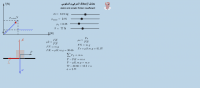
السطحان مجهولان (قيمتا \(\mu_s\) و\(\mu_k\) مخفيتان). زِد القوة \(F\) بالمؤشر؛ يتتبّع الجهاز أكبر قوة بقي عندها الصندوق ساكنًا. ثم اجعل \(F\) أكبر فيتحرك الصندوق. اضغط «سجّل \(\mu_s\)» و«سجّل \(\mu_k\)» لتضيف صفًّا إلى الجدول، وكرّر بكتلة مختلفة لترى ثبات المعاملين. أدخل نتيجتك واضغط «تحقق»، أو اضغط «اكشف القيم». لا شيء يتحرك من تلقاء نفسه.
The two surfaces are unknown (the values of \(\mu_s\) and \(\mu_k\) are hidden). Increase the force \(F\) with the slider; the device tracks the greatest force at which the box stayed at rest. Then make \(F\) greater so the box moves. Press “Record \(\mu_s\)” and “Record \(\mu_k\)” to add a row to the table, and repeat with another mass to see that the coefficients are constant. Enter your result and press “Check”, or press “Reveal the values”. Nothing moves by itself.
🧪 تجربة 2: حاسبة: من القياسات إلى المعاملين
🧪 Experiment 2: Calculator: from the measurements to the coefficients
مسألة جديدة في كل مرة (\(g=9.8\ \mathrm{m/s^2}\)). احسب القيم الثلاث ثم اضغط «صحّح».
A new problem every time (\(g=9.8\ \mathrm{m/s^2}\)). Calculate the three values and press “Check”.
🛠️ تطبيقات عملية
🛠️ Practical applications
- تصميم الإطارات: اختيار مطاط معامله مرتفع على الأسفلت.Tyre design: choosing a rubber of a high coefficient on asphalt.
- سلامة الأرضيات: اختبار انزلاق البلاط.Floor safety: testing the slipperiness of tiles.
- تحديد زاوية الاستقرار: \(\tan\theta_c=\mu_s\) على المستوى المائل.Finding the angle of repose: \(\tan\theta_c=\mu_s\) on the inclined plane.
✍️ أمثلة محلولة
✍️ Worked Examples
صندوق \(5\ \mathrm{kg}\) بقي ساكنًا حتى بلغت القوة \(24.5\ \mathrm{N}\) ثم تحرك. احسب \(\mu_s\) (\(g=9.8\)).
A \(5\ \mathrm{kg}\) box stayed at rest until the force reached \(24.5\ \mathrm{N}\) and then moved. Calculate \(\mu_s\) (\(g=9.8\)).
سُحب الصندوق نفسه بقوة ثابتة \(20\ \mathrm{N}\) فتحرك بتسارع \(1\ \mathrm{m/s^2}\). احسب \(\mu_k\).
The same box is pulled by a constant force of \(20\ \mathrm{N}\) and moves with an acceleration of \(1\ \mathrm{m/s^2}\). Calculate \(\mu_k\).
لو صار الصندوق \(10\ \mathrm{kg}\) على السطح نفسه، فما أكبر قوة يبقى عندها ساكنًا؟
If the box becomes \(10\ \mathrm{kg}\) on the same surface, what is the greatest force at which it stays at rest?
جسم على مستوى مائل بدأ ينزلق عند زاوية \(27^\circ\). ما \(\mu_s\)؟
A body on an inclined plane starts to slide at an angle of \(27^\circ\). What is \(\mu_s\)?
معامل الاحتكاك السكوني يساوي:
The coefficient of static friction equals:
وحدة معامل الاحتكاك:
The unit of the coefficient of friction is:
إذا تضاعفت كتلة الجسم على السطح نفسه فإن \(\mu_s\):
If the mass of the body doubles on the same surface then \(\mu_s\):
نحسب \(\mu_k\) من التسارع بالعلاقة:
We calculate \(\mu_k\) from the acceleration with:
📚 ملخص
📚 Summary
| الكميةQuantity | القانونLaw |
|---|---|
| \(\mu_s\)\(\mu_s\) | \(\dfrac{f_{s,max}}{N}\)\(\dfrac{f_{s,max}}{N}\) |
| \(\mu_k\)\(\mu_k\) | \(\dfrac{F-ma}{mg}\)\(\dfrac{F-ma}{mg}\) |
| العلاقةRelation | \(\mu_k\lt \mu_s\)\(\mu_k\lt \mu_s\) |
⚠️ أخطاء شائعة
⚠️ Common mistakes
- أخذ القوة بعد بدء الحركة لحساب \(\mu_s\)؛ نأخذ آخر قوة قبل الحركة.Taking the force after the motion starts to calculate \(\mu_s\); we take the last force before the motion.
- نسيان طرح \(ma\) عند حساب \(\mu_k\).Forgetting to subtract \(ma\) when calculating \(\mu_k\).
- الظن بأن المعامل يتغير بتغير الكتلة.Thinking the coefficient changes with the mass.
🔗 محاكيات GeoGebra للاستعانة بها عند اللزوم
🔗 GeoGebra Simulations to Use When Needed
اضغط «تشغيل» لتعمل المحاكاة هنا داخل الدرس؛ ويمكن للطالب الرجوع إليها لتجربة الفكرة بطريقة أخرى.
Press “Run” to run the simulation right here inside the lesson; the student can use it to try the idea in another way.