🎯 نواتج التعلم
🎯 Learning Outcomes
بعد هذه التجربة ستكون قادرًا على أن:
After this experiment you will be able to:
- تطبّق معادلات الحركة بتسارع ثابت \(v=v_0+at\) و\(x=x_0+v_0t+\tfrac12at^2\) و\(v^2=v_0^2+2a\Delta x\).Apply the equations of motion with constant acceleration \(v=v_0+at\), \(x=x_0+v_0t+\tfrac12at^2\) and \(v^2=v_0^2+2a\Delta x\).
- تختار المعادلة المناسبة حسب المعطيات والمجهول.Choose the suitable equation according to the given quantities and the unknown.
- تربط المعادلات بالرسمين البيانيين للموقع والزمن (قطع مكافئ) وللسرعة والزمن (خط مستقيم ميله التسارع).Relate the equations to the position–time graph (a parabola) and the velocity–time graph (a straight line whose slope is the acceleration).
🎬 شاهد الفيديو
🎬 Watch the Video
🚗 الحركة بتسارع ثابت
🚗 Motion with Constant Acceleration
عندما تتغير سرعة الجسم بمعدل ثابت تكون حركته بتسارع ثابت \(a\). نرمز بـ \(x_0\) للموقع الابتدائي و\(v_0\) للسرعة الابتدائية عند \(t=0\)، وبـ \(x\) و\(v\) للموقع والسرعة بعد زمن \(t\). التسارع \(a=\dfrac{\Delta v}{\Delta t}\) وإشارته مع اتجاه الحركة تحدّد التسارع أو التباطؤ.
When the velocity of a body changes at a constant rate its motion is with constant acceleration \(a\). We use \(x_0\) for the initial position and \(v_0\) for the initial velocity at \(t=0\), and \(x\) and \(v\) for the position and velocity after a time \(t\). The acceleration is \(a=\dfrac{\Delta v}{\Delta t}\) and its sign relative to the direction of motion decides whether the body speeds up or slows down.
📘 معادلات الحركة
📘 The equations of motion
\[v=v_0+at\]
\[x=x_0+v_0t+\tfrac12at^2\qquad(\Delta x=v_0t+\tfrac12at^2)\]
\[v^2=v_0^2+2a\,\Delta x\qquad \Delta x=\dfrac{v_0+v}{2}\,t\]
💡 كيف نختار المعادلة؟
💡 How do we choose the equation?
- لا يُذكر \(\Delta x\): استعمل \(v=v_0+at\).\(\Delta x\) is not mentioned: use \(v=v_0+at\).
- لا تُذكر \(v\) النهائية: استعمل \(\Delta x=v_0t+\tfrac12at^2\).The final \(v\) is not mentioned: use \(\Delta x=v_0t+\tfrac12at^2\).
- لا يُذكر \(t\): استعمل \(v^2=v_0^2+2a\Delta x\).\(t\) is not mentioned: use \(v^2=v_0^2+2a\Delta x\).
- الرسم البياني للسرعة والزمن خط مستقيم ميله \(a\) والمساحة تحته \(=\Delta x\)، وللموقع والزمن قطع مكافئ ميله عند أي لحظة \(=v\).The velocity–time graph is a straight line whose slope is \(a\) and the area under it \(=\Delta x\); the position–time graph is a parabola whose slope at any instant \(=v\).
- نتعامل مع الإشارات: الاتجاه الموجب يُحدَّد في البداية، فيكون التسارع سالبًا إذا كان عكسه (التباطؤ في حركة موجبة).Signs matter: the positive direction is chosen at the start, so the acceleration is negative if it is opposite to it (slowing down in a positive motion).
🧪 تجربة 1: حرّك السيارة بتسارع ثابت وعوّض في المعادلات
🧪 Experiment 1: Move the car with constant acceleration and substitute in the equations
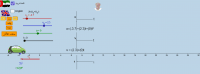
اختر الموقع الابتدائي \(x_0\) والسرعة الابتدائية \(v_0\) والتسارع \(a\)، ثم حرّك مؤشر الزمن \(t\) أو اضغط «شغّل» (لا تبدأ الحركة من تلقاء نفسها). يظهر التعويض المباشر في المعادلات، وتُرسم نقطة الحالة على الرسمين البيانيين: الموقع (قطع مكافئ) والسرعة (خط مستقيم ميله \(a\)).
Choose the initial position \(x_0\), the initial velocity \(v_0\) and the acceleration \(a\), then move the time slider \(t\) or press “Play” (the motion never starts by itself). The direct substitution in the equations appears, and the state point is drawn on the two graphs: position (a parabola) and velocity (a straight line of slope \(a\)).
🧪 تجربة 2: حاسبة التحقق: حلّ المسألة ثم صحّح
🧪 Experiment 2: Checker: solve the problem and check
مسألة جديدة في كل مرة. استعمل المعادلات المناسبة واحسب القيم الثلاث ثم اضغط «صحّح».
A new problem every time. Use the suitable equations, calculate the three values and press “Check”.
🛠️ تطبيقات عملية
🛠️ Practical applications
- مسافة الفرملة: \(\Delta x=\dfrac{v_0^2}{2|a|}\) تتضاعف أربع مرات إذا تضاعفت السرعة.Braking distance: \(\Delta x=\dfrac{v_0^2}{2|a|}\) becomes four times if the speed doubles.
- إقلاع الطائرات: تحسب الطول اللازم للمدرج من السرعة المطلوبة والتسارع.Take-off of aircraft: the required length of the runway is found from the required speed and the acceleration.
- السقوط الحر: حالة خاصة \(a=g\).Free fall: a special case \(a=g\).
✍️ أمثلة محلولة
✍️ Worked Examples
بقيم المحاكاة الأصلية: \(x_0=-5\ \mathrm{m}\) و\(v_0=2\ \mathrm{m/s}\) و\(a=0.8\ \mathrm{m/s^2}\). أوجد السرعة والموقع بعد \(5\ \mathrm{s}\).
With the values of the original simulation: \(x_0=-5\ \mathrm{m}\), \(v_0=2\ \mathrm{m/s}\) and \(a=0.8\ \mathrm{m/s^2}\). Find the velocity and the position after \(5\ \mathrm{s}\).
سيارة تنطلق من السكون بتسارع \(3\ \mathrm{m/s^2}\). كم ثانية تحتاج لتبلغ \(24\ \mathrm{m/s}\)؟ وما المسافة التي تقطعها؟
A car starts from rest with an acceleration of \(3\ \mathrm{m/s^2}\). How long does it need to reach \(24\ \mathrm{m/s}\)? What distance does it cover?
سيارة سرعتها \(20\ \mathrm{m/s}\) فرملت بتسارع \(-4\ \mathrm{m/s^2}\). أوجد زمن توقفها ومسافة الفرملة.
A car at \(20\ \mathrm{m/s}\) brakes with an acceleration of \(-4\ \mathrm{m/s^2}\). Find the time it takes to stop and the braking distance.
جسم سرعته الابتدائية \(5\ \mathrm{m/s}\) وتسارعه \(2\ \mathrm{m/s^2}\) قطع إزاحة \(24\ \mathrm{m}\). أوجد سرعته النهائية والزمن.
A body with an initial velocity of \(5\ \mathrm{m/s}\) and an acceleration of \(2\ \mathrm{m/s^2}\) covers a displacement of \(24\ \mathrm{m}\). Find its final velocity and the time.
ميل الرسم البياني للسرعة والزمن يمثل:
The slope of the velocity–time graph represents:
جسم ينطلق من السكون بتسارع \(2\ \mathrm{m/s^2}\). سرعته بعد \(5\ \mathrm{s}\):
A body starts from rest with an acceleration of \(2\ \mathrm{m/s^2}\). Its velocity after \(5\ \mathrm{s}\) is:
إذا تضاعفت السرعة الابتدائية لسيارة تفرمل بالتسارع نفسه فإن مسافة الفرملة:
If the initial speed of a car braking with the same acceleration doubles, the braking distance:
الرسم البياني للموقع والزمن في الحركة بتسارع ثابت غير صفري هو:
The position–time graph for motion with a non-zero constant acceleration is:
📚 ملخص
📚 Summary
| المعادلةEquation | تُستعمل عندما لا يُذكرUse when it is not mentioned |
|---|---|
| \(v=v_0+at\)\(v=v_0+at\) | الإزاحةthe displacement |
| \(\Delta x=v_0t+\tfrac12at^2\)\(\Delta x=v_0t+\tfrac12at^2\) | السرعة النهائيةthe final velocity |
| \(v^2=v_0^2+2a\Delta x\)\(v^2=v_0^2+2a\Delta x\) | الزمنthe time |
| \(\Delta x=\tfrac{v_0+v}{2}t\)\(\Delta x=\tfrac{v_0+v}{2}t\) | التسارعthe acceleration |
⚠️ أخطاء شائعة
⚠️ Common mistakes
- استعمال هذه المعادلات عندما يتغير التسارع؛ هي صالحة فقط للتسارع الثابت.Using these equations when the acceleration changes; they are valid only for constant acceleration.
- نسيان الموقع الابتدائي \(x_0\) عند حساب الموقع (الإزاحة غير الموقع).Forgetting the initial position \(x_0\) when finding the position (the displacement is not the position).
- إهمال إشارة التسارع في التباطؤ.Ignoring the sign of the acceleration when slowing down.
🔗 محاكيات GeoGebra للاستعانة بها عند اللزوم
🔗 GeoGebra Simulations to Use When Needed
اضغط «تشغيل» لتعمل المحاكاة هنا داخل الدرس؛ ويمكن للطالب الرجوع إليها لتجربة الفكرة بطريقة أخرى.
Press “Run” to run the simulation right here inside the lesson; the student can use it to try the idea in another way.