🎯 نواتج التعلم
🎯 Learning Outcomes
بعد هذه التجربة ستكون قادرًا على أن:
After this experiment you will be able to:
- تجد محصلة متجهين بينهما زاوية بطريقتي متوازي الأضلاع والمثلث.Find the resultant of two vectors at an angle by the parallelogram and the triangle methods.
- تحسب مقدار المحصلة بقانون جيب التمام واتجاهها بقانون الجيب أو المركبات.Calculate the magnitude of the resultant with the cosine rule and its direction with the sine rule or the components.
- تصف كيف تتغير المحصلة مع الزاوية بين المتجهين من القيمة العظمى إلى الصغرى.Describe how the resultant changes with the angle between the vectors from the maximum to the minimum value.
🎬 شاهد الفيديو
🎬 Watch the Video
📐 متجهان بينهما زاوية
📐 Two Vectors at an Angle
إذا رُسم المتجهان \(A\) و\(B\) من نقطة واحدة وكانت الزاوية بينهما \(\varphi\) فإن المحصلة هي قطر متوازي الأضلاع المنشأ عليهما. نحسب مقدارها بقانون جيب التمام، ونحسب اتجاهها بالنسبة إلى \(A\) من مركبتيها.
If the vectors \(A\) and \(B\) are drawn from one point with an angle \(\varphi\) between them the resultant is the diagonal of the parallelogram built on them. Its magnitude comes from the cosine rule and its direction relative to \(A\) from its components.
📘 القوانين
📘 The laws
\[R=\sqrt{A^2+B^2+2AB\cos\varphi}\]
\[R_x=A+B\cos\varphi\qquad R_y=B\sin\varphi\qquad \tan\alpha=\dfrac{B\sin\varphi}{A+B\cos\varphi}\]
💡 ملاحظات
💡 Notes
- \(\varphi=0^\circ\): \(R=A+B\) (أكبر قيمة). \(\varphi=180^\circ\): \(R=|A-B|\) (أصغر قيمة).\(\varphi=0^\circ\): \(R=A+B\) (the maximum). \(\varphi=180^\circ\): \(R=|A-B|\) (the minimum).
- \(\varphi=90^\circ\): \(R=\sqrt{A^2+B^2}\) (فيثاغورس).\(\varphi=90^\circ\): \(R=\sqrt{A^2+B^2}\) (Pythagoras).
- المحصلة تقع بين المتجهين وأقرب إلى الأكبر.The resultant lies between the two vectors and closer to the larger one.
🧪 تجربة 1: اضبط الزاوية وشاهد المحصلة
🧪 Experiment 1: Set the angle and watch the resultant
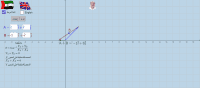
يخرج \(A\) أفقيًّا و\(B\) بزاوية \(\varphi\) معه. اسحب رأس \(B\) لتغيير مقداره والزاوية، ورأس \(A\) لتغيير مقداره، أو استعمل المنزلقات. اختر طريقة الرسم: متوازي الأضلاع أو المثلث (الرأس إلى الذيل). المنحنى أسفل الرسم يبيّن \(R\) مع \(\varphi\). (لا شيء يتحرك من تلقاء نفسه.)
\(A\) starts horizontally and \(B\) makes an angle \(\varphi\) with it. Drag the head of \(B\) to change its magnitude and the angle, the head of \(A\) to change its magnitude, or use the sliders. Choose the drawing method: parallelogram or triangle (head to tail). The curve under the drawing shows \(R\) against \(\varphi\). (Nothing moves by itself.)
🧪 تجربة 2: حاسبة: متجهان بينهما زاوية
🧪 Experiment 2: Calculator: two vectors at an angle
مسألة جديدة في كل مرة. أدخل الجواب.
A new problem every time. Enter the answer.
✍️ أمثلة محلولة
✍️ Worked Examples
قوتان \(3\ \mathrm{N}\) و\(5\ \mathrm{N}\) بينهما \(60^\circ\). احسب المحصلة.
Two forces \(3\ \mathrm{N}\) and \(5\ \mathrm{N}\) with \(60^\circ\) between them. Find the resultant.
قوتان \(3\ \mathrm{N}\) و\(8\ \mathrm{N}\) بينهما \(120^\circ\). احسب المحصلة.
Two forces \(3\ \mathrm{N}\) and \(8\ \mathrm{N}\) with \(120^\circ\) between them. Find the resultant.
في المثال 1 احسب اتجاه المحصلة بالنسبة إلى القوة \(3\ \mathrm{N}\).
In example 1 find the direction of the resultant relative to the \(3\ \mathrm{N}\) force.
ما أكبر وأصغر محصلة ممكنة لقوتين \(6\ \mathrm{N}\) و\(10\ \mathrm{N}\)؟
What are the largest and smallest possible resultants of forces \(6\ \mathrm{N}\) and \(10\ \mathrm{N}\)?
أكبر محصلة لمتجهين تكون عندما تكون الزاوية بينهما:
The largest resultant of two vectors occurs when the angle between them is:
عند \(\varphi=180^\circ\) تكون المحصلة:
At \(\varphi=180^\circ\) the resultant is:
زيادة الزاوية بين متجهين من \(0\) إلى \(180^\circ\) تجعل المحصلة:
Increasing the angle between two vectors from \(0\) to \(180^\circ\) makes the resultant:
متجهان متساويان المقدار \(F\) بينهما \(120^\circ\)، محصلتهما:
Two vectors of equal magnitude \(F\) with \(120^\circ\) between them have a resultant:
📚 ملخص
📚 Summary
| الزاوية \(\varphi\)Angle \(\varphi\) | المحصلة \(R\)Resultant \(R\) |
|---|---|
| \(0^\circ\)\(0^\circ\) | \(A+B\)\(A+B\) |
| \(90^\circ\)\(90^\circ\) | \(\sqrt{A^2+B^2}\)\(\sqrt{A^2+B^2}\) |
| \(180^\circ\)\(180^\circ\) | \(|A-B|\)\(|A-B|\) |
⚠️ أخطاء شائعة
⚠️ Common mistakes
- نسيان إشارة \(\cos\varphi\) عند الزوايا الأكبر من \(90^\circ\).Forgetting the sign of \(\cos\varphi\) for angles larger than \(90^\circ\).
- جمع المقدارين دون اعتبار الزاوية.Adding the magnitudes without considering the angle.
- الخلط بين الزاوية بين المتجهين والزاوية داخل المثلث (الفرق \(180^\circ-\varphi\)).Confusing the angle between the vectors with the angle inside the triangle (the difference \(180^\circ-\varphi\)).
🔗 محاكيات GeoGebra للاستعانة بها عند اللزوم
🔗 GeoGebra Simulations to Use When Needed
اضغط «تشغيل» لتعمل المحاكاة هنا داخل الدرس؛ ويمكن للطالب الرجوع إليها لتجربة الفكرة بطريقة أخرى.
Press “Run” to run the simulation right here inside the lesson; the student can use it to try the idea in another way.