🎯 نواتج التعلم
🎯 Learning Outcomes
بعد هذه التجربة ستكون قادرًا على أن:
After this experiment you will be able to:
- تحلّل متجهًا إلى مركّبتين \(A_x=A\cos\theta\) و\(A_y=A\sin\theta\).Resolve a vector into two components \(A_x=A\cos\theta\) and \(A_y=A\sin\theta\).
- تجمع مركّبات كل محور لإيجاد \(R_x\) و\(R_y\).Add the components of each axis to find \(R_x\) and \(R_y\).
- تحسب مقدار المحصلة واتجاهها وتحدّد الربع من إشارتي المركّبتين.Calculate the magnitude and the direction of the resultant and determine the quadrant from the signs of the two components.
🎬 شاهد الفيديو
🎬 Watch the Video
➕ لماذا نجمع بالتحليل؟
➕ Why Add by Resolution?
جمع متجهين بالرسم أو بقانون جيب التمام يصعب إذا زاد عددهما أو كانت زواياهما اعتباطية. أما طريقة التحليل فتحوّل المسألة إلى جمع أعداد عاديّة على محورين: نحلّل كل متجه إلى مركّبتين \(x\) و\(y\)، ونجمع مركّبات \(x\) معًا ومركّبات \(y\) معًا، فنحصل على مركّبتي المحصلة. وتصلح الطريقة لأي عدد من المتجهات.
Adding two vectors graphically or with the law of cosines becomes hard if there are more of them or their angles are arbitrary. The resolution method turns the problem into adding ordinary numbers on two axes: we resolve each vector into an \(x\) and a \(y\) component, add the \(x\) components together and the \(y\) components together and obtain the components of the resultant. The method works for any number of vectors.
📌 خطوات الطريقة
📌 The steps of the method
\[A_x=A\cos\theta_A,\quad A_y=A\sin\theta_A\qquad B_x=B\cos\theta_B,\quad B_y=B\sin\theta_B\]
\[R_x=A_x+B_x\qquad,\qquad R_y=A_y+B_y\]
\[R=\sqrt{R_x^{2}+R_y^{2}}\qquad,\qquad \theta=\tan^{-1}\dfrac{R_y}{R_x}\]
🧭 تحديد الاتجاه والربع
🧭 Determining the Direction and the Quadrant
الآلة الحاسبة تعطي \(\tan^{-1}\) بين \(-90^\circ\) و\(90^\circ\) فقط، لذلك ننظر إلى إشارتي \(R_x\) و\(R_y\) لنعرف الربع ونصحّح الزاوية:
The calculator gives \(\tan^{-1}\) only between \(-90^\circ\) and \(90^\circ\), so we look at the signs of \(R_x\) and \(R_y\) to know the quadrant and correct the angle:
| إشارتا \(R_x\) و\(R_y\)Signs of \(R_x\) and \(R_y\) | الربعQuadrant | الزاوية \(\theta\) من محور \(+x\)The angle \(\theta\) from the \(+x\) axis |
|---|---|---|
| \(+\ ,\ +\) | الأولFirst | \(\alpha\) |
| \(-\ ,\ +\) | الثانيSecond | \(180^\circ-\alpha\) |
| \(-\ ,\ -\) | الثالثThird | \(180^\circ+\alpha\) |
| \(+\ ,\ -\) | الرابعFourth | \(360^\circ-\alpha\) |
حيث \(\alpha=\tan^{-1}\left|\dfrac{R_y}{R_x}\right|\) الزاوية الحادة مع محور \(x\).
where \(\alpha=\tan^{-1}\left|\dfrac{R_y}{R_x}\right|\) is the acute angle with the \(x\)-axis.
🧪 جرّب بنفسك: التحليل والجمع
🧪 Try It Yourself: Resolve and Add
🧪 تجربة 1: محصلة متجهين بالتحليل إلى مركّبات
🧪 Experiment 1: The Resultant of Two Vectors by Resolution into Components
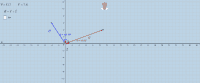
اضبط مقدار وزاوية كل من المتجهين \(A\) و\(B\) وراقب مركّباتهما على المحورين وجدول الجمع \(R_x\) و\(R_y\) ثم المحصلة \(R\) وزاويتها والربع الذي تقع فيه.
Set the magnitude and the angle of each of the vectors \(A\) and \(B\) and watch their components on the axes and the addition table \(R_x\) and \(R_y\) then the resultant \(R\), its angle and the quadrant in which it lies.
المتجه \(A=10\) بزاوية \(30^\circ\) والمتجه \(B=8\) بزاوية \(120^\circ\). أوجد المحصلة مقدارًا واتجاهًا.
The vector \(A=10\) at \(30^\circ\) and the vector \(B=8\) at \(120^\circ\). Find the resultant in magnitude and direction.
متجهان \(A=6\) بزاوية \(0^\circ\) و\(B=10\) بزاوية \(210^\circ\). أوجد المحصلة.
Two vectors \(A=6\) at \(0^\circ\) and \(B=10\) at \(210^\circ\). Find the resultant.
إذا كان \(R_x=-3\) و\(R_y=+4\) فإن المحصلة تقع في الربع:
If \(R_x=-3\) and \(R_y=+4\) the resultant lies in the quadrant:
🎲 تدرّب على المسائل
🎲 Practice Problems
🧪 تجربة 2: تدرّب: أوجد المحصلة
🧪 Experiment 2: Practice: Find the Resultant
مسائل عشوائية: أدخل مقدار المحصلة وزاويتها ثم اضغط «تحقّق».
Random problems: enter the magnitude of the resultant and its angle then press “Check”.
متجهان \(A=3\) بزاوية \(0^\circ\) و\(B=4\) بزاوية \(90^\circ\). مقدار المحصلة:
Two vectors \(A=3\) at \(0^\circ\) and \(B=4\) at \(90^\circ\). The magnitude of the resultant:
⚠️ أخطاء شائعة
⚠️ Common Mistakes
تجنّب هذه الأخطاء
Avoid these mistakes
- جمع المقدارين \(A+B\) مباشرة بدل جمع المركّبات.Adding the magnitudes \(A+B\) directly instead of adding the components.
- إهمال إشارة المركّبة عندما تقع الزاوية في الربع الثاني أو الثالث أو الرابع.Neglecting the sign of a component when the angle is in the second, third or fourth quadrant.
- الاكتفاء بقيمة \(\tan^{-1}\) من الآلة دون تصحيح الربع.Taking the value of \(\tan^{-1}\) from the calculator without correcting the quadrant.
- تشغيل الآلة بوضع الراديان بدل الدرجات.Using the calculator in radian mode instead of degrees.
📚 ملخص
📚 Summary
أهم ما تعلمناه
Key points
- نحلّل ثم نجمع كل محور على حدة: \(R_x=\Sigma V_x\) و\(R_y=\Sigma V_y\).We resolve then add each axis separately: \(R_x=\Sigma V_x\) and \(R_y=\Sigma V_y\).
- \(R=\sqrt{R_x^2+R_y^2}\) و\(\theta=\tan^{-1}(R_y/R_x)\) مع تصحيح الربع.\(R=\sqrt{R_x^2+R_y^2}\) and \(\theta=\tan^{-1}(R_y/R_x)\) with the quadrant corrected.
🔗 محاكيات GeoGebra للاستعانة بها عند اللزوم
🔗 GeoGebra Simulations to Use When Needed
اضغط «تشغيل» لتعمل المحاكاة هنا داخل الدرس؛ ويمكن للطالب الرجوع إليها لتجربة الفكرة بطريقة أخرى.
Press “Run” to run the simulation right here inside the lesson; the student can use it to try the idea in another way.