🎯 نواتج التعلم
🎯 Learning Outcomes
بعد هذه التجربة ستكون قادرًا على أن:
After this experiment you will be able to:
- تحسب محصلة قوتين على خط واحد بالجمع الجبري مع الإشارات.Calculate the resultant of two forces along one line by an algebraic sum with signs.
- تحدد اتجاه المحصلة وتفرّق بين حالة القوتين المتفقتين والمتعاكستين والمتعادلتين.Decide the direction of the resultant and distinguish forces in the same direction, opposite directions and balanced forces.
- تحسب التسارع \(a=\dfrac{F_{net}}{m}\) والسرعة والموضع لجسم تؤثر فيه المحصلة.Calculate the acceleration \(a=\dfrac{F_{net}}{m}\), the velocity and the position of a body acted on by the resultant.
🎬 شاهد الفيديو
🎬 Watch the Video
↔️ محصلة قوتين على خط واحد
↔️ The Resultant of Two Forces on One Line
القوة كمية متجهة، ففي بعد واحد نختار اتجاهًا موجبًا (عادة نحو اليمين) ونعطي كل قوة إشارة بحسب اتجاهها. المحصلة هي القوة الوحيدة التي تُحدث الأثر نفسه، وتساوي المجموع الجبري:
Force is a vector, so in one dimension we choose a positive direction (usually to the right) and give each force a sign according to its direction. The resultant is the single force that has the same effect and equals the algebraic sum:
📘 المحصلة والتسارع
📘 The resultant and the acceleration
\[F_{net}=F_1+F_2\]
\[a=\dfrac{F_{net}}{m}=\dfrac{F_1+F_2}{m}\qquad v=v_i+at\qquad x=v_it+\tfrac12at^2\]
| الحالةCase | المحصلةResultant | أثرهاEffect |
|---|---|---|
| قوتان بنفس الاتجاهtwo forces in the same direction | \(|F_{net}|=|F_1|+|F_2|\)\(|F_{net}|=|F_1|+|F_2|\) | تسارع كبير نحو اتجاههماa large acceleration along them |
| قوتان متعاكستان مختلفتانtwo opposite forces of different size | \(|F_{net}|=\big||F_1|-|F_2|\big|\)\(|F_{net}|=\big||F_1|-|F_2|\big|\) | اتجاه المحصلة نحو الأكبرthe resultant points toward the larger |
| قوتان متعاكستان متساويتانtwo opposite forces of equal size | \(F_{net}=0\)\(F_{net}=0\) | لا تسارع: ساكن أو سرعة ثابتةno acceleration: at rest or constant velocity |
💡 شرح إضافي: «القوى متعادلة» لا تعني أن الجسم ساكن
💡 Extra explanation: “balanced forces” does not mean that the body is at rest
عندما تكون المحصلة صفرًا يكون التسارع صفرًا، فيبقى الجسم على حالته: ساكنًا إن كان ساكنًا أو متحركًا بسرعة ثابتة إن كان متحركًا (قانون نيوتن الأول). جرّب في التجربة: اضبط \(F_2=-F_1\) ثم أعطِ الجسم سرعة ابتدائية \(v_i\) فيستمر في الحركة بالسرعة نفسها. وفي المقابل، إذا كانت المحصلة غير صفرية يتغير الجسم سرعته بمعدل \(a=F_{net}/m\) وتتناسب التسارعات عكسيًا مع الكتلة: ضاعف الكتلة يقل التسارع إلى النصف.
When the resultant is zero the acceleration is zero so the body keeps its state: at rest if it was at rest or moving with a constant velocity if it was moving (Newton’s first law). Try it in the experiment: set \(F_2=-F_1\) and give the body an initial velocity \(v_i\); it keeps moving with the same velocity. Conversely, if the resultant is not zero the velocity changes at the rate \(a=F_{net}/m\), and the acceleration is inversely proportional to the mass: doubling the mass halves the acceleration.
🧪 تجربة 1: شخصان يسحبان جسمًا: محصلة قوتين على خط واحد
🧪 Experiment 1: Two persons pull a body: the resultant of two forces on one line
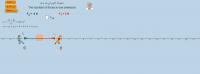
تؤثر قوتان \(F_1\) و\(F_2\) في جسم كتلته \(m\) على خط مستقيم. نعتبر الاتجاه نحو اليمين موجبًا ونحو اليسار سالبًا، فتكون المحصلة جمعًا جبريًا \(F_{net}=F_1+F_2\)، والتسارع \(a=\dfrac{F_{net}}{m}\)، والسرعة \(v=v_i+at\). اضبط القوتين والكتلة (واجعل إحدى القوتين سالبة لتتعاكسا) ثم اضغط «بدء»، وفعّل «F_net» لترى المحصلة على الجسم.
Two forces \(F_1\) and \(F_2\) act on a body of mass \(m\) along a straight line. We take the direction to the right as positive and to the left as negative, so the resultant is an algebraic sum \(F_{net}=F_1+F_2\), the acceleration is \(a=\dfrac{F_{net}}{m}\) and the velocity is \(v=v_i+at\). Set the two forces and the mass (make one force negative so they oppose each other) and press “Start”, and tick “F_net” to see the resultant on the body.
✍️ أمثلة محلولة
✍️ Worked Examples
شخصان يسحبان صندوقًا كتلته \(1\ \mathrm{kg}\): الأول بقوة \(3\ \mathrm{N}\) نحو اليمين والثاني بقوة \(2\ \mathrm{N}\) نحو اليسار (قيم الأداة الأصلية). احسب المحصلة والتسارع والسرعة بعد \(4\ \mathrm{s}\) من السكون.
Two persons pull a box of mass \(1\ \mathrm{kg}\): the first with \(3\ \mathrm{N}\) to the right and the second with \(2\ \mathrm{N}\) to the left (the values of the original applet). Calculate the resultant, the acceleration and the velocity after \(4\ \mathrm{s}\) from rest.
قوتان \(5\ \mathrm{N}\) و\(7\ \mathrm{N}\) تؤثران في جسم نحو اليمين. ما محصلتهما؟ وماذا لو كانت الثانية نحو اليسار؟
Two forces \(5\ \mathrm{N}\) and \(7\ \mathrm{N}\) act on a body to the right. What is their resultant? And if the second were to the left?
جسم كتلته \(2\ \mathrm{kg}\) تؤثر فيه قوتان \(10\ \mathrm{N}\) نحو اليمين و\(4\ \mathrm{N}\) نحو اليسار. احسب التسارع والإزاحة بعد \(4\ \mathrm{s}\) من السكون.
A body of mass \(2\ \mathrm{kg}\) is acted on by two forces: \(10\ \mathrm{N}\) to the right and \(4\ \mathrm{N}\) to the left. Calculate the acceleration and the displacement after \(4\ \mathrm{s}\) from rest.
جسم كتلته \(3\ \mathrm{kg}\) يتحرك بسرعة \(2\ \mathrm{m/s}\) نحو اليمين وتؤثر فيه قوتان \(6\ \mathrm{N}\) نحو اليمين و\(6\ \mathrm{N}\) نحو اليسار. ماذا تكون سرعته بعد \(10\ \mathrm{s}\)؟
A body of mass \(3\ \mathrm{kg}\) moves at \(2\ \mathrm{m/s}\) to the right and is acted on by two forces: \(6\ \mathrm{N}\) to the right and \(6\ \mathrm{N}\) to the left. What is its velocity after \(10\ \mathrm{s}\)?
قوتان على خط واحد \(F_1=8\ \mathrm{N}\) نحو اليمين و\(F_2=3\ \mathrm{N}\) نحو اليسار. المحصلة:
Two forces on one line \(F_1=8\ \mathrm{N}\) to the right and \(F_2=3\ \mathrm{N}\) to the left. The resultant is:
إذا تساوت قوتان متعاكستان على جسم متحرك بسرعة ثابتة فإنه:
If two opposite forces on a moving body are equal it:
ضاعفنا كتلة الجسم مع بقاء القوتين فإن تسارعه:
If the mass of the body is doubled with the two forces unchanged its acceleration:
إشارة التسارع السالبة في الأداة تعني أن المحصلة:
A negative sign of the acceleration means that the resultant is:
📚 ملخص
📚 Summary
| المفهومConcept | القانونLaw |
|---|---|
| محصلة قوتين على خط واحدResultant on one line | \(F_{net}=F_1+F_2\ (\text{with signs})\)\(F_{net}=F_1+F_2\ (\text{with signs})\) |
| التسارع والحركةAcceleration and motion | \(a=\dfrac{F_{net}}{m}\ ,\ v=v_i+at\)\(a=\dfrac{F_{net}}{m}\ ,\ v=v_i+at\) |
⚠️ أخطاء شائعة
⚠️ Common mistakes
- جمع مقداري القوتين دون إشارات عندما تكونان متعاكستين.Adding the sizes of the two forces without signs when they are opposite.
- الاعتقاد بأن الجسم يتوقف عندما تتعادل القوتان؛ يستمر بسرعته الثابتة.Believing that the body stops when the forces balance; it continues with its constant velocity.
- نسيان قسمة المحصلة على الكتلة عند حساب التسارع.Forgetting to divide the resultant by the mass when calculating the acceleration.
🔗 محاكيات GeoGebra للاستعانة بها عند اللزوم
🔗 GeoGebra Simulations to Use When Needed
اضغط «تشغيل» لتعمل المحاكاة هنا داخل الدرس؛ ويمكن للطالب الرجوع إليها لتجربة الفكرة بطريقة أخرى.
Press “Run” to run the simulation right here inside the lesson; the student can use it to try the idea in another way.