🎯 نواتج التعلم
🎯 Learning Outcomes
بعد هذه التجربة ستكون قادرًا على أن:
After this experiment you will be able to:
- تحسب عزم قوة حول محور \(\tau=rF\sin\theta\) وتحدد إشارته.Calculate the torque of a force about an axis \(\tau=rF\sin\theta\) and decide its sign.
- تحسب محصلة عزوم عدة قوى \(\Sigma\tau\) جبريًا.Calculate the net torque of several forces \(\Sigma\tau\) algebraically.
- تطبّق شرط الاتزان الدوراني \(\Sigma\tau=0\) (مع \(\Sigma F=0\)) في مسائل العارضة والأرجوحة.Apply the rotational-equilibrium condition \(\Sigma\tau=0\) (with \(\Sigma F=0\)) in beam and see-saw problems.
- تربط محصلة العزوم بالتسارع الزاوي \(\Sigma\tau=I\alpha\).Relate the net torque to the angular acceleration \(\Sigma\tau=I\alpha\).
🎬 شاهد الفيديو
🎬 Watch the Video
🔧 عزم الدوران لقوة واحدة
🔧 The Torque of One Force
القوة تدير الجسم حول محور ثابت بعزم يعتمد على ثلاثة أشياء: مقدار القوة \(F\) وبُعد نقطة تأثيرها عن المحور \(r\) والزاوية \(\theta\) بين القوة والخط الواصل من المحور إلى نقطة التأثير:
A force turns a body about a fixed axis with a torque that depends on three things: the size of the force \(F\), the distance \(r\) of its point of application from the axis and the angle \(\theta\) between the force and the line from the axis to the point of application:
📘 عزم القوة
📘 The torque of a force
\[\tau=r\,F\sin\theta\]
وحدته \(\mathrm{N\cdot m}\) (نيوتن·متر). ونفضّل كتابتها هكذا ولا نسميها «جول» مع أن أبعادها واحدة، لأن العزم كمية متجهة والجول وحدة الطاقة.
Its unit is \(\mathrm{N\cdot m}\) (newton·metre). We write it this way and do not call it a “joule” although the dimensions are the same, because torque is a vector and the joule is the unit of energy.
القوة \(F\) تؤثر في نقطة تبعد \(r\) عن محور الدوران \(P\) وتصنع زاوية \(\theta\) مع الخط الواصل بين المحور ونقطة التأثير؛ المركبة العمودية \(F\sin\theta\) هي التي تدير الجسم.
The force \(F\) acts at a point a distance \(r\) from the pivot \(P\) and makes an angle \(\theta\) with the line joining the pivot to the point; the perpendicular component \(F\sin\theta\) is what turns the body.
💡 شرح إضافي: لماذا \(\sin\theta\)؟ وما ذراع القوة؟
💡 Extra explanation: why \(\sin\theta\)? And what is the lever arm?
نحلّل القوة إلى مركبتين: مركبة على امتداد الخط الواصل من المحور (لا تدير الجسم لأنها تمرّ بالمحور) ومركبة عمودية عليه \(F_\perp=F\sin\theta\) هي التي تدير. لذلك \(\tau=r\,F_\perp\). ويمكن أن نرى الأمر بطريقة ثانية: \(\tau=F\,(r\sin\theta)=F\,d\) حيث \(d=r\sin\theta\) هي ذراع القوة أي البعد العمودي بين المحور وخط عمل القوة. أكبر عزم عندما \(\theta=90^\circ\) (دفع الباب عموديًا)، وينعدم العزم عندما \(\theta=0\) أو \(180^\circ\) (دفع الباب بمحاذاة مستواه) أو عندما تمرّ القوة بالمحور (\(r=0\)).
We resolve the force into two components: one along the line from the axis (it does not turn the body because it passes through the axis) and one perpendicular to it, \(F_\perp=F\sin\theta\), which does the turning. So \(\tau=r\,F_\perp\). Another way to see it: \(\tau=F\,(r\sin\theta)=F\,d\) where \(d=r\sin\theta\) is the lever arm, the perpendicular distance from the axis to the line of action of the force. The torque is largest at \(\theta=90^\circ\) (pushing a door perpendicularly) and vanishes at \(\theta=0\) or \(180^\circ\) (pushing along the plane of the door) or when the force passes through the axis (\(r=0\)).
⚖️ محصلة العزوم والاتزان الدوراني
⚖️ The Net Torque and Rotational Equilibrium
إذا أثّرت عدة قوى في جسم يدور حول محور فإن محصلة عزم الدوران هي المجموع الجبري لعزوم القوى حول المحور نفسه. نتفق على أن العزم موجب إذا أدار الجسم عكس عقارب الساعة وسالب إذا أداره مع عقارب الساعة:
When several forces act on a body that turns about an axis the net torque is the algebraic sum of the torques of the forces about the same axis. We agree that a torque is positive if it turns the body counter-clockwise and negative if it turns it clockwise:
📘 المحصلة وشرط الاتزان
📘 The net torque and the equilibrium condition
\[\Sigma\tau=\tau_1+\tau_2+\tau_3+\cdots\]
\[\Sigma\tau=0\quad\text{(no change in the rotation)}\qquad \Sigma F=0\quad\text{(no change in the translation)}\]
\[\Sigma\tau=I\,\alpha\]
| محصلة العزومNet torque | النتيجةResult |
|---|---|
| \(\Sigma\tau=0\)\(\Sigma\tau=0\) | متزن دورانيًا: لا يتغير دورانه (ساكن أو يدور بسرعة زاوية ثابتة)in rotational equilibrium: its rotation does not change (at rest or turning at a constant angular speed) |
| \(\Sigma\tau\gt 0\)\(\Sigma\tau\gt 0\) | غير متزن: تسارع زاوي عكس عقارب الساعةnot in equilibrium: counter-clockwise angular acceleration |
| \(\Sigma\tau\lt 0\)\(\Sigma\tau\lt 0\) | غير متزن: تسارع زاوي مع عقارب الساعةnot in equilibrium: clockwise angular acceleration |
💡 شرح إضافي: أي محور نختار؟
💡 Extra explanation: which axis do we choose?
عندما يكون الجسم في اتزان تام (\(\Sigma F=0\) و\(\Sigma\tau=0\)) تكون محصلة العزوم صفرًا حول أي نقطة، فنختار النقطة التي تُلغي أكبر عدد من القوى المجهولة (تمرّ بها فيكون عزمها صفرًا). في الأرجوحة نأخذ العزوم حول محور الدوران فتختفي قوة رد فعل المحور. ثم نحسب رد الفعل من \(\Sigma F=0\): \(N=F_1+F_2\) للقوتين العموديتين إلى الأسفل.
When the body is in full equilibrium (\(\Sigma F=0\) and \(\Sigma\tau=0\)) the net torque is zero about any point, so we choose the point that removes the most unknown forces (their torque is zero as they pass through it). In the see-saw we take torques about the pivot so the reaction force of the pivot disappears. Then we find the reaction from \(\Sigma F=0\): \(N=F_1+F_2\) for the two downward vertical forces.
🧪 تجربة 1: محصلة عزم الدوران على عارضة
🧪 Experiment 1: The net torque on a beam
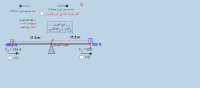
عارضة طولها \(20\ \mathrm{m}\) تدور حول محور عند منتصفها \(P\) (يُهمل وزنها). تؤثر فيها القوة \(F_2\) على يسار المحور والقوة \(F_1\) على يمينه، وقوة ثالثة اختيارية \(F_3\) بزاوية. عزم كل قوة \(\tau=r\,F\sin\theta\) (موجب إذا أدارت العارضة عكس عقارب الساعة)، ومحصلة العزوم \(\Sigma\tau=\tau_1+\tau_2+\tau_3\). تتزن العارضة دورانيًا إذا كانت \(\Sigma\tau=0\). غيّر القوى والمسافات وراقب ميل العارضة (للتوضيح فقط) والأرقام، أو اضغط «اضبط \(F_1\) للاتزان».
A beam \(20\ \mathrm{m}\) long turns about a pivot \(P\) at its middle (its weight is neglected). The force \(F_2\) acts to the left of the pivot and \(F_1\) to its right, and an optional third force \(F_3\) acts at an angle. The torque of each force is \(\tau=r\,F\sin\theta\) (positive if it turns the beam counter-clockwise) and the net torque is \(\Sigma\tau=\tau_1+\tau_2+\tau_3\). The beam is in rotational equilibrium if \(\Sigma\tau=0\). Change the forces and distances and watch the tilt of the beam (for illustration only) and the numbers, or press “Set \(F_1\) for balance”.
جرّب: اضبط \(F_2\) و\(r_2\) ثم استخدم زر الاتزان وراقب أن ناتج \(F_1r_1\) يساوي \(F_2r_2\). لاحظ أن القوة الصغيرة على ذراع طويل تتوازن مع قوة كبيرة على ذراع قصير — مبدأ الرافعة.
Try it: set \(F_2\) and \(r_2\), then use the balance button and notice that \(F_1r_1\) equals \(F_2r_2\). A small force on a long arm balances a large force on a short arm — the principle of the lever.
✍️ أمثلة محلولة
✍️ Worked Examples
مفتاح ربط طوله \(0.4\ \mathrm{m}\) تؤثر في طرفه قوة \(20\ \mathrm{N}\) تصنع زاوية \(30^\circ\) مع المفتاح. احسب عزم القوة.
A wrench \(0.4\ \mathrm{m}\) long has a force of \(20\ \mathrm{N}\) acting at its end at \(30^\circ\) to the wrench. Calculate the torque.
عارضة تدور حول محور في منتصفها، على يسارها قوة \(F_2=94.8\ \mathrm{N}\) إلى الأسفل على بُعد \(5.5\ \mathrm{m}\) وعلى يمينها قوة \(F_1=30.2\ \mathrm{N}\) إلى الأسفل على بُعد \(8\ \mathrm{m}\). احسب محصلة العزوم وحدد اتجاه الدوران.
A beam turns about a pivot at its middle; on its left a downward force \(F_2=94.8\ \mathrm{N}\) acts at \(5.5\ \mathrm{m}\) and on its right a downward force \(F_1=30.2\ \mathrm{N}\) acts at \(8\ \mathrm{m}\). Calculate the net torque and decide the direction of rotation.
عارضة في اتزان حول محور في منتصفها، على يسارها وزن \(60\ \mathrm{N}\) على بُعد \(4\ \mathrm{m}\). ما القوة الواجب تسليطها إلى الأسفل على يمين المحور على بُعد \(6\ \mathrm{m}\)؟ وما رد فعل المحور؟
A beam is in equilibrium about a pivot at its middle; on its left a weight of \(60\ \mathrm{N}\) is at \(4\ \mathrm{m}\). What downward force must be applied to the right of the pivot at \(6\ \mathrm{m}\)? What is the reaction of the pivot?
في الأرجوحة السابقة: \(F_2=20\ \mathrm{N}\) على اليسار بُعدها \(5\ \mathrm{m}\)، وقوة مائلة \(F_3=50\ \mathrm{N}\) عند \(x_3=+4\ \mathrm{m}\) (يمين) اتجاهها \(30^\circ\) فوق الأفقي إلى اليمين. أوجد \(F_1\) الرأسية إلى الأسفل عند \(8\ \mathrm{m}\) على اليمين لتحقيق الاتزان.
On the same see-saw: \(F_2=20\ \mathrm{N}\) on the left at \(5\ \mathrm{m}\) and an inclined force \(F_3=50\ \mathrm{N}\) at \(x_3=+4\ \mathrm{m}\) (right) directed \(30^\circ\) above the horizontal to the right. Find the vertical downward \(F_1\) at \(8\ \mathrm{m}\) on the right that gives equilibrium.
محصلة العزوم على عجلة \(12\ \mathrm{N\cdot m}\) وعزم قصورها الذاتي \(3\ \mathrm{kg\,m^2}\). احسب التسارع الزاوي.
The net torque on a wheel is \(12\ \mathrm{N\cdot m}\) and its moment of inertia is \(3\ \mathrm{kg\,m^2}\). Calculate the angular acceleration.
قوة تؤثر على جسم يدور حول محور وخط عملها يمرّ بالمحور. عزمها:
A force acts on a body that can turn about an axis and its line of action passes through the axis. Its torque is:
إذا تضاعف بُعد نقطة تأثير قوة عن المحور مع ثبات القوة وزاويتها فإن عزمها:
If the distance of the point of application of a force from the axis doubles with the force and its angle fixed, its torque:
أي القوى التالية على عارضة (محورها في المنتصف) تعطي عزمًا سالبًا بحسب الاتفاق؟
Which of the following forces on a beam (pivot at the middle) gives a negative torque by convention?
يتزن جسم صلب اتزانًا تامًا عندما:
A rigid body is in complete equilibrium when:
📚 ملخص
📚 Summary
| المفهومConcept | القانونLaw |
|---|---|
| عزم قوةTorque of a force | \(\tau=rF\sin\theta=F\,d\)\(\tau=rF\sin\theta=F\,d\) |
| المحصلةNet torque | \(\Sigma\tau=\sum\tau_i\)\(\Sigma\tau=\sum\tau_i\) |
| الاتزان الدورانيRotational equilibrium | \(\Sigma\tau=0\)\(\Sigma\tau=0\) |
| الديناميكا الدورانيةRotational dynamics | \(\Sigma\tau=I\alpha\)\(\Sigma\tau=I\alpha\) |
⚠️ أخطاء شائعة
⚠️ Common mistakes
- استخدام المسافة \(r\) وحدها دون \(\sin\theta\) عندما لا تكون القوة عمودية.Using the distance \(r\) alone without \(\sin\theta\) when the force is not perpendicular.
- جمع العزوم حسابيًا دون إشارات؛ يجب اتفاق على الاتجاه الموجب.Adding torques arithmetically without signs; a positive direction must be agreed.
- حساب عزوم القوى حول محاور مختلفة في المسألة نفسها.Calculating the torques of the forces about different axes in the same problem.
- نسيان قوة رد فعل المحور في معادلة \(\Sigma F=0\) (عزمها صفر حول المحور لكنها موجودة).Forgetting the reaction force of the pivot in \(\Sigma F=0\) (its torque about the pivot is zero but it exists).
🔗 محاكيات GeoGebra للاستعانة بها عند اللزوم
🔗 GeoGebra Simulations to Use When Needed
اضغط «تشغيل» لتعمل المحاكاة هنا داخل الدرس؛ ويمكن للطالب الرجوع إليها لتجربة الفكرة بطريقة أخرى.
Press “Run” to run the simulation right here inside the lesson; the student can use it to try the idea in another way.