🎯 نواتج التعلم
🎯 Learning Outcomes
بعد هذه التجربة ستكون قادرًا على أن:
After this experiment you will be able to:
- تنص على قانون هوك \(F=-kx\) وتفسّر الإشارة السالبة.State Hooke’s law \(F=-kx\) and explain the minus sign.
- تحسب ثابت النابض من ميل الخط البياني بين القوة والاستطالة.Find the spring constant from the slope of the force–extension graph.
- تحسب الطاقة المرنة \(\tfrac12kx^2\) وثابت نابضين على التوالي وعلى التوازي.Calculate the elastic energy \(\tfrac12kx^2\) and the constant of two springs in series and in parallel.
🎬 شاهد الفيديو
🎬 Watch the Video
🧷 قانون هوك
🧷 Hooke’s Law
عندما نشدّ نابضًا أو نضغطه قليلًا ثم نتركه يعود إلى طوله الأصلي لأنه يؤثر بقوة مرجِعة تعاكس الإزاحة. وجد هوك أن مقدار هذه القوة يتناسب طرديًا مع مقدار الإزاحة \(x\) عن وضع الاتزان (الطول الأصلي \(L_0\)):
When we stretch or compress a spring slightly and let go it returns to its original length because it exerts a restoring force opposing the displacement. Hooke found that the size of this force is directly proportional to the displacement \(x\) from the equilibrium position (the original length \(L_0\)):
📘 قانون هوك
📘 Hooke’s law
\[F=-k\,x\]
\(k\) ثابت النابض (صلابته) ووحدته \(\mathrm{N/m}\)، والإشارة السالبة تعني أن قوة النابض عكس الإزاحة. عند تعليق كتلة \(m\) ساكنة يتزن الوزن مع قوة النابض: \(mg=kx\).
\(k\) is the spring constant (its stiffness) in \(\mathrm{N/m}\), and the minus sign means that the spring force is opposite to the displacement. When a mass \(m\) hangs at rest the weight balances the spring force: \(mg=kx\).
🔬 طريقة التجربة
🔬 The procedure
- علّق كتلة معروفة واقرأ استطالة النابض \(x=L_f-L_0\) من المسطرة بعد أن يستقر.Hang a known mass and read the extension of the spring \(x=L_f-L_0\) from the ruler after it settles.
- احسب القوة \(F=mg\) وسجّل النقطة \((x,F)\).Calculate the force \(F=mg\) and record the point \((x,F)\).
- كرّر بكتل مختلفة وارسم \(F\) مع \(x\): يخرج خط مستقيم يمرّ بنقطة الأصل.Repeat with different masses and plot \(F\) against \(x\): a straight line through the origin results.
- ميل الخط هو ثابت النابض: \(k=\dfrac{\Delta F}{\Delta x}\).The slope of the line is the spring constant: \(k=\dfrac{\Delta F}{\Delta x}\).
🧪 تجربة 1: اكتشف ثابت النابض: علّق كتلًا وارسم القوة مع الاستطالة
🧪 Experiment 1: Find the spring constant: hang masses and plot the force against the extension
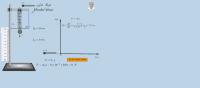
علّق كتلة \(m\) بنابض رأسي فيستطيل حتى يتزن عند \(kx=mg\). غيّر الكتلة وانتظر حتى يستقر النابض، ثم اضغط «سجّل النقطة» ليُضاف الزوج \((x,F)\) إلى الرسم. اجعل ثابت النابض مجهولًا (كما في الأداة الأصلية) واحسبه من ميل الخط \(k=\dfrac{\Delta F}{\Delta x}\) ثم أدخله للتحقق. سجّل ثلاث نقاط على الأقل بكتل مختلفة. (يتذبذب النابض ويستقر ببطء ليبدو الحركة واضحة.)
Hang a mass \(m\) on a vertical spring and it stretches until it balances at \(kx=mg\). Change the mass and wait until the spring settles, then press “Record the point” to add the pair \((x,F)\) to the graph. Keep the spring constant unknown (as in the original applet) and find it from the slope \(k=\dfrac{\Delta F}{\Delta x}\) then enter it to check. Record at least three points with different masses. (The spring oscillates and settles slowly so that the motion is clear.)
💡 شرح إضافي: حدّ المرونة وماذا لو ازدادت الكتلة كثيرًا؟
💡 Extra explanation: the elastic limit and what if the mass grows a lot?
يصح القانون ضمن حدّ التناسب فقط. إذا شددنا النابض أكثر من اللازم ينحني الخط البياني (لا يعود \(F\) متناسبًا مع \(x\))، وإذا تجاوزنا حد المرونة لا يعود النابض إلى طوله الأصلي بل يبقى مشوّهًا. لذلك نختار كتلًا صغيرة تبقى ضمن النطاق الخطي. ثم إن الخط يمر بنقطة الأصل لأن \(x=0\) عندما \(F=0\)؛ فلو لم يمر بها فهذا يعني أن \(L_0\) قيس خطأً.
The law holds only within the proportional limit. If we stretch the spring too far the graph bends (\(F\) is no longer proportional to \(x\)), and beyond the elastic limit the spring does not return to its original length but stays deformed. So we choose small masses that stay in the linear range. The line passes through the origin because \(x=0\) when \(F=0\); if it does not, \(L_0\) was measured wrongly.
🔋 الطاقة المرنة وتوصيل النوابض
🔋 Elastic Energy and Connecting Springs
📘 الطاقة المخزنة في نابض
📘 The energy stored in a spring
\[U=\tfrac12\,k\,x^2=\tfrac12\,F\,x\]
وهي مساحة المثلث تحت خط \(F\)–\(x\) (لأن القوة تزداد من الصفر إلى \(kx\) فمتوسطها \(\tfrac12kx\)).
It is the area of the triangle under the \(F\)–\(x\) line (the force grows from zero to \(kx\) so its average is \(\tfrac12kx\)).
| التوصيلConnection | ثابت النابض المكافئEquivalent spring constant | الأثرEffect |
|---|---|---|
| على التوازي (يتشاركان الحمل)in parallel (they share the load) | \(k_{eq}=k_1+k_2\)\(k_{eq}=k_1+k_2\) | أصلب: استطالة أقلstiffer: less extension |
| على التوالي (كل منهما يحمل الحمل كله)in series (each carries the whole load) | \(\dfrac{1}{k_{eq}}=\dfrac{1}{k_1}+\dfrac{1}{k_2}\)\(\dfrac{1}{k_{eq}}=\dfrac{1}{k_1}+\dfrac{1}{k_2}\) | أطرى: استطالة أكبرsofter: larger extension |
✍️ أمثلة محلولة
✍️ Worked Examples
علّقنا كتلة \(50\ \mathrm{g}\) بنابض فاستطال \(9.81\ \mathrm{cm}\) (قيم الأداة الأصلية). احسب ثابت النابض.
A mass of \(50\ \mathrm{g}\) hung on a spring stretches it by \(9.81\ \mathrm{cm}\) (the values of the original applet). Calculate the spring constant.
رُسم خط بياني فمرّ بالنقطتين \((4\ \mathrm{cm},\ 0.2\ \mathrm{N})\) و\((20\ \mathrm{cm},\ 1.0\ \mathrm{N})\). احسب ثابت النابض.
A graph passes through the points \((4\ \mathrm{cm},\ 0.2\ \mathrm{N})\) and \((20\ \mathrm{cm},\ 1.0\ \mathrm{N})\). Calculate the spring constant.
نابض ثابته \(200\ \mathrm{N/m}\) شُدّ \(3\ \mathrm{cm}\). احسب القوة والطاقة المخزنة.
A spring of constant \(200\ \mathrm{N/m}\) is stretched \(3\ \mathrm{cm}\). Calculate the force and the stored energy.
نابضان \(k_1=30\ \mathrm{N/m}\) و\(k_2=60\ \mathrm{N/m}\). احسب الثابت المكافئ على التوازي وعلى التوالي.
Two springs \(k_1=30\ \mathrm{N/m}\) and \(k_2=60\ \mathrm{N/m}\). Calculate the equivalent constant in parallel and in series.
ما الكتلة التي تستطيل بها نابضًا ثابته \(40\ \mathrm{N/m}\) مسافة \(10\ \mathrm{cm}\)؟ (\(g=9.81\ \mathrm{m/s^2}\))
What mass stretches a spring of constant \(40\ \mathrm{N/m}\) by \(10\ \mathrm{cm}\)? (\(g=9.81\ \mathrm{m/s^2}\))
إذا تضاعفت الكتلة المعلّقة بنابض (ضمن حدّ التناسب) فإن استطالته:
If the mass hung on a spring doubles (within the proportional limit) its extension:
ميل الخط البياني بين القوة (محور رأسي) والاستطالة (محور أفقي) يمثل:
The slope of the graph of force (vertical axis) against extension (horizontal axis) represents:
الإشارة السالبة في \(F=-kx\) تعني أن قوة النابض:
The minus sign in \(F=-kx\) means that the spring force is:
نابضان متماثلان ثابت كل منهما \(k\) وُصلا على التوالي، ثابتهما المكافئ:
Two identical springs of constant \(k\) each connected in series have an equivalent constant:
📚 ملخص
📚 Summary
| المفهومConcept | القانونLaw |
|---|---|
| قانون هوكHooke’s law | \(F=-kx\ ,\ k=\Delta F/\Delta x\)\(F=-kx\ ,\ k=\Delta F/\Delta x\) |
| الطاقة المرنةElastic energy | \(U=\tfrac12kx^2\)\(U=\tfrac12kx^2\) |
| توازي / توالٍParallel / series | \(k_1+k_2\ ,\ \dfrac{k_1k_2}{k_1+k_2}\)\(k_1+k_2\ ,\ \dfrac{k_1k_2}{k_1+k_2}\) |
⚠️ أخطاء شائعة
⚠️ Common mistakes
- أخذ طول النابض كله بدل الاستطالة \(x=L_f-L_0\).Taking the whole length of the spring instead of the extension \(x=L_f-L_0\).
- نسيان تحويل \(\mathrm{g}\) إلى \(\mathrm{kg}\) و\(\mathrm{cm}\) إلى \(\mathrm{m}\).Forgetting to convert \(\mathrm{g}\) to \(\mathrm{kg}\) and \(\mathrm{cm}\) to \(\mathrm{m}\).
- تسجيل القراءة قبل أن يستقر النابض.Recording the reading before the spring has settled.
- استعمال القانون خارج حدّ التناسب.Using the law beyond the proportional limit.
🔗 محاكيات GeoGebra للاستعانة بها عند اللزوم
🔗 GeoGebra Simulations to Use When Needed
اضغط «تشغيل» لتعمل المحاكاة هنا داخل الدرس؛ ويمكن للطالب الرجوع إليها لتجربة الفكرة بطريقة أخرى.
Press “Run” to run the simulation right here inside the lesson; the student can use it to try the idea in another way.