🎯 نواتج التعلم
🎯 Learning Outcomes
بعد هذه التجربة ستكون قادرًا على أن:
After this experiment you will be able to:
- تستنتج تجريبيًا أن التسارع يتناسب طرديًا مع القوة المحصلة عند ثبات الكتلة \(a\propto F\).Deduce experimentally that the acceleration is directly proportional to the net force when the mass is constant \(a\propto F\).
- تطبّق قانون نيوتن الثاني \(\sum F=ma\) وتستنتج الكتلة من ميل الرسم \(a\)–\(F\) (الميل \(=\dfrac1m\)).Apply Newton’s second law \(\sum F=ma\) and deduce the mass from the slope of the \(a\)–\(F\) graph (slope \(=\dfrac1m\)).
- تحلّل نظام عربة وثقل معلّق وتحسب التسارع وقوة الشد.Analyse a system of a cart and a hanging weight and calculate the acceleration and the tension.
🎬 شاهد الفيديو
🎬 Watch the Video
🧪 قانون نيوتن الثاني: القوة والتسارع
🧪 Newton’s Second Law: Force and Acceleration
ينص قانون نيوتن الثاني على أن تسارع جسم يتناسب طرديًا مع القوة المحصلة المؤثرة عليه وعكسيًا مع كتلته، ويكون في اتجاه القوة المحصلة: \(\vec a=\dfrac{\sum\vec F}{m}\). وحدة القوة النيوتن \(1\ \mathrm{N}=1\ \mathrm{kg\cdot m/s^2}\).
Newton’s second law states that the acceleration of a body is directly proportional to the net force acting on it and inversely proportional to its mass, and it is in the direction of the net force: \(\vec a=\dfrac{\sum\vec F}{m}\). The unit of force is the newton \(1\ \mathrm{N}=1\ \mathrm{kg\cdot m/s^2}\).
📘 القانون وتجربة العربة والثقل
📘 The law and the cart-and-weight experiment
\[\sum F=m\,a\qquad a=\dfrac{\sum F}{m}\qquad F=m_2g\]
في التجربة نربط عربة كتلتها \(m_1\) بخيط يمر على بكرة ويحمل ثقلًا \(m_2\). القوة المحرّكة للنظام هي وزن الثقل \(F=m_2g\) والكتلة الكلية \(M=m_1+m_2\) ثابتة (ننقل الكتل من العربة إلى الثقل). المعادلتان: \(m_2g-F_T=m_2a\) و\(F_T=m_1a\) وبجمعهما:
In the experiment a cart of mass \(m_1\) is tied to a string that passes over a pulley and carries a weight \(m_2\). The force that drives the system is the weight of the hanging mass \(F=m_2g\) and the total mass \(M=m_1+m_2\) is kept constant (we move masses from the cart to the weight). The two equations: \(m_2g-F_T=m_2a\) and \(F_T=m_1a\) and by adding them:
\[m_2g=(m_1+m_2)\,a\ \Rightarrow\ a=\dfrac{m_2\,g}{m_1+m_2}=\dfrac{F}{M}\]
💡 شرح إضافي
💡 Extra explanation
- عند ثبات \(M\): رسم \(a\)–\(F\) خط مستقيم يمر بالأصل ميله \(\dfrac1M\)؛ فإذا تضاعفت القوة تضاعف التسارع.At constant \(M\): the \(a\)–\(F\) graph is a straight line through the origin of slope \(\dfrac1M\); if the force doubles the acceleration doubles.
- قوة الشد \(F_T=m_1a\) أصغر من وزن الثقل \(m_2g\) (لأن الثقل نفسه يتسارع).The tension \(F_T=m_1a\) is less than the weight \(m_2g\) of the hanging mass (because the hanging mass itself accelerates).
- نستعمل \(g=10\ \mathrm{m/s^2}\) في هذه التجربة كما في المحاكاة الأصلية؛ ونهمل الاحتكاك وكتلة الخيط والبكرة.We use \(g=10\ \mathrm{m/s^2}\) in this experiment as in the original simulation; the friction and the masses of the string and the pulley are neglected.
- عند \(\sum F=0\) يكون \(a=0\) وهي حالة قانون نيوتن الأول.When \(\sum F=0\) then \(a=0\), which is the case of Newton’s first law.
🧪 تجربة 1: غيّر القوة وسجّل التسارع: العلاقة بين القوة والتسارع
🧪 Experiment 1: Change the force and record the acceleration: the relation between force and acceleration
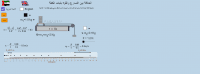
عربة على طاولة يشدها ثقل معلّق عبر بكرة (\(g=10\ \mathrm{m/s^2}\)). الكتلة الكلية \(M=m_1+m_2\) ثابتة (ننقل الكتل من العربة إلى الثقل) فتتغير القوة \(F=m_2g\). اختر \(F\) و\(M\) ثم حرّك مؤشر الزمن أو اضغط «اترك العربة» (لا تتحرك من تلقاء نفسها). اضغط «سجّل» لتضيف نقطة \((F,a)\) إلى الرسم وتحقق أنها على خط مستقيم يمر بالأصل ميله \(1/M\).
A cart on a table is pulled by a hanging weight over a pulley (\(g=10\ \mathrm{m/s^2}\)). The total mass \(M=m_1+m_2\) is kept constant (masses are moved from the cart to the weight) so the force \(F=m_2g\) changes. Choose \(F\) and \(M\) then move the time slider or press “Release the cart” (it never moves by itself). Press “Record” to add a point \((F,a)\) to the graph and check that it lies on a straight line through the origin with slope \(1/M\).
🧪 تجربة 2: حاسبة: التسارع والكتل وقوة الشد
🧪 Experiment 2: Calculator: the acceleration, the masses and the tension
مسألة جديدة في كل مرة على نظام العربة والثقل (\(g=10\ \mathrm{m/s^2}\)). احسب القيم الثلاث ثم اضغط «صحّح».
A new problem every time on the cart-and-weight system (\(g=10\ \mathrm{m/s^2}\)). Calculate the three values and press “Check”.
🛠️ تطبيقات عملية
🛠️ Practical applications
- السيارات: قوة المحرك الأكبر لكتلة معينة تعطي تسارعًا أكبر.Cars: a greater engine force for a given mass gives a greater acceleration.
- الرافعات والمصاعد: القوة المحصلة تحدد تسارع الصعود أو الهبوط.Cranes and lifts: the net force decides the acceleration of rising or falling.
- الصواريخ: قوة الدفع الكبيرة مقسومة على الكتلة تعطي التسارع.Rockets: the large thrust divided by the mass gives the acceleration.
✍️ أمثلة محلولة
✍️ Worked Examples
بقيم المحاكاة الأصلية: عربة \(m_1=0.9\ \mathrm{kg}\) وثقل \(m_2=0.1\ \mathrm{kg}\) (\(g=10\ \mathrm{m/s^2}\)). احسب القوة والتسارع وقوة الشد.
With the values of the original simulation: a cart \(m_1=0.9\ \mathrm{kg}\) and a weight \(m_2=0.1\ \mathrm{kg}\) (\(g=10\ \mathrm{m/s^2}\)). Calculate the force, the acceleration and the tension.
قوة محصلة \(12\ \mathrm{N}\) على جسم كتلته \(4\ \mathrm{kg}\) ساكن. احسب تسارعه وسرعته بعد \(5\ \mathrm{s}\).
A net force of \(12\ \mathrm{N}\) acts on a body of mass \(4\ \mathrm{kg}\) at rest. Calculate its acceleration and its velocity after \(5\ \mathrm{s}\).
رسم \(a\)–\(F\) لجسم يمر بالأصل وبالنقطة \((F=2\ \mathrm{N},\ a=1\ \mathrm{m/s^2})\). ما كتلة الجسم؟
The \(a\)–\(F\) graph of a body passes through the origin and the point \((F=2\ \mathrm{N},\ a=1\ \mathrm{m/s^2})\). What is the mass of the body?
قوتان متعاكستان \(30\ \mathrm{N}\) و\(18\ \mathrm{N}\) تؤثران على جسم كتلته \(6\ \mathrm{kg}\). أوجد تسارعه واتجاهه.
Two opposite forces \(30\ \mathrm{N}\) and \(18\ \mathrm{N}\) act on a body of mass \(6\ \mathrm{kg}\). Find its acceleration and its direction.
عند ثبات الكتلة إذا تضاعفت القوة المحصلة فإن التسارع:
At constant mass if the net force doubles the acceleration:
ميل الرسم \(a\)–\(F\) (التسارع على المحور الرأسي) يساوي:
The slope of the \(a\)–\(F\) graph (acceleration on the vertical axis) equals:
جسم كتلته \(2\ \mathrm{kg}\) أثّرت عليه قوة محصلة \(10\ \mathrm{N}\). تسارعه:
A body of mass \(2\ \mathrm{kg}\) is acted on by a net force of \(10\ \mathrm{N}\). Its acceleration is:
اتجاه التسارع هو اتجاه:
The direction of the acceleration is the direction of:
📚 ملخص
📚 Summary
| المفهومConcept | العلاقةRelation |
|---|---|
| قانون نيوتن الثانيNewton’s second law | \(\sum F=ma\)\(\sum F=ma\) |
| عند ثبات الكتلةAt constant mass | \(a\propto F\)\(a\propto F\) |
| ميل a–FSlope of a–F | \(\dfrac1m\)\(\dfrac1m\) |
| العربة والثقلCart and weight | \(a=\dfrac{m_2g}{m_1+m_2}\)\(a=\dfrac{m_2g}{m_1+m_2}\) |
⚠️ أخطاء شائعة
⚠️ Common mistakes
- استعمال وزن الثقل \(m_2g\) كقوة شد؛ الشد أقل منه عندما يتسارع الثقل.Using the weight \(m_2g\) as the tension; the tension is less when the weight accelerates.
- نسيان تضمين كتلة الثقل في الكتلة الكلية \(M=m_1+m_2\).Forgetting to include the hanging mass in the total mass \(M=m_1+m_2\).
- الخلط بين القوة الكلية على الجسم والقوة المحصلة؛ نستعمل المحصلة في \(ma\).Confusing the total force on a body with the net force; we use the net force in \(ma\).
🔗 محاكيات GeoGebra للاستعانة بها عند اللزوم
🔗 GeoGebra Simulations to Use When Needed
اضغط «تشغيل» لتعمل المحاكاة هنا داخل الدرس؛ ويمكن للطالب الرجوع إليها لتجربة الفكرة بطريقة أخرى.
Press “Run” to run the simulation right here inside the lesson; the student can use it to try the idea in another way.