🎯 نواتج التعلم
🎯 Learning Outcomes
بعد هذه التجربة ستكون قادرًا على أن:
After this experiment you will be able to:
- تنص على قانون كولوم وتكتبه \(F=k\dfrac{|q_1q_2|}{r^2}\) وتعرف معنى كل رمز ووحدته.State Coulomb’s law and write it \(F=k\dfrac{|q_1q_2|}{r^2}\) and know the meaning and unit of each symbol.
- تحدد اتجاه القوة (تنافر أو تجاذب) وتبيّن أن القوتين متساويتان ومتعاكستان.Determine the direction of the force (repulsion or attraction) and show that the two forces are equal and opposite.
- تفسّر القانون التربيعي العكسي وتقيس \(k\) من ميل الخط \(F\) مع \(1/r^2\).Explain the inverse-square law and measure \(k\) from the slope of the line \(F\) against \(1/r^2\).
- تقارن القوة الكهربائية بقوة الجاذبية وتفسّر لماذا تهيمن الكهربائية في الذرة.Compare the electric force with gravity and explain why the electric one dominates in the atom.
- تحل مسائل على القوة والمسافة والشحنة.Solve problems on the force, the distance and the charge.
🎬 شاهد الفيديو
🎬 Watch the Video
🎬 شاهد الفيديو
🎬 Watch the Video
❓ السؤال الذي تجيب عنه التجربة
❓ The Question That the Experiment Answers
إذا قرّبت شحنتين من بعضهما إلى نصف المسافة فماذا يحدث للقوة بينهما؟ وإذا ضاعفت إحدى الشحنتين؟ في عام 1785 قاس الفيزيائي الفرنسي شارل كولوم القوة بين كرتين مشحونتين بميزان الليّ فوجد علاقة دقيقة بسيطة بين القوة والشحنة والمسافة. في هذه التجربة تكتشف هذه العلاقة بنفسك وتقيس ثابتها.
If you bring two charges to half the distance what happens to the force between them? And if you double one of the charges? In 1785 the French physicist Charles Coulomb measured the force between two charged spheres with a torsion balance and found a precise simple relation between the force, the charge and the distance. In this experiment you discover this relation yourself and measure its constant.
⚖️ قانون كولوم
⚖️ Coulomb’s Law
تتناسب القوة الكهربائية بين شحنتين نقطيتين طرديًّا مع حاصل ضرب مقداريهما وعكسيًّا مع مربع المسافة بينهما، وتقع على الخط الواصل بينهما: تنافر إذا تشابهتا في الإشارة وتجاذب إذا اختلفتا.
The electric force between two point charges is directly proportional to the product of their magnitudes and inversely proportional to the square of the distance between them, and it lies along the line joining them: repulsion if they have the same sign and attraction if they are different.
📘 القوانين
📘 The laws
\[F=k\frac{|q_1||q_2|}{r^{2}}\]
\[k=\frac{1}{4\pi\varepsilon_0}=8.99\times10^{9}\ \mathrm{N\,m^2/C^2},\quad \varepsilon_0=8.85\times10^{-12}\ \mathrm{C^2/N\,m^2}\]
| الرمزSymbol | المعنىMeaning | الوحدةUnit |
|---|---|---|
| \(F\)\(F\) | القوة الكهربائيةThe electric force | نيوتن \(\mathrm N\)newton \(\mathrm N\) |
| \(q_1,q_2\)\(q_1,q_2\) | مقدار الشحنتينThe magnitudes of the charges | كولوم \(\mathrm C\) (و\(1\ \mu\mathrm C=10^{-6}\ \mathrm C\))coulomb \(\mathrm C\) (and \(1\ \mu\mathrm C=10^{-6}\ \mathrm C\)) |
| \(r\)\(r\) | المسافة بين الشحنتينThe distance between the charges | متر \(\mathrm m\) (حوّل cm إلى m)metre \(\mathrm m\) (convert cm to m) |
| \(k\)\(k\) | ثابت كولومCoulomb’s constant | \(\mathrm{N\,m^2/C^2}\)\(\mathrm{N\,m^2/C^2}\) |
🧭 الاتجاه وقانون نيوتن الثالث
🧭 Direction and Newton’s Third Law
لا تضع إشارة الشحنة في القانون؛ استعمل المقادير للحصول على \(F\) ثم حدّد الاتجاه بالرسم. القوة التي تؤثر بها \(q_1\) على \(q_2\) تساوي في المقدار وتعاكس في الاتجاه التي تؤثر بها \(q_2\) على \(q_1\) مهما اختلفت الشحنتان في المقدار: \(\vec F_{12}=-\vec F_{21}\). الشحنة الأكبر لا «تدفع» أشد من الأصغر.
Do not put the sign of the charge in the law; use the magnitudes to get \(F\) then find the direction with a drawing. The force exerted by \(q_1\) on \(q_2\) equals in magnitude and opposes in direction the force exerted by \(q_2\) on \(q_1\) however different the charges are: \(\vec F_{12}=-\vec F_{21}\). The larger charge does not “push” harder than the smaller one.
📈 لماذا تربيعي عكسي؟
📈 Why Inverse-Square?
تنتشر تأثيرات القوة من الشحنة في الفراغ ثلاثي الأبعاد؛ فإذا ضاعفت المسافة توزعت على سطح كرة مساحته أكبر أربع مرات، فتصير القوة ربعًا. وبالتجربة: \(r\to2r\) يعطي \(F\to F/4\)، و\(r\to3r\) يعطي \(F/9\)، و\(r\to r/2\) يعطي \(4F\).
The influence of the charge spreads in three-dimensional space; if you double the distance it is spread over the surface of a sphere four times larger, so the force becomes a quarter. By experiment: \(r\to2r\) gives \(F\to F/4\), \(r\to3r\) gives \(F/9\) and \(r\to r/2\) gives \(4F\).
| المسافةDistance | \(r\)\(r\) | \(2r\)\(2r\) | \(3r\)\(3r\) | \(r/2\)\(r/2\) |
|---|---|---|---|---|
| القوةForce | \(F\)\(F\) | \(F/4\)\(F/4\) | \(F/9\)\(F/9\) | \(4F\)\(4F\) |
🧪 التجربة 1: شحنتان والمسافة بينهما
🧪 Experiment 1: Two Charges and the Distance Between Them
🛠️ خطوات العمل
🛠️ Procedure
- ثبّت \(q_1\) و\(q_2\) وغيّر \(r\): سجّل \(F\) عند \(r=10\) ثم \(r=20\ \mathrm{cm}\) وقارن.Fix \(q_1\) and \(q_2\) and change \(r\): record \(F\) at \(r=10\) then \(r=20\ \mathrm{cm}\) and compare.
- ثبّت \(r\) وضاعف \(q_1\) ثم ضاعف \(q_2\): كيف تتغير القوة؟Fix \(r\) and double \(q_1\) then double \(q_2\): how does the force change?
- بدّل إشارة إحدى الشحنتين وراقب انعكاس اتجاه السهمين مع بقاء المقدار.Change the sign of one charge and watch the two arrows reverse while the magnitude stays.
- تتبّع نقطة المنحنى الحمراء وهي تتحرك على منحنى \(F\) مع \(r\).Follow the red point on the curve as it moves on the \(F\)–\(r\) curve.
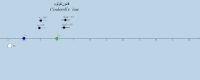
🧪 تجربة 1: شحنتان والمسافة بينهما: القوة والرسم البياني
🧪 Experiment 1: Two Charges and the Distance Between Them: The Force and the Graph
غيّر الشحنتين (بالإشارة) والمسافة، وراقب القوتين المتساويتين المتعاكستين ومنحنى \(F\) مع \(r\) الذي يدل على القانون التربيعي العكسي.
Change the two charges (with their signs) and the distance, and watch the two equal and opposite forces and the curve of \(F\) against \(r\) that shows the inverse-square law.
🔍 ماذا نلاحظ؟
🔍 What do we observe?
- عند مضاعفة \(r\) تصبح القوة ربع قيمتها، وعند مضاعفة أي شحنة تتضاعف القوة.Doubling \(r\) makes the force a quarter of its value, and doubling any charge doubles the force.
- السهمان متساويان في الطول دائمًا مهما كانت الشحنتان غير متساويتين (القانون الثالث).The two arrows are always equal in length however unequal the charges (the third law).
- المنحنى يرتفع بشدة عند المسافات الصغيرة: القوة تتضخم عند التقارب.The curve rises steeply at small distances: the force becomes huge when the charges come close.
📊 التجربة 2: قياس ثابت كولوم \(k\)
📊 Experiment 2: Measuring Coulomb’s Constant \(k\)
بما أن \(F=kq_1q_2\cdot\dfrac{1}{r^2}\) فإن رسم \(F\) مقابل \(1/r^2\) يعطي خطًّا مستقيمًا يمر بالأصل وميله \(kq_1q_2\). نسجّل قياسات عند مسافات مختلفة (يضيف الحاسوب خطأ تجريبيًّا صغيرًا كما في المختبر) ثم نمرّر أفضل خط، ونقسم ميله على \(q_1q_2\) فنحصل على \(k\) ونقارنه بالقيمة المقبولة \(8.99\times10^9\).
Since \(F=kq_1q_2\cdot\dfrac{1}{r^2}\) a graph of \(F\) against \(1/r^2\) gives a straight line through the origin of slope \(kq_1q_2\). We record measurements at different distances (the computer adds a small experimental error as in the lab) then pass the best line, and divide its slope by \(q_1q_2\) to get \(k\) and compare it with the accepted value \(8.99\times10^9\).
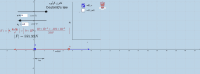
🧪 تجربة 2: قياس ثابت كولوم \(k\) من الميل
🧪 Experiment 2: Measuring Coulomb’s Constant \(k\) from the Slope
سجّل قياسات للقوة عند مسافات مختلفة (فيها خطأ تجريبي صغير) ثم انظر إلى الرسم \(F\) مع \(1/r^2\): خط مستقيم ميله \(kq_1q_2\). من الميل تحسب \(k\).
Record measurements of the force at different distances (with a small experimental error) then look at the graph \(F\) against \(1/r^2\): a straight line of slope \(kq_1q_2\). From the slope you calculate \(k\).
🔍 ماذا نلاحظ؟
🔍 What do we observe?
- كلما زاد عدد القياسات اقتربت قيمة \(k\) من القيمة المقبولة.The more measurements you take the closer \(k\) gets to the accepted value.
- تغيير الشحنتين يغيّر الميل لكن الشكل يبقى خطًّا مستقيمًا بالأصل.Changing the charges changes the slope but the shape remains a straight line through the origin.
- لو رسمنا \(F\) مع \(r\) لحصلنا على منحنى لا خط مستقيم؛ لذلك نغيّر المتغير إلى \(1/r^2\) لنحصل على خط يسهل تحليله.If we plotted \(F\) against \(r\) we would get a curve not a straight line; so we change the variable to \(1/r^2\) to get a line that is easy to analyse.
⚛️ التجربة 3: الكهربائية أم الجاذبية؟
⚛️ Experiment 3: Electric Force or Gravity?
قانون نيوتن للجذب \(F_g=G\dfrac{m_1m_2}{r^2}\) يشبه قانون كولوم في الصيغة. لكن الفرق في الحجم هائل: في ذرة الهيدروجين القوة الكهربائية بين الإلكترون والبروتون أكبر من الجاذبية بينهما بنحو \(10^{39}\) مرة! لهذا نهمل الجاذبية في الفيزياء الذرية. وتبقى النسبة ثابتة عند تغيير المسافة لأن كلتا القوتين تتناسب مع \(1/r^2\).
Newton’s law of gravitation \(F_g=G\dfrac{m_1m_2}{r^2}\) has the same form as Coulomb’s law. But the difference in size is enormous: in the hydrogen atom the electric force between the electron and the proton is larger than the gravity between them by about \(10^{39}\) times! This is why we neglect gravity in atomic physics. The ratio stays constant when the distance changes because both forces are proportional to \(1/r^2\).
🧪 تجربة 3: القوة الكهربائية أم الجاذبية؟
🧪 Experiment 3: Electric Force or Gravity?
اختر منظومة وقارن القوة الكهربائية بقوة الجاذبية بينهما على مقياس لوغاريتمي. غيّر المسافة وانظر كيف تتغير القوتان معًا وتبقى النسبة ثابتة.
Choose a system and compare the electric force with the gravitational force between them on a logarithmic scale. Change the distance and see how both forces change together while the ratio stays constant.
🔍 ماذا نلاحظ؟
🔍 What do we observe?
- الشريط الذهبي (الكهربائية) أطول بعشرات الأسس من الشريط الأزرق (الجاذبية) في الأنظمة الذرية.The golden bar (electric) is longer by tens of powers of ten than the blue bar (gravity) in atomic systems.
- حتى في الكرتين العاديتين (1 kg و1 μC) تزيد الكهربائية على الجاذبية بنحو \(10^{8}\).Even for ordinary balls (1 kg and 1 μC) the electric force exceeds gravity by about \(10^{8}\).
- تغيير المسافة يحرّك الشريطين معًا ولا يغيّر الفرق بينهما.Changing the distance moves the two bars together and does not change the gap between them.
🎲 التجربة 4: تدرّب
🎲 Experiment 4: Practice
🧪 تجربة 4: تدرّب: قانون كولوم
🧪 Experiment 4: Practice: Coulomb’s Law
مسائل عشوائية: احسب القوة بين شحنتين، ثم القوة الجديدة إذا تضاعفت المسافة عدة مرات.
Random problems: calculate the force between two charges, then the new force if the distance is multiplied several times.
✍️ أمثلة محلولة
✍️ Worked Examples
شحنتان \(q_1=+3\ \mu\mathrm C\) و\(q_2=-2\ \mu\mathrm C\) والمسافة بينهما \(10\ \mathrm{cm}\). أوجد القوة بينهما ونوعها.
Two charges \(q_1=+3\ \mu\mathrm C\) and \(q_2=-2\ \mu\mathrm C\) with \(10\ \mathrm{cm}\) between them. Find the force between them and its kind.
تؤثر شحنتان بقوة \(8\ \mathrm N\) عندما تكون المسافة بينهما \(3\ \mathrm{cm}\). ما القوة إذا أصبحت المسافة \(9\ \mathrm{cm}\)؟
Two charges exert a force of \(8\ \mathrm N\) when the distance between them is \(3\ \mathrm{cm}\). What is the force if the distance becomes \(9\ \mathrm{cm}\)?
كرتان شحنة كل منهما \(+1\ \mu\mathrm C\). على أي مسافة تكون القوة بينهما \(2\ \mathrm N\)؟
Two spheres each of charge \(+1\ \mu\mathrm C\). At what distance is the force between them \(2\ \mathrm N\)?
كرتان متماثلتان تفصل بينهما مسافة \(20\ \mathrm{cm}\) تتنافران بقوة \(0.9\ \mathrm N\). ما شحنة كل منهما؟
Two identical spheres \(20\ \mathrm{cm}\) apart repel with a force of \(0.9\ \mathrm N\). What is the charge on each?
قارن القوة الكهربائية والجاذبية بين إلكترون وبروتون في ذرة الهيدروجين (\(r=5.29\times10^{-11}\ \mathrm m\)).
Compare the electric force and the gravitational force between an electron and a proton in the hydrogen atom (\(r=5.29\times10^{-11}\ \mathrm m\)).
🛠️ تطبيقات عملية
🛠️ Practical Applications
أين يظهر قانون كولوم؟
Where does Coulomb’s law appear?
- الذرة: يجذب النواة الإلكترونات بقوة كولوم فتحدد حجم الذرة ومستويات الطاقة.The atom: the nucleus attracts the electrons with the Coulomb force which sets the size of the atom and its energy levels.
- الروابط الكيميائية والبلورات الأيونية: تنشأ من قوى كولوم بين الأيونات.Chemical bonds and ionic crystals: they arise from Coulomb forces between ions.
- التصوير الضوئي والطابعات الليزرية: تلتصق جزيئات الحبر بالورق بقوى كهروستاتيكية.Photocopiers and laser printers: ink particles stick to the paper by electrostatic forces.
- مرشحات الغبار في المداخن: تشحن الجسيمات وتجذبها صفائح مشحونة.Dust filters in chimneys: the particles are charged and attracted by charged plates.
⚠️ أخطاء شائعة
⚠️ Common Mistakes
تجنّب هذه الأخطاء
Avoid these mistakes
- نسيان تحويل \(\mu\mathrm C\) إلى \(\mathrm C\) و\(\mathrm{cm}\) إلى \(\mathrm m\).Forgetting to convert \(\mu\mathrm C\) to \(\mathrm C\) and \(\mathrm{cm}\) to \(\mathrm m\).
- الاعتقاد أن الشحنة الكبرى تؤثر بقوة أكبر في الصغرى؛ القوتان متساويتان دائمًا.Believing that the larger charge exerts a larger force on the smaller one; the two forces are always equal.
- نسيان تربيع المسافة، أو قسمة الشحنة بدل الضرب في حاصل الشحنتين.Forgetting to square the distance, or dividing by the charge instead of multiplying the product of the charges.
- وضع إشارة الشحنة داخل القانون ثم الحيرة في معنى الإشارة السالبة؛ السالب يعني فقط التجاذب.Putting the sign of the charge inside the law then being confused about the negative sign; negative only means attraction.
📚 ملخص
📚 Summary
أهم ما تعلمناه
Key points
- \(F=k|q_1q_2|/r^2\) و\(k=8.99\times10^9\ \mathrm{N\,m^2/C^2}\).\(F=k|q_1q_2|/r^2\) and \(k=8.99\times10^9\ \mathrm{N\,m^2/C^2}\).
- تنافر للمتشابهتين وتجاذب للمختلفتين، والقوتان متساويتان ومتعاكستان.Repulsion for like charges and attraction for unlike ones, and the two forces are equal and opposite.
- ضِعف المسافة يقلل القوة إلى الربع؛ ضِعف الشحنة يضاعفها.Doubling the distance reduces the force to a quarter; doubling a charge doubles it.
- الكهربائية أكبر من الجاذبية بأضعاف هائلة في الذرة.The electric force is enormously larger than gravity in the atom.
🔗 محاكيات GeoGebra للاستعانة بها عند اللزوم
🔗 GeoGebra Simulations to Use When Needed
اضغط «تشغيل» لتعمل المحاكاة هنا داخل الدرس؛ ويمكن للطالب الرجوع إليها لتجربة الفكرة بطريقة أخرى.
Press “Run” to run the simulation right here inside the lesson; the student can use it to try the idea in another way.