🎯 نواتج التعلم
🎯 Learning Outcomes
بعد هذه التجربة ستكون قادرًا على أن:
After this experiment you will be able to:
- تصف انكسار الضوء عند السطح الفاصل بين وسطين وتحدّد اتجاه انحراف الشعاع.Describe the refraction of light at the boundary between two media and decide the direction in which the ray bends.
- تطبّق قانون سنل \(n_1\sin\theta_1=n_2\sin\theta_2\) لحساب زاوية الانكسار.Apply Snell’s law \(n_1\sin\theta_1=n_2\sin\theta_2\) to calculate the angle of refraction.
- تحسب الزاوية الحرجة وتحدّد متى يحدث الانعكاس الكلي الداخلي، وتربط معامل الانكسار بسرعة الضوء.Calculate the critical angle, decide when total internal reflection occurs, and relate the refractive index to the speed of light.
🎬 شاهد الفيديو
🎬 Watch the Video
🌈 انكسار الضوء
🌈 Refraction of Light
عندما ينتقل الضوء من وسط شفاف إلى آخر ينحرف عن مساره عند السطح الفاصل لأن سرعته تتغير؛ وتسمى الظاهرة الانكسار. نقيس الزاويتين من العمود على السطح: \(\theta_1\) زاوية السقوط في الوسط الأول و\(\theta_2\) زاوية الانكسار في الوسط الثاني. معامل الانكسار لوسط \(n=\dfrac cv\) حيث \(c\) سرعة الضوء في الفراغ و\(v\) سرعته في الوسط، وهو دائمًا \(n\ge1\).
When light passes from one transparent medium to another it bends at the boundary because its speed changes; this is called refraction. We measure both angles from the normal: \(\theta_1\) the angle of incidence in the first medium and \(\theta_2\) the angle of refraction in the second. The refractive index of a medium is \(n=\dfrac cv\) where \(c\) is the speed of light in vacuum and \(v\) its speed in the medium, and it is always \(n\ge1\).
📘 قانون سنل
📘 Snell’s law
\[n_1\sin\theta_1=n_2\sin\theta_2\]
\[n=\dfrac cv\qquad \sin\theta_c=\dfrac{n_2}{n_1}\ (n_1\gt n_2)\]
إذا كان \(n_2\gt n_1\) ينكسر الشعاع نحو العمود (\(\theta_2\lt \theta_1\))، وإذا كان \(n_2\lt n_1\) ينكسر مبتعدًا عن العمود (\(\theta_2\gt \theta_1\)). والشعاع الساقط والمنكسر والعمود في مستوى واحد.
If \(n_2\gt n_1\) the ray bends toward the normal (\(\theta_2\lt \theta_1\)); if \(n_2\lt n_1\) it bends away from the normal (\(\theta_2\gt \theta_1\)). The incident ray, the refracted ray and the normal lie in one plane.
💡 شرح إضافي: الانعكاس الكلي الداخلي
💡 Extra explanation: total internal reflection
- عند الانتقال من وسط أكبر معامل انكسار إلى أقل (\(n_1\gt n_2\)) تكبر \(\theta_2\) أسرع من \(\theta_1\) حتى تصل \(90^\circ\) عند الزاوية الحرجة \(\theta_c=\sin^{-1}\dfrac{n_2}{n_1}\).When going from a medium of larger index to a smaller one (\(n_1\gt n_2\)), \(\theta_2\) grows faster than \(\theta_1\) until it reaches \(90^\circ\) at the critical angle \(\theta_c=\sin^{-1}\dfrac{n_2}{n_1}\).
- إذا زادت \(\theta_1\) عن \(\theta_c\) لا ينكسر الضوء بل ينعكس كليًا داخل الوسط الأول (\(n_1\sin\theta_1\gt n_2\) لا يوجد حل لـ \(\theta_2\)).If \(\theta_1\) exceeds \(\theta_c\) the light is not refracted but totally reflected inside the first medium (\(n_1\sin\theta_1\gt n_2\) has no solution for \(\theta_2\)).
- عند السقوط العمودي (\(\theta_1=0\)) لا ينحرف الشعاع لكن سرعته وطول موجته يتغيران.At normal incidence (\(\theta_1=0\)) the ray is not deviated but its speed and wavelength change.
- جزء من الضوء ينعكس دائمًا عن السطح الفاصل (الشعاع الباهت في التجربة) حسب قانون الانعكاس.A part of the light is always reflected at the boundary (the faint ray in the experiment) according to the law of reflection.
🧪 تجربة 1: أرسل شعاعًا بين وسطين وتحقق من قانون سنل
🧪 Experiment 1: Send a ray between two media and verify Snell’s law
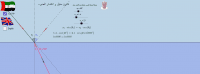
يسقط الشعاع الأحمر من الوسط العلوي (\(n_1\)) على الوسط السفلي (\(n_2\)) فينكسر (أزرق) وينعكس جزء منه (باهت). النقاط المتحركة على الأشعة تتحرك بسرعة تتناسب مع \(c/n\) فترى أن الضوء أبطأ في الوسط الأكبر معاملًا. غيّر المعاملين وزاوية السقوط (تتغير تلقائيًا ما لم تحرّك المؤشر) ولاحظ أن \(n_1\sin\theta_1=n_2\sin\theta_2\)، وأن الانتقال إلى وسط أقل معاملًا يعطي زاوية حرجة وانعكاسًا كليًا. سجّل عدة قراءات في الجدول.
The red ray falls from the upper medium (\(n_1\)) onto the lower medium (\(n_2\)) and is refracted (blue) while a part is reflected (faint). The moving dots on the rays travel at a speed proportional to \(c/n\) so you see that light is slower in the medium of larger index. Change the two indices and the angle of incidence (it changes automatically unless you move the slider) and notice that \(n_1\sin\theta_1=n_2\sin\theta_2\), and that going to a lower-index medium gives a critical angle and total reflection. Record several readings in the table.
🧪 تجربة 2: حاسبة التحقق: ضوء من وسط كثيف إلى وسط أقل كثافة
🧪 Experiment 2: Checker: light from a dense medium into a less dense one
مسألة جديدة في كل مرة (\(c=3\times10^8\ \mathrm{m/s}\)). احسب القيم الثلاث ثم اضغط «صحّح».
A new problem every time (\(c=3\times10^8\ \mathrm{m/s}\)). Calculate the three values and press “Check”.
🛠️ تطبيقات عملية
🛠️ Practical applications
- الألياف الضوئية: ينتقل الضوء داخلها بانعكاسات كلية متتالية.Optical fibres: light travels inside them by successive total internal reflections.
- المنشور العاكس والمناظير: تغيّر اتجاه الضوء بالانعكاس الكلي دون فقد يُذكر.Reflecting prisms and binoculars: they change the direction of light by total internal reflection with little loss.
- تبدو الأجسام في الماء أقرب: لأن الأشعة تنكسر مبتعدة عن العمود عند خروجها إلى الهواء.Objects in water look closer: because the rays bend away from the normal when they leave into the air.
✍️ أمثلة محلولة
✍️ Worked Examples
كما في المحاكاة الأصلية: \(n_1=3\) و\(n_2=1.4\) وزاوية السقوط \(24^\circ\). احسب زاوية الانكسار.
As in the original simulation: \(n_1=3\), \(n_2=1.4\) and the angle of incidence \(24^\circ\). Calculate the angle of refraction.
ينتقل شعاع من الهواء (\(n=1\)) إلى الزجاج (\(n=1.5\)) بزاوية سقوط \(45^\circ\). احسب زاوية الانكسار.
A ray passes from air (\(n=1\)) into glass (\(n=1.5\)) with an angle of incidence of \(45^\circ\). Calculate the angle of refraction.
احسب الزاوية الحرجة للزجاج (\(n=1.5\)) إلى الهواء، وبيّن ماذا يحدث لشعاع يسقط بزاوية \(50^\circ\).
Calculate the critical angle from glass (\(n=1.5\)) to air, and say what happens to a ray incident at \(50^\circ\).
معامل انكسار الماس \(2.42\). احسب سرعة الضوء فيه (\(c=3\times10^8\ \mathrm{m/s}\)).
The refractive index of diamond is \(2.42\). Calculate the speed of light in it (\(c=3\times10^8\ \mathrm{m/s}\)).
عند انتقال الضوء من الهواء إلى الماء ينكسر الشعاع:
When light passes from air into water the ray bends:
يحدث الانعكاس الكلي الداخلي عندما:
Total internal reflection occurs when:
سقط شعاع عموديًا على سطح زجاجي. زاوية انكساره:
A ray falls along the normal on a glass surface. Its angle of refraction is:
سرعة الضوء في وسط معامل انكساره \(1.5\) تساوي:
The speed of light in a medium of refractive index \(1.5\) is:
📚 ملخص
📚 Summary
| المفهومConcept | القانونLaw |
|---|---|
| قانون سنلSnell’s law | \(n_1\sin\theta_1=n_2\sin\theta_2\)\(n_1\sin\theta_1=n_2\sin\theta_2\) |
| معامل الانكسارRefractive index | \(n=\dfrac cv\)\(n=\dfrac cv\) |
| الزاوية الحرجةCritical angle | \(\sin\theta_c=\dfrac{n_2}{n_1}\ (n_1\gt n_2)\)\(\sin\theta_c=\dfrac{n_2}{n_1}\ (n_1\gt n_2)\) |
⚠️ أخطاء شائعة
⚠️ Common mistakes
- قياس الزاويتين من السطح بدل العمود.Measuring the angles from the surface instead of the normal.
- عكس مواضع \(n_1\) و\(n_2\) في القانون: \(n_1\) للوسط الذي يسقط منه الشعاع.Swapping \(n_1\) and \(n_2\) in the law: \(n_1\) belongs to the medium the ray comes from.
- الظن بأن الانعكاس الكلي يحدث عند الانتقال إلى وسط أكبر معاملًا؛ يحدث فقط إلى وسط أصغر معاملًا.Thinking total reflection occurs when going to a larger-index medium; it occurs only toward a smaller-index medium.
🔗 محاكيات GeoGebra للاستعانة بها عند اللزوم
🔗 GeoGebra Simulations to Use When Needed
اضغط «تشغيل» لتعمل المحاكاة هنا داخل الدرس؛ ويمكن للطالب الرجوع إليها لتجربة الفكرة بطريقة أخرى.
Press “Run” to run the simulation right here inside the lesson; the student can use it to try the idea in another way.