🎯 نواتج التعلم
🎯 Learning Outcomes
بعد هذه التجربة ستكون قادرًا على أن:
After this experiment you will be able to:
- تعرّف عزم القصور الذاتي \(I\) وتفسّر اعتماده على توزيع الكتلة حول المحور.Define the moment of inertia \(I\) and explain its dependence on the distribution of the mass around the axis.
- تشتق \(a=\dfrac{g\sin\theta}{1+I/mR^2}\) للتدحرج بلا انزلاق وتطبّقها على أجسام مختلفة.Derive \(a=\dfrac{g\sin\theta}{1+I/mR^2}\) for rolling without slipping and apply it to different bodies.
- ترتّب الأجسام في السباق وتعلّل بالطاقة سبب خسارة الجسم المجوّف.Order the bodies in the race and explain by energy why the hollow body loses.
- تحدد نوع جسم مجهول من زمن تدحرجه.Identify the type of a mystery body from its rolling time.
🎬 شاهد الفيديو
🎬 Watch the Video
❓ السؤال الذي تجيب عنه التجربة
❓ The Question That the Experiment Answers
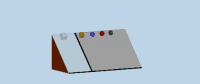
نطلق مكعبًا (ينزلق بلا احتكاك) وكرة مصمتة وكرة مجوفة واسطوانة مصمتة واسطوانة مجوفة معًا من قمة مستوى مائل واحد وفي اللحظة نفسها ومن الارتفاع نفسه. أيّها يصل إلى الأسفل أولًا؟ الجواب ليس «كلها معًا» كما في سقوط جاليليو الحر، لأن هذه الأجسام لا تسقط سقوطًا حرًّا بل تتدحرج (أو تنزلق)، وهنا يدخل مفهوم جديد هو عزم القصور الذاتي.
We release a cube (sliding without friction), a solid sphere, a hollow sphere, a solid cylinder and a hollow cylinder together from the top of one inclined plane at the same instant and from the same height. Which one reaches the bottom first? The answer is not “all together” as in Galileo’s free fall, because these bodies do not fall freely but roll (or slide), and here a new concept enters: the moment of inertia.
⚙️ ما هو عزم القصور الذاتي؟
⚙️ What Is the Moment of Inertia?
عزم القصور الذاتي \(I\) هو المكافئ الدوراني للكتلة: كما تقيس الكتلة \(m\) مقاومة الجسم لتغيير سرعته الخطية، يقيس \(I\) مقاومته لتغيير سرعته الزاوية. ويعتمد \(I\) على الكتلة وعلى كيفية توزّعها حول محور الدوران: كلما ابتعدت الكتلة عن المحور زاد \(I\). لذلك يكون للجسم المجوّف (كتلته عند الحافة) عزم قصور أكبر من المصمت.
The moment of inertia \(I\) is the rotational equivalent of the mass: as the mass \(m\) measures the resistance of the body to a change of its linear velocity, \(I\) measures its resistance to a change of its angular velocity. \(I\) depends on the mass and on how it is distributed around the axis of rotation: the farther the mass from the axis the larger \(I\). So a hollow body (its mass at the rim) has a larger moment of inertia than a solid one.
📌 عزم القصور الذاتي
📌 The moment of inertia
\[I=\sum m_i\,r_i^{2}\]
📐 اشتقاق التسارع أثناء التدحرج
📐 Deriving the Acceleration While Rolling
الخطوات
The steps
- الانتقال على طول المستوى: \(mg\sin\theta-f=ma\) (\(f\) قوة الاحتكاك الساكن).Translation along the incline: \(mg\sin\theta-f=ma\) (\(f\) the static friction).
- الدوران حول المحور: عزم الاحتكاك فقط \(fR=I\alpha\).Rotation about the axis: only the torque of the friction \(fR=I\alpha\).
- شرط التدحرج بلا انزلاق: \(a=\alpha R\) فيكون \(f=\dfrac{Ia}{R^2}\).The condition of rolling without slipping: \(a=\alpha R\) so \(f=\dfrac{Ia}{R^2}\).
- نعوّض: \(mg\sin\theta=a\left(m+\dfrac{I}{R^2}\right)\).We substitute: \(mg\sin\theta=a\left(m+\dfrac{I}{R^2}\right)\).
📌 التسارع
📌 The acceleration
\[a=\frac{g\sin\theta}{1+\dfrac{I}{mR^{2}}}\]
الكتلة \(m\) ونصف القطر \(R\) لا يظهران إلا في النسبة \(I/mR^2\)، وهي رقم «شكلي» يعتمد على توزيع الكتلة فقط. لذلك تتساوى كل الكرات المصمتة في السباق مهما اختلفت كتلتها أو حجمها.
The mass \(m\) and the radius \(R\) appear only in the ratio \(I/mR^2\), which is a “shape” number that depends on the distribution of the mass only. So all solid spheres tie in the race whatever their mass or size.
| الجسمBody | \(I\)\(I\) | \(I/mR^2\)\(I/mR^2\) | \(a\) عند \(45^\circ\)\(a\) at \(45^\circ\) | الزمن لـ \(3\ \mathrm m\)Time for \(3\ \mathrm m\) |
|---|---|---|---|---|
| مكعب (انزلاق)Cube (sliding) | \(0\) | \(0\) | \(6.93\) | \(0.93\ \mathrm s\) |
| كرة مصمتةSolid sphere | \(\tfrac25mR^2\) | \(0.400\) | \(4.95\) | \(1.10\ \mathrm s\) |
| اسطوانة مصمتةSolid cylinder | \(\tfrac12mR^2\) | \(0.500\) | \(4.62\) | \(1.14\ \mathrm s\) |
| كرة مجوفةHollow sphere | \(\tfrac23mR^2\) | \(0.667\) | \(4.16\) | \(1.20\ \mathrm s\) |
| اسطوانة مجوفةHollow cylinder | \(mR^2\) | \(1.000\) | \(3.46\) | \(1.32\ \mathrm s\) |
كرة مصمتة تتدحرج بلا انزلاق على مستوى مائل بزاوية \(30^\circ\). أوجد تسارعها وزمن قطعها \(3\ \mathrm m\) (\(g=9.8\)).
A solid sphere rolls without slipping on an incline of \(30^\circ\). Find its acceleration and the time to cover \(3\ \mathrm m\) (\(g=9.8\)).
🏁 التجربة 1: السباق
🏁 Experiment 1: The Race
🛠️ خطوات العمل
🛠️ Procedure
- اضبط \(\theta=30^\circ\) واضغط «ابدأ السباق» وراقب الترتيب.Set \(\theta=30^\circ\) and press “Start the race” and watch the order.
- غيّر الزاوية وكرّر: هل يتغير الترتيب؟Change the angle and repeat: does the order change?
- قارن الأزمنة في الجدول بالجدول النظري أعلاه.Compare the times in the table with the theoretical table above.
🧪 تجربة 1: سباق التدحرج على مستوى مائل (كمحاكاة GeoGebra)
🧪 Experiment 1: The Rolling Race on an Inclined Plane (like the GeoGebra applet)
خمسة أجسام تنطلق معًا من القمة: مكعب منزلق بلا احتكاك وكرة مصمتة واسطوانة مصمتة وكرة مجوفة واسطوانة مجوفة. غيّر زاوية الميل واضغط «ابدأ السباق» (يمكن إبطاء الحركة).
Five bodies are released together from the top: a frictionless sliding cube, a solid sphere, a solid cylinder, a hollow sphere and a hollow cylinder. Change the angle of the incline and press “Start the race” (you can slow the motion).
🔍 ماذا نلاحظ؟
🔍 What do we observe?
- الترتيب ثابت: المكعب ثم الكرة المصمتة ثم الاسطوانة المصمتة ثم الكرة المجوفة ثم الاسطوانة المجوفة.The order is fixed: the cube then the solid sphere then the solid cylinder then the hollow sphere then the hollow cylinder.
- زاوية الميل تغيّر السرعات كلها معًا ولا تغيّر الترتيب.The angle of the incline changes all the speeds together and does not change the order.
- المكعب (\(I=0\)) الأسرع لأن طاقته كلها انتقالية.The cube (\(I=0\)) is the fastest because all its energy is translational.
🔋 لماذا يخسر الجسم المجوّف؟ الطاقة
🔋 Why Does the Hollow Body Lose? The Energy
عند التدحرج تتحول طاقة الوضع الابتدائية \(mgh\) إلى طاقتين: انتقالية \(\tfrac12mv^2\) ودورانية \(\tfrac12I\omega^2\). وكلما كبر \(I\) اقتطعت الطاقة الدورانية حصة أكبر فبقي للانتقال أقل، أي سرعة أقل عند القاع مع أن الارتفاع الابتدائي واحد.
When rolling the initial potential energy \(mgh\) turns into two energies: translational \(\tfrac12mv^2\) and rotational \(\tfrac12I\omega^2\). The larger \(I\) the larger the share taken by the rotational energy so less remains for the translation, i.e. a smaller speed at the bottom although the initial height is the same.
📌 حفظ الطاقة
📌 Conservation of energy
\[mgh=\tfrac12mv^2+\tfrac12I\omega^2\ \Rightarrow\ v=\sqrt{\frac{2gh}{1+I/mR^2}}\]
كرة مجوفة (\(I/mR^2=2/3\)) تتدحرج من ارتفاع \(1.2\ \mathrm m\). أوجد سرعتها عند القاع.
A hollow sphere (\(I/mR^2=2/3\)) rolls from a height of \(1.2\ \mathrm m\). Find its speed at the bottom.
🔬 التجربة 2: أين تذهب الطاقة؟
🔬 Experiment 2: Where Does the Energy Go?
🛠️ خطوات العمل
🛠️ Procedure
- اختر المكعب وراقب أن الطاقة كلها انتقالية.Choose the cube and notice that all the energy is translational.
- اختر الكرة المصمتة ثم الاسطوانة المجوفة وقارن نصيب الدوران.Choose the solid sphere then the hollow cylinder and compare the rotational share.
- غيّر الارتفاع وراقب السرعة عند القاع.Change the height and watch the speed at the bottom.
🧪 تجربة 2: أين تذهب الطاقة؟
🧪 Experiment 2: Where Does the Energy Go?
تتحول طاقة الوضع \(mgh\) إلى طاقة حركة انتقالية وأخرى دورانية. اختر الجسم والارتفاع وراقب نصيب كلٍّ منهما والسرعة عند القاع.
The potential energy \(mgh\) turns into translational and rotational kinetic energy. Choose the body and the height and watch the share of each and the speed at the bottom.
🔍 ماذا نلاحظ؟
🔍 What do we observe?
- نصيب الدوران \(\dfrac{I/mR^2}{1+I/mR^2}\): 0 للمكعب و2/7 للكرة المصمتة وللاسطوانة المجوفة النصف.The rotational share \(\dfrac{I/mR^2}{1+I/mR^2}\): 0 for the cube, 2/7 for the solid sphere and one half for the hollow cylinder.
- السرعة عند القاع لا تعتمد على الكتلة ولا على نصف القطر.The speed at the bottom does not depend on the mass or the radius.
🕵️ التجربة 3: الجسم المجهول
🕵️ Experiment 3: The Mystery Body
بقياس الزمن اللازم لقطع \(L=3\ \mathrm m\) نحسب التسارع \(a=2L/t^2\) ثم النسبة \(I/mR^2=\dfrac{g\sin\theta}{a}-1\) فنعرف الجسم من الجدول.
By measuring the time needed to cover \(L=3\ \mathrm m\) we calculate the acceleration \(a=2L/t^2\) then the ratio \(I/mR^2=\dfrac{g\sin\theta}{a}-1\) so we know the body from the table.
🧪 تجربة 3: الجسم المجهول
🧪 Experiment 3: The Mystery Body
جسم مجهول (مكعب أو كرة أو اسطوانة) يتدحرج 3 m. اضغط «قِس الزمن» واحسب \(I/mR^2\) من التسارع لتحدّد نوعه.
A mystery body (a cube, a sphere or a cylinder) rolls 3 m. Press “Measure the time” and calculate \(I/mR^2\) from the acceleration to identify its type.
🎲 التجربة 4: تدرّب
🎲 Experiment 4: Practice
🧪 تجربة 4: تدرّب: التسارع والزمن
🧪 Experiment 4: Practice: Acceleration and Time
مسائل عشوائية: جسم يتدحرج بلا انزلاق؛ أوجد التسارع وزمن قطع 3 m.
Random problems: a body rolls without slipping; find the acceleration and the time to cover 3 m.
🚀 تطبيقات
🚀 Applications
أين يظهر عزم القصور الذاتي؟
Where does the moment of inertia appear?
- الدواليب (Flywheels) لتخزين الطاقة: كتلتها عند الحافة لزيادة \(I\).Flywheels for storing energy: their mass is at the rim to increase \(I\).
- الرياضة: كرة البولينغ المصمتة تتدحرج بصورة تختلف عن كرة القدم المجوفة.Sports: a solid bowling ball rolls differently from a hollow football.
- الجيروسكوبات وأقمار التوجيه: عزم قصور كبير لثبات المحور.Gyroscopes and guidance satellites: a large moment of inertia for the stability of the axis.
- الزلاجون والراقصون: يغيّرون \(I\) بضم الذراعين فتتغير السرعة الزاوية.Skaters and dancers: they change \(I\) by pulling in the arms so the angular speed changes.
⚠️ أخطاء شائعة
⚠️ Common Mistakes
تجنّب هذه الأخطاء
Avoid these mistakes
- الظن أن الجسم الأثقل أو الأكبر يتدحرج أسرع؛ الذي يهم هو الشكل \(I/mR^2\).Thinking that the heavier or larger body rolls faster; what matters is the shape \(I/mR^2\).
- إهمال الطاقة الدورانية عند استعمال حفظ الطاقة للتدحرج.Neglecting the rotational energy when using conservation of energy for rolling.
- استعمال \(a=g\sin\theta\) لجسم يتدحرج (هذا للانزلاق بلا احتكاك).Using \(a=g\sin\theta\) for a rolling body (this is for sliding without friction).
📚 ملخص
📚 Summary
أهم ما تعلمناه
Key points
- \(I=\sum m_ir_i^2\) ويكبر كلما ابتعدت الكتلة عن المحور.\(I=\sum m_ir_i^2\) and it increases as the mass goes farther from the axis.
- \(a=\dfrac{g\sin\theta}{1+I/mR^2}\) والترتيب: مكعب، كرة مصمتة، اسطوانة مصمتة، كرة مجوفة، اسطوانة مجوفة.\(a=\dfrac{g\sin\theta}{1+I/mR^2}\) and the order: cube, solid sphere, solid cylinder, hollow sphere, hollow cylinder.
- \(mgh=\tfrac12mv^2+\tfrac12I\omega^2\) و\(v=\sqrt{2gh/(1+I/mR^2)}\).\(mgh=\tfrac12mv^2+\tfrac12I\omega^2\) and \(v=\sqrt{2gh/(1+I/mR^2)}\).
🔗 محاكيات GeoGebra للاستعانة بها عند اللزوم
🔗 GeoGebra Simulations to Use When Needed
اضغط «تشغيل» لتعمل المحاكاة هنا داخل الدرس؛ ويمكن للطالب الرجوع إليها لتجربة الفكرة بطريقة أخرى.
Press “Run” to run the simulation right here inside the lesson; the student can use it to try the idea in another way.