🎯 نواتج التعلم
🎯 Learning Outcomes
بعد هذه التجربة ستكون قادرًا على أن:
After this experiment you will be able to:
- تفسّر ظاهرة الحث الكهرومغناطيسي: تيار وق.د.ك. مستحثان عند تغير التدفق المغناطيسي.Explain electromagnetic induction: an induced current and emf appear when the magnetic flux changes.
- تعدّد الطرق الثلاث لتغيير التدفق \(\Phi_B=BA\cos\theta\).List the three ways of changing the flux \(\Phi_B=BA\cos\theta\).
- تطبّق قانون فاراداي \(\varepsilon=-N\dfrac{d\Phi_B}{dt}\) وقانون لنز لتحديد اتجاه التيار.Apply Faraday’s law \(\varepsilon=-N\dfrac{d\Phi_B}{dt}\) and Lenz’s law to find the direction of the current.
- تحسب \(\varepsilon=BLv\) لقضيب متحرك و\(\varepsilon=A\dfrac{dB}{dt}\) لمجال متغير.Calculate \(\varepsilon=BLv\) for a moving rod and \(\varepsilon=A\dfrac{dB}{dt}\) for a changing field.
🎬 شاهد الفيديو
🎬 Watch the Video
💡 فكرة الظاهرة
💡 The Idea of the Phenomenon
اكتشف فاراداي أن المجال المغناطيسي الثابت لا يولّد تيارًا في دائرة، لكن إذا تغير التدفق المغناطيسي \(\Phi_B\) عبر دائرة مغلقة نشأت فيها ق.د.ك. مستحثة وتيار مستحث. والتدفق عبر دائرة مساحتها \(A\) في مجال منتظم هو:
Faraday discovered that a steady magnetic field does not produce a current in a circuit, but if the magnetic flux \(\Phi_B\) through a closed circuit changes, an induced emf and an induced current arise. The flux through a circuit of area \(A\) in a uniform field is:
📘 قانون فاراداي وقانون لنز
📘 Faraday’s law and Lenz’s law
\[\Phi_B=BA\cos\theta\]
\[\varepsilon=-N\,\dfrac{d\Phi_B}{dt}\]
الإشارة السالبة (قانون لنز): التيار المستحث اتجاهه بحيث يكوّن مجالًا مغناطيسيًا يعاكس التغير في التدفق الذي سببه.
The minus sign (Lenz’s law): the induced current flows in the direction whose magnetic field opposes the change of flux that caused it.
| كيف يتغير التدفق؟How does the flux change? | المتغيرThe variable | مثالExample |
|---|---|---|
| تغير شدة المجالchanging the field strength | \(B\)\(B\) | مغناطيس كهربائي يزداد تيارهan electromagnet with a growing current |
| تغير مساحة الدائرةchanging the area of the circuit | \(A\)\(A\) | قضيب يتحرك على سكتينa rod sliding on rails |
| تغير الزاويةchanging the angle | \(\theta\)\(\theta\) | ملف يدور (المولد)a rotating coil (the generator) |
💡 شرح إضافي: لماذا لا يكفي وجود المجال؟
💡 Extra explanation: why is the presence of a field not enough?
الذي يدفع الشحنات في السلك هو المجال الكهربائي المستحث الذي ينشأ حين يتغير التدفق. ولو كان \(\Phi_B\) ثابتًا فمعدل تغيره صفر فلا ق.د.ك. حتى لو كان المجال قويًا جدًا. لذلك لا يضيء المصباح في التجربة قبل الضغط على «بدء»، ولا بعد توقف القضيب. ومقدار الجهد يتناسب مع سرعة التغير: قضيب أسرع أو مجال يتغير أسرع يعطي جهدًا أكبر ومصباحًا أشد إضاءة.
What pushes the charges in the wire is the induced electric field that appears when the flux changes. If \(\Phi_B\) is constant its rate of change is zero so there is no emf even if the field is very strong. That is why the lamp does not light in the experiment before pressing “Start”, nor after the rod has stopped. The size of the voltage is proportional to the speed of the change: a faster rod or a faster-changing field gives a bigger voltage and a brighter lamp.
🧪 تجربة 1: ظاهرة الحث الكهرومغناطيسي: مصباح في دائرة بها قضيب متحرك
🧪 Experiment 1: Electromagnetic induction: a lamp in a circuit with a moving rod
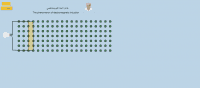
دائرة مغلقة فيها مصباح ومجال مغناطيسي منتظم \(B\) عمودي على الصفحة (نحو الداخل). لا يضيء المصباح ما دام التدفق \(\Phi_B\) عبر الدائرة ثابتًا، ويضيء عندما يتغير. اختر طريقة تغيير التدفق: قضيب يتحرك فتزداد مساحة الدائرة، أو مجال يتغير مع بقاء الدائرة ثابتة. ثم اضغط «بدء»؛ و«إعادة» لإعادة التجربة. القوة المحركة المستحثة \(\varepsilon=-\dfrac{d\Phi_B}{dt}\) (قانونا فاراداي ولنز).
A closed circuit contains a lamp and a uniform magnetic field \(B\) perpendicular to the page (into it). The lamp does not light while the flux \(\Phi_B\) through the circuit is constant, and it lights when the flux changes. Choose how the flux changes: a moving rod so the area of the circuit grows, or a changing field with the circuit fixed. Then press “Start”; “Repeat” runs the experiment again. The induced emf is \(\varepsilon=-\dfrac{d\Phi_B}{dt}\) (Faraday’s and Lenz’s laws).
🧭 اتجاه التيار المستحث (قانون لنز)
🧭 The Direction of the Induced Current (Lenz’s Law)
في الشكل المجال \(B\) داخل الصفحة. عند تحرك القضيب إلى اليمين تزداد مساحة الدائرة فيزداد التدفق نحو الداخل، فيكوّن التيار المستحث مجالًا نحو الخارج داخل الدائرة ليعاكس الزيادة، وهذا يتحقق بتيار عكس عقارب الساعة. وإذا قلّ المجال (\(dB/dt\lt 0\)) والدائرة ثابتة يقل التدفق نحو الداخل فيكوّن التيار مجالًا نحو الداخل ليعوّض النقصان أي تيارًا مع عقارب الساعة.
In the figure the field \(B\) is into the page. When the rod moves to the right the area of the circuit grows so the flux into the page increases, and the induced current makes a field out of the page inside the circuit to oppose the increase, which happens with a counter-clockwise current. If the field decreases (\(dB/dt\lt 0\)) with the circuit fixed the flux into the page decreases, so the current makes a field into the page to compensate, i.e. a clockwise current.
💡 شرح إضافي: تفاصيل قضيب يتحرك على سكتين
💡 Extra explanation: the details of a rod sliding on rails
إذا كان عرض الدائرة \(L\) وطولها \(x\) فإن \(\Phi_B=BLx\) ومنه \(\varepsilon=\left|\dfrac{d\Phi_B}{dt}\right|=BL\dfrac{dx}{dt}=BLv\) (وهي ق.د.ك. الحركية). وإذا كانت الدائرة ثابتة \(A=Lx\) والمجال يتغير فإن \(\varepsilon=A\left|\dfrac{dB}{dt}\right|\). ثم التيار \(I=\dfrac{\varepsilon}{R}\). لاحظ أن \(\Phi_B\) في الرسم يزداد خطيًا بالزمن في الحالتين لأن \(v\) أو \(dB/dt\) ثابتان، فتكون \(\varepsilon\) ثابتة.
If the circuit has width \(L\) and length \(x\) then \(\Phi_B=BLx\) so \(\varepsilon=\left|\dfrac{d\Phi_B}{dt}\right|=BL\dfrac{dx}{dt}=BLv\) (the motional emf). If the circuit is fixed \(A=Lx\) and the field changes then \(\varepsilon=A\left|\dfrac{dB}{dt}\right|\). Then the current is \(I=\dfrac{\varepsilon}{R}\). Notice that \(\Phi_B\) in the graph changes linearly with time in both cases because \(v\) or \(dB/dt\) is constant, so \(\varepsilon\) is constant.
✍️ أمثلة محلولة
✍️ Worked Examples
قضيب طوله \(0.5\ \mathrm{m}\) ينزلق بسرعة \(2\ \mathrm{m/s}\) على سكتين في مجال \(0.5\ \mathrm{T}\) عمودي على مستوى الدائرة، ومقاومة الدائرة \(5\ \Omega\). احسب \(\varepsilon\) والتيار.
A rod \(0.5\ \mathrm{m}\) long slides at \(2\ \mathrm{m/s}\) on two rails in a field of \(0.5\ \mathrm{T}\) perpendicular to the plane of the circuit, and the resistance of the circuit is \(5\ \Omega\). Calculate \(\varepsilon\) and the current.
دائرة ثابتة مساحتها \(0.8\ \mathrm{m^2}\) (عرض \(0.5\ \mathrm{m}\) وطول \(1.6\ \mathrm{m}\)) في مجال يزداد بمعدل \(0.2\ \mathrm{T/s}\). احسب \(\varepsilon\) وحدد اتجاه التيار إذا كان المجال نحو الداخل.
A fixed circuit of area \(0.8\ \mathrm{m^2}\) (width \(0.5\ \mathrm{m}\) and length \(1.6\ \mathrm{m}\)) is in a field increasing at \(0.2\ \mathrm{T/s}\). Calculate \(\varepsilon\) and find the direction of the current if the field is into the page.
ملف عدد لفاته \(100\) تغيّر التدفق عبر كل لفة منه من \(0.02\ \mathrm{Wb}\) إلى \(0.08\ \mathrm{Wb}\) خلال \(0.3\ \mathrm{s}\). احسب متوسط الـ ق.د.ك. المستحثة.
The flux through each turn of a \(100\)-turn coil changes from \(0.02\ \mathrm{Wb}\) to \(0.08\ \mathrm{Wb}\) in \(0.3\ \mathrm{s}\). Calculate the average induced emf.
يضيء المصباح في دائرة مغلقة تقع في مجال مغناطيسي عندما:
The lamp in a closed circuit placed in a magnetic field lights when:
إذا تضاعفت سرعة القضيب المنزلق (مع ثبات بقية القيم) فإن \(\varepsilon\):
If the speed of the sliding rod doubles (the other values fixed) \(\varepsilon\):
قضيب يتحرك إلى اليمين في مجال نحو الداخل يزداد معه التدفق. اتجاه التيار المستحث:
A rod moves to the right in a field into the page so the flux increases. The direction of the induced current is:
السالب في قانون فاراداي \(\varepsilon=-N\,d\Phi_B/dt\) يعبّر عن:
The minus sign in Faraday’s law \(\varepsilon=-N\,d\Phi_B/dt\) expresses:
📚 ملخص
📚 Summary
| المفهومConcept | القانونLaw |
|---|---|
| التدفقFlux | \(\Phi_B=BA\cos\theta\)\(\Phi_B=BA\cos\theta\) |
| قانون فارادايFaraday’s law | \(\varepsilon=-N\dfrac{d\Phi_B}{dt}\)\(\varepsilon=-N\dfrac{d\Phi_B}{dt}\) |
| قضيب متحركMoving rod | \(\varepsilon=BLv\ ,\ I=\varepsilon/R\)\(\varepsilon=BLv\ ,\ I=\varepsilon/R\) |
| مجال متغيرChanging field | \(\varepsilon=A\,dB/dt\)\(\varepsilon=A\,dB/dt\) |
⚠️ أخطاء شائعة
⚠️ Common mistakes
- الاعتقاد بأن وجود مجال قوي يولّد تيارًا؛ المطلوب تغير التدفق.Believing that a strong field produces a current; what is needed is a change of flux.
- نسيان عدد اللفات \(N\) في قانون فاراداي لملف.Forgetting the number of turns \(N\) in Faraday’s law for a coil.
- الخلط في اتجاه التيار: المستحث يعاكس التغير لا المجال نفسه.Confusing the direction of the current: the induced effect opposes the change, not the field itself.
🔗 محاكيات GeoGebra للاستعانة بها عند اللزوم
🔗 GeoGebra Simulations to Use When Needed
اضغط «تشغيل» لتعمل المحاكاة هنا داخل الدرس؛ ويمكن للطالب الرجوع إليها لتجربة الفكرة بطريقة أخرى.
Press “Run” to run the simulation right here inside the lesson; the student can use it to try the idea in another way.