🎯 نواتج التعلم
🎯 Learning Outcomes
بعد هذه التجربة ستكون قادرًا على أن:
After this experiment you will be able to:
- تفسّر لماذا يمر التيار نفسه في جميع المصابيح المتصلة على التوالي.Explain why the same current flows through all bulbs connected in series.
- تحسب المقاومة المكافئة والتيار والجهد والقدرة المستهلكة في كل مصباح.Calculate the equivalent resistance, the current, the voltage and the power used by each bulb.
- تستنتج أن المصباح الأكبر مقاومة يكون أكثر سطوعًا.Conclude that the bulb with the larger resistance is brighter.
- تفسّر لماذا يخفت كل المصابيح عند إضافة مصباح، ولماذا تنطفئ كلها عند احتراق أحدها.Explain why all bulbs dim when another bulb is added, and why they all go out when one burns out.
🎬 شاهد الفيديو
🎬 Watch the Video
🔍 الفكرة في صورة
🔍 The Idea in a Picture
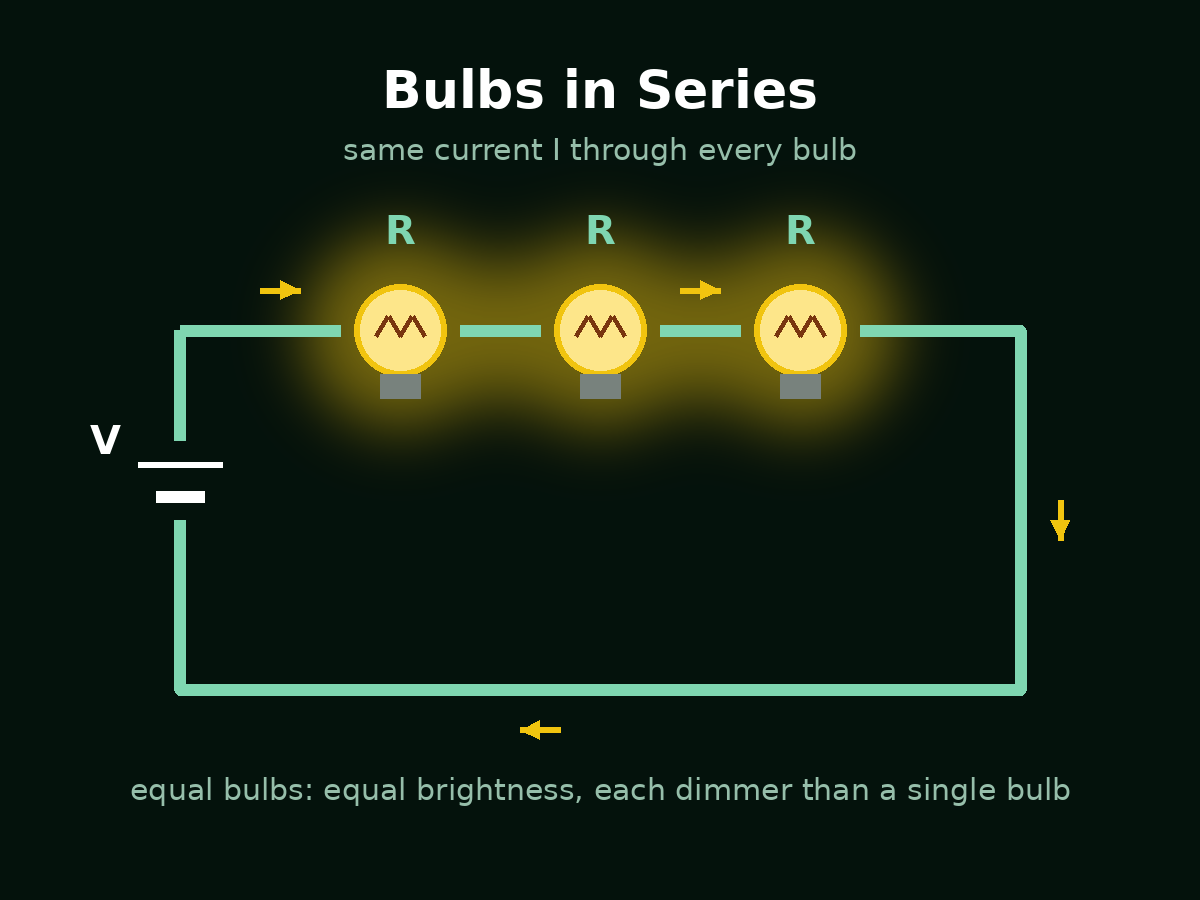
⚡ ماذا يحدث للتيار والجهد؟
⚡ What Happens to the Current and the Voltage?
عند توصيل المصابيح على التوالي فإنها تكوّن مسارًا واحدًا للتيار. لا يوجد طريق آخر يتفرع منه التيار، لذلك يمر التيار نفسه في كل مصباح، بينما يتوزع الجهد الكلي للبطارية بين المصابيح.
When bulbs are connected in series they form one path for the current. There is no branch where the current can split, so the same current flows through every bulb, while the total voltage of the battery is shared among the bulbs.
📘 قوانين التوالي
📘 Series Laws
\[I=I_1=I_2=I_3\]
\[V=V_1+V_2+V_3\]
\[R_{eq}=R_1+R_2+R_3\]
\[P_i=I^2R_i\]
حيث \(I\) التيار المشترك، و\(V\) جهد البطارية، و\(R_{eq}\) المقاومة المكافئة للدارة، و\(P_i\) القدرة المستهلكة في المصباح \(i\) وهي التي تحدد سطوعه.
where \(I\) is the common current, \(V\) the battery voltage, \(R_{eq}\) the equivalent resistance of the circuit, and \(P_i\) the power used by bulb \(i\), which determines its brightness.
💡 شرح إضافي: لماذا يكون المصباح الأكبر مقاومة أسطع؟
💡 Extra explanation: why is the bulb with the larger resistance brighter?
التيار واحد في كل المصابيح، فالشيء الوحيد الذي يختلف بينها هو المقاومة. القدرة التي يتحول بها الكهرباء إلى ضوء وحرارة في المصباح هي \(P=I^2R\)؛ وعند ثبات \(I\) تتناسب القدرة طرديًا مع \(R\). إذن المصباح ذو المقاومة الأكبر يستهلك قدرة أكبر فيتوهج أكثر. ولا يعني هذا أن التيار يتجزأ بين المصابيح، بل يبقى التيار واحدًا، والذي يتوزع هو الجهد: المصباح الأكبر مقاومة ينال جهدًا أكبر (\(V_i=IR_i\)).
The current is the same in every bulb, so the only thing that differs between them is the resistance. The power that turns electricity into light and heat in a bulb is \(P=I^2R\); when \(I\) is constant, \(P\) is proportional to \(R\). So the bulb with the larger resistance uses more power and glows brighter. This does not mean the current is divided between the bulbs: the current stays the same, and it is the voltage that is shared (\(V_i=IR_i\)), so the bulb with the larger resistance gets a larger voltage.
💡 شرح إضافي: لماذا تخفت كل المصابيح عند إضافة مصباح؟
💡 Extra explanation: why do all the bulbs dim when a bulb is added?
إضافة مصباح تزيد \(R_{eq}\)، فيقل التيار \(I=\dfrac{V}{R_{eq}}\) عند جهد بطارية ثابت. وبما أن كل المصابيح تشترك في التيار نفسه، تقل قدرة كل واحد منها \(P=I^2R\)، فيخفت الجميع معًا.
Adding a bulb increases \(R_{eq}\), so the current \(I=\dfrac{V}{R_{eq}}\) decreases for a fixed battery voltage. Since all bulbs share that same current, the power of each one, \(P=I^2R\), drops, and all of them dim together.
وعند احتراق أحد المصابيح ينقطع المسار، فيصبح التيار صفرًا وتنطفئ كل المصابيح. هذه نقطة ضعف الدوائر المتوالية، وهي عكس ما يحدث في التوازي.
When one bulb burns out the path is broken, the current becomes zero and all the bulbs go out. This is the weak point of series circuits, and it is the opposite of what happens in parallel circuits.
🧪 التجربة: محاكاة سطوع المصابيح على التوالي
🧪 The Experiment: Simulating Bulbs in Series
أدوات المحاكاة أدناه تتيح لك إضافة مصابيح، وتغيير مقاومة كل منها، ومراقبة سطوعها وأثر احتراق أحدها. الهدف أن تربط كل ما رأيته في الشروح بما يحدث أمامك.
The simulation below lets you add bulbs, change the resistance of each one, and observe their brightness and the effect of one burning out. Its goal is to connect everything you read above with what you see happening.
خطوات مقترحة
Suggested steps
- ابدأ بمصباحين متماثلين، ولاحظ أن سطوعهما متساوٍ.Start with two identical bulbs and notice that their brightness is equal.
- أضف مصباحًا ثالثًا، وراقب انخفاض سطوع الجميع وانخفاض التيار.Add a third bulb and watch the brightness of all of them and the current drop.
- غيّر مقاومة مصباح واحد وزدها، ولاحظ أنه يصبح الأكثر سطوعًا.Change the resistance of one bulb and increase it; notice that it becomes the brightest.
- اجعل أحد المصابيح يحترق، ولاحظ انطفاء كل المصابيح.Make one of the bulbs burn out and notice that all the bulbs go off.
🧪 تجربة تفاعلية: مصابيح على التوالي
🧪 Interactive experiment: bulbs in series
غيّر عدد المصابيح ومقاومة كل منها وجهد البطارية، ثم اختر مصباحًا ليحترق وراقب السطوع. يتوهج كل مصباح بقدرته \(P=I^2R\).
Change the number of bulbs, the resistance of each one and the battery voltage, then choose a bulb to burn out and watch the brightness. Each bulb glows according to its power \(P=I^2R\).
✍️ أمثلة محلولة
✍️ Worked Examples
ثلاثة مصابيح متماثلة مقاومة كل منها \(4\ \mathrm{\Omega}\) متصلة على التوالي ببطارية جهدها \(12\ \mathrm{V}\). احسب المقاومة المكافئة، والتيار، والجهد على كل مصباح، والقدرة في كل مصباح. ثم قارن قدرة المصباح بقدرة مصباح واحد موصول بالبطارية وحده.
Three identical bulbs, each of resistance \(4\ \mathrm{\Omega}\), are connected in series to a \(12\ \mathrm{V}\) battery. Find the equivalent resistance, the current, the voltage across each bulb and the power in each bulb. Then compare the power with that of one bulb connected alone to the battery.
ثلاثة مصابيح مقاوماتها \(2\ \mathrm{\Omega}\) و\(6\ \mathrm{\Omega}\) و\(4\ \mathrm{\Omega}\) متصلة على التوالي ببطارية \(12\ \mathrm{V}\). أيها أسطع؟ ولماذا؟
Three bulbs with resistances \(2\ \mathrm{\Omega}\), \(6\ \mathrm{\Omega}\) and \(4\ \mathrm{\Omega}\) are connected in series to a \(12\ \mathrm{V}\) battery. Which one is the brightest? Why?
نعود إلى المثال الأول (ثلاثة مصابيح \(4\ \mathrm{\Omega}\) لكل منها على \(12\ \mathrm{V}\)) ونضيف إلى الدارة مصباحًا رابعًا مماثلًا دون تغيير البطارية. ما التيار الجديد؟ وما قدرة كل مصباح الآن؟ هل يزداد السطوع أم يقل؟
Return to Example 1 (three \(4\ \mathrm{\Omega}\) bulbs on \(12\ \mathrm{V}\)) and add a fourth identical bulb to the circuit without changing the battery. What is the new current? What is the power of each bulb now? Does the brightness increase or decrease?
📚 ملخص
📚 Summary
| المفهومConcept | القانون أو النتيجةLaw or result |
|---|---|
| التيارCurrent | \(I\) واحد في كل المصابيح\(I\) is the same in every bulb |
| الجهد الكليTotal voltage | \(V=V_1+V_2+\dots\)\(V=V_1+V_2+\dots\) |
| المقاومة المكافئةEquivalent resistance | \(R_{eq}=R_1+R_2+\dots\)\(R_{eq}=R_1+R_2+\dots\) |
| السطوعBrightness | \(P=I^2R\): المصباح الأكبر مقاومة أسطع\(P=I^2R\): the bulb with the larger resistance is brighter |
| إضافة مصباحAdding a bulb | \(R_{eq}\) تزيد ⇒ \(I\) يقل ⇒ الجميع يخفت\(R_{eq}\) increases ⇒ \(I\) decreases ⇒ all dim |
| احتراق مصباحA bulb burns out | الدارة مفتوحة ⇒ \(I=0\) ⇒ تنطفئ الكلCircuit open ⇒ \(I=0\) ⇒ all go off |
⚠️ أخطاء شائعة
⚠️ Common mistakes
- الظن أن التيار يضعف كلما مرّ في مصباح؛ التيار واحد في كل نقطة من المسار المتوالي.Thinking the current gets weaker after each bulb; the current is the same at every point of a series path.
- الخلط بين الجهد والتيار: الذي يتوزع بين المصابيح هو الجهد، أما التيار فيبقى واحدًا.Confusing voltage and current: it is the voltage that is shared among the bulbs, while the current stays the same.
- افتراض أن كل مصباح يأخذ جهد البطارية كاملًا؛ المصابيح المتماثلة فقط تأخذ جهدًا متساويًا، وهو \(V/n\).Assuming each bulb gets the full battery voltage; only identical bulbs share it equally, each receiving \(V/n\).
- نسيان أن احتراق مصباح واحد يطفئ الكل في التوالي، بعكس التوازي.Forgetting that one burnt-out bulb switches off all the others in series, unlike in parallel.
🧠 اختبر نفسك
🧠 Test Yourself
في دائرة مصابيح متصلة على التوالي، أي العبارات الآتية صحيحة؟
In a circuit of bulbs connected in series, which statement is correct?
ثلاثة مصابيح متماثلة متصلة على التوالي ببطارية ثابتة الجهد. أُضيف مصباح رابع مماثل إلى الدارة نفسها. سطوع كل مصباح:
Three identical bulbs are connected in series to a battery of fixed voltage. A fourth identical bulb is added to the same circuit. The brightness of each bulb:
🔗 محاكاة GeoGebra للاستعانة بها عند اللزوم
🔗 GeoGebra Simulation to Use When Needed
اضغط «تشغيل» لتعمل المحاكاة هنا داخل الدرس؛ ويمكن للطالب الرجوع إليها لتجربة الفكرة بطريقة أخرى.
Press “Run” to run the simulation right here inside the lesson; the student can use it to try the idea in another way.