🎯 نواتج التعلم
🎯 Learning Outcomes
بعد هذه التجربة ستكون قادرًا على أن:
After this experiment you will be able to:
- تبيّن أن فرق الجهد نفسه يكون على كل مصباح في التوصيل على التوازي.Show that the same voltage is across every bulb in a parallel connection.
- تحسب تيار كل مصباح \(I=V/R\) وقدرته \(P=V^2/R\) وتفسّر لماذا يكون الأقل مقاومة أسطع.Calculate the current of each bulb \(I=V/R\) and its power \(P=V^2/R\) and explain why the bulb with the smaller resistance is brighter.
- تفسّر لماذا لا يتأثر سطوع مصباح بإضافة مصابيح أخرى، ولماذا يبقى الباقي مضاءً عند احتراق أحدها.Explain why a bulb’s brightness is not affected by adding other bulbs, and why the rest stay lit when one burns out.
- تحسب المقاومة المكافئة \(\dfrac{1}{R_{eq}}=\sum\dfrac{1}{R_i}\) والتيار والقدرة الكلية.Calculate the equivalent resistance \(\dfrac{1}{R_{eq}}=\sum\dfrac{1}{R_i}\) and the total current and power.
- تقارن بين السطوع على التوالي وعلى التوازي.Compare the brightness in series and in parallel.
🎬 شاهد الفيديو
🎬 Watch the Video
❓ السؤال الذي تجيب عنه التجربة
❓ The Question That the Experiment Answers
في المنزل تعمل المصابيح والأجهزة كلها مستقلة: إذا أطفأت مصباحًا لا ينطفئ الآخر، وإذا احترق أحدها تبقى بقيتها مضاءة. كيف نفسّر ذلك؟ وهل يصبح المصباح الواحد أخفت كلما أضفنا مصباحًا آخر على التوازي؟ هذه التجربة تجيب عن السؤالين بتتبع الجهد والتيار والقدرة في كل فرع.
At home the bulbs and appliances all work independently: if you switch off one bulb the others stay on, and if one burns out the rest remain lit. How do we explain this? And does a bulb become dimmer each time we add another bulb in parallel? This experiment answers both questions by following the voltage, the current and the power in each branch.
⚡ التوصيل على التوازي
⚡ The Parallel Connection
في التوصيل على التوازي تتفرع الدائرة إلى مسارات، ويتصل كل مصباح مباشرةً بطرفي البطارية. لذلك يأخذ كل مصباح فرق الجهد نفسه \(V\)، ويمرّ فيه تيار يساوي \(I_i=\dfrac{V}{R_i}\)، والتيار الكلي من البطارية هو مجموع هذه التيارات: \(I=\sum I_i\).
In a parallel connection the circuit branches into paths and each bulb is connected directly across the two terminals of the battery. So each bulb takes the same voltage \(V\), the current through it is \(I_i=\dfrac{V}{R_i}\), and the total current from the battery is the sum of these currents \(I=\sum I_i\).
📘 القوانين
📘 The laws
\[I_i=\frac{V}{R_i},\qquad P_i=\frac{V^{2}}{R_i}\]
\[I=\sum_i I_i,\qquad \frac{1}{R_{eq}}=\sum_i\frac{1}{R_i}\]
\[P_{total}=VI\]
💡 لماذا يكون الأقل مقاومة أسطع؟
💡 Why Is the Smaller Resistance Brighter?
سطوع المصباح يتناسب مع قدرته \(P\) (الطاقة التي يحولها إلى ضوء وحرارة في كل ثانية). ولأن الجهد ثابت، فإن \(P=V^2/R\): كلما قلّت المقاومة زادت القدرة. مثلًا مصباح \(R=4\ \Omega\) قدرته ضعف قدرة مصباح \(R=8\ \Omega\) عند الجهد نفسه.
The brightness of a bulb is proportional to its power \(P\) (the energy it converts into light and heat each second). Since the voltage is constant, \(P=V^2/R\): the smaller the resistance the larger the power. For example a bulb with \(R=4\ \Omega\) has twice the power of a bulb with \(R=8\ \Omega\) at the same voltage.
🔌 لماذا لا يتأثر السطوع بإضافة مصابيح؟
🔌 Why Does Adding Bulbs Not Change the Brightness?
كل مصباح موصول بالبطارية مباشرة، فالجهد عليه \(V\) مهما كان عدد المصابيح الأخرى، وتياره \(V/R\) لا يعتمد على تلك المصابيح. الذي يتغير هو التيار الكلي من البطارية فقط، لأن كل مصباح يضيف مسارًا جديدًا يسحب تيارًا إضافيًّا. لذلك تُوصَل أجهزة المنزل على التوازي: كل جهاز يعمل بالجهد نفسه ومستقلًّا عن غيره.
Every bulb is connected directly to the battery, so the voltage across it is \(V\) whatever the number of other bulbs, and its current \(V/R\) does not depend on them. What changes is only the total current from the battery, because each bulb adds a new path that draws an extra current. This is why household appliances are wired in parallel: each one works at the same voltage and independently of the others.
🧪 التجربة 1: دائرة المصابيح على التوازي
🧪 Experiment 1: The Bulbs-in-Parallel Circuit
🛠️ خطوات العمل
🛠️ Procedure
- اضبط الجهد \(V=6\ \mathrm V\) وعدد المصابيح 2 بمقاومتين \(R_1=6\) و\(R_2=12\ \Omega\)، وقارن السطوع والقدرة.Set \(V=6\ \mathrm V\) and the number of bulbs 2 with \(R_1=6\) and \(R_2=12\ \Omega\), and compare the brightness and power.
- زِد عدد المصابيح إلى 3 و4 وراقب سطوع المصباح 1: هل يتغير؟Increase the number of bulbs to 3 and 4 and watch the brightness of bulb 1: does it change?
- اختر مصباحًا محروقًا من القائمة وراقب بقية المصابيح.Choose a burnt bulb from the list and watch the other bulbs.
- غيّر الجهد وراقب أن التيار والقدرة يتغيران، لكن نسبة التيارات تبقى كما هي.Change the voltage and watch that the currents and powers change, but the ratio of the currents stays the same.
🧪 تجربة 1: دائرة المصابيح على التوازي
🧪 Experiment 1: The Bulbs-in-Parallel Circuit
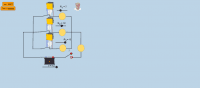
وصّل مصابيح بمقاومات مختلفة على التوازي مع بطارية \(V\)، ثم اقطع أحدها: كل مصباح يأخذ الجهد نفسه، والمصباح الأقل مقاومة أسطع.
Connect bulbs with different resistances in parallel with a battery \(V\), then burn one out: every bulb takes the same voltage, and the bulb with the smaller resistance is brighter.
🔍 ماذا نلاحظ؟
🔍 What do we observe?
- المصباح الأقل مقاومة يمرّ فيه تيار أكبر وقدرته أكبر، فيكون أسطع.The bulb with the smaller resistance carries a larger current and has a larger power, so it is brighter.
- سطوع المصباح 1 لا يتغير عند إضافة مصابيح أخرى.The brightness of bulb 1 does not change when other bulbs are added.
- احتراق مصباح يقطع فرعه فقط، والباقي يبقى مضاءً بالسطوع نفسه.When a bulb burns out only its own branch is cut, and the rest stay lit at the same brightness.
🔢 التجربة 2: المقاومة المكافئة
🔢 Experiment 2: The Equivalent Resistance
كلما أضفنا مسارًا على التوازي زاد التيار الكلي، أي أن المقاومة المكافئة تقلّ. لهذا تكون \(R_{eq}\) أصغر من أصغر مقاومة في الدائرة دائمًا. وإذا كانت المصابيح متماثلة فإن \(R_{eq}=\dfrac{R}{n}\)، فتحصل على الرسم البياني الذي تراه.
Each time we add a parallel path the total current increases, so the equivalent resistance decreases. That is why \(R_{eq}\) is always smaller than the smallest resistance in the circuit. If the bulbs are identical then \(R_{eq}=\dfrac{R}{n}\), which is the graph you see.
🧪 تجربة 2: المقاومة المكافئة للمصابيح المتماثلة
🧪 Experiment 2: The Equivalent Resistance of Identical Bulbs
عدد من المصابيح المتماثلة على التوازي. غيّر المقاومة الواحدة وعددها وراقب \(R_{eq}=R/n\) على الرسم البياني.
A number of identical bulbs in parallel. Change the resistance of one bulb and their number, and watch \(R_{eq}=R/n\) on the graph.
🔍 ماذا نلاحظ؟
🔍 What do we observe?
- مع أربعة مصابيح متماثلة \(R=12\ \Omega\) تكون \(R_{eq}=3\ \Omega\).With four identical bulbs \(R=12\ \Omega\) the equivalent resistance is \(R_{eq}=3\ \Omega\).
- المنحنى هبوطه سريع في البداية ثم يقترب من الصفر: إضافة أول مصباح تغيّر كثيرًا، والمصابيح التالية تغيّر أقل.The curve falls quickly at first and then approaches zero: the first added bulb changes it a lot, the next ones change it less.
⚖️ التجربة 3: التوالي أم التوازي؟
⚖️ Experiment 3: Series or Parallel?
على التوالي يمرّ التيار نفسه في المصباحين، فتتوزع الجهد عليهما، و\(P=I^2R\)، وكلما زادت المقاومة قلّ السطوع إلى حد بعيد. أما على التوازي فيأخذ كل مصباح \(V\) كاملًا فيكون أسطع. لذلك تُوصَّل المصابيح في المنزل على التوازي.
In series the same current flows through both bulbs, the voltage is shared between them, and \(P=I^2R\). In parallel each bulb takes the full \(V\) so it is brighter. That is why bulbs in a house are wired in parallel.
🧪 تجربة 3: التوالي أم التوازي؟ قارن السطوع
🧪 Experiment 3: Series or Parallel? Compare the Brightness
مصباحان بالمقاومتين نفسيهما: مرة على التوالي ومرة على التوازي مع البطارية نفسها. قارن القدرة (السطوع) لكل مصباح.
Two bulbs with the same resistances: once in series and once in parallel with the same battery. Compare the power (brightness) of each bulb.
🔍 ماذا نلاحظ؟
🔍 What do we observe?
- على التوالي كل مصباح أخفت من المصباح الوحيد على البطارية نفسها.In series each bulb is dimmer than a single bulb on the same battery.
- على التوازي يبقى سطوع كل مصباح كما هو تقريبًا عند إضافة الآخر.In parallel the brightness of each bulb stays almost the same when the other is added.
🎲 التجربة 4: تدرّب
🎲 Experiment 4: Practice
🧪 تجربة 4: تدرّب: التيار والقدرة في التوازي
🧪 Experiment 4: Practice: Current and Power in Parallel
ثلاثة مصابيح على التوازي مع بطارية. أوجد التيار الكلي والقدرة الكلية.
Three bulbs in parallel with a battery. Find the total current and the total power.
✍️ أمثلة محلولة
✍️ Worked Examples
مصباحان مقاومتاهما \(4\ \Omega\) و\(12\ \Omega\) موصولان على التوازي ببطارية \(12\ \mathrm V\). أوجد تيار كل مصباح وقدرته والتيار الكلي.
Two bulbs of resistances \(4\ \Omega\) and \(12\ \Omega\) are connected in parallel to a \(12\ \mathrm V\) battery. Find the current and the power of each bulb and the total current.
ثلاثة مصابيح متماثلة \(R=9\ \Omega\) على التوازي. أوجد المقاومة المكافئة.
Three identical bulbs \(R=9\ \Omega\) in parallel. Find the equivalent resistance.
مصباح مقاومته \(6\ \Omega\) موصول على التوازي مع مصباح مقاومته \(6\ \Omega\)، ثم احترق الثاني. ما قدرة الأول قبل الاحتراق وبعده عند جهد \(6\ \mathrm V\)؟
A bulb of resistance \(6\ \Omega\) is connected in parallel with a bulb of resistance \(6\ \Omega\), then the second burns out. What is the power of the first before and after, at \(6\ \mathrm V\)?
مصباحان على التوازي مع بطارية. قدرة الأول \(8\ \mathrm W\) ومقاومته \(18\ \Omega\). أوجد الجهد ومقاومة الثاني إذا كانت قدرته \(4\ \mathrm W\).
Two bulbs are in parallel with a battery. The power of the first is \(8\ \mathrm W\) and its resistance \(18\ \Omega\). Find the voltage and the resistance of the second if its power is \(4\ \mathrm W\).
ثلاثة مصابيح على التوازي بجهد \(9\ \mathrm V\) ومقاوماتها \(3\)، و\(6\)، و\(9\ \Omega\). أوجد التيار الكلي والقدرة الكلية.
Three bulbs in parallel at \(9\ \mathrm V\) with resistances \(3\), \(6\) and \(9\ \Omega\). Find the total current and the total power.
🛠️ تطبيقات عملية
🛠️ Practical Applications
أين يظهر التوصيل على التوازي؟
Where does the parallel connection appear?
- الكهرباء المنزلية: كل جهاز وكل مصباح موصول على التوازي ليعمل بالجهد نفسه (220 V أو 230 V) مستقلًّا.Household electricity: every appliance and bulb is wired in parallel to work at the same voltage (220 V or 230 V) independently.
- الإضاءة في الشوارع والمباني: احتراق مصباح لا يُطفئ البقية.Street and building lighting: one burnt bulb does not switch off the others.
- السيارات: المصابيح والأجهزة الكهربائية موصولة على التوازي مع البطارية.Cars: the lights and electrical devices are connected in parallel with the battery.
⚠️ أخطاء شائعة
⚠️ Common Mistakes
تجنّب هذه الأخطاء
Avoid these mistakes
- الظن أن المصباح يخفت عند إضافة مصباح آخر على التوازي؛ جهده يبقى \(V\).Thinking that a bulb gets dimmer when another bulb is added in parallel; its voltage stays \(V\).
- جمع المقاومات بدل مقلوباتها: \(\frac{1}{R_{eq}}=\sum\frac{1}{R_i}\) وليس \(R_{eq}=\sum R_i\).Adding the resistances instead of their reciprocals: \(\frac{1}{R_{eq}}=\sum\frac{1}{R_i}\) not \(R_{eq}=\sum R_i\).
- الخلط بين الجهد الكلي والجهد على كل مصباح؛ على التوازي الجهد واحد.Confusing the total voltage with the voltage across each bulb; in parallel the voltage is the same.
- نسيان أن التيار الكلي يزيد عند إضافة فرع، وأن المقاومة المكافئة تقل.Forgetting that the total current increases when a branch is added and the equivalent resistance decreases.
📚 ملخص
📚 Summary
أهم ما تعلمناه
Key points
- على التوازي يأخذ كل مصباح الجهد نفسه \(V\)، و\(P=V^2/R\).In parallel each bulb takes the same voltage \(V\), and \(P=V^2/R\).
- المصباح الأقل مقاومة أسطع، ولا يتأثر سطوع مصباح بإضافة مصابيح أخرى.The bulb with the smaller resistance is brighter, and a bulb’s brightness is not affected by adding other bulbs.
- \(\frac{1}{R_{eq}}=\sum\frac{1}{R_i}\) و\(I=\sum I_i\)؛ والاحتراق يقطع فرعه فقط.\(\frac{1}{R_{eq}}=\sum\frac{1}{R_i}\) and \(I=\sum I_i\); a burnt bulb cuts only its own branch.
🔗 محاكيات GeoGebra للاستعانة بها عند اللزوم
🔗 GeoGebra Simulations to Use When Needed
اضغط «تشغيل» لتعمل المحاكاة هنا داخل الدرس؛ ويمكن للطالب الرجوع إليها لتجربة الفكرة بطريقة أخرى.
Press “Run” to run the simulation right here inside the lesson; the student can use it to try the idea in another way.