🎯 نواتج التعلم
🎯 Learning Outcomes
بعد هذه التجربة ستكون قادرًا على أن:
After this experiment you will be able to:
- تحسب المفاعلة الحثية \(X_L=2\pi fL\) والمفاعلة السعوية \(X_C=\dfrac{1}{2\pi fC}\)، وتعرف أنهما متعاكستان في تأثيرهما على التيار.Calculate the inductive reactance \(X_L=2\pi fL\) and the capacitive reactance \(X_C=\dfrac{1}{2\pi fC}\), and know that they have opposite effects on the current.
- تحسب المفاعلة الكلية \(X=X_L-X_C\) والمعاوقة \(Z=\sqrt{R^2+X^2}\) لدائرة RLC متوالية.Calculate the net reactance \(X=X_L-X_C\) and the impedance \(Z=\sqrt{R^2+X^2}\) of a series RLC circuit.
- تحدد من إشارة \(X\) هل الدائرة حثية أم سعوية، وهل التيار يتأخر عن الجهد أم يسبقه.Use the sign of \(X\) to decide whether the circuit is inductive or capacitive, and whether the current lags or leads the voltage.
- تحسب تردد الرنين \(f_0=\dfrac{1}{2\pi\sqrt{LC}}\)، وتفسر لماذا يكون التيار عنده أكبر ما يمكن.Calculate the resonance frequency \(f_0=\dfrac{1}{2\pi\sqrt{LC}}\), and explain why the current is largest there.
- تتوقع أثر تغيير التردد أو الحث أو السعة أو المقاومة على التيار وفرق الطور، وتتحقق من توقعك بالمحاكاة.Predict how changing the frequency, the inductance, the capacitance or the resistance affects the current and the phase difference, and check your prediction with the simulation.
💡 فكرة التجربة
💡 The Idea of the Experiment
في الدائرة المتوالية تحتوي مقاومة \(R\) وملفًا حثه \(L\) ومكثفًا سعته \(C\)، وكلها موصولة على التوالي بمصدر تيار متردد. يحاول الملف أن يؤخر التيار، والمكثف أن يقدمه، فيحدث بينهما تعاكس: الجهد على الملف يتقدم التيار بـ \(90^\circ\)، والجهد على المكثف يتأخر عنه بـ \(90^\circ\). لذلك تطرح المفاعلتان من بعضهما، وتكون المفاعلة الكلية \(X=X_L-X_C\).
In a series circuit with a resistor \(R\), an inductor \(L\) and a capacitor \(C\) connected to an alternating source, the coil tries to delay the current and the capacitor tries to advance it, so they oppose each other: the voltage on the coil leads the current by \(90^\circ\), and the voltage on the capacitor lags it by \(90^\circ\). The two reactances therefore subtract, and the net reactance is \(X=X_L-X_C\).
📘 المفاعلات والمعاوقة في دائرة RLC
📘 Reactances and impedance in an RLC circuit
\[X_L=2\pi fL\qquad X_C=\dfrac{1}{2\pi fC}\qquad X=X_L-X_C\]
\[Z=\sqrt{R^2+X^2}\qquad I_{rms}=\dfrac{V_{rms}}{Z}\qquad \tan\varphi=\dfrac{X}{R}\]
\[f_0=\dfrac{1}{2\pi\sqrt{LC}}\]
إذا كانت \(X>0\) تكون الدائرة حثية ويتأخر التيار عن الجهد. وإذا كانت \(X<0\) تكون سعوية ويسبق التيار الجهد. وعند \(X=0\) (أي عند \(f=f_0\)) تكون الدائرة في حالة رنين: \(Z=R\)، و\(\varphi=0\)، والتيار أكبر ما يمكن.
If \(X>0\) the circuit is inductive and the current lags the voltage. If \(X<0\) the circuit is capacitive and the current leads the voltage. When \(X=0\) (that is, at \(f=f_0\)) the circuit is at resonance: \(Z=R\), \(\varphi=0\), and the current is largest.
| الحالةCase | الإشارةSign | العلاقة بين الجهد والتيارVoltage–current relation |
|---|---|---|
| حثيةInductive | \(X>0\) | الجهد يسبق التيارVoltage leads current |
| سعويةCapacitive | \(X<0\) | التيار يسبق الجهدCurrent leads voltage |
| رنينResonance | \(X=0\) | في طور واحد، \(Z=R\)In phase, \(Z=R\) |
💡 شرح إضافي: لماذا يكون التيار أكبر ما يمكن عند الرنين؟
💡 Extra explanation: why is the current largest at resonance?
عند الرنين تتساوى \(X_L\) و\(X_C\)، فيلغي جهد الملف جهد المكثف، ولا يبقى إلا الجهد على المقاومة. لذلك تكون المعاوقة أصغر ما يمكن (\(Z=R\))، ويكون التيار \(I=V/R\) أكبر ما يمكن. وتنتقل الطاقة في الدائرة بين الملف والمكثف دون فقد كبير.
At resonance \(X_L\) and \(X_C\) are equal, so the voltage on the coil cancels the voltage on the capacitor and only the voltage on the resistor is left. The impedance is then at its smallest (\(Z=R\)), so the current \(I=V/R\) is at its largest. Energy moves back and forth between the coil and the capacitor with little loss.
💡 شرح إضافي: لماذا لا نجمع الجهود جبريًا؟
💡 Extra explanation: why don’t we add the voltages directly?
الجهد على المقاومة \(V_R=IR\) في طور التيار، والجهد على الملف \(V_L=IX_L\) يتقدمه بـ \(90^\circ\)، والجهد على المكثف \(V_C=IX_C\) يتأخر عنه بـ \(90^\circ\). لذلك \(V^2=V_R^2+(V_L-V_C)^2\)، ويمكن أن يكون \(V_L\) أو \(V_C\) أكبر من الجهد الكلي، وهذا ليس خطأ.
The voltage on the resistor \(V_R=IR\) is in phase with the current, the voltage on the coil \(V_L=IX_L\) leads it by \(90^\circ\), and the voltage on the capacitor \(V_C=IX_C\) lags it by \(90^\circ\). So \(V^2=V_R^2+(V_L-V_C)^2\). Either \(V_L\) or \(V_C\) can be larger than the total voltage, and that is not a mistake.
🧪 التجربة: دائرة تيار متردد RLC
🧪 The Experiment: AC Circuit RLC
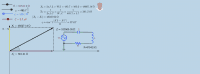
في التجربة التفاعلية أدناه دائرة كاملة: مصدر تيار متردد، ومفتاح، وأميتر على التوالي، وملف، ومكثف، ومقاومة. أغلق المفتاح لتتحرك الشحنات في السلك، وتتحرك إبر الأميتر والفولتميترات الثلاثة، ثم اتبع الخطوات:
The interactive experiment below is a complete circuit: an AC source, a switch, an ammeter in series, a coil, a capacitor and a resistor. Close the switch so the charges move in the wire and the needles of the ammeter and the three voltmeters move, then follow the steps:
خطوات التجربة
Steps of the experiment
- توقّع أولًا: احسب \(X_L\) و\(X_C\) و\(X\) و\(Z\) و\(I_{rms}\) و\(\varphi\) قبل تغيير أي قيمة، وحدد هل الدائرة حثية أم سعوية.Predict first: before changing any value, calculate \(X_L\), \(X_C\), \(X\), \(Z\), \(I_{rms}\) and \(\varphi\), and decide whether the circuit is inductive or capacitive.
- حوّل الوحدات: الحث بالهنري، والسعة بالميكروفاراد (\(1\,\mu\mathrm{F}=10^{-6}\,\mathrm{F}\)).Convert the units: the inductance in henries and the capacitance in microfarads (\(1\,\mu\mathrm{F}=10^{-6}\,\mathrm{F}\)).
- غيّر التردد ببطء من الصغير إلى الكبير: لاحظ أن \(I\) يبلغ أقصاه عند تردد الرنين، وأن \(\varphi\) تقترب من الصفر هناك.Change the frequency slowly from small to large: notice that \(I\) reaches its maximum at the resonance frequency, and \(\varphi\) approaches zero there.
- قارن بين الحالتين: عندما يكون التردد أقل من الرنين تكون الدائرة سعوية (التيار يسبق)، وعندما يكون أكبر تكون حثية (التيار يتأخر).Compare the two sides: below resonance the circuit is capacitive (the current leads), and above resonance it is inductive (the current lags).
- غيّر المقاومة: لاحظ أن الرنين لا يتغير، لكن قمة التيار تكون أعلى وأضيق عند المقاومة الصغيرة.Change the resistance: notice that the resonance frequency does not change, but the current peak is higher and narrower for a small resistance.
🧪 تجربة تفاعلية: دائرة تيار متردد RLC
🧪 Interactive Experiment: AC Circuit RLC
أغلق المفتاح بالزر أو بالنقر عليه في الرسم. الأميتر والفولتميترات تعرض القيم اللحظية: الإبرة تتأرجح مع التيار والجهد، وإشارتها تتبع الاتجاه (الصفر في المنتصف). أما الجداول أسفل الرسم فتعرض القيم الفعالة. لاحظ في الموجات أن \(\varphi\) تتغير مع التردد، وأن الفرق بين الجهدين على الملف والمكثف هو ما يحدد الدائرة.
Close the switch with the button or by clicking it in the drawing. The ammeter and voltmeters show instantaneous values: the needle swings with the current and voltage, and its sign follows the direction (zero is in the middle). The readouts below the figure show the RMS values. In the waves, notice that \(\varphi\) changes with the frequency, and that the difference between the voltages on the coil and the capacitor decides the type of circuit.
✍️ مثال محلول
✍️ Worked Example
المعطيات: \(R=30\,\Omega,\quad L=0.2\,\mathrm{H},\quad C=20\,\mu\mathrm{F},\quad f=50\,\mathrm{Hz},\quad V_{rms}=100\,\mathrm{V}\)
Given: \(R=30\,\Omega,\quad L=0.2\,\mathrm{H},\quad C=20\,\mu\mathrm{F},\quad f=50\,\mathrm{Hz},\quad V_{rms}=100\,\mathrm{V}\)
- المفاعلة الحثية: \(X_L=2\pi(50)(0.2)\approx 62.8\,\Omega\)Inductive reactance: \(X_L=2\pi(50)(0.2)\approx 62.8\,\Omega\)
- المفاعلة السعوية: \(X_C=\dfrac{1}{2\pi(50)(20\times10^{-6})}\approx 159.2\,\Omega\)Capacitive reactance: \(X_C=\dfrac{1}{2\pi(50)(20\times10^{-6})}\approx 159.2\,\Omega\)
- المفاعلة الكلية: \(X=X_L-X_C=62.8-159.2\approx -96.3\,\Omega\)، والإشارة السالبة تعني أن الدائرة سعوية.Net reactance: \(X=X_L-X_C=62.8-159.2\approx -96.3\,\Omega\); the negative sign means the circuit is capacitive.
- المعاوقة: \(Z=\sqrt{30^2+96.3^2}\approx 100.9\,\Omega\)Impedance: \(Z=\sqrt{30^2+96.3^2}\approx 100.9\,\Omega\)
- التيار الفعال: \(I_{rms}=\dfrac{100}{100.9}\approx 0.99\,\mathrm{A}\)RMS current: \(I_{rms}=\dfrac{100}{100.9}\approx 0.99\,\mathrm{A}\)
- فرق الطور: \(\tan\varphi=\dfrac{-96.3}{30}\Rightarrow\varphi\approx -72.7^\circ\)، أي أن التيار يسبق الجهد بـ \(72.7^\circ\).Phase difference: \(\tan\varphi=\dfrac{-96.3}{30}\Rightarrow\varphi\approx -72.7^\circ\), so the current leads the voltage by \(72.7^\circ\).
- الجهود المفردة: \(V_R=IR\approx 29.7\,\mathrm{V}\)، \(V_L=IX_L\approx 62.3\,\mathrm{V}\)، \(V_C=IX_C\approx 157.8\,\mathrm{V}\)Separate voltages: \(V_R=IR\approx 29.7\,\mathrm{V}\), \(V_L=IX_L\approx 62.3\,\mathrm{V}\), \(V_C=IX_C\approx 157.8\,\mathrm{V}\)
- تحقّق: \(\sqrt{29.7^2+(62.3-157.8)^2}\approx 100\,\mathrm{V}\) ✓Check: \(\sqrt{29.7^2+(62.3-157.8)^2}\approx 100\,\mathrm{V}\) ✓
- القدرة المتوسطة: \(P=I_{rms}^2R\approx (0.99)^2(30)\approx 29.5\,\mathrm{W}\)Average power: \(P=I_{rms}^2R\approx (0.99)^2(30)\approx 29.5\,\mathrm{W}\)
🧠 اختبر نفسك
🧠 Test Yourself
دائرة RLC متوالية فيها \(L=0.2\,\mathrm{H}\) و\(C=20\,\mu\mathrm{F}\). احسب تردد الرنين، وماذا تكون \(X\) و\(\varphi\) عنده؟A series RLC circuit has \(L=0.2\,\mathrm{H}\) and \(C=20\,\mu\mathrm{F}\). Calculate the resonance frequency, and what are \(X\) and \(\varphi\) there?
دائرة RLC متوالية: \(R=30\,\Omega\)، \(X_L=70\,\Omega\)، \(X_C=30\,\Omega\)، وجهد المصدر الفعال \(100\,\mathrm{V}\). احسب \(Z\)، و\(I_{rms}\)، و\(\varphi\)، وحدد نوع الدائرة.A series RLC circuit: \(R=30\,\Omega\), \(X_L=70\,\Omega\), \(X_C=30\,\Omega\), and the RMS source voltage is \(100\,\mathrm{V}\). Calculate \(Z\), \(I_{rms}\) and \(\varphi\), and determine the type of circuit.
📚 ملخص
📚 Summary
| المفهومConcept | القانونLaw |
|---|---|
| المفاعلة الحثيةInductive reactance | \(X_L=2\pi fL\) |
| المفاعلة السعويةCapacitive reactance | \(X_C=\dfrac{1}{2\pi fC}\) |
| المفاعلة الكليةNet reactance | \(X=X_L-X_C\) |
| المعاوقةImpedance | \(Z=\sqrt{R^2+X^2}\) |
| تردد الرنينResonance frequency | \(f_0=\dfrac{1}{2\pi\sqrt{LC}}\) |
| فرق الطورPhase difference | \(\tan\varphi=X/R\) |
| الجهود المفردةSeparate voltages | \(V^2=V_R^2+(V_L-V_C)^2\) |
| القدرة المتوسطةAverage power | \(P=I_{rms}^2R\) |
⚠️ أخطاء شائعة
⚠️ Common mistakes
- جمع \(X_L\) و\(X_C\) جمعًا عاديًا؛ الصحيح \(X=X_L-X_C\)، ثم تحسب \(Z\) منها.Adding \(X_L\) and \(X_C\) directly; the correct rule is \(X=X_L-X_C\), and then \(Z\) is calculated from it.
- نسيان الإشارة: \(X<0\) تعني دائرة سعوية والتيار يسبق، و\(X>0\) تعني حثية والتيار يتأخر.Forgetting the sign: \(X<0\) means a capacitive circuit with the current leading, and \(X>0\) means an inductive circuit with the current lagging.
- الخلط في الوحدات، مثل ميكروفاراد وفاراد، أو ملي هنري وهنري.Mixing up units, such as microfarads and farads, or millihenries and henries.
- اعتبار التيار صفرًا عند الرنين؛ الصحيح أن التيار يكون أكبر ما يمكن لأن \(Z=R\) هي أصغر قيمة للمعاوقة.Thinking the current is zero at resonance; the correct statement is that it is largest there, because \(Z=R\) is the smallest impedance.
- جمع \(V_L\) و\(V_C\) جبريًا بدلًا من \(V^2=V_R^2+(V_L-V_C)^2\).Adding \(V_L\) and \(V_C\) directly instead of using \(V^2=V_R^2+(V_L-V_C)^2\).
🔗 محاكيات GeoGebra للاستعانة بها عند اللزوم
🔗 GeoGebra Simulations to Use When Needed
اضغط «تشغيل» لتعمل المحاكاة هنا داخل الدرس؛ ويمكن للطالب الرجوع إليها لتجربة الفكرة بطريقة أخرى.
Press “Run” to run the simulation right here inside the lesson; the student can use it to try the idea in another way.