🎯 نواتج التعلم
🎯 Learning Outcomes
بعد هذه التجربة ستكون قادرًا على أن:
After this experiment you will be able to:
- تفسّر سبب مقاومة الملف للتيار المتردد بظاهرة الحث الذاتي، وتعرّف المفاعلة الحثية \(X_L=\omega L=2\pi fL\).Explain why a coil resists alternating current because of self-induction, and define the inductive reactance \(X_L=\omega L=2\pi fL\).
- تحسب المعاوقة \(Z=\sqrt{R^2+X_L^2}\) لدائرة ملف ومقاومة متصلين على التوالي.Calculate the impedance \(Z=\sqrt{R^2+X_L^2}\) of a coil and a resistor connected in series.
- تحسب التيار الفعال \(I_{rms}=\dfrac{V_{rms}}{Z}\) وفرق الطور \(\varphi\) بين الجهد الكلي والتيار.Calculate the RMS current \(I_{rms}=\dfrac{V_{rms}}{Z}\) and the phase difference \(\varphi\) between the total voltage and the current.
- تميّز بين الجهد على المقاومة (في الطور مع التيار) والجهد على الملف (يتقدم على التيار بزاوية \(90^\circ\))، وتجمعهما جمعًا اتجاهيًا.Distinguish between the voltage across the resistor (in phase with the current) and the voltage across the coil (leads the current by \(90^\circ\)), and add them as phasors.
- تتوقع أثر تغيير التردد أو الحث الذاتي أو المقاومة على التيار وفرق الطور والقدرة المتوسطة، وتتحقق من توقعك بالمحاكاة.Predict how changing the frequency, the self-inductance or the resistance affects the current, the phase difference and the average power, and check your prediction with the simulation.
💡 فكرة التجربة
💡 The Idea of the Experiment
عند وصل ملف (له حث ذاتي \(L\)) ومقاومة \(R\) على التوالي بمصدر تيار متردد، يتغير التيار باستمرار. وكلما تغيّر التيار تولّدت في الملف ق.د.ك. مستحثة ذاتية تعاكس هذا التغير. هذه المعاكسة هي ما يجعل الملف يعيق التيار المتردد، ومقدار هذه الإعاقة يسمّى المفاعلة الحثية. أما المقاومة \(R\) فتعيق التيار بالطريقة المعتادة في التيار المستمر أيضًا.
When a coil (self-inductance \(L\)) and a resistor \(R\) are connected in series to an alternating source, the current keeps changing. Whenever the current changes, a self-induced emf appears in the coil that opposes this change. This opposition is what makes the coil resist alternating current, and the amount of this resistance is called the inductive reactance. The resistor \(R\) opposes the current in the usual way, as it does in direct current.
📘 المفاعلة الحثية والمعاوقة
📘 Inductive reactance and impedance
\[X_L=\omega L=2\pi fL\]
\[Z=\sqrt{R^2+X_L^2}\]
\[I_{rms}=\dfrac{V_{rms}}{Z}\qquad\qquad \tan\varphi=\dfrac{X_L}{R}\]
حيث \(\omega=2\pi f\) السرعة الزاوية، و\(f\) التردد بالهرتز، و\(L\) الحث الذاتي بالهنري، و\(\varphi\) فرق الطور. في هذه الدائرة يتأخر التيار عن الجهد الكلي بالزاوية \(\varphi\).
where \(\omega=2\pi f\) is the angular speed, \(f\) the frequency in hertz, \(L\) the self-inductance in henries, and \(\varphi\) the phase difference. In this circuit the current lags the total voltage by the angle \(\varphi\).
| العنصرElement | العلاقة بين الجهد والتيارVoltage–current relation | الممانعةOpposition |
|---|---|---|
| المقاومة \(R\)Resistor \(R\) | في الطور (بلا فرق طور)In phase (no phase difference) | \(R\) |
| الملف \(L\)Coil \(L\) | الجهد يتقدم التيار بـ \(90^\circ\)Voltage leads the current by \(90^\circ\) | \(X_L=2\pi fL\) |
| الدائرة (ملف + مقاومة)The circuit (coil + resistor) | التيار يتأخر عن الجهد الكلي بالزاوية \(\varphi\)Current lags the total voltage by \(\varphi\) | \(Z=\sqrt{R^2+X_L^2}\) |
💡 شرح إضافي: لماذا يعيق الملف التيار المتردد ولا يعيق التيار المستمر؟
💡 Extra explanation: why does a coil block alternating current but not direct current?
في التيار المستمر يكون التيار ثابتًا، فلا يتغير التدفق في الملف، ولا تتولد ق.د.ك. ذاتية، ويتصرف الملف كأنه سلك موصل (\(X_L=0\) عند \(f=0\)). أما في التيار المتردد فالتيار يتغير باستمرار، فتتولد ق.د.ك. ذاتية دائمًا تعاكس التغير، وكلما زاد التردد زاد معدل التغير فزادت الإعاقة. لذلك تكون \(X_L\) متناسبة طرديًا مع \(f\) و\(L\).
With direct current the current is constant, so the flux in the coil does not change, no self-induced emf appears, and the coil behaves like an ordinary wire (\(X_L=0\) at \(f=0\)). With alternating current the current changes all the time, so a self-induced emf always appears to oppose the change, and the faster the change (higher frequency), the stronger the opposition. That is why \(X_L\) is proportional to both \(f\) and \(L\).
💡 شرح إضافي: لماذا لا نجمع الجهدين جبريًا؟
💡 Extra explanation: why don’t we add the two voltages directly?
الجهد على المقاومة \(V_R=IR\) في طور التيار، أما الجهد على الملف \(V_L=IX_L\) فيتقدم عليه بزاوية \(90^\circ\). لذلك نجمعهما كمتجهين متعامدين، فيكون: \(V^2=V_R^2+V_L^2\). ومن هنا قد يكون مجموع الجهدين المفردين أكبر من الجهد الكلي، وهذا ليس خطأ.
The voltage across the resistor \(V_R=IR\) is in phase with the current, while the voltage across the coil \(V_L=IX_L\) leads it by \(90^\circ\). So we add them as perpendicular phasors: \(V^2=V_R^2+V_L^2\). This is why the two separate voltages can add up to more than the total voltage, and that is not a mistake.
🧪 التجربة: دائرة تيار متردد (ملف - مقاوم)
🧪 The Experiment: AC Circuit (Coil – Resistor)
المحاكاة التالية تمثل دائرة تيار متردد فيها ملف ومقاومة متصلان على التوالي. اضغط «تشغيل» لفتح المحاكاة داخل الدرس، ثم اتبع الخطوات:
The simulation below shows an AC circuit with a coil and a resistor connected in series. Press “Run” to open the simulation inside the lesson, then follow the steps:
خطوات التجربة
Steps of the experiment
- توقّع أولًا: قبل تغيير أي قيمة، احسب \(X_L\) و\(Z\) و\(I_{rms}\) و\(\varphi\) من القيم المعطاة في المحاكاة.Predict first: before changing any value, calculate \(X_L\), \(Z\), \(I_{rms}\) and \(\varphi\) from the values given in the simulation.
- قارن: قارن قراءات المحاكاة بقيمك المحسوبة، وإذا اختلفت فراجع الوحدات (Hz وH وΩ).Compare: compare the simulation readings with your calculated values, and if they differ check the units (Hz, H, Ω).
- غيّر التردد مع ثبات \(R\) و\(L\): لاحظ أن \(X_L\) والمعاوقة تزدادان، وأن \(I\) يقل، وأن \(\varphi\) يقترب من \(90^\circ\).Change the frequency while keeping \(R\) and \(L\) fixed: notice that \(X_L\) and the impedance increase, \(I\) decreases, and \(\varphi\) approaches \(90^\circ\).
- غيّر المقاومة مع ثبات \(L\) والتردد: لاحظ أن \(\varphi\) يقل كلما زادت \(R\)، لأن \(\tan\varphi=X_L/R\).Change the resistance while keeping \(L\) and the frequency fixed: notice that \(\varphi\) decreases as \(R\) increases, because \(\tan\varphi=X_L/R\).
- غيّر الحث الذاتي \(L\): لاحظ أن زيادته تعني زيادة \(X_L\) وتقليل التيار، وتحقق من أن النتيجة تطابق \(X_L=2\pi fL\).Change the self-inductance \(L\): notice that increasing it increases \(X_L\) and reduces the current, and check that the result matches \(X_L=2\pi fL\).
إذا وُجدت في المحاكاة أدوات إضافية مثل الحاسبة أو الرسوم البيانية، فاستخدمها للتحقق من نتائجك، ولا تكتفِ بقراءة القيم دون أن تفسرها بالمعادلات.
If the simulation includes extra tools such as a calculator or graphs, use them to check your results, and do not just read the values without explaining them with the equations.
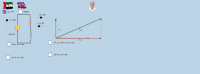
🧪 تجربة تفاعلية: دائرة تيار متردد (ملف - مقاوم)
🧪 Interactive Experiment: AC Circuit (Coil – Resistor)
الدائرة مكوّنة من مصدر تيار متردد، ومفتاح، وأميتر على التوالي، وملف، ومقاومة. ركّب الدائرة بالضغط على المفتاح (أو على المفتاح نفسه في الرسم)، فتتحرك الشحنات في السلك، وتتحرك مؤشرات الأميتر والفولتميترين. ثم غيّر القيم وراقب أثرها على المؤشرات والموجات. الأميتر والفولتميترات هنا تعرض القيم اللحظية: الإبرة تتأرجح مع التيار والجهد، وتتغير إشارتها مع اتجاه التيار (الصفر في المنتصف). أما الجداول أسفل الرسم فتعرض القيم الفعالة \(I_{rms}\) و\(V_{rms}\).
The circuit consists of an AC source, a switch, an ammeter in series, a coil and a resistor. Close the circuit with the button (or by clicking the switch in the drawing): charges start to move in the wires and the needles of the ammeter and the two voltmeters move. Then change the values and watch their effect on the readings and the waves. The ammeter and voltmeters here show instantaneous values: the needle swings with the current and voltage, and its sign follows the direction of the current (zero is in the middle). The readouts below the figure show the RMS values \(I_{rms}\) and \(V_{rms}\).
✍️ مثال محلول
✍️ Worked Example
المعطيات: \(R=40\,\Omega,\quad L=0.2\,\mathrm{H},\quad f=50\,\mathrm{Hz},\quad V_{rms}=120\,\mathrm{V}\)
Given: \(R=40\,\Omega,\quad L=0.2\,\mathrm{H},\quad f=50\,\mathrm{Hz},\quad V_{rms}=120\,\mathrm{V}\)
- المفاعلة الحثية: \(X_L=2\pi fL=2\pi(50)(0.2)\approx 62.8\,\Omega\)Inductive reactance: \(X_L=2\pi fL=2\pi(50)(0.2)\approx 62.8\,\Omega\)
- المعاوقة: \(Z=\sqrt{40^2+62.8^2}\approx 74.5\,\Omega\)Impedance: \(Z=\sqrt{40^2+62.8^2}\approx 74.5\,\Omega\)
- التيار الفعال: \(I_{rms}=\dfrac{120}{74.5}\approx 1.61\,\mathrm{A}\)RMS current: \(I_{rms}=\dfrac{120}{74.5}\approx 1.61\,\mathrm{A}\)
- فرق الطور: \(\tan\varphi=\dfrac{62.8}{40}\Rightarrow\varphi\approx 57.5^\circ\)، والتيار يتأخر عن الجهد الكلي.Phase difference: \(\tan\varphi=\dfrac{62.8}{40}\Rightarrow\varphi\approx 57.5^\circ\), and the current lags the total voltage.
- الجهود المفردة: \(V_R=IR\approx 64.4\,\mathrm{V}\)، \(V_L=IX_L\approx 101.1\,\mathrm{V}\)Separate voltages: \(V_R=IR\approx 64.4\,\mathrm{V}\), \(V_L=IX_L\approx 101.1\,\mathrm{V}\)
- تحقّق بالجمع الاتجاهي: \(\sqrt{64.4^2+101.1^2}\approx 120\,\mathrm{V}\) ✓ (مع أن \(64.4+101.1\approx 165\) وليس 120).Check with phasor addition: \(\sqrt{64.4^2+101.1^2}\approx 120\,\mathrm{V}\) ✓ (even though \(64.4+101.1\approx 165\), not 120).
- القدرة المتوسطة: \(P=I_{rms}^2R=(1.61)^2(40)\approx 104\,\mathrm{W}\)Average power: \(P=I_{rms}^2R=(1.61)^2(40)\approx 104\,\mathrm{W}\)
🧠 اختبر نفسك
🧠 Test Yourself
ملف حثه \(L\) ومقاومة \(R\) متصلان على التوالي بمصدر تردده 50 Hz. إذا أصبح التردد 100 Hz مع بقاء \(L\) و\(R\) ثابتين، فماذا يحدث لـ \(X_L\) وللتيار \(I\)؟A coil of inductance \(L\) and a resistor \(R\) are connected in series to a 50 Hz source. If the frequency becomes 100 Hz while \(L\) and \(R\) stay fixed, what happens to \(X_L\) and to the current \(I\)?
في دائرة ملف ومقاومة على التوالي: \(R=30\,\Omega\)، \(X_L=40\,\Omega\)، وجهد المصدر الفعال \(100\,\mathrm{V}\). احسب \(Z\)، و\(I_{rms}\)، و\(\varphi\).In a coil and resistor in series: \(R=30\,\Omega\), \(X_L=40\,\Omega\), and the RMS source voltage is \(100\,\mathrm{V}\). Calculate \(Z\), \(I_{rms}\) and \(\varphi\).
📚 ملخص
📚 Summary
| المفهومConcept | القانونLaw |
|---|---|
| المفاعلة الحثيةInductive reactance | \(X_L=2\pi fL\) |
| المعاوقةImpedance | \(Z=\sqrt{R^2+X_L^2}\) |
| التيار الفعالRMS current | \(I_{rms}=V_{rms}/Z\) |
| فرق الطورPhase difference | \(\tan\varphi=X_L/R\) |
| الجهود المفردةSeparate voltages | \(V^2=V_R^2+V_L^2\) |
| القدرة المتوسطةAverage power | \(P=I_{rms}^2R=V_{rms}I_{rms}\cos\varphi\) |
⚠️ أخطاء شائعة
⚠️ Common mistakes
- جمع \(R\) و\(X_L\) جمعًا عاديًا بدلًا من حساب \(Z=\sqrt{R^2+X_L^2}\).Adding \(R\) and \(X_L\) directly instead of calculating \(Z=\sqrt{R^2+X_L^2}\).
- جمع \(V_R\) و\(V_L\) جبريًا بدلًا من الجمع الاتجاهي، مع أن الجمع الصحيح هو \(V^2=V_R^2+V_L^2\).Adding \(V_R\) and \(V_L\) directly instead of as phasors; the correct rule is \(V^2=V_R^2+V_L^2\).
- اعتبار الملف سلكًا كما في التيار المستمر؛ هذا صحيح فقط عند \(f=0\).Treating the coil as a plain wire, as in direct current; this is only true at \(f=0\).
- نسيان تحويل الوحدات قبل الحساب، مثل تحويل mH إلى H (\(1\,\mathrm{mH}=10^{-3}\,\mathrm{H}\)).Forgetting to convert units before calculating, such as converting mH to H (\(1\,\mathrm{mH}=10^{-3}\,\mathrm{H}\)).
- الخلط بين القيمة الفعالة والقيمة القصوى: \(V_{max}=\sqrt{2}\,V_{rms}\).Confusing the RMS value with the peak value: \(V_{max}=\sqrt{2}\,V_{rms}\).
🔗 محاكيات GeoGebra للاستعانة بها عند اللزوم
🔗 GeoGebra Simulations to Use When Needed
اضغط «تشغيل» لتعمل المحاكاة هنا داخل الدرس؛ ويمكن للطالب الرجوع إليها لتجربة الفكرة بطريقة أخرى.
Press “Run” to run the simulation right here inside the lesson; the student can use it to try the idea in another way.