🎯 نواتج التعلم
🎯 Learning Outcomes
بعد هذه التجربة ستكون قادرًا على أن:
After this experiment you will be able to:
- تمثّل المجال المغناطيسي بخطوط، وتحدد اتجاهها بحسب القطبين.Represent a magnetic field with lines, and find their direction from the poles.
- تستخدم البوصلة لتحديد اتجاه المجال عند نقطة.Use a compass to find the direction of the field at a point.
- تفسّر لماذا تتقارب الخطوط قرب القطبين، ولا تتقاطع أبدًا.Explain why the lines are closer together near the poles and never cross.
- تقارن شدة المجال في نقطتين باستخدام كثافة الخطوط.Compare the field strength at two points using the density of the lines.
🎬 شاهد الفيديو
🎬 Watch the Video
🔍 الفكرة في صورة
🔍 The Idea in a Picture
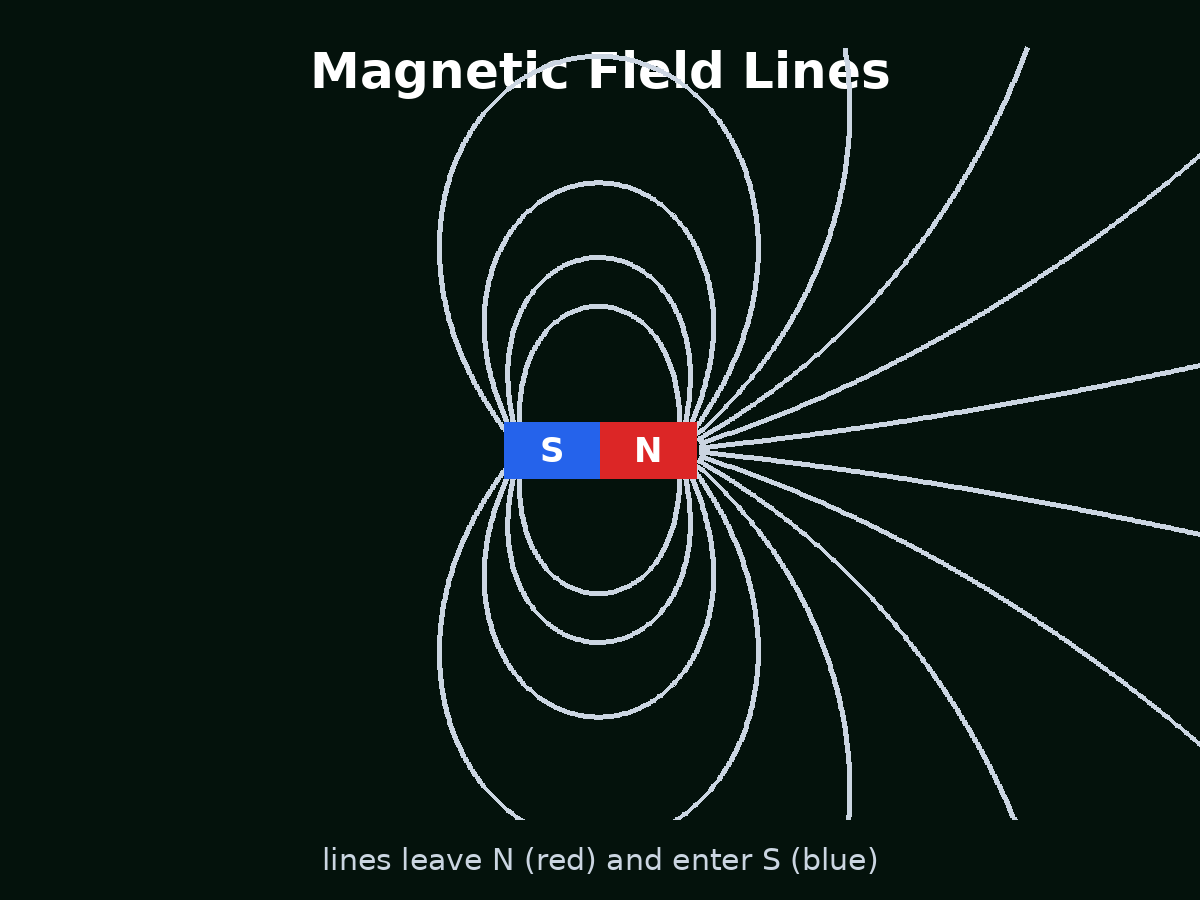
🧭 ماذا تخبرنا خطوط المجال؟
🧭 What do the field lines tell us?
خط المجال هو خط يُرسم بحيث يكون المماس له في أي نقطة في اتجاه المجال عندها. وكلما تقاربت الخطوط في منطقة كان المجال فيها أقوى، والعكس صحيح.
A field line is drawn so that its tangent at any point gives the direction of the field there. Where the lines are closer together the field is stronger, and the reverse is also true.
📘 قواعد خطوط المجال المغناطيسي
📘 Rules of magnetic field lines
(1) خارج المغناطيس: من \(N\) إلى \(S\). (2) داخله: من \(S\) إلى \(N\)، فتكون الخطوط حلقات مغلقة. (3) لا تتقاطع خطوط المجال أبدًا، لأن المجال عند نقطة له اتجاه واحد فقط. (4) تقارب الخطوط يدل على قوة المجال.
(1) Outside the magnet: from \(N\) to \(S\). (2) Inside it: from \(S\) to \(N\), so the lines form closed loops. (3) Field lines never cross, because the field at a point has only one direction. (4) Closer lines mean a stronger field.
💡 شرح إضافي: لماذا تشير البوصلة إلى اتجاه المجال؟
💡 Extra explanation: why does a compass point along the field?
الإبرة في البوصلة مغناطيس صغير، وتتجه قطبيتها الشمالية في اتجاه المجال عند موضعها. لذلك يعطينا اتجاه الإبرة اتجاه خط المجال المار بالنقطة. ويجب أن نتذكر أن الإبرة تشير إلى اتجاه المجال، لا إلى القطب الشمالي الجغرافي للأرض في كل مكان.
The needle of a compass is a small magnet, and its north-seeking end points along the field at its position. So the needle gives the direction of the field line through that point. Remember that the needle points along the field, not toward the geographic north everywhere.
💡 شرح إضافي: لماذا تتقارب الخطوط قرب القطبين؟
💡 Extra explanation: why are the lines closer near the poles?
المجال يضعف بسرعة مع البعد عن المغناطيس، فيكون قرب القطب أقوى بكثير. وحتى يمثّل الرسم هذا التفاوت، نرسم عددًا ثابتًا من الخطوط من كل قطب، فتتقارب كلما كان المجال أقوى.
The field weakens quickly with distance from the magnet, so it is much stronger near a pole. To show this, we draw a fixed number of lines from each pole, so they crowd together where the field is stronger.
🧪 التجربة التفاعلية: خطوط المجال لأشكال مختلفة من المغناطيس
🧪 Interactive Experiment: Field Lines for Different Magnets
اختر الشكل من الأزرار: قضيب مغناطيسي، أو حدوة، أو قطبان متشابهان يتنافران، أو قطبان مختلفان يتجاذبان. اضغط «خطوط المجال» لترى الخطوط تخرج من القطب الشمالي \(N\) وتدخل القطب الجنوبي \(S\)، والنقاط الزرقاء على الخطوط تبيّن اتجاهها. حرّك البوصلة لترى إبرتها تشير إلى اتجاه المجال عند موضعها.
Choose the shape with the buttons: a bar magnet, a horseshoe magnet, two like poles that repel, or two unlike poles that attract. Press “Field lines” to see the lines leave the north pole \(N\) and enter the south pole \(S\); the dots on the lines show their direction. Drag the compass to see its needle point along the field at its position.
ملاحظة: الشدة هنا بوحدات نسبية، والخطوط تُرسم بطريقة تقريبية تبيّن الشكل العام.
Note: the strength here is in relative units, and the lines are drawn approximately to show the general shape.
🧲 أشكال المغناطيس وخطوط المجال
🧲 Magnet shapes and field lines
✍️ أمثلة محلولة
✍️ Worked Examples
عُيّنت شدة المجال المغناطيسي لمغناطيس مستقيم على محوره فوجدت \(B=0.04\ \mathrm{T}\) عند المسافة \(r\) من قطبه. ما شدة المجال عند المسافة \(2r\) على المحور نفسه؟ (يُعطى أن المجال على محور المغناطيس يتناسب مع \(1/r^3\)).
The field of a bar magnet along its axis was measured: \(B=0.04\ \mathrm{T}\) at a distance \(r\) from its pole. What is the field at a distance \(2r\) on the same axis? (Given that along the axis the field is proportional to \(1/r^3\).)
وضعت بوصلة فوق مغناطيس مستقيم فوجدت إبرتها تشير إلى اليمين. أي قطب للمغناطيس يقع على اليمين إذا كانت الإبرة تشير إلى اتجاه المجال، مع العلم أن خطوط المجال خارجه تخرج من \(N\)؟
A compass is placed above a bar magnet and its needle points to the right. Which pole of the magnet is on the right, given that the field lines outside it leave \(N\)?
لماذا لا تتقاطع خطوط المجال المغناطيسي؟
Why do magnetic field lines never cross?
📚 ملخص
📚 Summary
| المفهومConcept | الوصف أو النتيجةDescription or result |
|---|---|
| خارج المغناطيسOutside the magnet | من القطب \(N\) إلى القطب \(S\)From pole \(N\) to pole \(S\) |
| داخل المغناطيسInside the magnet | من \(S\) إلى \(N\)، فتكون حلقات مغلقةFrom \(S\) to \(N\), forming closed loops |
| اتجاه المجال عند نقطةField direction at a point | اتجاه مماس خط المجال، وتشير إليه البوصلةThe tangent to the field line; the compass points along it |
| شدة المجالField strength | تتناسب مع كثافة الخطوطProportional to the density of the lines |
⚠️ أخطاء شائعة
⚠️ Common mistakes
- الظن أن خطوط المجال تبدأ وتنتهي عند القطبين فقط؛ داخل المغناطيس تكمل الخطوط مسارها من \(S\) إلى \(N\).Thinking the lines only start and end at the poles; inside the magnet they continue from \(S\) to \(N\).
- الخلط بين اتجاه المجال خارج المغناطيس (من \(N\) إلى \(S\)) واتجاهه داخله.Mixing up the field direction outside the magnet (from \(N\) to \(S\)) with the direction inside it.
- اعتبار الخطوط حقيقية مادية؛ هي وسيلة لتمثيل المجال واتجاهه.Treating the lines as physical objects; they are a way to represent the field and its direction.
- الظن أن شدة المجال ثابتة على طول الخط؛ شدته تتغير حسب تقارب الخطوط.Thinking the field strength is constant along a line; it changes with the closeness of the lines.
🧠 اختبر نفسك
🧠 Test Yourself
خارج مغناطيس مستقيم، في أي اتجاه تسير خطوط المجال؟
Outside a bar magnet, in which direction do the field lines run?
أين يكون المجال المغناطيسي أقوى؟
Where is the magnetic field strongest?
💡 شرح إضافي: كيف تقرأ محاكاة GeoGebra؟
💡 Extra explanation: how to read the GeoGebra simulation?
في المحاكاة تُرسم خطوط المجال الكاملة للمغناطيس، ويمكنك أن تتحقق بنفسك من القواعد: الخطوط تخرج من \(N\) وتدخل \(S\) خارجه، ولا تتقاطع. انظر إلى المواضع التي تتقارب فيها الخطوط، فهناك المجال أقوى، ثم قارن ذلك بالمسافات من المغناطيس.
The simulation draws the complete field lines of the magnet, and you can check the rules yourself: the lines leave \(N\) and enter \(S\) outside it, and they never cross. Look where the lines come closer together: the field is stronger there, and compare this with the distances from the magnet.
💡 شرح إضافي: لماذا تكتمل الحلقات داخل المغناطيس؟
💡 Extra explanation: why do the loops close inside the magnet?
خطوط المجال لا تبدأ ولا تنتهي في القطبين، بل تكوّن حلقات مغلقة. لذلك كل خط يخرج من \(N\) خارجًا يعود إلى \(S\)، ثم يكمل داخل المغناطيس من \(S\) إلى \(N\). هذا يبيّن أن المجال المغناطيسي لا يملك «شحنات مغناطيسية» منفصلة مثل الشحنات الكهربائية.
Field lines do not start or end at the poles; they form closed loops. So each line that leaves \(N\) outside the magnet returns to \(S\), then continues inside the magnet from \(S\) to \(N\). This shows that a magnetic field has no separate magnetic charges like electric charges do.
🔗 محاكاة GeoGebra للاستعانة بها عند اللزوم
🔗 GeoGebra Simulation to Use When Needed
اضغط «تشغيل» لتعمل المحاكاة هنا داخل الدرس؛ ويمكن للطالب الرجوع إليها لتجربة الفكرة بطريقة أخرى.
Press “Run” to run the simulation right here inside the lesson; the student can use it to try the idea in another way.