🎯 نواتج التعلم
🎯 Learning Outcomes
بعد هذه التجربة ستكون قادرًا على أن:
After this experiment you will be able to:
- تعرّف الموجة وتميّز بين الموجة المستعرضة والموجة الطولية.Define a wave and distinguish between transverse and longitudinal waves.
- تعرّف الطول الموجي \(\lambda\) والتردد \(f\) والزمن الدوري \(T\) والسعة \(A\)، وتربط بينها: \(T=\dfrac1f\).Define the wavelength \(\lambda\), the frequency \(f\), the period \(T\) and the amplitude \(A\), and relate them: \(T=\dfrac1f\).
- تطبّق العلاقة الأساسية للموجة \(v=f\lambda\) لحساب سرعة الموجة.Apply the fundamental wave relation \(v=f\lambda\) to calculate the wave speed.
- تفسّر أن السعة لا تؤثر في السرعة، وأن السرعة تعتمد على الوسط.Explain that the amplitude does not affect the speed, and that the speed depends on the medium.
- تقرأ مخطط الإزاحة والزمن لنقطة واحدة وتستخرج منه الزمن الدوري والسعة.Read the displacement–time graph of one point and extract the period and the amplitude from it.
💡 فكرة التجربة
💡 The Idea of the Experiment
الموجة اضطراب ينتقل في وسط دون أن ينتقل الوسط نفسه. في الموجة المستعرضة تهتز الجسيمات عموديًا على اتجاه الانتشار، كموجات الحبل والضوء. وفي الموجة الطولية تهتز الجسيمات في اتجاه الانتشار نفسه، كالصوت الذي ينتقل بتضاغط الهواء وتخلخله.
A wave is a disturbance that travels through a medium without the medium itself travelling. In a transverse wave the particles vibrate at right angles to the direction of travel, as in a string or light. In a longitudinal wave the particles vibrate along the direction of travel, as sound does through compressions and rarefactions of air.
📘 العلاقات الأساسية للموجة
📘 The basic wave relations
\[T=\dfrac{1}{f}\qquad v=f\lambda=\dfrac{\lambda}{T}\]
حيث \(T\) الزمن الدوري بالثانية، و\(f\) التردد بالهرتز، و\(\lambda\) الطول الموجي بالمتر، و\(v\) سرعة الموجة بالمتر لكل ثانية. الطول الموجي هو المسافة بين قمتين متتاليتين، والسعة هي أكبر إزاحة للجسيم عن وضع السكون.
where \(T\) is the period in seconds, \(f\) the frequency in hertz, \(\lambda\) the wavelength in metres and \(v\) the wave speed in metres per second. The wavelength is the distance between two successive crests, and the amplitude is the largest displacement of a particle from rest.
| الكميةQuantity | تعريفهاDefinition | وحدتهاUnit |
|---|---|---|
| الطول الموجي \(\lambda\)Wavelength \(\lambda\) | المسافة بين قمتين متتاليتينDistance between successive crests | m |
| التردد \(f\)Frequency \(f\) | عدد الاهتزازات في الثانيةVibrations per second | Hz |
| الزمن الدوري \(T\)Period \(T\) | الزمن لاهتزازة كاملةTime for one complete vibration | s |
| السعة \(A\)Amplitude \(A\) | أكبر إزاحة عن وضع السكونLargest displacement from rest | m |
| السرعة \(v\)Speed \(v\) | المسافة التي تقطعها الموجة في الثانيةDistance the wave travels per second | m/s |
💡 شرح إضافي: لماذا لا تؤثر السعة في السرعة؟
💡 Extra explanation: why does the amplitude not affect the speed?
السرعة تحددها خصائص الوسط، مثل شد الحبل وكثافته، أو مرونة الهواء في الصوت. فإذا زادت سعة الموجة بقيت سرعتها كما هي، ولكن زادت الطاقة التي تحملها. ولذلك تكون السعة مرتبطة بالطاقة، والتردد والطول الموجي مرتبطين بالسرعة.
The speed is set by the properties of the medium, such as the tension and density of a string or the elasticity of air for sound. Increasing the amplitude leaves the speed unchanged but increases the energy the wave carries. So the amplitude is linked to energy, while frequency and wavelength are linked to speed.
🧪 التجربة: خصائص الأمواج
🧪 The Experiment: Wave Properties
في التجربة التفاعلية أدناه موجة تنتشر إلى اليمين. تستطيع تغيير التردد والطول الموجي والسعة، فتتغير سرعة الموجة ومخطط الزمن لنقطة ثابتة. اضغط «ابدأ الموجة» لترى انتشارها، ثم اتبع الخطوات:
In the interactive experiment below a wave travels to the right. You can change the frequency, the wavelength and the amplitude, which changes the wave speed and the displacement–time graph of a fixed point. Press “Start the wave” to see it travel, then follow the steps:
خطوات التجربة
Steps of the experiment
- توقّع أولًا: إذا كان \(f=2\,\mathrm{Hz}\) و\(\lambda=2\,\mathrm{m}\)، فما السرعة والزمن الدوري؟Predict first: if \(f=2\,\mathrm{Hz}\) and \(\lambda=2\,\mathrm{m}\), what are the speed and the period?
- غيّر التردد مع ثبات \(\lambda\): لاحظ أن السرعة تزداد، والزمن الدوري يقل.Change the frequency while keeping \(\lambda\): notice that the speed increases and the period decreases.
- غيّر السعة: لاحظ أن السرعة والزمن الدوري لا يتغيران، وأن ارتفاع المنحنى يزداد.Change the amplitude: notice that the speed and period do not change, but the height of the graph increases.
- اقرأ المخطط: المسافة الزمنية بين قمتين متتاليتين في المخطط هي الزمن الدوري \(T\).Read the graph: the time between two successive crests on the graph is the period \(T\).
🧪 تجربة تفاعلية: خصائص الأمواج
🧪 Interactive Experiment: Wave Properties
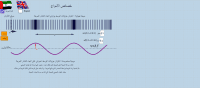
الأعلى: الموجة تنتشر إلى اليمين، والمسافة بين قمتين متتاليتين هي \(\lambda\). الأسفل: مخطط الإزاحة والزمن للنقطة المحددة بالخط العمودي، والمسافة الزمنية بين قمتين هي \(T\).
Top: the wave travels to the right, and the distance between two successive crests is \(\lambda\). Bottom: the displacement–time graph of the point marked by the vertical line, where the time between two crests is \(T\).
🧪 التجربة التفاعلية 2: الموجات الطولية والمستعرضة
🧪 Interactive Experiment 2: Longitudinal and Transverse Waves
في هذه التجربة نرى جسيمات موزّعة على خط. في الموجة الطولية تهتز الجسيمات في اتجاه الانتشار نفسه، فتتجمع في مناطق تسمى تضاغطًا (الخلفية الحمراء) وتتباعد في مناطق تسمى تخلخلًا (الخلفية الزرقاء). وفي الموجة المستعرضة تهتز الجسيمات عموديًا على الانتشار. بدّل بين النوعين واضغط «ابدأ» لترى الفرق.
In this experiment we see particles spread along a line. In a longitudinal wave the particles vibrate along the direction of travel, bunching up into regions called compressions (red background) and spreading out into rarefactions (blue background). In a transverse wave they vibrate at right angles to the direction of travel. Switch between the two types and press “Start” to see the difference.
🧪 تجربة تفاعلية 2: مقارنة الموجة الطولية بالمستعرضة
🧪 Interactive Experiment 2: Comparing Longitudinal and Transverse Waves
✍️ مثال محلول
✍️ Worked Example
المعطيات: \(f=5\,\mathrm{Hz}\)، \(\lambda=2\,\mathrm{m}\)
Given: \(f=5\,\mathrm{Hz}\), \(\lambda=2\,\mathrm{m}\)
- السرعة: \(v=f\lambda=5\times2=10\,\mathrm{m/s}\)Speed: \(v=f\lambda=5\times2=10\,\mathrm{m/s}\)
- الزمن الدوري: \(T=\dfrac1f=\dfrac15=0.2\,\mathrm{s}\)Period: \(T=\dfrac1f=\dfrac15=0.2\,\mathrm{s}\)
- تحقّق: \(v=\dfrac{\lambda}{T}=\dfrac{2}{0.2}=10\,\mathrm{m/s}\) ✓Check: \(v=\dfrac{\lambda}{T}=\dfrac{2}{0.2}=10\,\mathrm{m/s}\) ✓
- إذا زادت السعة إلى الضعف بقيت السرعة \(10\,\mathrm{m/s}\) كما هي.If the amplitude doubles, the speed stays \(10\,\mathrm{m/s}\).
🧠 اختبر نفسك
🧠 Test Yourself
موجة صوتية ترددها \(680\,\mathrm{Hz}\) وسرعتها \(340\,\mathrm{m/s}\). احسب طولها الموجي وزمنها الدوري.A sound wave has a frequency of \(680\,\mathrm{Hz}\) and a speed of \(340\,\mathrm{m/s}\). Calculate its wavelength and period.
موجة في حبل تقطع \(20\,\mathrm{m}\) في \(4\,\mathrm{s}\)، والمسافة بين قمتين متتاليتين \(2.5\,\mathrm{m}\). احسب التردد والزمن الدوري.A wave on a rope travels \(20\,\mathrm{m}\) in \(4\,\mathrm{s}\), and the distance between two successive crests is \(2.5\,\mathrm{m}\). Calculate the frequency and the period.
📚 ملخص
📚 Summary
| المفهومConcept | القانونLaw |
|---|---|
| الزمن الدوريPeriod | \(T=\dfrac1f\) |
| سرعة الموجةWave speed | \(v=f\lambda\) |
| السرعة والسعةSpeed and amplitude | السرعة لا تعتمد على السعةSpeed does not depend on amplitude |
⚠️ أخطاء شائعة
⚠️ Common mistakes
- الخلط بين التردد والزمن الدوري؛ الزمن الدوري هو مقلوب التردد.Confusing frequency with period; the period is the reciprocal of the frequency.
- الظن أن السعة تؤثر في السرعة؛ السرعة تعتمد على الوسط.Thinking the amplitude affects the speed; the speed depends on the medium.
- أخذ المسافة بين قمة وقاع بدل المسافة بين قمتين متتاليتين عند تعريف الطول الموجي.Taking the distance between a crest and a trough as the wavelength instead of the distance between successive crests.
- نسيان أن السعة هي أكبر إزاحة، وليست المسافة الكلية التي تقطعها النقطة.Forgetting that the amplitude is the largest displacement, not the total distance the point travels.
🔗 محاكيات GeoGebra للاستعانة بها عند اللزوم
🔗 GeoGebra Simulations to Use When Needed
اضغط «تشغيل» لتعمل المحاكاة هنا داخل الدرس؛ ويمكن للطالب الرجوع إليها لتجربة الفكرة بطريقة أخرى.
Press “Run” to run the simulation right here inside the lesson; the student can use it to try the idea in another way.