🎯 نواتج التعلم
🎯 Learning Outcomes
بعد هذه التجربة ستكون قادرًا على أن:
After this experiment you will be able to:
- تحسب طاقة الوضع للبندول \(PE=mgL(1-\cos\theta)\) وطاقته الحركية \(KE=\tfrac12mv^2\).Calculate the potential energy of the pendulum \(PE=mgL(1-\cos\theta)\) and its kinetic energy \(KE=\tfrac12mv^2\).
- تفسّر لماذا تبقى الطاقة الميكانيكية ثابتة وتحسب السرعة عند أي موضع.Explain why the mechanical energy stays constant and calculate the speed at any position.
- تحلل وزن الكرة إلى \(mg\sin\theta\) و\(mg\cos\theta\) وتحسب الزمن الدوري \(T=2\pi\sqrt{L/g}\).Resolve the weight of the bob into \(mg\sin\theta\) and \(mg\cos\theta\) and calculate the period \(T=2\pi\sqrt{L/g}\).
🎬 شاهد الفيديو
🎬 Watch the Video
🕰️ طاقة البندول
🕰️ The Energy of the Pendulum
البندول البسيط كرة كتلتها \(m\) معلقة بخيط خفيف طوله \(L\). إذا أزحناها إلى زاوية \(\theta\) ارتفعت عن أخفض نقطة بمقدار:
A simple pendulum is a bob of mass \(m\) hung on a light string of length \(L\). If we displace it to an angle \(\theta\) it rises above the lowest point by:
📘 الارتفاع وطاقة الوضع
📘 The height and the potential energy
\[h=L-L\cos\theta=L\,(1-\cos\theta)\]
\[PE=mgh=mgL\,(1-\cos\theta)\qquad KE=\tfrac12mv^2\]
\[E=KE+PE=\text{constant}\]
وعند الإفلات من السكون عند الزاوية \(\theta_0\) تكون \(KE=0\) و\(E=mgL(1-\cos\theta_0)\). ومن حفظ الطاقة نجد السرعة عند أي زاوية \(\theta\):
On release from rest at the angle \(\theta_0\), \(KE=0\) and \(E=mgL(1-\cos\theta_0)\). From conservation of energy we find the speed at any angle \(\theta\):
📘 السرعة من حفظ الطاقة
📘 The speed from energy conservation
\[\tfrac12mv^2=mgL(\cos\theta-\cos\theta_0)\ \Rightarrow\ v=\sqrt{2gL(\cos\theta-\cos\theta_0)}\]
\[v_{max}=\sqrt{2gL(1-\cos\theta_0)}\quad(\theta=0)\]
💡 شرح إضافي: لماذا لا يعمل الشد شغلًا؟ ولماذا لا تظهر الكتلة؟
💡 Extra explanation: why does the tension do no work? And why does the mass not appear?
قوتان تؤثران في الكرة: الوزن \(mg\) وشد الخيط \(T\). الشد يكون دائمًا عموديًا على اتجاه الحركة (على امتداد الخيط والكرة تتحرك على قوس) فشغله صفر، أما الوزن فقوة محافظة فتبقى الطاقة الميكانيكية ثابتة. وتختفي الكتلة من \(v=\sqrt{2gL(\cos\theta-\cos\theta_0)}\) لأنها تدخل في \(KE\) و\(PE\) معًا فتُختصر. جرّب تغيير الكتلة في التجربة: تتغير مقادير الطاقات لكن سرعة الكرة وزمن الدورة لا يتغيران.
Two forces act on the bob: the weight \(mg\) and the tension \(T\) of the string. The tension is always perpendicular to the direction of motion (along the string while the bob moves on an arc) so its work is zero, while the weight is a conservative force so the mechanical energy stays constant. The mass disappears from \(v=\sqrt{2gL(\cos\theta-\cos\theta_0)}\) because it appears in both \(KE\) and \(PE\) and cancels. Try changing the mass in the experiment: the energies change but the speed of the bob and the period do not.
🧪 تجربة 1: بندول بسيط: تبادل الطاقة الحركية وطاقة الوضع
🧪 Experiment 1: A simple pendulum: the exchange of kinetic and potential energy
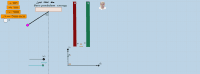
تُرفع كرة البندول إلى زاوية \(\theta_0\) ثم تُترك. أثناء الحركة يعمل وزنها شغلًا فتتحول طاقة الوضع \(PE=mgL(1-\cos\theta)\) إلى طاقة حركية \(KE=\tfrac12mv^2\) والعكس، بينما المجموع \(E=KE+PE\) ثابت (قوة الشد عمودية على الحركة فلا تعمل شغلًا). فعّل مربع القوى لترى مركبتي الوزن \(mg\sin\theta\) و\(mg\cos\theta\). اضغط «بدء» (الحركة حقيقية بلا احتكاك).
The pendulum bob is raised to an angle \(\theta_0\) and released. During the motion its weight does work so the potential energy \(PE=mgL(1-\cos\theta)\) turns into kinetic energy \(KE=\tfrac12mv^2\) and back, while the sum \(E=KE+PE\) is constant (the tension is perpendicular to the motion so it does no work). Tick the forces box to see the two components of the weight \(mg\sin\theta\) and \(mg\cos\theta\). Press “Start” (the motion is real and frictionless).
↔️ قوى البندول والزمن الدوري
↔️ The Forces and the Period
نحلّل وزن الكرة عند زاوية \(\theta\) إلى مركبتين: مماسية \(F_{gx}=mg\sin\theta\) تعيد الكرة نحو أخفض نقطة (القوة المرجِعة)، وعلى امتداد الخيط \(F_{gy}=mg\cos\theta\) يقابلها الشد (مع القوة المركزية). وللزوايا الصغيرة (أقل من نحو \(10^\circ\)) \(\sin\theta\approx\theta\) فتكون الحركة توافقية بسيطة وزمنها الدوري:
We resolve the weight of the bob at the angle \(\theta\) into two components: a tangential one \(F_{gx}=mg\sin\theta\) which brings the bob back toward the lowest point (the restoring force), and one along the string \(F_{gy}=mg\cos\theta\) which is opposed by the tension (together with the centripetal force). For small angles (below about \(10^\circ\)) \(\sin\theta\approx\theta\) so the motion is simple harmonic and its period is:
📘 الزمن الدوري (زوايا صغيرة)
📘 The period (small angles)
\[T_0=2\pi\sqrt{\dfrac{L}{g}}\]
لا يتوقف على الكتلة ولا على سعة الاهتزاز (في حدود الزوايا الصغيرة).
It does not depend on the mass nor on the amplitude (for small angles).
💡 شرح إضافي: ماذا يحدث للزمن الدوري عند زاوية كبيرة؟
💡 Extra explanation: what happens to the period at a large angle?
الصيغة \(T_0=2\pi\sqrt{L/g}\) تقريبية للزوايا الصغيرة. عند زاوية إفلات كبيرة (مثل \(57^\circ\) كما في الأداة الأصلية) يكون الزمن الدوري الحقيقي أكبر قليلًا (تقريبًا \(T\approx T_0\left(1+\dfrac{\theta_0^2}{16}\right)\) مع \(\theta_0\) بالراديان، أي نحو \(6\%\) عند \(57^\circ\))، لأن القوة المرجِعة \(mg\sin\theta\) أقل من \(mg\theta\). في التجربة يظهر الزمن المقاس بعد دورة كاملة فقارنه بـ \(T_0\).
The formula \(T_0=2\pi\sqrt{L/g}\) is an approximation for small angles. At a large release angle (such as \(57^\circ\) as in the original applet) the true period is a bit larger (approximately \(T\approx T_0\left(1+\dfrac{\theta_0^2}{16}\right)\) with \(\theta_0\) in radians, i.e. about \(6\%\) at \(57^\circ\)), because the restoring force \(mg\sin\theta\) is smaller than \(mg\theta\). In the experiment the measured period appears after a full cycle, so compare it with \(T_0\).
✍️ أمثلة محلولة
✍️ Worked Examples
بندول طوله \(3\ \mathrm{m}\) وكتلة كرته \(0.4\ \mathrm{kg}\) أُفلت من زاوية \(57^\circ\) (قيم الأداة الأصلية). احسب \(h\) و\(PE\) والسرعة عند أخفض نقطة.
A pendulum of length \(3\ \mathrm{m}\) and bob mass \(0.4\ \mathrm{kg}\) is released from \(57^\circ\) (the values of the original applet). Calculate \(h\), \(PE\) and the speed at the lowest point.
احسب الزمن الدوري للبندول في المثال السابق بالصيغة التقريبية.
Calculate the period of the pendulum of the previous example with the approximate formula.
بندول طوله \(1\ \mathrm{m}\) أُفلت من السكون من زاوية \(60^\circ\). احسب سرعته عند أخفض نقطة وعند زاوية \(30^\circ\).
A pendulum \(1\ \mathrm{m}\) long is released from rest at \(60^\circ\). Calculate its speed at the lowest point and at an angle of \(30^\circ\).
ما قوة الشد في خيط البندول عند أخفض نقطة إذا كانت الكتلة \(0.5\ \mathrm{kg}\) وزاوية الإفلات \(60^\circ\)؟
What is the tension in the string at the lowest point if the mass is \(0.5\ \mathrm{kg}\) and the release angle is \(60^\circ\)?
أثناء حركة البندول الحرة (بإهمال الاحتكاك) أي كمية تبقى ثابتة؟
During the free motion of the pendulum (friction neglected) which quantity stays constant?
عند أخفض نقطة في مسار البندول تكون:
At the lowest point of the path of the pendulum:
إذا تضاعف طول البندول (زوايا صغيرة) فإن زمنه الدوري:
If the length of the pendulum doubles (small angles) its period:
إذا تضاعفت كتلة كرة البندول مع بقاء بقية القيم فإن سرعتها عند أخفض نقطة:
If the mass of the bob doubles with the other values unchanged its speed at the lowest point:
📚 ملخص
📚 Summary
| المفهومConcept | القانونLaw |
|---|---|
| طاقة الوضعPotential energy | \(PE=mgL(1-\cos\theta)\)\(PE=mgL(1-\cos\theta)\) |
| السرعةSpeed | \(v=\sqrt{2gL(\cos\theta-\cos\theta_0)}\)\(v=\sqrt{2gL(\cos\theta-\cos\theta_0)}\) |
| الزمن الدوريPeriod | \(T_0=2\pi\sqrt{L/g}\)\(T_0=2\pi\sqrt{L/g}\) |
⚠️ أخطاء شائعة
⚠️ Common mistakes
- أخذ \(h=L\cos\theta\) بدل \(h=L(1-\cos\theta)\) (الارتفاع عن أخفض نقطة).Taking \(h=L\cos\theta\) instead of \(h=L(1-\cos\theta)\) (the height above the lowest point).
- الاعتقاد بأن الزمن الدوري يعتمد على الكتلة.Believing that the period depends on the mass.
- استعمال \(T=2\pi\sqrt{L/g}\) لزوايا كبيرة دون الانتباه إلى أنها تقريبية.Using \(T=2\pi\sqrt{L/g}\) for large angles without noticing that it is approximate.
- حساب شغل الشد؛ هو صفر لأنه عمودي على الحركة.Calculating the work of the tension; it is zero because it is perpendicular to the motion.
🔗 محاكيات GeoGebra للاستعانة بها عند اللزوم
🔗 GeoGebra Simulations to Use When Needed
اضغط «تشغيل» لتعمل المحاكاة هنا داخل الدرس؛ ويمكن للطالب الرجوع إليها لتجربة الفكرة بطريقة أخرى.
Press “Run” to run the simulation right here inside the lesson; the student can use it to try the idea in another way.