🎯 نواتج التعلم
🎯 Learning Outcomes
بعد هذه التجربة ستكون قادرًا على أن:
After this experiment you will be able to:
- تنص على قانون حفظ الزخم الخطي لنظام معزول وتطبقه على الانفجار والارتداد.State the law of conservation of linear momentum for an isolated system and apply it to explosions and recoil.
- تحسب سرعة ارتداد مدفع (أو بندقية) من \(v_2=-\dfrac{m_1v_1}{m_2}\).Calculate the recoil velocity of a cannon (or a rifle) from \(v_2=-\dfrac{m_1v_1}{m_2}\).
- تفسّر لماذا لا تُحفظ الطاقة الحركية في الانفجار وتحسب الطاقة المتحررة.Explain why kinetic energy is not conserved in an explosion and calculate the energy released.
🎬 شاهد الفيديو
🎬 Watch the Video
💥 قانون حفظ الزخم
💥 The Law of Conservation of Momentum
زخم الجسم \(\vec p=m\vec v\) كمية متجهة. في نظام معزول (لا تؤثر فيه قوة خارجية محصلتها غير صفرية) تؤثر الأجسام بعضها في بعض بقوى داخلية متساوية ومتعاكسة (قانون نيوتن الثالث)، فيبقى الزخم الكلي ثابتًا قبل الحدث وبعده:
The momentum of a body \(\vec p=m\vec v\) is a vector. In an isolated system (no external force with a non-zero resultant) the bodies act on each other with equal and opposite internal forces (Newton’s third law), so the total momentum is constant before and after the event:
📘 حفظ الزخم
📘 Conservation of momentum
\[\vec P_{i1}+\vec P_{i2}=\vec P_{f1}+\vec P_{f2}\]
\[m_1\vec v_{i1}+m_2\vec v_{i2}=m_1\vec v_{f1}+m_2\vec v_{f2}\]
في حالة المدفع والقذيفة يكونان ساكنين قبل الإطلاق (\(\vec v_{i1}=\vec v_{i2}=0\)) فيكون الزخم الكلي صفرًا:
For the cannon and the shell, both are at rest before the shot (\(\vec v_{i1}=\vec v_{i2}=0\)) so the total momentum is zero:
\[0=m_1\vec v_{1}+m_2\vec v_{2}\ \Rightarrow\ v_2=-\dfrac{m_1}{m_2}\,v_1\]
💡 شرح إضافي: لماذا يرتد المدفع بسرعة أقل وبطاقة أقل؟
💡 Extra explanation: why does the cannon recoil with a smaller speed and less energy?
القوتان متساويتان في المقدار ولمدة التأثير نفسها، فالدفع \(F\Delta t\) واحد على الجسمين وزخماهما متساويان مقدارًا ومتعاكسان اتجاهًا: \(m_1v_1=m_2|v_2|\). وبما أن \(m_2\gg m_1\) تكون \(|v_2|\ll v_1\). أما الطاقة الحركية \(KE=\dfrac{p^2}{2m}\) فمع زخم واحد تتناسب عكسيًا مع الكتلة: \(\dfrac{KE_1}{KE_2}=\dfrac{m_2}{m_1}\) فتحمل القذيفة الخفيفة معظم الطاقة. ومجموع الطاقتين الحركيتين أكبر من الصفر (كانت صفرًا قبل الإطلاق)، فالطاقة الحركية لا تُحفظ هنا؛ مصدرها الطاقة الكيميائية للبارود. والمحفوظ هو الزخم والطاقة الكلية.
The two forces are equal in size and act for the same time, so the impulse \(F\Delta t\) is the same on both bodies and their momenta are equal in size and opposite in direction: \(m_1v_1=m_2|v_2|\). Since \(m_2\gg m_1\), \(|v_2|\ll v_1\). The kinetic energy \(KE=\dfrac{p^2}{2m}\) with the same momentum is inversely proportional to the mass: \(\dfrac{KE_1}{KE_2}=\dfrac{m_2}{m_1}\) so the light shell carries most of the energy. The sum of the two kinetic energies is greater than zero (it was zero before the shot), so the kinetic energy is not conserved here; its source is the chemical energy of the powder. What is conserved is the momentum and the total energy.
🧪 تجربة 1: مدفع يطلق قذيفة: حفظ الزخم والارتداد
🧪 Experiment 1: A cannon fires a shell: conservation of momentum and recoil
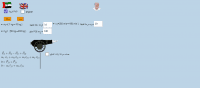
قبل الإطلاق يكون المدفع والقذيفة ساكنين فالزخم الكلي صفر. أثناء الإطلاق تؤثر قوتان داخليتان متساويتان ومتعاكستان بين المدفع والقذيفة، فيبقى الزخم الكلي صفرًا: \(0=m_1v_1+m_2v_2\) أي أن القذيفة تنطلق نحو اليمين بزخم \(m_1v_1\) ويرتد المدفع نحو اليسار بزخم مساوٍ له في المقدار \(v_2=-\dfrac{m_1v_1}{m_2}\). غيّر كتلة القذيفة وسرعتها وكتلة المدفع وراقب الارتداد. (التجربة متحركة وتعيد نفسها؛ المقياس واحد للمسافات: المدفع يتحرك أقل لأنه أثقل.)
Before the shot the cannon and the shell are at rest so the total momentum is zero. During the shot two equal and opposite internal forces act between the cannon and the shell, so the total momentum stays zero: \(0=m_1v_1+m_2v_2\), i.e. the shell leaves to the right with momentum \(m_1v_1\) and the cannon recoils to the left with a momentum of the same size \(v_2=-\dfrac{m_1v_1}{m_2}\). Change the mass and speed of the shell and the mass of the cannon and watch the recoil. (The experiment is animated and repeats itself; the distances use one scale: the cannon moves less because it is heavier.)
💡 شرح إضافي: متى ينطبق القانون في الحياة الواقعية؟
💡 Extra explanation: when does the law apply in real life?
القانون دقيق للنظام المعزول، لكن المدفع الحقيقي على الأرض تؤثر فيه قوى احتكاك وقوة رد فعل الأرض (خارجية)، فيكون ارتداده أقل أو يُمتص بنظام ارتداد هيدروليكي. ولكن خلال لحظة الانفجار القصيرة جدًا تكون القوى الداخلية هائلة أمام الخارجية، فيصلح حفظ الزخم لحساب السرعات مباشرة بعد الإطلاق. وهو نفس مبدأ ارتداد البندقية وانطلاق الصاروخ بدفع الغازات للخلف.
The law is exact for an isolated system, but a real cannon on the ground is acted on by friction and the reaction of the ground (external forces), so its recoil is smaller or is absorbed by a hydraulic recoil system. During the very short moment of the explosion the internal forces are enormous compared with the external ones, so conservation of momentum can be used to calculate the speeds just after the shot. It is the same principle as the recoil of a rifle and the launch of a rocket by pushing the gases backward.
✍️ أمثلة محلولة
✍️ Worked Examples
يطلق مدفع كتلته \(100\ \mathrm{kg}\) قذيفة كتلتها \(10\ \mathrm{kg}\) بسرعة \(50\ \mathrm{m/s}\) (قيم الأداة الأصلية). احسب سرعة ارتداد المدفع.
A cannon of mass \(100\ \mathrm{kg}\) fires a shell of mass \(10\ \mathrm{kg}\) at \(50\ \mathrm{m/s}\) (the values of the original applet). Calculate the recoil velocity of the cannon.
في المثال السابق احسب الطاقة الحركية لكل من القذيفة والمدفع والطاقة الكلية المتحررة.
In the previous example calculate the kinetic energy of the shell and of the cannon and the total energy released.
بندقية كتلتها \(4\ \mathrm{kg}\) تطلق رصاصة كتلتها \(10\ \mathrm{g}\) بسرعة \(400\ \mathrm{m/s}\). احسب سرعة ارتداد البندقية.
A rifle of mass \(4\ \mathrm{kg}\) fires a bullet of mass \(10\ \mathrm{g}\) at \(400\ \mathrm{m/s}\). Calculate the recoil velocity of the rifle.
ما كتلة مدفع يرتد بسرعة \(2\ \mathrm{m/s}\) عند إطلاق قذيفة \(8\ \mathrm{kg}\) بسرعة \(100\ \mathrm{m/s}\)؟
What is the mass of a cannon that recoils at \(2\ \mathrm{m/s}\) when a shell of \(8\ \mathrm{kg}\) is fired at \(100\ \mathrm{m/s}\)?
الزخم الكلي لمدفع وقذيفة ساكنين قبل الإطلاق وبعده مباشرة:
The total momentum of a cannon and a shell at rest before the shot and just after it:
إذا زادت كتلة المدفع مع بقاء كتلة القذيفة وسرعتها فإن سرعة ارتداده:
If the mass of the cannon increases with the mass and speed of the shell unchanged, its recoil speed:
في انفجار من السكون الطاقة الحركية الكلية بعد الانفجار:
In an explosion from rest the total kinetic energy after the explosion:
قذيفة كتلتها \(2\ \mathrm{kg}\) انطلقت بسرعة \(60\ \mathrm{m/s}\) من مدفع كتلته \(40\ \mathrm{kg}\). سرعة الارتداد:
A shell of \(2\ \mathrm{kg}\) leaves a cannon of \(40\ \mathrm{kg}\) at \(60\ \mathrm{m/s}\). The recoil speed is:
📚 ملخص
📚 Summary
| المفهومConcept | القانونLaw |
|---|---|
| الزخمMomentum | \(\vec p=m\vec v\)\(\vec p=m\vec v\) |
| حفظ الزخمConservation of momentum | \(\sum\vec P_i=\sum\vec P_f\)\(\sum\vec P_i=\sum\vec P_f\) |
| الارتداد من السكونRecoil from rest | \(v_2=-\dfrac{m_1}{m_2}v_1\ ,\ \dfrac{KE_1}{KE_2}=\dfrac{m_2}{m_1}\)\(v_2=-\dfrac{m_1}{m_2}v_1\ ,\ \dfrac{KE_1}{KE_2}=\dfrac{m_2}{m_1}\) |
⚠️ أخطاء شائعة
⚠️ Common mistakes
- نسيان إشارة السرعة: الزخم متجه فارتداد المدفع في الاتجاه المعاكس (إشارة سالبة).Forgetting the sign of the velocity: momentum is a vector so the recoil of the cannon is in the opposite direction (a minus sign).
- الاعتقاد بأن الطاقة الحركية تُحفظ في الانفجار؛ المحفوظ هو الزخم.Believing that kinetic energy is conserved in an explosion; what is conserved is the momentum.
- عدم تحويل الغرام إلى كيلوغرام.Not converting grams to kilograms.
🔗 محاكيات GeoGebra للاستعانة بها عند اللزوم
🔗 GeoGebra Simulations to Use When Needed
اضغط «تشغيل» لتعمل المحاكاة هنا داخل الدرس؛ ويمكن للطالب الرجوع إليها لتجربة الفكرة بطريقة أخرى.
Press “Run” to run the simulation right here inside the lesson; the student can use it to try the idea in another way.