🎯 نواتج التعلم
🎯 Learning Outcomes
بعد هذه التجربة ستكون قادرًا على أن:
After this experiment you will be able to:
- تحدد القوى المؤثرة في جسم على مستوى مائل خشن: الوزن (مركّبتاه) والعمودية والاحتكاك.Identify the forces acting on a body on a rough inclined plane: the weight (its two components), the normal force and the friction.
- تحسب التسارع \(a=g(\sin\theta-\mu\cos\theta)\) وتحدّد متى يبقى الجسم ساكنًا (\(\tan\theta\le\mu\)).Calculate the acceleration \(a=g(\sin\theta-\mu\cos\theta)\) and decide when the body stays at rest (\(\tan\theta\le\mu\)).
- تفسّر ضياع الطاقة الميكانيكية بالاحتكاك \(W_f=f\,s\) وتحوّلها إلى حرارة.Explain the loss of mechanical energy by the friction \(W_f=f\,s\) and its change into heat.
🎬 شاهد الفيديو
🎬 Watch the Video
🏔️ المستوى المائل الخشن
🏔️ The Rough Inclined Plane
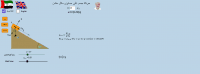
على مستوى مائل خشن (معامل احتكاكه \(\mu\)) تؤثر في الجسم: الوزن \(mg\) ومركّبتاه \(mg\sin\theta\) (موازية) و\(mg\cos\theta\) (عمودية)، والقوة العمودية \(N=mg\cos\theta\)، وقوة الاحتكاك \(f\) إلى أعلى المستوى (تعاكس الانزلاق). الاحتكاك الحركي \(f=\mu N=\mu mg\cos\theta\).
On a rough inclined plane (friction coefficient \(\mu\)) the forces on the body are: the weight \(mg\) with its components \(mg\sin\theta\) (parallel) and \(mg\cos\theta\) (perpendicular), the normal force \(N=mg\cos\theta\), and the friction \(f\) up the plane (opposing the sliding). The kinetic friction is \(f=\mu N=\mu mg\cos\theta\).
📘 القوانين
📘 The laws
\[\sum F_x=mg\sin\theta-\mu mg\cos\theta=ma\ \Rightarrow\ a=g(\sin\theta-\mu\cos\theta)\]
\[\text{rest if }\tan\theta\le\mu\qquad\theta_c=\tan^{-1}\mu\qquad \mu=\tan\theta\Rightarrow v=\text{constant}\]
\[M_E=K_E+P_E\ \text{decreases}:\ \Delta M_E=-f\,s\qquad Q=f\,s\]
💡 شرح إضافي
💡 Extra explanation
- \(\tan\theta\lt \mu\): الاحتكاك السكوني يوازن \(mg\sin\theta\) فيبقى الجسم ساكنًا (وإذا دُفع يتباطأ ويقف).\(\tan\theta\lt \mu\): the static friction balances \(mg\sin\theta\) so the body stays at rest (and if it is pushed it slows down and stops).
- \(\tan\theta=\mu\): \(a=0\) والجسم المتحرك يستمر بسرعة ثابتة (الزاوية الحرجة).\(\tan\theta=\mu\): \(a=0\) and a moving body continues at constant velocity (the critical angle).
- \(\tan\theta\gt \mu\): ينزلق الجسم بتسارع أصغر من \(g\sin\theta\) في المستوى الأملس.\(\tan\theta\gt \mu\): the body slides with an acceleration smaller than \(g\sin\theta\) of the smooth plane.
- الاحتكاك يحوّل جزءًا من طاقة الوضع إلى حرارة فلا تبقى الطاقة الميكانيكية ثابتة: \(mgh=K_E+f\,s\).Friction changes a part of the potential energy into heat so the mechanical energy is not constant: \(mgh=K_E+f\,s\).
- نستعمل \(g=9.8\ \mathrm{m/s^2}\) ونفترض أن معامل الاحتكاك السكوني يساوي الحركي.We use \(g=9.8\ \mathrm{m/s^2}\) and assume that the static friction coefficient equals the kinetic one.
🧪 تجربة 1: هل ينزلق الجسم؟ غيّر الزاوية والاحتكاك
🧪 Experiment 1: Does the body slide? Change the angle and the friction
اختر زاوية المستوى \(\theta\) ومعامل الاحتكاك \(\mu\) والكتلة وطول المستوى (\(g=9.8\ \mathrm{m/s^2}\)). إذا كانت \(\tan\theta\gt \mu\) ينزلق الجسم بتسارع \(g(\sin\theta-\mu\cos\theta)\)، وإلا بقي ساكنًا (والاحتكاك السكوني \(=mg\sin\theta\)). يمكنك أيضًا دفعه بسرعة ابتدائية. اضغط «اترك الجسم» أو حرّك مؤشر الزمن (لا شيء يتحرك من تلقاء نفسه).
Choose the angle of the plane \(\theta\), the friction coefficient \(\mu\), the mass and the length of the plane (\(g=9.8\ \mathrm{m/s^2}\)). If \(\tan\theta\gt \mu\) the body slides with an acceleration \(g(\sin\theta-\mu\cos\theta)\); otherwise it stays at rest (the static friction \(=mg\sin\theta\)). You can also push it with an initial velocity. Press “Release the body” or move the time slider (nothing moves by itself).
🧪 تجربة 2: حاسبة: المستوى المائل الخشن
🧪 Experiment 2: Calculator: the rough inclined plane
مسألة جديدة في كل مرة (\(g=9.8\ \mathrm{m/s^2}\)). احسب القوة العمودية والاحتكاك والتسارع ثم اضغط «صحّح».
A new problem every time (\(g=9.8\ \mathrm{m/s^2}\)). Calculate the normal force, the friction and the acceleration then press “Check”.
🛠️ تطبيقات عملية
🛠️ Practical applications
- الطرق الجبلية: انحدار الطريق يجب أن يبقى أقل من الزاوية التي تنزلق عندها السيارات.Mountain roads: the slope of the road must stay below the angle at which cars slide.
- سلالم الأرضيات المائلة: الاحتكاك يمنع انزلاق الأجسام.Ramps: friction prevents the objects from sliding.
- فرامل المنحدرات: الاحتكاك يحوّل الطاقة إلى حرارة.Brakes on slopes: friction changes the energy into heat.
✍️ أمثلة محلولة
✍️ Worked Examples
جسم \(10\ \mathrm{kg}\) على مستوى زاويته \(30^\circ\) ومعامل احتكاكه \(0.2\) (\(g=9.8\)). احسب \(N\) والاحتكاك والتسارع.
A \(10\ \mathrm{kg}\) body on a plane of angle \(30^\circ\) and friction coefficient \(0.2\) (\(g=9.8\)). Calculate \(N\), the friction and the acceleration.
ما أكبر زاوية يبقى عندها جسم ساكنًا على مستوى معامل احتكاكه \(0.5\)؟ وماذا يحدث عند \(20^\circ\)؟
What is the largest angle at which a body stays at rest on a plane of friction coefficient \(0.5\)? What happens at \(20^\circ\)?
عند أي معامل احتكاك ينزلق جسم بسرعة ثابتة على مستوى زاويته \(30^\circ\)؟
At what friction coefficient does a body slide at constant velocity on a plane of angle \(30^\circ\)?
جسم \(2\ \mathrm{kg}\) انزلق من السكون \(10\ \mathrm{m}\) على مستوى \(30^\circ\) و\(\mu=0.2\). احسب السرعة النهائية والحرارة الناتجة.
A \(2\ \mathrm{kg}\) body slid from rest \(10\ \mathrm{m}\) on a plane of \(30^\circ\) and \(\mu=0.2\). Calculate the final velocity and the heat produced.
تسارع جسم ينزلق على مستوى خشن:
The acceleration of a body sliding on a rough plane is:
يبدأ الجسم بالانزلاق عندما:
The body starts to slide when:
اتجاه الاحتكاك على جسم ينزلق على مستوى:
The direction of the friction on a body sliding on a plane is:
الطاقة الميكانيكية لجسم ينزلق على مستوى خشن:
The mechanical energy of a body sliding on a rough plane:
📚 ملخص
📚 Summary
| الحالةCase | النتيجةResult |
|---|---|
| \(\tan\theta\lt \mu\)\(\tan\theta\lt \mu\) | ساكن، f = mg sinθat rest, f = mg sinθ |
| \(\tan\theta=\mu\)\(\tan\theta=\mu\) | a = 0 (سرعة ثابتة)a = 0 (constant velocity) |
| \(\tan\theta\gt \mu\)\(\tan\theta\gt \mu\) | \(a=g(\sin\theta-\mu\cos\theta)\)\(a=g(\sin\theta-\mu\cos\theta)\) |
| الطاقةEnergy | \(mgh=K_E+fs\)\(mgh=K_E+fs\) |
⚠️ أخطاء شائعة
⚠️ Common mistakes
- حساب الاحتكاك بـ \(\mu mg\) بدل \(\mu mg\cos\theta\).Calculating the friction as \(\mu mg\) instead of \(\mu mg\cos\theta\).
- رسم الاحتكاك في اتجاه الحركة بدل عكسها.Drawing the friction in the direction of the motion instead of opposite to it.
- نسيان أن الاحتكاك السكوني يساوي \(mg\sin\theta\) (لا \(\mu N\)) عندما يكون الجسم ساكنًا.Forgetting that the static friction equals \(mg\sin\theta\) (not \(\mu N\)) when the body is at rest.
🔗 محاكيات GeoGebra للاستعانة بها عند اللزوم
🔗 GeoGebra Simulations to Use When Needed
اضغط «تشغيل» لتعمل المحاكاة هنا داخل الدرس؛ ويمكن للطالب الرجوع إليها لتجربة الفكرة بطريقة أخرى.
Press “Run” to run the simulation right here inside the lesson; the student can use it to try the idea in another way.