🎯 نواتج التعلم
🎯 Learning Outcomes
بعد هذه التجربة ستكون قادرًا على أن:
After this experiment you will be able to:
- تتعرف أجزاء الميكرومتر (الإطار، السندان، المغزل، الأسطوانة الثابتة، الأسطوانة الدوارة) ووظيفة كل جزء.Identify the parts of the micrometer (the frame, anvil, spindle, sleeve and thimble) and the function of each.
- تقرأ الميكرومتر بدقة \(0.01\ \mathrm{mm}\): قراءة الأسطوانة الثابتة + رقم قسم الأسطوانة الدوارة المنطبق على خط الأساس × \(0.01\).Read the micrometer to \(0.01\ \mathrm{mm}\): the sleeve reading + the number of the thimble division at the datum line × \(0.01\).
- تحدّد خطأ الصفر وتصحّح القراءة به، وتحسب خطوة اللولب وأصغر قراءة.Find the zero error and correct the reading with it, and calculate the pitch and the least count.
🎬 شاهد الفيديو
🎬 Watch the Video
🔩 جهاز الميكرومتر
🔩 The Micrometer Screw Gauge
الميكرومتر أداة لقياس الأطوال الصغيرة جدًا (سمك سلك أو ورقة أو قطر كرة صغيرة) بدقة أكبر من القدمة. يعتمد على لولب دقيق: كل دورة كاملة للأسطوانة الدوارة تحرّك المغزل مسافة ثابتة تسمى خطوة اللولب \(=0.5\ \mathrm{mm}\). تتكون الأداة من إطار على شكل \(C\) يحمل السندان الثابت، والمغزل المتحرك، والأسطوانة الثابتة (عليها مقياس بالمليمتر ونصف المليمتر)، والأسطوانة الدوارة (عليها 50 قسمًا)، وسقاطة تضمن ضغطًا ثابتًا، وقفلًا لتثبيت القراءة.
The micrometer is a tool for measuring very small lengths (the thickness of a wire or a sheet, the diameter of a small ball) more precisely than the caliper. It depends on a fine screw: each complete turn of the thimble moves the spindle by a fixed distance called the pitch \(=0.5\ \mathrm{mm}\). It consists of a \(C\)-shaped frame carrying the fixed anvil, the moving spindle, the sleeve (with a scale in millimetres and half-millimetres), the thimble (with 50 divisions), a ratchet that gives a constant pressure, and a lock to fix the reading.
📘 أصغر قراءة وطريقة القراءة
📘 The least count and how to read
\[\text{least count}=\dfrac{\text{pitch}}{\text{number of thimble divisions}}=\dfrac{0.5\ \mathrm{mm}}{50}=0.01\ \mathrm{mm}\]
\[\text{reading}=\text{sleeve reading}+\left(\text{thimble division at the datum line}\times0.01\ \mathrm{mm}\right)\]
\[\text{true length}=\text{reading}-\text{zero error}\]
💡 خطوات القراءة وخطأ الصفر
💡 Steps of reading and the zero error
- الخطوة 1: اقرأ على الأسطوانة الثابتة آخر خط ظاهر قبل حافة الأسطوانة الدوارة: خطوط فوق خط الأساس للمليمترات وخطوط تحته لأنصاف المليمترات (\(0.5\ \mathrm{mm}\) إذا كان خط النصف ظاهرًا).Step 1: read on the sleeve the last visible line before the edge of the thimble: lines above the datum line for millimetres and lines below it for half-millimetres (\(0.5\ \mathrm{mm}\) if the half-line is visible).
- الخطوة 2: اقرأ رقم القسم على الأسطوانة الدوارة المنطبق على خط الأساس واضربه في \(0.01\ \mathrm{mm}\).Step 2: read the number of the division of the thimble that is in line with the datum line and multiply it by \(0.01\ \mathrm{mm}\).
- الخطوة 3: اجمع القراءتين.Step 3: add the two readings.
- خطأ الصفر: أغلق الجهاز (باستعمال السقاطة) فإذا لم تقرأ صفرًا فهناك خطأ: إذا انطبق القسم \(T\) بعد صفر الأسطوانة (يتجاوز الصفر) فالخطأ موجب \(+T\times0.01\)، وإذا لم يصل صفر الأسطوانة إلى خط الأساس وانطبق القسم \(T\) فالخطأ سالب \(-(50-T)\times0.01\). الطول الصحيح \(=\) القراءة \(-\) الخطأ.Zero error: close the gauge (using the ratchet); if it does not read zero there is an error: if division \(T\) is at the datum line after the zero of the thimble (it has passed zero) the error is positive \(+T\times0.01\); if the zero of the thimble has not reached the datum line and division \(T\) is in line, the error is negative \(-(50-T)\times0.01\). The true length \(=\) reading \(-\) error.
🧪 تجربة 1: قِس الجسم بالميكرومتر
🧪 Experiment 1: Measure the object with the micrometer
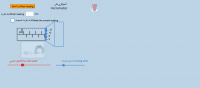
يدور المغزل (والأسطوانة الدوارة) ليطبق على جسم سمكه \(w\). الشكل العلوي للجهاز والسفلي مكبّر عند حافة الأسطوانة الدوارة: اقرأ آخر خط ظاهر على الأسطوانة الثابتة (فوق خط الأساس مليمترات وتحته أنصاف المليمترات)، ثم رقم القسم المنطبق على خط الأساس × \(0.01\ \mathrm{mm}\). اضغط «جسم جديد للتدرّب» لتخفى القراءة فتقرأها بنفسك وتتحقق، وغيّر خطأ الصفر لترى أثره.
The spindle (and the thimble) turns to grip an object of thickness \(w\). The upper picture shows the whole gauge and the lower one is zoomed at the edge of the thimble: read the last visible line on the sleeve (millimetres above the datum line and half-millimetres below it), then the number of the division in line with the datum line × \(0.01\ \mathrm{mm}\). Press “New object to practise” so the reading is hidden and you read it yourself and check, and change the zero error to see its effect.
🧪 تجربة 2: حاسبة: قراءات مكتوبة
🧪 Experiment 2: Calculator: written readings
مسألة جديدة في كل مرة تعتمد على قراءات مكتوبة (من دون صورة). احسب القيم الثلاث ثم اضغط «صحّح».
A new problem every time based on written readings (without a picture). Calculate the three values and press “Check”.
🛠️ تطبيقات عملية
🛠️ Practical applications
- قياس سمك الأسلاك والصفائح والورق: بدقة \(0.01\ \mathrm{mm}\).Measuring the thickness of wires, sheets and paper: to \(0.01\ \mathrm{mm}\).
- الورش والتصنيع: فحص أقطار القطع الدقيقة.Workshops and manufacturing: checking the diameters of precise parts.
- استعمال السقاطة: تمنع الضغط الزائد الذي يعطي قراءة أصغر من الحقيقية.Using the ratchet: it prevents excessive pressure that would give a reading smaller than the true one.
✍️ أمثلة محلولة
✍️ Worked Examples
ظهر على الأسطوانة الثابتة خط \(5\ \mathrm{mm}\) وخط نصف المليمتر بعده، وانطبق القسم \(28\) من الأسطوانة الدوارة على خط الأساس. ما القراءة؟
On the sleeve the \(5\ \mathrm{mm}\) line and the half-millimetre line after it are visible, and division \(28\) of the thimble is in line with the datum line. What is the reading?
قراءة ميكرومتر لسلك \(7.34\ \mathrm{mm}\) وخطأ الصفر \(+0.03\ \mathrm{mm}\). ما القطر الصحيح؟
A micrometer reading for a wire is \(7.34\ \mathrm{mm}\) and the zero error is \(+0.03\ \mathrm{mm}\). What is the true diameter?
عند إغلاق الميكرومتر انطبق القسم \(47\) على خط الأساس (لم يصل الصفر إليه). ما خطأ الصفر؟ وما الطول الصحيح إذا كانت القراءة \(2.15\ \mathrm{mm}\)؟
When the micrometer was closed division \(47\) was in line with the datum line (the zero had not reached it). What is the zero error? What is the true length if the reading is \(2.15\ \mathrm{mm}\)?
كم يتحرك المغزل إذا دارت الأسطوانة الدوارة \(3.5\) دورة؟ وكم قسمًا مرّ على خط الأساس؟
How far does the spindle move if the thimble turns \(3.5\) revolutions? How many divisions passed the datum line?
أصغر قراءة للميكرومتر (خطوة اللولب \(0.5\ \mathrm{mm}\) و50 قسمًا):
The least count of a micrometer (pitch \(0.5\ \mathrm{mm}\) and 50 divisions) is:
أسطوانة ثابتة تقرأ \(3.5\ \mathrm{mm}\) والقسم \(12\) على خط الأساس. القراءة:
The sleeve reads \(3.5\ \mathrm{mm}\) and division \(12\) is at the datum line. The reading is:
نستعمل السقاطة عند إغلاق الميكرومتر على الجسم لأنها:
We use the ratchet when closing the micrometer on the object because it:
إذا كان خطأ الصفر \(-0.02\ \mathrm{mm}\) وقراءة الجسم \(4.50\ \mathrm{mm}\) فإن الطول الصحيح:
If the zero error is \(-0.02\ \mathrm{mm}\) and the reading of the object is \(4.50\ \mathrm{mm}\), the true length is:
📚 ملخص
📚 Summary
| المفهومConcept | القاعدةRule |
|---|---|
| خطوة اللولبPitch | \(0.5\ \mathrm{mm}\)\(0.5\ \mathrm{mm}\) |
| أصغر قراءةLeast count | \(\dfrac{0.5}{50}=0.01\ \mathrm{mm}\)\(\dfrac{0.5}{50}=0.01\ \mathrm{mm}\) |
| القراءةReading | الثابتة + (قسم الدوارة × 0.01)sleeve + (thimble division × 0.01) |
| الطول الصحيحTrue length | القراءة − خطأ الصفرreading − zero error |
⚠️ أخطاء شائعة
⚠️ Common mistakes
- نسيان إضافة \(0.5\ \mathrm{mm}\) عندما يكون خط نصف المليمتر ظاهرًا.Forgetting to add \(0.5\ \mathrm{mm}\) when the half-millimetre line is visible.
- إغلاق الجهاز بالأسطوانة الدوارة مباشرة بقوة بدل السقاطة.Closing the gauge forcefully by the thimble itself instead of the ratchet.
- عكس إشارة خطأ الصفر عند التصحيح.Reversing the sign of the zero error when correcting.
🔗 محاكيات GeoGebra للاستعانة بها عند اللزوم
🔗 GeoGebra Simulations to Use When Needed
اضغط «تشغيل» لتعمل المحاكاة هنا داخل الدرس؛ ويمكن للطالب الرجوع إليها لتجربة الفكرة بطريقة أخرى.
Press “Run” to run the simulation right here inside the lesson; the student can use it to try the idea in another way.