🎯 نواتج التعلم
🎯 Learning Outcomes
بعد هذه التجربة ستكون قادرًا على أن:
After this experiment you will be able to:
- تشرح النموذج الجسيمي الذي يمثّل الجسم بنقطة في منتصفه.Explain the particle model that represents the body by a point at its centre.
- تمثّل حركة الجسم بنقاط عند فترات زمنية متساوية (مخطط الحركة) وتقرأ المسافات بين النقاط.Represent the motion of a body by dots at equal time intervals (a motion diagram) and read the distances between the dots.
- تميّز الحركة المنتظمة والمتسارعة والمتباطئة من تباعد النقاط وتحدّد إشارة التسارع.Distinguish uniform, speeding-up and slowing-down motion from the spacing of the dots and decide the sign of the acceleration.
🎬 شاهد الفيديو
🎬 Watch the Video
⚫ النموذج الجسيمي ومخطط الحركة
⚫ The Particle Model and the Motion Diagram
النموذج الجسيمي هو نموذج فيزيائي يمثّل الجسم كنقطة تتمركز في منتصفه. يُستخدم لدراسة حركة الأجسام دون الاهتمام بحجمها أو شكلها.
The particle model is a physical model that represents the body as a point at its centre. It is used to study the motion of bodies without caring about their size or shape.
مخطط الحركة (التمثيل النقطي) هو صورة تُرسم فيها نقطة لموقع الجسم عند كل فترة زمنية متساوية \(\Delta t\). المسافة بين كل نقطتين متتاليتين تدل على سرعة الجسم في تلك الفترة: كلما تباعدت النقاط كانت السرعة أكبر. ويمكن رسم سهم السرعة \(v\) عند كل نقطة.
The motion diagram (dot representation) is a picture in which a dot shows the position of the body at every equal time interval \(\Delta t\). The distance between two successive dots shows the speed of the body in that interval: the farther apart the dots the greater the speed. An arrow for the velocity \(v\) can be drawn at each dot.
📊 مقارنة بين أنواع الحركة
📊 Comparison of the Types of Motion
| نوع الحركةType of motion | السرعةVelocity | المسافات المقطوعةDistances covered | التسارعAcceleration |
|---|---|---|---|
| السرعة الثابتةConstant velocity | ثابتةconstant | مسافات متساوية في أزمنة متساويةequal distances in equal times | صفرzero |
| السرعة المتزايدةIncreasing velocity | متزايدةincreasing | مسافات متزايدة في أزمنة متساويةincreasing distances in equal times | موجبpositive |
| السرعة المتناقصةDecreasing velocity | متناقصةdecreasing | مسافات متناقصة في أزمنة متساويةdecreasing distances in equal times | سالبnegative |
💡 شرح إضافي
💡 Extra explanation
- الحركة المنتظمة: المسافات بين النقاط متساوية فالسرعة ثابتة والتسارع صفر.Uniform motion: the distances between the dots are equal so the velocity is constant and the acceleration is zero.
- الحركة المتسارعة: تتباعد النقاط أكثر فأكثر؛ السرعة تزداد والتسارع في اتجاه الحركة (موجب إذا كانت الحركة نحو الموجب).Speeding-up motion: the dots get farther and farther apart; the velocity increases and the acceleration is in the direction of the motion (positive if the motion is toward the positive direction).
- الحركة المتباطئة: تتقارب النقاط أكثر فأكثر؛ السرعة تقل والتسارع عكس اتجاه الحركة (سالب إذا كانت الحركة نحو الموجب).Slowing-down motion: the dots get closer and closer; the velocity decreases and the acceleration is opposite to the direction of the motion (negative if the motion is toward the positive direction).
- الفرق بين مسافتين متتاليتين في الحركة المنتظمة التسارع هو ثابت: \(\Delta x_{n+1}-\Delta x_n=a\,\Delta t^2\).In uniformly accelerated motion the difference between two successive distances is constant: \(\Delta x_{n+1}-\Delta x_n=a\,\Delta t^2\).
🧪 تجربة 1: ارسم مخطط الحركة نقطةً نقطة
🧪 Experiment 1: Draw the motion diagram dot by dot
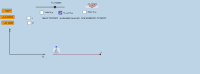
اختر نوع الحركة والسرعة الابتدائية والتسارع والفترة الزمنية \(\Delta t\)، ثم اضغط «ضع النقطة التالية» لتظهر نقطة جديدة بعد كل فترة زمنية (أو «اعرض الحركة كاملة»). لا شيء يتحرك من تلقاء نفسه. لاحظ المسافات بين النقاط وجدول \(\Delta x\) وأسهم السرعة، وبدّل بين عرض الجسم (السيارة) وعرض النقطة (النموذج الجسيمي).
Choose the type of motion, the initial velocity, the acceleration and the time interval \(\Delta t\), then press “Place the next dot” so a new dot appears after every time interval (or “Show the whole motion”). Nothing moves by itself. Notice the distances between the dots, the table of \(\Delta x\) and the velocity arrows, and switch between showing the body (the car) and showing the point (the particle model).
🧪 تجربة 2: تعرّف على نوع الحركة من النقاط
🧪 Experiment 2: Identify the type of motion from the dots
يظهر مخطط حركة عشوائي (الحركة نحو اليمين = الاتجاه الموجب). اختر نوع الحركة وإشارة التسارع ثم اضغط «صحّح».
A random motion diagram appears (motion to the right = the positive direction). Choose the type of motion and the sign of the acceleration then press “Check”.
🛠️ تطبيقات عملية
🛠️ Practical applications
- التصوير المتتابع (ستروبوسكوب): تظهر صور الجسم عند فترات زمنية متساوية فنقرأ نوع حركته.Strobe photography: the images of the body appear at equal time intervals so we read the type of its motion.
- مؤقت الشرائط (Ticker Timer): يضع نقاطًا على شريط عند فترات متساوية لقياس السرعة والتسارع.The ticker timer: it puts dots on a tape at equal intervals to measure the velocity and the acceleration.
- تحليل الفيديو: تتبّع موقع جسم في كل إطار لرسم مخطط حركته.Video analysis: tracking the position of a body in every frame to draw its motion diagram.
✍️ أمثلة محلولة
✍️ Worked Examples
نقاط مخطط حركة عند \(0,\ 2,\ 4,\ 6,\ 8\ \mathrm{m}\) كل \(1\ \mathrm{s}\). ما نوع الحركة وما سرعتها؟
The dots of a motion diagram are at \(0,\ 2,\ 4,\ 6,\ 8\ \mathrm{m}\) every \(1\ \mathrm{s}\). What is the type of the motion and what is its velocity?
نقاط عند \(0,\ 1,\ 4,\ 9,\ 16\ \mathrm{m}\) كل \(1\ \mathrm{s}\). ما نوع الحركة وكم التسارع؟
The dots are at \(0,\ 1,\ 4,\ 9,\ 16\ \mathrm{m}\) every \(1\ \mathrm{s}\). What is the type of the motion and what is the acceleration?
نقاط عند \(0,\ 7,\ 12,\ 15,\ 16\ \mathrm{m}\) كل \(1\ \mathrm{s}\). ما نوع الحركة وكم التسارع؟
The dots are at \(0,\ 7,\ 12,\ 15,\ 16\ \mathrm{m}\) every \(1\ \mathrm{s}\). What is the type of the motion and what is the acceleration?
متى يمكن تمثيل سيارة بنقطة؟
When can a car be represented by a point?
في الحركة بسرعة ثابتة تكون المسافات بين النقاط المتتالية:
In motion at constant velocity the distances between successive dots are:
تباعد النقاط أكثر فأكثر يعني أن الجسم:
Dots getting farther and farther apart mean that the body is:
جسم يتحرك نحو الاتجاه الموجب وتتقارب نقاطه. إشارة تسارعه:
A body moves in the positive direction and its dots get closer. The sign of its acceleration is:
يمثّل النموذج الجسيمي الجسم بـ:
The particle model represents the body by:
📚 ملخص
📚 Summary
| المسافات بين النقاطSpacing of the dots | الحركةMotion | التسارع (حركة نحو الموجب)Acceleration (motion toward +) |
|---|---|---|
| متساويةequal | منتظمةuniform | صفرzero |
| تتزايدincreasing | متسارعةspeeding up | موجبpositive |
| تتناقصdecreasing | متباطئةslowing down | سالبnegative |
⚠️ أخطاء شائعة
⚠️ Common mistakes
- الظن بأن التسارع السالب يعني دائمًا تباطؤًا؛ التباطؤ يحدث عندما يكون التسارع عكس السرعة.Thinking that a negative acceleration always means slowing down; slowing down happens when the acceleration is opposite to the velocity.
- نسيان أن الفترات الزمنية بين النقاط متساوية دائمًا.Forgetting that the time intervals between the dots are always equal.
- قراءة المسافة بين النقاط على أنها السرعة نفسها دون قسمتها على \(\Delta t\).Reading the distance between the dots as the velocity itself without dividing it by \(\Delta t\).
🔗 محاكيات GeoGebra للاستعانة بها عند اللزوم
🔗 GeoGebra Simulations to Use When Needed
اضغط «تشغيل» لتعمل المحاكاة هنا داخل الدرس؛ ويمكن للطالب الرجوع إليها لتجربة الفكرة بطريقة أخرى.
Press “Run” to run the simulation right here inside the lesson; the student can use it to try the idea in another way.