🎯 نواتج التعلم
🎯 Learning Outcomes
بعد هذه التجربة ستكون قادرًا على أن:
After this experiment you will be able to:
- تطبّق قانون العقدة (كيرشوف الأول) \(\sum I=0\) عند وصلة التفرع.Apply the junction rule (Kirchhoff’s first law) \(\sum I=0\) at the junction.
- تطبّق قانون الحلقة (كيرشوف الثاني) \(\sum \Delta V=0\) على كل حلقة مغلقة.Apply the loop rule (Kirchhoff’s second law) \(\sum \Delta V=0\) to each closed loop.
- تحلّ المعادلات لإيجاد التيارات وتفسّر الإشارة السالبة.Solve the equations to find the currents and explain a negative sign.
🎬 شاهد الفيديو
🎬 Watch the Video
⚖️ قانونا كيرشوف
⚖️ Kirchhoff’s Laws
قانون العقدة: مجموع التيارات الداخلة إلى وصلة يساوي مجموع التيارات الخارجة منها (حفظ الشحنة). قانون الحلقة: مجموع التغيرات في الجهد حول أي مسار مغلق يساوي صفرًا (حفظ الطاقة). نفترض اتجاهًا لكل تيار؛ فإذا خرجت قيمته سالبة فاتجاهه الحقيقي عكس المفترض.
The junction rule: the sum of the currents entering a junction equals the sum leaving it (conservation of charge). The loop rule: the sum of the potential changes around any closed path is zero (conservation of energy). We assume a direction for each current; if its value comes out negative its real direction is opposite to the assumed one.
📘 القواعد
📘 The rules
\[\sum I_{in}=\sum I_{out}\qquad \sum \Delta V=0\]
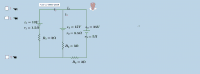
\[\varepsilon_1-I_1R_1-I_3R_3=0\qquad \varepsilon_2-I_2R_2-I_3R_3=0\qquad I_3=I_1+I_2\]
💡 إشارات الجهد
💡 Sign conventions
- عند المرور في بطارية من السالب إلى الموجب: \(+\varepsilon\) ومن الموجب إلى السالب: \(-\varepsilon\).Passing through a battery from − to +: \(+\varepsilon\); from + to −: \(-\varepsilon\).
- عند المرور في مقاومة باتجاه التيار: \(-IR\) وعكس التيار: \(+IR\).Passing through a resistor along the current: \(-IR\); against the current: \(+IR\).
- نحتاج معادلات بعدد المجاهيل: هنا ثلاثة تيارات ⇒ معادلة عقدة ومعادلتا حلقة.We need as many equations as unknowns: here three currents ⇒ one junction equation and two loop equations.
🧪 تجربة 1: حلّ الدائرة بقانوني كيرشوف
🧪 Experiment 1: Solve the circuit with Kirchhoff’s laws
1) غيّر البطاريتين (يمكن عكس قطبية أي منهما بإشارة سالبة) والمقاومات الثلاث. 2) اضغط «قانون العقدة» ثم «الحلقة الأولى» ثم «الحلقة الثانية» لتظهر المعادلات بالأرقام، ثم «الحل». 3) تحقق بالمسبارين: اسحب المسبارين إلى النقاط \(Q\) و\(X_1\) و\(P\) و\(X_2\) وتأكد أن مجموع فروق الجهد حول الحلقة صفر. 4) اكتب تيّاراتك المتوقعة وتحقق منها. (لا شيء يتحرك من تلقاء نفسه.)
1) Change the two batteries (a negative sign reverses a battery) and the three resistors. 2) Press “Junction rule”, then “First loop”, then “Second loop” to show the equations with numbers, then “Solve”. 3) Check with the probes: drag the two probes to the points \(Q\), \(X_1\), \(P\) and \(X_2\) and verify that the potential differences around a loop add up to zero. 4) Type your predicted currents and check them. (Nothing moves by itself.)
🧪 تجربة 2: حاسبة: دائرة بحلقتين
🧪 Experiment 2: Calculator: a two-loop circuit
مسألة جديدة في كل مرة (\(\varepsilon_1\) و\(\varepsilon_2\) موجبتان وتتجه تياراتهما كما في الرسم). احسب التيارات الثلاثة.
A new problem every time. Calculate the three currents.
✍️ أمثلة محلولة
✍️ Worked Examples
\(\varepsilon_1=12\ \mathrm{V}\) و\(\varepsilon_2=3\ \mathrm{V}\) و\(R_1=R_2=R_3=6\ \Omega\). احسب \(I_1\) و\(I_2\) و\(I_3\).
\(\varepsilon_1=12\ \mathrm{V}\), \(\varepsilon_2=3\ \mathrm{V}\) and \(R_1=R_2=R_3=6\ \Omega\). Find \(I_1\), \(I_2\) and \(I_3\).
ماذا تعني الإشارة السالبة لـ \(I_2\) في المثال السابق؟
What does the negative sign of \(I_2\) in the previous example mean?
\(\varepsilon_1=\varepsilon_2=10\ \mathrm{V}\) و\(R_1=R_2=10\ \Omega\) و\(R_3=5\ \Omega\). احسب \(I_3\).
\(\varepsilon_1=\varepsilon_2=10\ \mathrm{V}\), \(R_1=R_2=10\ \Omega\) and \(R_3=5\ \Omega\). Find \(I_3\).
في المثال 3 احسب فرق الجهد بين الوصلتين.
In example 3 find the potential difference between the two junctions.
قانون العقدة يعبّر عن حفظ:
The junction rule expresses conservation of:
قانون الحلقة يعبّر عن حفظ:
The loop rule expresses conservation of:
إذا خرجت قيمة تيار سالبة فهذا يعني أن:
If a current comes out negative it means:
عند المرور في مقاومة باتجاه التيار يكون التغير في الجهد:
Passing through a resistor along the current the potential change is:
📚 ملخص
📚 Summary
| القانونLaw | الصيغةFormula |
|---|---|
| العقدةJunction | \(\sum I_{in}=\sum I_{out}\)\(\sum I_{in}=\sum I_{out}\) |
| الحلقةLoop | \(\sum\Delta V=0\)\(\sum\Delta V=0\) |
| عدد المعادلاتNumber of equations | = عدد المجاهيل= the number of unknowns |
⚠️ أخطاء شائعة
⚠️ Common mistakes
- خطأ في إشارة \(\varepsilon\) أو \(IR\) عند الدوران حول الحلقة.Wrong sign of \(\varepsilon\) or \(IR\) when going around the loop.
- نسيان أن التيار في الفرع الأوسط هو المجموع \(I_1+I_2\).Forgetting that the middle branch current is the sum \(I_1+I_2\).
- اعتبار التيار السالب خطأ بدل أنه اتجاه معاكس.Treating a negative current as a mistake instead of an opposite direction.
🔗 محاكيات GeoGebra للاستعانة بها عند اللزوم
🔗 GeoGebra Simulations to Use When Needed
اضغط «تشغيل» لتعمل المحاكاة هنا داخل الدرس؛ ويمكن للطالب الرجوع إليها لتجربة الفكرة بطريقة أخرى.
Press “Run” to run the simulation right here inside the lesson; the student can use it to try the idea in another way.