🎯 نواتج التعلم
🎯 Learning Outcomes
بعد هذه التجربة ستكون قادرًا على أن:
After this experiment you will be able to:
- ترسم مخطط الجسم الحر لكل كتلة وتطبّق قانون نيوتن الثاني \(\sum F=ma\) على النظام وعلى كل جسم.Draw the free-body diagram of each block and apply Newton’s second law \(\sum F=ma\) to the system and to each body.
- تحسب تسارع كتلتين متلاصقتين وقوة الاحتكاك على كل منهما.Calculate the acceleration of two blocks in contact and the friction force on each.
- تحسب قوة التلامس بين الكتلتين وتربطها بقانون نيوتن الثالث (فعل ورد فعل).Calculate the contact force between the two blocks and relate it to Newton’s third law (action and reaction).
🎬 شاهد الفيديو
🎬 Watch the Video
🧱 كتلتان متلاصقتان تُدفعان على سطح خشن
🧱 Two Blocks in Contact Pushed on a Rough Surface
كتلتان \(m_1\) و\(m_2\) متلاصقتان على سطح أفقي معامل احتكاكه \(\mu\). تُدفع \(m_1\) بقوة أفقية \(F\) فتدفع بدورها \(m_2\). على الكتلة الأولى: القوة \(F\) وقوة التلامس \(N_{21}\) من الكتلة الثانية (إلى الخلف) والاحتكاك \(f_1=\mu m_1g\). وعلى الثانية: قوة التلامس \(N_{12}\) (إلى الأمام) والاحتكاك \(f_2=\mu m_2g\). \(N_{12}\) و\(N_{21}\) زوج فعل ورد فعل متساويان مقدارًا.
Two blocks \(m_1\) and \(m_2\) are in contact on a horizontal surface of friction coefficient \(\mu\). \(m_1\) is pushed by a horizontal force \(F\) and in turn pushes \(m_2\). On the first block: the force \(F\), the contact force \(N_{21}\) from the second block (backward) and the friction \(f_1=\mu m_1g\). On the second: the contact force \(N_{12}\) (forward) and the friction \(f_2=\mu m_2g\). \(N_{12}\) and \(N_{21}\) are an action–reaction pair of equal magnitude.
📘 خطوات الحل
📘 Steps of the solution
\[\text{system: }a=\dfrac{F-\mu(m_1+m_2)g}{m_1+m_2}\qquad(F\gt \mu(m_1+m_2)g)\]
\[\text{block }2:\ N_{12}-\mu m_2g=m_2a\ \Rightarrow\ N_{12}=m_2\,(a+\mu g)\]
\[\text{block }1:\ F-N_{21}-\mu m_1g=m_1a\qquad N_{21}=N_{12}\]
💡 شرح إضافي
💡 Extra explanation
- إذا كان \(F\le\mu(m_1+m_2)g\) بقيت الكتلتان ساكنتين (احتكاك سكوني يساوي \(F\))، وهذا تطبيق على قانون نيوتن الأول.If \(F\le\mu(m_1+m_2)g\) the blocks stay at rest (a static friction equal to \(F\)); this is an application of Newton’s first law.
- قوة التلامس تساوي \(N_{12}=\dfrac{m_2}{m_1+m_2}\,(F)\) فقط عندما \(\mu=0\)؛ ومع الاحتكاك تكون \(N_{12}=m_2(a+\mu g)\).The contact force equals \(N_{12}=\dfrac{m_2}{m_1+m_2}F\) only when \(\mu=0\); with friction it is \(N_{12}=m_2(a+\mu g)\).
- نستعمل \(g=9.8\ \mathrm{m/s^2}\) كما في المحاكاة الأصلية، والقوة العمودية على كل كتلة تساوي وزنها \(m g\).We use \(g=9.8\ \mathrm{m/s^2}\) as in the original simulation, and the normal force on each block equals its weight \(mg\).
🧪 تجربة 1: ادفع الكتلتين وحلّل القوى على كل منهما
🧪 Experiment 1: Push the two blocks and analyse the forces on each
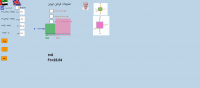
اختر الكتلتين والقوة \(F\) ومعامل الاحتكاك \(\mu\) (\(g=9.8\ \mathrm{m/s^2}\)). تظهر القوى على كل كتلة (مخطط الجسم الحر): \(F\) وقوة التلامس والاحتكاك والتسارع. اضغط الأزرار لإظهار خطوات حساب التسارع والاحتكاك وقوة التلامس، ثم حرّك مؤشر الزمن أو اضغط «شغّل» (لا شيء يتحرك من تلقاء نفسه).
Choose the two masses, the force \(F\) and the friction coefficient \(\mu\) (\(g=9.8\ \mathrm{m/s^2}\)). The forces on every block appear (the free-body diagram): \(F\), the contact force, the friction and the acceleration. Press the buttons to show the steps of calculating the acceleration, the friction and the contact force, then move the time slider or press “Play” (nothing moves by itself).
🧪 تجربة 2: حاسبة: كتلتان متلاصقتان
🧪 Experiment 2: Calculator: two blocks in contact
مسألة جديدة في كل مرة (\(g=9.8\ \mathrm{m/s^2}\)). احسب القيم الثلاث ثم اضغط «صحّح».
A new problem every time (\(g=9.8\ \mathrm{m/s^2}\)). Calculate the three values and press “Check”.
🛠️ تطبيقات عملية
🛠️ Practical applications
- قاطرة وعربات: قوة الشد بين العربات تعطي كل عربة التسارع اللازم.A locomotive and its wagons: the tension between the wagons gives each wagon the acceleration it needs.
- دفع صناديق متلاصقة: نحسب الدفع الذي تتلقاه الصناديق الأمامية.Pushing boxes in contact: we calculate the push received by the front boxes.
- سيارة تسحب مقطورة: قوة شد الوصلة ترتبط بالكتلة والتسارع.A car towing a trailer: the tension in the coupling depends on the mass and the acceleration.
✍️ أمثلة محلولة
✍️ Worked Examples
كتلتان \(m_1=m_2=10\ \mathrm{kg}\) متلاصقتان، \(\mu=0.1\) و\(F=58.1\ \mathrm{N}\) (\(g=9.8\)). احسب التسارع وقوة الاحتكاك على كل كتلة.
Two blocks \(m_1=m_2=10\ \mathrm{kg}\) in contact, \(\mu=0.1\) and \(F=58.1\ \mathrm{N}\) (\(g=9.8\)). Calculate the acceleration and the friction on each block.
للمثال السابق: احسب قوة التلامس بين الكتلتين وتحقق من الكتلة الأولى.
For the previous example: calculate the contact force between the blocks and check with the first block.
كتلتان \(3\ \mathrm{kg}\) و\(2\ \mathrm{kg}\) على سطح أملس تُدفع الأولى بقوة \(20\ \mathrm{N}\). أوجد التسارع وقوة التلامس.
Two blocks \(3\ \mathrm{kg}\) and \(2\ \mathrm{kg}\) on a smooth surface, the first pushed with \(20\ \mathrm{N}\). Find the acceleration and the contact force.
كتلتان \(5\ \mathrm{kg}\) لكل منهما و\(\mu=0.3\). هل تتحركان إذا كانت \(F=25\ \mathrm{N}\)؟ (\(g=9.8\))
Two blocks of \(5\ \mathrm{kg}\) each and \(\mu=0.3\). Do they move if \(F=25\ \mathrm{N}\)? (\(g=9.8\))
قوتا التلامس بين الكتلتين \(N_{12}\) و\(N_{21}\):
The contact forces between the two blocks \(N_{12}\) and \(N_{21}\) are:
تسارع الكتلتين المتلاصقتين المدفوعتين على سطح أملس بقوة \(F\):
The acceleration of two blocks in contact pushed on a smooth surface by a force \(F\) is:
قوة الاحتكاك الحركي على كتلة \(m\) تساوي:
The kinetic friction on a block of mass \(m\) equals:
إذا كانت \(F\) أقل من الاحتكاك الأقصى فإن التسارع:
If \(F\) is less than the maximum friction the acceleration is:
📚 ملخص
📚 Summary
| الكميةQuantity | القانونLaw |
|---|---|
| الاحتكاكFriction | \(f_i=\mu m_ig\)\(f_i=\mu m_ig\) |
| التسارعAcceleration | \(a=\dfrac{F-\mu(m_1+m_2)g}{m_1+m_2}\)\(a=\dfrac{F-\mu(m_1+m_2)g}{m_1+m_2}\) |
| قوة التلامسContact force | \(N_{12}=m_2(a+\mu g)\)\(N_{12}=m_2(a+\mu g)\) |
⚠️ أخطاء شائعة
⚠️ Common mistakes
- نسيان إضافة قوة التلامس في معادلة الكتلة الأولى.Forgetting to include the contact force in the equation of the first block.
- اعتبار قوة التلامس تساوي \(F\) كاملة.Taking the contact force to equal the whole \(F\).
- حساب الاحتكاك بدلالة \(F\) بدل القوة العمودية \(mg\).Calculating the friction from \(F\) instead of the normal force \(mg\).
🔗 محاكيات GeoGebra للاستعانة بها عند اللزوم
🔗 GeoGebra Simulations to Use When Needed
اضغط «تشغيل» لتعمل المحاكاة هنا داخل الدرس؛ ويمكن للطالب الرجوع إليها لتجربة الفكرة بطريقة أخرى.
Press “Run” to run the simulation right here inside the lesson; the student can use it to try the idea in another way.