🎯 نواتج التعلم
🎯 Learning Outcomes
بعد هذه التجربة ستكون قادرًا على أن:
After this experiment you will be able to:
- تفسّر انكسار الموجة عند انتقالها من وسط إلى آخر يختلف عنه في السرعة.Explain the refraction of a wave when it passes from one medium into another with a different speed.
- تطبّق قانون سنل للأمواج: \(\dfrac{\sin\theta_1}{\sin\theta_2}=\dfrac{v_1}{v_2}\).Apply Snell’s law for waves: \(\dfrac{\sin\theta_1}{\sin\theta_2}=\dfrac{v_1}{v_2}\).
- تبيّن أن التردد لا يتغير عند الانكسار، وأن الطول الموجي يتغير مع السرعة: \(\dfrac{\lambda_2}{\lambda_1}=\dfrac{v_2}{v_1}\).Show that the frequency does not change on refraction, and that the wavelength changes with the speed: \(\dfrac{\lambda_2}{\lambda_1}=\dfrac{v_2}{v_1}\).
- تحدد اتجاه انحناء الشعاع: نحو العمود عند الانتقال إلى وسط أبطأ، وبعيدًا عنه عند الانتقال إلى وسط أسرع.Determine the bending direction of the ray: towards the normal when entering a slower medium, and away from it when entering a faster one.
- تتوقع أثر تغيير زاوية السقوط أو نسبة السرعات، وتتحقق من توقعك بالمحاكاة.Predict how changing the angle of incidence or the speed ratio affects the refracted wave, and check your prediction with the simulation.
💡 فكرة التجربة
💡 The Idea of the Experiment
عندما تنتقل موجة من وسط إلى آخر تختلف سرعتها فيه، فإن جزءًا من الموجة يدخل الوسط الجديد أولًا فتتغير سرعته، بينما ما زال الجزء الآخر في الوسط القديم. فيحدث انحراف في اتجاه انتشار الموجة. الذي لا يتغير هو التردد، أما الطول الموجي والسرعة فيتغيران معًا بالنسبة نفسها.
When a wave passes into a medium where its speed is different, one part of the wavefront enters the new medium first and changes speed while the rest is still in the old medium. This produces a change of direction. What does not change is the frequency; the speed and the wavelength change in the same ratio.
📘 قانون سنل للأمواج
📘 Snell’s law for waves
\[\dfrac{\sin\theta_1}{\sin\theta_2}=\dfrac{v_1}{v_2}=\dfrac{\lambda_1}{\lambda_2}\qquad f_1=f_2\]
حيث \(\theta_1\) زاوية السقوط و\(\theta_2\) زاوية الانكسار، وكلتاهما تُقاس من العمود على سطح الفصل، و\(v_1\) و\(v_2\) سرعتا الموجة في الوسطين، و\(\lambda_1\) و\(\lambda_2\) طولاها الموجيان.
where \(\theta_1\) is the angle of incidence and \(\theta_2\) the angle of refraction, both measured from the normal to the interface; \(v_1\) and \(v_2\) are the wave speeds in the two media, and \(\lambda_1\) and \(\lambda_2\) their wavelengths.
| الانتقالTransition | السرعةSpeed | الطول الموجيWavelength | اتجاه الشعاعRay direction |
|---|---|---|---|
| إلى وسط أبطأ (\(v_2<v_1\))Into a slower medium (\(v_2<v_1\)) | تقلDecreases | يقلDecreases | نحو العمود (\(\theta_2<\theta_1\))Towards the normal (\(\theta_2<\theta_1\)) |
| إلى وسط أسرع (\(v_2>v_1\))Into a faster medium (\(v_2>v_1\)) | تزدادIncreases | يزدادIncreases | بعيدًا عن العمود (\(\theta_2>\theta_1\))Away from the normal (\(\theta_2>\theta_1\)) |
| الترددFrequency | لا يتغير في الوسطينThe same in both media | ||
💡 شرح إضافي: متى لا ينكسر الضوء بل ينعكس كليًا؟
💡 Extra explanation: when does the wave reflect totally instead of refracting?
عند الانتقال إلى وسط أسرع (\(v_2>v_1\)) تزداد زاوية الانكسار، فإذا بلغت \(90^\circ\) لا تنكسر الموجة بل تنعكس كليًا عن سطح الفصل. وتسمى زاوية السقوط التي تبدأ عندها هذه الظاهرة الزاوية الحرجة، وتُحسب من \(\sin\theta_c=\dfrac{v_1}{v_2}\).
When entering a faster medium (\(v_2>v_1\)) the angle of refraction increases; if it reaches \(90^\circ\) the wave does not refract but is reflected totally from the interface. The incidence angle at which this begins is the critical angle, given by \(\sin\theta_c=\dfrac{v_1}{v_2}\).
🧪 التجربة: انكسار الأمواج في بعدين
🧪 The Experiment: Wave Refraction in Two Dimensions
في التجربة التفاعلية أدناه موجة مستوية تنتقل من وسط علوي إلى وسط سفلي. اضغط «ابدأ الأمواج» لترى الأمواج تسقط واحدة تلو الأخرى، ثم غيّر زاوية السقوط ونسبة السرعات واتبع الخطوات:
In the interactive experiment below a plane wave passes from an upper medium into a lower one. Press “Start the waves” to see the waves arrive one after another, then change the angle of incidence and the speed ratio and follow the steps:
خطوات التجربة
Steps of the experiment
- توقّع أولًا: إذا كانت \(v_2=0.5\,v_1\) وزاوية السقوط \(30^\circ\)، فما زاوية الانكسار؟Predict first: if \(v_2=0.5\,v_1\) and the angle of incidence is \(30^\circ\), what is the angle of refraction?
- غيّر نسبة السرعات إلى أكبر من 1: لاحظ أن الشعاع ينحرف بعيدًا عن العمود.Change the speed ratio to above 1: notice that the ray bends away from the normal.
- لاحظ الطول الموجي في الوسط السفلي: المسافة بين الخطوط أصغر عندما يكون الوسط أبطأ.Watch the wavelength in the lower medium: the lines are closer together when that medium is slower.
- قارن بين التردد في الوسطين: عدد الخطوط التي تمر في الثانية واحد في الوسطين.Compare the frequency in the two media: the number of wavefronts passing per second is the same in both.
🧪 تجربة تفاعلية: انكسار الأمواج في بعدين
🧪 Interactive Experiment: Wave Refraction in Two Dimensions
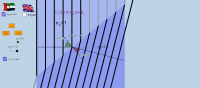
الوسط العلوي (الأزرق الفاتح) سرعته \(v_1\)، والوسط السفلي (الأزرق الداكن) سرعته \(v_2\). الخطوط الزرقاء الساقطة والخضراء المنكسرة هي خطوط الموجة. زاوية السقوط \(\theta_1\) والانكسار \(\theta_2\) تُقاسان من العمود المنقط.
The upper medium (light blue) has speed \(v_1\) and the lower medium (dark blue) has speed \(v_2\). The blue incident lines and the green refracted lines are the wavefronts. The angles of incidence \(\theta_1\) and refraction \(\theta_2\) are measured from the dotted normal.
✍️ مثال محلول
✍️ Worked Example
المعطيات: \(\theta_1=30^\circ\)، \(\dfrac{v_2}{v_1}=0.5\)، \(\lambda_1=4\,\mathrm{cm}\)
Given: \(\theta_1=30^\circ\), \(\dfrac{v_2}{v_1}=0.5\), \(\lambda_1=4\,\mathrm{cm}\)
- زاوية الانكسار: \(\sin\theta_2=\dfrac{v_2}{v_1}\sin\theta_1=0.5\times0.5=0.25\)، فـ \(\theta_2\approx14.5^\circ\)Angle of refraction: \(\sin\theta_2=\dfrac{v_2}{v_1}\sin\theta_1=0.5\times0.5=0.25\), so \(\theta_2\approx14.5^\circ\)
- الطول الموجي: \(\lambda_2=\lambda_1\dfrac{v_2}{v_1}=4\times0.5=2\,\mathrm{cm}\)Wavelength: \(\lambda_2=\lambda_1\dfrac{v_2}{v_1}=4\times0.5=2\,\mathrm{cm}\)
- لأن الوسط الثاني أبطأ، اقترب الشعاع من العمود (\(14.5^\circ<30^\circ\)).Because the second medium is slower, the ray moved towards the normal (\(14.5^\circ<30^\circ\)).
🧠 اختبر نفسك
🧠 Test Yourself
موجة تسقط بزاوية \(40^\circ\) على سطح فاصل، وسرعتها في الوسط الثاني \(0.8\) من سرعتها في الأول. احسب زاوية الانكسار.A wave hits an interface at \(40^\circ\), and its speed in the second medium is \(0.8\) of its speed in the first. Calculate the angle of refraction.
طول موجة \(3\,\mathrm{cm}\) في الوسط الأول، وسرعتها في الوسط الثاني \(0.75\) من سرعتها في الأول. احسب الطول الموجي في الوسط الثاني، وهل يتغير التردد؟A wave has a wavelength of \(3\,\mathrm{cm}\) in the first medium, and its speed in the second medium is \(0.75\) of its speed in the first. Calculate the wavelength in the second medium, and say whether the frequency changes.
📚 ملخص
📚 Summary
| المفهومConcept | القانونLaw |
|---|---|
| قانون سنل للأمواجSnell’s law for waves | \(\dfrac{\sin\theta_1}{\sin\theta_2}=\dfrac{v_1}{v_2}\) |
| الطول الموجيWavelength | \(\lambda_2=\lambda_1\dfrac{v_2}{v_1}\) |
| الترددFrequency | ثابتConstant |
| الزاوية الحرجةCritical angle | \(\sin\theta_c=\dfrac{v_1}{v_2}\) |
⚠️ أخطاء شائعة
⚠️ Common mistakes
- قياس زاوية الانكسار من سطح الفصل بدلًا من العمود.Measuring the angle of refraction from the interface instead of the normal.
- الظن أن التردد يتغير عند الانكسار؛ الذي يتغير هو السرعة والطول الموجي.Thinking the frequency changes on refraction; it is the speed and the wavelength that change.
- الخلط في نسبة السرعات: \(\dfrac{v_1}{v_2}\) مع \(\dfrac{\sin\theta_1}{\sin\theta_2}\) بالترتيب الصحيح.Mixing up the speed ratio: keep the correct order in \(\dfrac{\sin\theta_1}{\sin\theta_2}=\dfrac{v_1}{v_2}\).
- الظن أن الشعاع ينحني نحو العمود دائمًا؛ ينحني نحوه فقط عند الانتقال إلى وسط أبطأ.Thinking the ray always bends towards the normal; it does so only when entering a slower medium.
🔗 محاكيات GeoGebra للاستعانة بها عند اللزوم
🔗 GeoGebra Simulations to Use When Needed
اضغط «تشغيل» لتعمل المحاكاة هنا داخل الدرس؛ ويمكن للطالب الرجوع إليها لتجربة الفكرة بطريقة أخرى.
Press “Run” to run the simulation right here inside the lesson; the student can use it to try the idea in another way.