🎯 نواتج التعلم
🎯 Learning Outcomes
بعد هذه التجربة ستكون قادرًا على أن:
After this experiment you will be able to:
- تطبّق قانون الانعكاس للأمواج: زاوية السقوط \(\theta_i\) تساوي زاوية الانعكاس \(\theta_r\).Apply the law of reflection for waves: the angle of incidence \(\theta_i\) equals the angle of reflection \(\theta_r\).
- تبيّن أن الشعاع الساقط والشعاع المنعكس والعمود على السطح تقع في مستوى واحد.Show that the incident ray, the reflected ray and the normal to the surface lie in one plane.
- تفسّر أن سرعة الموجة وطولها الموجي لا يتغيران عند الانعكاس في الوسط نفسه.Explain that the speed and the wavelength of the wave do not change on reflection in the same medium.
- ترسم الموجات الدائرية من مصدر نقطي وتحدد موضع المصدر الصوري خلف الحاجز.Draw circular waves from a point source and locate the image source behind the barrier.
💡 فكرة التجربة
💡 The Idea of the Experiment
عندما تصطدم موجة بحاجز مستقيم (مثل جدار أو مرآة للأمواج) فإنها ترتد عنه. في الانعكاس تبقى الموجة في الوسط نفسه، لذلك لا تتغير سرعتها ولا طولها الموجي، وتتغير الاتجاهات فقط. الشعاع الساقط والشعاع المنعكس يكونان في جهتين مختلفتين من العمود على الحاجز، وكلاهما في مستوى واحد مع العمود.
When a wave hits a straight barrier (such as a wall or a wave reflector), it bounces back. On reflection the wave stays in the same medium, so its speed and wavelength do not change; only the directions change. The incident and the reflected rays lie on opposite sides of the normal, and all three lie in one plane.
📘 قانون انعكاس الأمواج
📘 The law of reflection for waves
\[\theta_i=\theta_r\qquad v_{\text{بعد}}=v_{\text{قبل}}\qquad \lambda_{\text{بعد}}=\lambda_{\text{قبل}}\]
\[\text{الزاوية بين الشعاع الساقط والمنعكس}=180^\circ-2\theta_i\]
حيث \(\theta_i\) زاوية السقوط و\(\theta_r\) زاوية الانعكاس، وكلتاهما تُقاس من العمود على الحاجز وليس من السطح نفسه.
where \(\theta_i\) is the angle of incidence and \(\theta_r\) the angle of reflection, both measured from the normal to the barrier, not from the surface itself.
💡 شرح إضافي: لماذا ينعكس الصدى؟
💡 Extra explanation: why does an echo occur?
الصدى موجة صوتية ترتد عن جدار بعيد. إذا كان الجدار مستقيمًا، فالموجة المنعكسة تبدو كأنها صادرة من مصدر صوري يقع خلف الجدار على البعد نفسه الذي يبعد عنه المصدر الحقيقي. وهذا يفسر أن الصدى يصل من الاتجاه نفسه الذي يبدو منه الصوت.
An echo is a sound wave that bounces off a distant wall. If the wall is straight, the reflected wave appears to come from an image source behind the wall, at the same distance behind it as the real source is in front of it.
| الكميةQuantity | قبل الانعكاسBefore reflection | بعد الانعكاسAfter reflection |
|---|---|---|
| السرعة \(v\)Speed \(v\) | \(v\) | لا تتغيرUnchanged |
| الطول الموجي \(\lambda\)Wavelength \(\lambda\) | \(\lambda\) | لا يتغيرUnchanged |
| الاتجاهDirection | نحو الحاجزTowards the barrier | بعيدًا عن الحاجز، بزاوية \(\theta_r=\theta_i\)Away from the barrier, at \(\theta_r=\theta_i\) |
🧪 التجربة: انعكاس الأمواج في بعدين
🧪 The Experiment: Wave Reflection in Two Dimensions
في التجربة التفاعلية أدناه حاجز مستقيم يمكن ميله عن الأفق. اختر موجة مستوية لترى خطوط الموجة المتوازية، أو مصدرًا نقطيًا لترى الدوائر وموضع المصدر الصوري. غيّر زاوية السقوط أو بعد المصدر، ثم اتبع الخطوات:
The interactive experiment below has a straight barrier that can be tilted from the horizon. Choose a plane wave to see parallel wavefronts, or a point source to see circles and the position of the image source. Change the angle of incidence or the source distance, then follow the steps:
خطوات التجربة
Steps of the experiment
- توقّع أولًا: إذا كانت زاوية السقوط \(30^\circ\) فما زاوية الانعكاس؟ وما الزاوية بين الشعاعين الساقط والمنعكس؟Predict first: if the angle of incidence is \(30^\circ\), what is the angle of reflection? What is the angle between the incident and reflected rays?
- غيّر زاوية السقوط: لاحظ أن زاوية الانعكاس تتغير معها دائمًا بالمقدار نفسه.Change the angle of incidence: notice that the angle of reflection always changes by the same amount.
- بدّل إلى المصدر النقطي: لاحظ أن الموجة المنعكسة تبدو كأنها صادرة من المصدر الصوري خلف الحاجز.Switch to the point source: notice that the reflected wave appears to come from the image source behind the barrier.
- لاحظ الطول الموجي: المسافة بين خطوط الموجة الساقطة والمنعكسة متساوية، فالطول الموجي لم يتغير.Watch the wavelength: the spacing between incident and reflected wavefronts is the same, so the wavelength did not change.
🧪 تجربة تفاعلية: انعكاس الأمواج في بعدين
🧪 Interactive Experiment: Wave Reflection in Two Dimensions
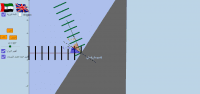
الخطوط الزرقاء موجات ساقطة، والحمراء موجات منعكسة. زاوية السقوط \(\theta_i\) تُقاس من العمود المنقط. الأسهم تبيّن اتجاه الانتقال، والخطوط المتقطعة هي العمود على الحاجز. في وضع المصدر النقطي، المركز الأحمر خلف الحاجز هو المصدر الصوري.
The blue lines are incident waves and the red lines are reflected waves. The angle of incidence \(\theta_i\) is measured from the dotted normal. The arrows show the direction of travel. In point-source mode, the red centre behind the barrier is the image source.
✍️ مثال محلول
✍️ Worked Example
المعطيات: موجة مستوية تسقط على حاجز مستقيم بزاوية \(\theta_i=30^\circ\) من العمود
Given: a plane wave hits a straight barrier at \(\theta_i=30^\circ\) from the normal
- زاوية الانعكاس: \(\theta_r=\theta_i=30^\circ\)Angle of reflection: \(\theta_r=\theta_i=30^\circ\)
- الزاوية بين الشعاعين: \(180^\circ-2(30^\circ)=120^\circ\)Angle between the rays: \(180^\circ-2(30^\circ)=120^\circ\)
- إذا كان الطول الموجي \(\lambda=2\,\mathrm{cm}\) قبل الانعكاس، فيبقى \(\lambda=2\,\mathrm{cm}\) بعده، لأن الوسط لم يتغير.If the wavelength is \(\lambda=2\,\mathrm{cm}\) before reflection, it stays \(2\,\mathrm{cm}\) after it, because the medium did not change.
- مصدر نقطي يبعد \(4\,\mathrm{cm}\) عن الحاجز: يقع المصدر الصوري خلف الحاجز على بعد \(4\,\mathrm{cm}\)، فتكون المسافة بين المصدر وصورته \(8\,\mathrm{cm}\).A point source \(4\,\mathrm{cm}\) from the barrier: its image source lies \(4\,\mathrm{cm}\) behind the barrier, so the distance between the source and its image is \(8\,\mathrm{cm}\).
🧠 اختبر نفسك
🧠 Test Yourself
شعاع يصنع \(50^\circ\) مع الحاجز المستقيم. ما زاوية السقوط؟ وما زاوية الانعكاس؟A ray makes \(50^\circ\) with a straight barrier. What is the angle of incidence? And the angle of reflection?
موجة مستوية تسقط بزاوية \(20^\circ\) على حاجز. ما الزاوية بين الشعاعين الساقط والمنعكس؟ ولماذا لا يتغير الطول الموجي؟A plane wave hits a barrier at \(20^\circ\). What is the angle between the incident and reflected rays? Why does the wavelength not change?
📚 ملخص
📚 Summary
| المفهومConcept | القانونLaw |
|---|---|
| قانون الانعكاسLaw of reflection | \(\theta_i=\theta_r\) |
| الزاوية بين الشعاعينAngle between the rays | \(180^\circ-2\theta_i\) |
| الطول الموجي والسرعةWavelength and speed | لا يتغيران في الوسط نفسهUnchanged in the same medium |
⚠️ أخطاء شائعة
⚠️ Common mistakes
- قياس زاوية السقوط من سطح الحاجز بدلًا من العمود عليه.Measuring the angle of incidence from the barrier surface instead of the normal.
- الظن أن الزاوية بين الشعاعين تساوي زاوية السقوط؛ الصحيح \(180^\circ-2\theta_i\).Thinking the angle between the rays equals the angle of incidence; the correct value is \(180^\circ-2\theta_i\).
- الظن أن الطول الموجي يتغير عند الانعكاس في الوسط نفسه.Thinking the wavelength changes on reflection in the same medium.
- نسيان أن المصدر الصوري يقع خلف الحاجز على البعد نفسه للمصدر الحقيقي.Forgetting that the image source lies behind the barrier at the same distance as the real source.
🔗 محاكيات GeoGebra للاستعانة بها عند اللزوم
🔗 GeoGebra Simulations to Use When Needed
اضغط «تشغيل» لتعمل المحاكاة هنا داخل الدرس؛ ويمكن للطالب الرجوع إليها لتجربة الفكرة بطريقة أخرى.
Press “Run” to run the simulation right here inside the lesson; the student can use it to try the idea in another way.