🎯 نواتج التعلم
🎯 Learning Outcomes
بعد هذه التجربة ستكون قادرًا على أن:
After this experiment you will be able to:
- تحسب سرعة مقذوف عند ارتطامه بالأرض بمبدأ حفظ الطاقة الميكانيكية.Calculate the speed of a projectile when it hits the ground using conservation of mechanical energy.
- تحسب السرعة نفسها بطريقة مركبات السرعة وزمن التحليق.Calculate the same speed using the velocity components and the flight time.
- تقارن بين الطريقتين وتحدد متى تستخدم كلًّا منهما.Compare the two methods and decide when to use each.
🎬 شاهد الفيديو
🎬 Watch the Video
⚡ الطريقة الأولى: حفظ الطاقة الميكانيكية
⚡ Method 1: Conservation of Mechanical Energy
إذا أهملنا مقاومة الهواء فالقوة الوحيدة المؤثرة في المقذوف هي وزنه (قوة محافظة) فتبقى الطاقة الميكانيكية ثابتة: مجموع الطاقة الحركية وطاقة الوضع الجاذبية. نقارن بين لحظة القذف (ارتفاع \(h\) وسرعة \(v_0\)) ولحظة الارتطام بالأرض (ارتفاع صفر وسرعة \(v\)):
If air resistance is neglected the only force on the projectile is its weight (a conservative force) so the mechanical energy is constant: the sum of the kinetic energy and the gravitational potential energy. We compare the moment of launch (height \(h\) and speed \(v_0\)) with the moment of hitting the ground (height zero and speed \(v\)):
📘 السرعة عند الارتطام بحفظ الطاقة
📘 The impact speed by energy conservation
\[ME_1=ME_2\ \Rightarrow\ KE_1+GPE_1=KE_2+GPE_2\]
\[\tfrac12mv_0^2+mgh=\tfrac12mv^2+0\]
\[v^2=v_0^2+2gh\ \Rightarrow\ v=\sqrt{v_0^2+2gh}\]
حيث \(v_0\) السرعة الابتدائية و\(g=9.8\ \mathrm{m/s^2}\) و\(h\) الارتفاع الابتدائي عن الأرض. لاحظ أن الكتلة اختفت وأن الزاوية لا تظهر في الجواب.
where \(v_0\) is the initial speed, \(g=9.8\ \mathrm{m/s^2}\) and \(h\) is the initial height above the ground. Notice that the mass cancelled and the angle does not appear in the answer.
💡 شرح إضافي: لماذا لا تعتمد السرعة على زاوية القذف؟
💡 Extra explanation: why does the speed not depend on the launch angle?
الطاقة كمية قياسية لا اتجاه لها: الطاقة الحركية \(\tfrac12mv^2\) تعتمد على مقدار السرعة فقط. وطاقة الوضع تعتمد على الارتفاع فقط. وبما أن المقذوفين المقذوفين من الارتفاع نفسه بالسرعة نفسها \(v_0\) يمتلكان الطاقة الميكانيكية نفسها، فإنهما يصلان إلى الأرض بالسرعة نفسها مهما اختلفت زاويتا القذف (لكن أزمنة التحليق وأماكن السقوط وزوايا الارتطام تختلف). جرّب تغيير الزاوية في التجربة وراقب أن سرعة الارتطام لا تتغير.
Energy is a scalar with no direction: the kinetic energy \(\tfrac12mv^2\) depends only on the magnitude of the velocity, and the potential energy only on the height. Two projectiles launched from the same height with the same speed \(v_0\) have the same mechanical energy, so they hit the ground with the same speed whatever the launch angles (but the flight times, landing places and impact angles differ). Try changing the angle in the experiment and watch that the impact speed does not change.
📐 الطريقة الثانية: مركبات السرعة
📐 Method 2: The Velocity Components
نحلّل الحركة إلى مركبتين: أفقية بسرعة ثابتة، ورأسية بتسارع \(-g\). نضع المبدأ عند الأرض فيكون الارتفاع \(y=h+v_{0y}t-\tfrac12gt^2\) وعند الارتطام \(y=0\):
We resolve the motion into two components: a horizontal one at constant speed and a vertical one with acceleration \(-g\). Taking the origin at the ground the height is \(y=h+v_{0y}t-\tfrac12gt^2\) and at impact \(y=0\):
🪜 الخطوات
🪜 The steps
- المركبتان الابتدائيتان: \(v_{0x}=v_0\cos\theta\) و\(v_{0y}=v_0\sin\theta\).The initial components: \(v_{0x}=v_0\cos\theta\) and \(v_{0y}=v_0\sin\theta\).
- زمن التحليق من المعادلة \(0=h+v_{0y}t-\tfrac12gt^2\) (نأخذ الجذر الموجب).The flight time from \(0=h+v_{0y}t-\tfrac12gt^2\) (take the positive root).
- المركبة الرأسية عند الارتطام: \(v_y=v_{0y}-gt\) (سالبة: إلى الأسفل).The vertical component at impact: \(v_y=v_{0y}-gt\) (negative: downward).
- المركبة الأفقية ثابتة: \(v_x=v_0\cos\theta\).The horizontal component is constant: \(v_x=v_0\cos\theta\).
- السرعة النهائية: \(v=\sqrt{v_x^2+v_y^2}\) وزاويتها \(\varphi=\tan^{-1}\dfrac{|v_y|}{v_x}\) تحت الأفقي.The final speed: \(v=\sqrt{v_x^2+v_y^2}\) and its angle \(\varphi=\tan^{-1}\dfrac{|v_y|}{v_x}\) below the horizontal.
💡 شرح إضافي: انتبه لإشارة الارتفاع
💡 Extra explanation: mind the sign of the height
عند كتابة معادلة الزمن بطريقة \(\Delta y=v_{0y}t-\tfrac12gt^2\) يكون الإزاحة الرأسية \(\Delta y=-h\) (إلى الأسفل) لا \(+h\)، فتصبح \(-h=v_{0y}t-\tfrac12gt^2\). وكتابة \(h=v_{0y}t-\tfrac12gt^2\) بإشارة موجبة تقود إلى معادلة تربيعية بلا حل حقيقي في كثير من الأمثلة. الطريقة الأوضح هي أن \(y=0\) عند الأرض كما في الخطوات أعلاه.
When writing the time equation in the form \(\Delta y=v_{0y}t-\tfrac12gt^2\) the vertical displacement is \(\Delta y=-h\) (downward), not \(+h\), so it becomes \(-h=v_{0y}t-\tfrac12gt^2\). Writing \(h=v_{0y}t-\tfrac12gt^2\) with a positive sign leads to a quadratic with no real root in many examples. The clearest way is to put \(y=0\) at the ground as in the steps above.
🧪 تجربة 1: مقذوف من ارتفاع: السرعة النهائية بطريقتين
🧪 Experiment 1: A projectile from a height: the final speed in two ways
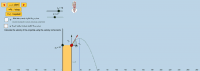
يُقذف جسم من حافة منحدر ارتفاعها \(y_0\) بسرعة \(v_0\) بزاوية \(\theta\) مع الأفقي (أهمل مقاومة الهواء). يبيّن الرسم المسار ومتجه السرعة، ويبيّن مخطط الطاقة (لكل \(1\ \mathrm{kg}\)) أن الطاقة الحركية والكامنة تتبادلان بينما الطاقة الميكانيكية ثابتة. فعّل مربعي الاختيار لترى حساب سرعة الارتطام بطريقة حفظ الطاقة (لا تحتاج الزاوية) وبطريقة مركبات السرعة (تعطي الاتجاه أيضًا) وتأكد أنهما تعطيان القيمة نفسها. (الحركة مبطّأة.)
A body is projected from the edge of a cliff of height \(y_0\) with speed \(v_0\) at an angle \(\theta\) to the horizontal (air resistance is neglected). The drawing shows the path and the velocity vector, and the energy chart (per \(1\ \mathrm{kg}\)) shows that the kinetic and potential energies are exchanged while the mechanical energy is constant. Tick the two check boxes to see the impact speed calculated by energy conservation (the angle is not needed) and by the velocity components (which also gives the direction) and confirm that they give the same value. (The motion is slowed.)
⚖️ المقارنة بين الطريقتين
⚖️ Comparing the Two Methods
| حفظ الطاقةEnergy conservation | مركبات السرعةVelocity components |
|---|---|
| لا تعتمد على زاوية القذفdoes not depend on the launch angle | تتطلب معرفة زاوية القذفneeds the launch angle |
| أسرع للحسابات البسيطة (سرعة الارتطام فقط)faster for simple calculations (the impact speed only) | تحدد اتجاه السرعة النهائية وزمن التحليق والمدىgives the direction of the final speed, the flight time and the range |
التطبيقات: تصميم منصات إطلاق الصواريخ وحساب مسارات القذائف والكرات في الألعاب الرياضية والمحاكاة.
Applications: designing rocket launch platforms and calculating the paths of projectiles and balls in sports and simulations.
✍️ أمثلة محلولة
✍️ Worked Examples
قُذفت كرة بسرعة \(15\ \mathrm{m/s}\) بزاوية \(45^\circ\) من ارتفاع \(10\ \mathrm{m}\). احسب سرعتها عند الارتطام بالأرض بالطريقتين.
A ball is thrown at \(15\ \mathrm{m/s}\) at \(45^\circ\) from a height of \(10\ \mathrm{m}\). Calculate its speed when it hits the ground by the two methods.
في المثال السابق ما زاوية الارتطام مع الأفقي؟ وما المدى الأفقي؟
In the previous example what is the angle of impact with the horizontal? And what is the horizontal range?
قُذف حجر بسرعة \(20\ \mathrm{m/s}\) بزاوية \(41^\circ\) من حافة ارتفاعها \(31\ \mathrm{m}\) (قيم التجربة الأصلية). احسب سرعة الارتطام وزمن التحليق.
A stone is thrown at \(20\ \mathrm{m/s}\) at \(41^\circ\) from an edge \(31\ \mathrm{m}\) high (the default values of the experiment). Calculate the impact speed and the flight time.
قُذفت كرتان من ارتفاع \(20\ \mathrm{m}\) بالسرعة نفسها \(10\ \mathrm{m/s}\): الأولى أفقيًا والثانية إلى الأعلى بزاوية \(30^\circ\). قارن سرعتيهما عند الارتطام.
Two balls are thrown from a height of \(20\ \mathrm{m}\) with the same speed \(10\ \mathrm{m/s}\): the first horizontally and the second upward at \(30^\circ\). Compare their impact speeds.
قُذف جسمان من الارتفاع نفسه بالسرعة نفسها بزاويتين مختلفتين. عند الارتطام بالأرض يكون:
Two bodies are launched from the same height with the same speed at different angles. When they hit the ground:
الكمية التي تبقى ثابتة أثناء حركة المقذوف (بإهمال مقاومة الهواء):
The quantity that stays constant during the motion of the projectile (air resistance neglected):
كرة قُذفت أفقيًا بسرعة \(6\ \mathrm{m/s}\) من ارتفاع \(3.2\ \mathrm{m}\). سرعتها عند الارتطام (\(g=10\ \mathrm{m/s^2}\)):
A ball is thrown horizontally at \(6\ \mathrm{m/s}\) from a height of \(3.2\ \mathrm{m}\). Its speed at impact (\(g=10\ \mathrm{m/s^2}\)):
أي الطريقتين تحدد اتجاه السرعة عند الارتطام؟
Which method gives the direction of the velocity at impact?
📚 ملخص
📚 Summary
| الطريقةMethod | القانونLaw |
|---|---|
| حفظ الطاقةEnergy conservation | \(v=\sqrt{v_0^2+2gh}\)\(v=\sqrt{v_0^2+2gh}\) |
| المركباتComponents | \(v=\sqrt{v_x^2+v_y^2}\ ,\ v_y=v_{0y}-gt\)\(v=\sqrt{v_x^2+v_y^2}\ ,\ v_y=v_{0y}-gt\) |
⚠️ أخطاء شائعة
⚠️ Common mistakes
- إدخال زاوية القذف في معادلة حفظ الطاقة؛ لا تظهر فيها.Putting the launch angle in the energy equation; it does not appear.
- أخذ الارتفاع بإشارة موجبة في معادلة الزمن من دون الانتباه إلى اتجاه الإزاحة.Taking the height with a positive sign in the time equation without noticing the direction of the displacement.
- اعتبار \(v_y\) موجبة عند الارتطام؛ هي سالبة (إلى الأسفل) لكن مربعها هو ما يدخل في المقدار.Treating \(v_y\) as positive at impact; it is negative (downward) but only its square enters the magnitude.
🔗 محاكيات GeoGebra للاستعانة بها عند اللزوم
🔗 GeoGebra Simulations to Use When Needed
اضغط «تشغيل» لتعمل المحاكاة هنا داخل الدرس؛ ويمكن للطالب الرجوع إليها لتجربة الفكرة بطريقة أخرى.
Press “Run” to run the simulation right here inside the lesson; the student can use it to try the idea in another way.