🎯 نواتج التعلم
🎯 Learning Outcomes
بعد هذه التجربة ستكون قادرًا على أن:
After this experiment you will be able to:
- تحلّل حركة المقذوف الأفقي إلى مركبتين مستقلتين: أفقية بسرعة ثابتة ورأسية بتسارع \(g\).Resolve the horizontal projectile motion into two independent components: a horizontal one with constant speed and a vertical one with acceleration \(g\).
- تحسب زمن الطيران والمدى الأفقي وموضع المقذوف وسرعته لحظة معينة.Calculate the time of flight, the horizontal range and the position and the velocity of the projectile at a given moment.
- تفسّر لماذا يصل جسم مقذوف أفقيًا وجسم ساقط من السكون إلى الأرض معًا.Explain why a horizontally thrown body and a body dropped from rest reach the ground together.
🎬 شاهد الفيديو
🎬 Watch the Video
🏹 ما هو المقذوف الأفقي؟
🏹 What Is a Horizontal Projectile?
المقذوف الأفقي جسم يُقذف أفقيًا بسرعة ابتدائية \(v_0\) من ارتفاع \(h\) فوق سطح الأرض، ثم يتحرك تحت تأثير الجاذبية فقط (بإهمال مقاومة الهواء). مساره قطع مكافئ، ويمكن دراسة حركته على أنها حركتان مستقلتان تحدثان معًا في الزمن نفسه.
A horizontal projectile is a body thrown horizontally with an initial speed \(v_0\) from a height \(h\) above the ground, then it moves under gravity alone (neglecting air resistance). Its path is a parabola and its motion can be studied as two independent motions occurring together in the same time.
| الاتجاهDirection | نوع الحركةKind of motion | المعادلاتEquations |
|---|---|---|
| أفقي (محور x)Horizontal (x axis) | سرعة ثابتة (\(a_x=0\))Constant speed (\(a_x=0\)) | \(v_x=v_0\ ,\ x=v_0t\) |
| رأسي (محور y)Vertical (y axis) | سقوط حر من السكون الرأسي (\(a_y=-g\))Free fall with zero initial vertical speed (\(a_y=-g\)) | \(v_y=-gt\ ,\ y=h-\tfrac12gt^2\) |
📌 القوانين المهمة
📌 The important laws
\[T=\sqrt{\frac{2h}{g}}\qquad,\qquad R=v_0T\qquad,\qquad v=\sqrt{v_0^2+(gT)^2}=\sqrt{v_0^2+2gh}\]
تنبيهات
Notes
- زمن الطيران يعتمد على الارتفاع \(h\) و\(g\) فقط، ولا يعتمد على \(v_0\) ولا على الكتلة.The time of flight depends only on the height \(h\) and \(g\); it does not depend on \(v_0\) nor on the mass.
- السرعة الأفقية \(v_x\) لا تتغير أبدًا بينما تزداد السرعة الرأسية \(|v_y|\) بمقدار \(g\) كل ثانية.The horizontal speed \(v_x\) never changes while the vertical speed \(|v_y|\) increases by \(g\) every second.
- الزاوية تحت الأفق عند لحظة ما: \(\tan\theta=\dfrac{|v_y|}{v_x}\).The angle below the horizontal at a given moment: \(\tan\theta=\dfrac{|v_y|}{v_x}\).
قُذفت كرة أفقيًا بسرعة \(15\ \mathrm{m/s}\) من قمة جرف ارتفاعه \(45\ \mathrm m\). أوجد زمن الطيران والمدى الأفقي وسرعتها لحظة الاصطدام (\(g=9.8\ \mathrm{m/s^2}\)).
A ball is thrown horizontally with a speed of \(15\ \mathrm{m/s}\) from the top of a cliff \(45\ \mathrm m\) high. Find the time of flight, the horizontal range and its speed on impact (\(g=9.8\ \mathrm{m/s^2}\)).
🧪 جرّب بنفسك: مسار المقذوف
🧪 Try It Yourself: the Path of the Projectile
🧪 تجربة 1: المقذوف الأفقي (كمحاكاة GeoGebra)
🧪 Experiment 1: The Horizontal Projectile (like the GeoGebra applet)
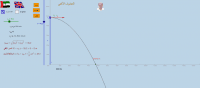
تُقذف كرة أفقيًا من حافة مرتفعة \(h\) بسرعة \(v_0\). غيّر \(h\) و\(v_0\) ثم اضغط «بدء» وراقب المسار ومركبتي السرعة \(v_x\) و\(v_y\) والمدى الأفقي \(X\).
A ball is thrown horizontally from the edge of a height \(h\) with speed \(v_0\). Change \(h\) and \(v_0\) then press “Start” and watch the path, the velocity components \(v_x\) and \(v_y\) and the horizontal range \(X\).
قُذف جسمان أفقيًا من الارتفاع نفسه بسرعتين مختلفتين \(10\) و\(20\ \mathrm{m/s}\). أيهما يصل إلى الأرض أولًا؟
Two bodies are thrown horizontally from the same height with different speeds \(10\) and \(20\ \mathrm{m/s}\). Which reaches the ground first?
⚖️ استقلال الحركتين
⚖️ Independence of the Two Motions
إذا قُذفت كرة أفقيًا وتُركت كرة أخرى لتسقط من الارتفاع نفسه في اللحظة نفسها فإنهما تبقيان على ارتفاع واحد في كل لحظة وتصلان إلى الأرض معًا. فالسرعة الأفقية لا تُنقص ولا تزيد زمن السقوط لأن مركبة السرعة الرأسية الابتدائية في الحالتين صفر.
If a ball is thrown horizontally and another is dropped from the same height at the same moment they stay at the same height at every moment and reach the ground together. The horizontal speed neither shortens nor lengthens the time of fall because the initial vertical component of velocity is zero in both cases.
🧪 تجربة 2: استقلال الحركتين: الأفقية والرأسية
🧪 Experiment 2: Independence of the Two Motions
تُقذف الكرة A أفقيًا بينما تُترك الكرة B لتسقط من السكون من الارتفاع نفسه في اللحظة نفسها. قارن ارتفاعيهما عند كل لحظة.
Ball A is thrown horizontally while ball B is dropped from rest from the same height at the same moment. Compare their heights at every moment.
تدحرجت كرة عن حافة طاولة ارتفاعها \(1.25\ \mathrm m\) وسقطت على الأرض على بعد \(1.5\ \mathrm m\) من قاعدة الطاولة. ما سرعتها لحظة مغادرة الطاولة؟
A ball rolled off the edge of a table \(1.25\ \mathrm m\) high and hit the floor \(1.5\ \mathrm m\) from the base of the table. What was its speed when it left the table?
تحلّق طائرة على ارتفاع \(500\ \mathrm m\) بسرعة أفقية \(100\ \mathrm{m/s}\) وتُسقط صندوق مساعدات. على أي بعد أفقي من الهدف يجب إسقاطه؟
A plane flies at a height of \(500\ \mathrm m\) with a horizontal speed of \(100\ \mathrm{m/s}\) and drops a box of supplies. At what horizontal distance from the target must it be released?
🎯 تحدّي: أصب الهدف
🎯 Challenge: Hit the Target
🧪 تجربة 3: أصب الهدف
🧪 Experiment 3: Hit the Target
يوجد هدف على الأرض على بعد \(X\) من قاعدة الحافة. احسب السرعة الأفقية اللازمة \(v_0=X/T\) بعد حساب \(T=\sqrt{2h/g}\) وأدخلها ثم اضغط «أطلق».
There is a target on the ground at a distance \(X\) from the base of the cliff. Calculate the needed horizontal speed \(v_0=X/T\) after finding \(T=\sqrt{2h/g}\), enter it then press “Fire”.
إذا تضاعف الارتفاع \(h\) أربع مرات مع بقاء \(v_0\) ثابتة فإن المدى الأفقي:
If the height \(h\) becomes four times while \(v_0\) stays constant the horizontal range:
🚀 تطبيقات
🚀 Applications
أين نصادف المقذوف الأفقي؟
Where do we meet a horizontal projectile?
- إسقاط المساعدات من الطائرات وتحديد لحظة الإفلات.Dropping supplies from planes and choosing the moment of release.
- الماء المتدفق من فتحة أفقية في خزان والكرة الدافعة عن حافة طاولة.Water coming from a horizontal hole in a tank and a ball rolling off a table.
- القفز الأفقي من منصة في الرياضات المائية والتزلج.Horizontal jumps from a platform in water sports and skiing.
⚠️ أخطاء شائعة
⚠️ Common Mistakes
تجنّب هذه الأخطاء
Avoid these mistakes
- الظن بأن الجسم الأسرع أفقيًا يبقى في الهواء زمنًا أطول.Thinking that the body faster horizontally stays in the air longer.
- استعمال \(v_0\) بدل \(v_y=gt\) عند حساب الزمن الرأسي أو العكس.Using \(v_0\) instead of \(v_y=gt\) when calculating the vertical time or the opposite.
- نسيان تركيب المركبتين عند حساب سرعة الاصطدام: \(v=\sqrt{v_x^2+v_y^2}\).Forgetting to combine the two components when calculating the impact speed: \(v=\sqrt{v_x^2+v_y^2}\).
📚 ملخص
📚 Summary
أهم ما تعلمناه
Key points
- الحركتان الأفقية والرأسية مستقلتان وتتمان في الزمن نفسه.The horizontal and the vertical motions are independent and take the same time.
- \(T=\sqrt{2h/g}\) و\(R=v_0T\) و\(v=\sqrt{v_0^2+2gh}\).\(T=\sqrt{2h/g}\), \(R=v_0T\) and \(v=\sqrt{v_0^2+2gh}\).
- المسار قطع مكافئ: \(y=h-\dfrac{g}{2v_0^2}x^2\).The path is a parabola: \(y=h-\dfrac{g}{2v_0^2}x^2\).
🔗 محاكيات GeoGebra للاستعانة بها عند اللزوم
🔗 GeoGebra Simulations to Use When Needed
اضغط «تشغيل» لتعمل المحاكاة هنا داخل الدرس؛ ويمكن للطالب الرجوع إليها لتجربة الفكرة بطريقة أخرى.
Press “Run” to run the simulation right here inside the lesson; the student can use it to try the idea in another way.