🎯 نواتج التعلم
🎯 Learning Outcomes
بعد هذه التجربة ستكون قادرًا على أن:
After this experiment you will be able to:
- تميّز بين توصيل المقاومات على التوالي وعلى التوازي والتوصيل المختلط.Distinguish between series, parallel and mixed connections of resistors.
- تحسب المقاومة المكافئة والتيار الكلي في كل نوع.Calculate the equivalent resistance and the total current in each type.
- تحسب فرق الجهد والتيار والقدرة لكل مقاومة.Calculate the potential difference, the current and the power of each resistor.
🎬 شاهد الفيديو
🎬 Watch the Video
🔗 التوالي والتوازي
🔗 Series and Parallel
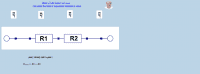
تُوصل المقاومات على التوالي إذا كان لها مسار واحد للتيار، فيمر التيار نفسه في كل منها. وتُوصل على التوازي إذا كانت أطرافها متصلة بنقطتين مشتركتين، فيتساوى فرق الجهد عليها ويتوزع التيار بينها.
Resistors are in series if they have a single path for the current, so the same current passes through each. They are in parallel if their ends are connected to two common points, so the potential difference across them is the same and the current is shared.
📘 القوانين
📘 The laws
\[\text{توالٍ: }\ R_{eq}=R_1+R_2+R_3\qquad I\ \text{ثابت},\ \ V=V_1+V_2+V_3\]
\[\text{توازٍ: }\ \dfrac{1}{R_{eq}}=\dfrac{1}{R_1}+\dfrac{1}{R_2}+\dfrac{1}{R_3}\qquad V\ \text{ثابت},\ \ I=I_1+I_2+I_3\]
\[\text{مقاومتان على التوازي: }\ R_{eq}=\dfrac{R_1R_2}{R_1+R_2}\qquad P=VI=I^2R=\dfrac{V^2}{R}\]
💡 ملاحظات
💡 Notes
- على التوالي: المقاومة المكافئة أكبر من أكبر مقاومة، والأكبر مقاومة يستهلك أكبر فرق جهد وأكبر قدرة.In series: the equivalent resistance is greater than the largest resistor, and the largest resistor takes the largest voltage and power.
- على التوازي: المقاومة المكافئة أقل من أصغر مقاومة، والأصغر مقاومة يمر فيه أكبر تيار.In parallel: the equivalent resistance is less than the smallest resistor, and the smallest resistor carries the largest current.
- قدرة البطارية تساوي مجموع قدرات المقاومات في كل أنواع التوصيل.The battery power equals the sum of the powers of the resistors in every type of connection.
🧪 تجربة 1: ركّب المقاومات
🧪 Experiment 1: Connect the resistors
اختر طريقة التوصيل (توالٍ أو توازٍ أو مختلط) وغيّر البطارية والمقاومات الثلاث. يعرض الرسم التيار وفرق الجهد لكل مقاومة، ويحسب الجدول \(R_{eq}\) والقدرة. (لا شيء يتحرك من تلقاء نفسه.)
Choose the connection (series, parallel or mixed) and change the battery and the three resistors. The drawing shows the current and the voltage of each resistor and the table gives \(R_{eq}\) and the power. (Nothing moves by itself.)
🧪 تجربة 2: حاسبة المقاومات
🧪 Experiment 2: Resistors calculator
مسألة جديدة في كل مرة (توالٍ أو توازٍ أو مختلط). احسب \(R_{eq}\) والتيار الكلي.
A new problem every time (series, parallel or mixed). Calculate \(R_{eq}\) and the total current.
✍️ أمثلة محلولة
✍️ Worked Examples
ثلاث مقاومات \(10\ \Omega\) و\(20\ \Omega\) و\(30\ \Omega\) على التوالي مع بطارية \(12\ \mathrm{V}\). احسب \(I\) وفرق الجهد على كل مقاومة.
Three resistors \(10\ \Omega\), \(20\ \Omega\) and \(30\ \Omega\) in series with a \(12\ \mathrm{V}\) battery. Find \(I\) and the voltage across each resistor.
مقاومتان \(20\ \Omega\) و\(30\ \Omega\) على التوازي مع بطارية \(12\ \mathrm{V}\). احسب \(R_{eq}\) والتيار الكلي والتيار في كل فرع.
Two resistors \(20\ \Omega\) and \(30\ \Omega\) in parallel with a \(12\ \mathrm{V}\) battery. Find \(R_{eq}\), the total current and each branch current.
\(R_1=4\ \Omega\) على التوالي مع مجموعة متوازية \(R_2=R_3=6\ \Omega\) وبطارية \(14\ \mathrm{V}\). احسب \(R_{eq}\) و\(I\) و\(V_1\).
\(R_1=4\ \Omega\) in series with a parallel group \(R_2=R_3=6\ \Omega\) and a \(14\ \mathrm{V}\) battery. Find \(R_{eq}\), \(I\) and \(V_1\).
ما المقاومة المكافئة لثلاث مقاومات متساوية قيمة كل منها \(R\) على التوازي؟
What is the equivalent resistance of three equal resistors \(R\) in parallel?
المقاومة المكافئة لمقاومتين \(6\ \Omega\) و\(3\ \Omega\) على التوازي:
The equivalent resistance of \(6\ \Omega\) and \(3\ \Omega\) in parallel:
في التوصيل على التوالي تتساوى:
In a series connection the following are equal:
في التوصيل على التوازي تتساوى:
In a parallel connection the following are equal:
إضافة مقاومة على التوازي مع مقاومة موجودة تجعل المقاومة المكافئة:
Adding a resistor in parallel with an existing one makes the equivalent resistance:
📚 ملخص
📚 Summary
| الكميةQuantity | توالٍSeries | توازٍParallel |
|---|---|---|
| التيارCurrent | ثابتsame | يتوزعshared |
| فرق الجهدVoltage | يتوزعshared | ثابتsame |
| \(R_{eq}\)\(R_{eq}\) | مجموعsum | مجموع المقلوباتsum of inverses |
⚠️ أخطاء شائعة
⚠️ Common mistakes
- جمع المقاومات مباشرة على التوازي.Adding resistors directly in parallel.
- نسيان أخذ مقلوب الناتج في \(1/R_{eq}\).Forgetting to invert the result of \(1/R_{eq}\).
- الظن أن التيار ينقص بعد المقاومة الأولى في التوالي: التيار ثابت.Thinking the current decreases after the first resistor in series: the current is constant.
🔗 محاكيات GeoGebra للاستعانة بها عند اللزوم
🔗 GeoGebra Simulations to Use When Needed
اضغط «تشغيل» لتعمل المحاكاة هنا داخل الدرس؛ ويمكن للطالب الرجوع إليها لتجربة الفكرة بطريقة أخرى.
Press “Run” to run the simulation right here inside the lesson; the student can use it to try the idea in another way.