🎯 نواتج التعلم
🎯 Learning Outcomes
بعد هذه التجربة ستكون قادرًا على أن:
After this experiment you will be able to:
- تذكر العوامل التي تتوقف عليها مقاومة موصل: الطول والمساحة ونوع المادة ودرجة الحرارة.State the factors that a conductor’s resistance depends on: length, cross-section area, material and temperature.
- تستخدم العلاقة \(R=\rho L/A\) في الحساب.Use the relation \(R=\rho L/A\) in calculations.
- تفسّر العلاقة بين المقاومة وكل عامل بالرسم البياني.Explain the relation between the resistance and each factor using graphs.
🎬 شاهد الفيديو
🎬 Watch the Video
🔌 مقاومة السلك
🔌 Resistance of a Wire
تعيق المادة مرور التيار الكهربائي فيها، ومقدار هذا الإعاقة هو المقاومة \(R\). تزداد مقاومة السلك كلما زاد طوله، وتقل كلما زادت مساحة مقطعه، وتتوقف على نوع مادته (المقاومية \(\rho\)) وعلى درجة حرارته.
A material opposes the flow of electric current through it, and the amount of this opposition is the resistance \(R\). The resistance of a wire increases with its length, decreases with its cross-section area, and depends on its material (the resistivity \(\rho\)) and on its temperature.
📘 القانون
📘 The law
\[R=\rho\dfrac{L}{A}\qquad A=\pi r^2=\dfrac{\pi d^2}{4}\]
\[\rho_T=\rho_{20}\left[1+\alpha\,(T-20)\right]\]
💡 ملاحظات
💡 Notes
- \(R\propto L\): مضاعفة الطول تضاعف المقاومة (الرسم \(R\)–\(L\) خط مستقيم).\(R\propto L\): doubling the length doubles the resistance (the \(R\)–\(L\) graph is a straight line).
- \(R\propto 1/A\propto 1/d^2\): مضاعفة القطر تقلل المقاومة إلى الربع.\(R\propto 1/A\propto 1/d^2\): doubling the diameter reduces the resistance to a quarter.
- المقاومية \(\rho\) خاصية للمادة وتقاس بوحدة \(\Omega\cdot\mathrm{m}\)، ولا تتوقف على شكل السلك.The resistivity \(\rho\) is a property of the material measured in \(\Omega\cdot\mathrm{m}\) and does not depend on the wire’s shape.
- في الفلزات تزداد المقاومة بارتفاع درجة الحرارة.In metals the resistance increases as the temperature rises.
🧪 تجربة 1: عوامل مقاومة السلك
🧪 Experiment 1: Factors of a wire’s resistance
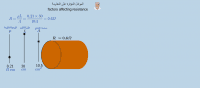
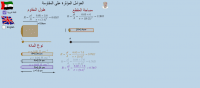
غيّر الطول والقطر والمادة ودرجة الحرارة وراقب المقاومة \(R=\rho L/A\). يتغير رسم السلك، ويتحرك المؤشر على الرسمين البيانيين: \(R\)–\(L\) و\(R\)–\(d\). (لا شيء يتحرك من تلقاء نفسه.)
Change the length, the diameter, the material and the temperature and watch the resistance \(R=\rho L/A\). The wire drawing changes and the marker moves on the two graphs: \(R\)–\(L\) and \(R\)–\(d\). (Nothing moves by itself.)
🧪 تجربة 2: حاسبة: تغيّر المقاومة
🧪 Experiment 2: Calculator: change in resistance
مسألة جديدة في كل مرة: غُيّرت أبعاد السلك. أوجد المقاومة الجديدة (Ω).
A new problem every time: the wire’s dimensions are changed. Find the new resistance (Ω).
✍️ أمثلة محلولة
✍️ Worked Examples
سلك نحاس طوله \(100\ \mathrm{m}\) وقطره \(1\ \mathrm{mm}\) (\(\rho=1.7\times10^{-8}\ \Omega\cdot\mathrm{m}\)). احسب مقاومته.
A copper wire is \(100\ \mathrm{m}\) long with a diameter of \(1\ \mathrm{mm}\) (\(\rho=1.7\times10^{-8}\ \Omega\cdot\mathrm{m}\)). Calculate its resistance.
سلك مقاومته \(8\ \Omega\). ما مقاومة سلك من المادة نفسها طوله ضعف طوله وقطره ضعف قطره؟
A wire has a resistance of \(8\ \Omega\). What is the resistance of a wire of the same material whose length and diameter are both twice as large?
قُطع سلك مقاومته \(6\ \Omega\) إلى نصفين متساويين. ما مقاومة كل نصف؟
A wire of resistance \(6\ \Omega\) is cut into two equal halves. What is the resistance of each half?
سلك نيكروم طوله \(2\ \mathrm{m}\) وقطره \(0.4\ \mathrm{mm}\) (\(\rho=1.1\times10^{-6}\ \Omega\cdot\mathrm{m}\)). احسب مقاومته.
A nichrome wire is \(2\ \mathrm{m}\) long with a diameter of \(0.4\ \mathrm{mm}\) (\(\rho=1.1\times10^{-6}\ \Omega\cdot\mathrm{m}\)). Calculate its resistance.
إذا تضاعف طول سلك مع ثبات بقية العوامل فإن مقاومته:
If a wire’s length is doubled with the other factors constant, its resistance:
إذا تضاعف قطر سلك فإن مقاومته:
If a wire’s diameter is doubled its resistance:
تتوقف المقاومية \(\rho\) على:
The resistivity \(\rho\) depends on:
عند ارتفاع درجة حرارة فلز تزداد:
When the temperature of a metal rises, its:
📚 ملخص
📚 Summary
| العاملFactor | العلاقة بـ \(R\)Relation to \(R\) |
|---|---|
| الطول \(L\)Length \(L\) | طرديةdirect |
| المساحة \(A\)Area \(A\) | عكسيةinverse |
| المقاومية \(\rho\)Resistivity \(\rho\) | طرديةdirect |
| الحرارة (فلز)Temperature (metal) | طرديةdirect |
⚠️ أخطاء شائعة
⚠️ Common mistakes
- الخلط بين القطر والنصف قطر عند حساب \(A\).Mixing up the diameter and the radius when finding \(A\).
- نسيان تربيع القطر: \(R\propto1/d^2\).Forgetting to square the diameter: \(R\propto1/d^2\).
- عدم تحويل mm إلى m قبل الحساب.Not converting mm to m before calculating.
🔗 محاكيات GeoGebra للاستعانة بها عند اللزوم
🔗 GeoGebra Simulations to Use When Needed
اضغط «تشغيل» لتعمل المحاكاة هنا داخل الدرس؛ ويمكن للطالب الرجوع إليها لتجربة الفكرة بطريقة أخرى.
Press “Run” to run the simulation right here inside the lesson; the student can use it to try the idea in another way.