🎯 نواتج التعلم
🎯 Learning Outcomes
بعد هذه التجربة ستكون قادرًا على أن:
After this experiment you will be able to:
- تعرّف الضغط \(P=F/A\) وتذكر وحدته الباسكال \(\mathrm{Pa}=\mathrm{N/m^2}\).Define the pressure \(P=F/A\) and state its unit the pascal \(\mathrm{Pa}=\mathrm{N/m^2}\).
- تحسب ضغط السائل عند عمق معيّن \(P_L=\rho g h\) والضغط الكلي \(P_{tot}=P_0+\rho g h\).Calculate the pressure of a liquid at a given depth \(P_L=\rho g h\) and the total pressure \(P_{tot}=P_0+\rho g h\).
- تفسّر أن الضغط يزداد خطيًا مع العمق ومع الكثافة ولا يتوقف على شكل الإناء.Explain that the pressure increases linearly with depth and with density and does not depend on the shape of the vessel.
- تستعمل توازن الضغطين في الأنبوب U لإيجاد كثافة سائل مجهول وتطبّق مبدأ باسكال.Use the balance of the two pressures in the U-tube to find the density of an unknown liquid and apply Pascal’s principle.
🎬 شاهد الفيديو
🎬 Watch the Video
💧 ما هو الضغط؟
💧 What Is Pressure?
الموائع هي المواد التي تنساب وتأخذ شكل وعائها، وهي السوائل والغازات. عندما يلامس مائع سطحًا يؤثر فيه بقوة عمودية عليه. والضغط هو القوة العمودية المؤثرة في وحدة المساحة:
Fluids are materials that flow and take the shape of their container: liquids and gases. When a fluid touches a surface it exerts a force perpendicular to it. The pressure is the perpendicular force acting on a unit area:
📌 تعريف الضغط
📌 Definition of pressure
\[P=\frac{F}{A}\qquad,\qquad 1\ \mathrm{Pa}=1\ \mathrm{N/m^2}\]
حقائق مهمة عن ضغط المائع
Important facts about fluid pressure
- الضغط كمية قياسية (ليس له اتجاه)، أما القوة الناتجة عنه فتكون عمودية على السطح.Pressure is a scalar (it has no direction), while the force it causes is perpendicular to the surface.
- في المائع الساكن يؤثر الضغط في كل الاتجاهات بالمقدار نفسه عند النقطة الواحدة.In a fluid at rest the pressure acts in all directions with the same value at a given point.
- يزداد الضغط داخل السائل كلما ازداد العمق لأن وزن السائل فوق النقطة يزداد.The pressure inside a liquid increases with the depth because the weight of the liquid above the point increases.
📐 ضغط عمود السائل
📐 The Pressure of a Column of Liquid
نتخيّل عمودًا رأسيًا من السائل مساحة مقطعه \(A\) وارتفاعه \(h\) فوق النقطة المدروسة. وزن هذا العمود هو القوة التي يضغط بها على المساحة \(A\):
Imagine a vertical column of liquid of cross-section \(A\) and height \(h\) above the point under study. The weight of this column is the force with which it presses on the area \(A\):
📌 الاشتقاق
📌 The derivation
\[F=mg=\rho Vg=\rho A h g\ \Rightarrow\ P_L=\frac{F}{A}=\rho\,g\,h\]
حيث \(\rho\) كثافة السائل (kg/m³) و\(g\) تسارع الجاذبية (m/s²) و\(h\) العمق تحت سطح السائل (m). لاحظ أن \(P_L\) لا تعتمد على مساحة المقطع ولا على حجم السائل؛ فقط على \(\rho\) و\(h\).
where \(\rho\) is the density of the liquid (kg/m³), \(g\) the gravitational acceleration (m/s²) and \(h\) the depth below the surface of the liquid (m). Notice that \(P_L\) does not depend on the cross-section or on the volume of the liquid; only on \(\rho\) and \(h\).
🌬️ الضغط الجوي والضغط الكلي
🌬️ Atmospheric Pressure and Total Pressure
الهواء أيضًا مائع وله وزن، ولذلك يضغط على سطح السائل بضغط جوي \(P_0\approx101325\ \mathrm{Pa}\) عند سطح البحر. ينتقل هذا الضغط عبر السائل فيضاف إلى ضغط السائل، فيكون الضغط الكلي (المطلق) عند العمق \(h\):
Air is also a fluid and has weight, so it presses on the surface of the liquid with an atmospheric pressure \(P_0\approx101325\ \mathrm{Pa}\) at sea level. This pressure is transmitted through the liquid and added to the pressure of the liquid, so the total (absolute) pressure at depth \(h\) is:
📌 الضغط الكلي
📌 The total pressure
\[P_{tot}=P_0+\rho\,g\,h\]
| الوحدةUnit | تساويEquals |
|---|---|
| \(1\ \mathrm{atm}\) | \(101325\ \mathrm{Pa}\) |
| \(1\ \mathrm{atm}\) | \(760\ \mathrm{mmHg}\) |
| \(1\ \mathrm{bar}\) | \(10^5\ \mathrm{Pa}\) |
| \(1\ \mathrm{atm}\) | \(1.013\ \mathrm{bar}\approx14.7\ \mathrm{psi}\) |
🧪 الضغط داخل سائل
🧪 Pressure Inside a Liquid
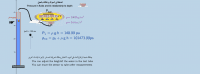
هذه التجربة تحاكي تطبيق GeoGebra «الضغط في السوائل وعلاقته بالعمق»: أنبوب اختبار فيه ماء وحساس ضغط يتحرك داخله، وتُقرأ قيمة \(P_L\) و\(P_{tot}\) بالباسكال.
This experiment simulates the GeoGebra applet “Pressure in liquids and its relationship to depth”: a test tube with water and a pressure sensor that moves inside it, and \(P_L\) and \(P_{tot}\) are read in pascals.
🛠️ خطوات العمل
🛠️ Procedure
- اترك السائل ماءً وحرّك الحساس إلى الأسفل (بالسحب أو بالشريط) وراقب ازدياد \(P_L\) و\(P_{tot}\).Keep the liquid as water and move the sensor downward (by dragging or with the slider) and watch \(P_L\) and \(P_{tot}\) increase.
- ثبّت العمق وغيّر ارتفاع الماء \(H\): لا يتغير الضغط، لأن العمق مقيس من سطح السائل.Fix the depth and change the height of the water \(H\): the pressure does not change because the depth is measured from the surface of the liquid.
- بدّل السائل (زيت، غليسرين، زئبق) عند العمق نفسه وراقب ميل الخط في الرسم: الميل \(=\rho g\).Change the liquid (oil, glycerin, mercury) at the same depth and watch the slope of the line in the graph: the slope \(=\rho g\).
🧪 تجربة 1: الضغط في السوائل وعلاقته بالعمق (كمحاكاة GeoGebra)
🧪 Experiment 1: Pressure in Liquids and Its Relationship to Depth (like the GeoGebra applet)
أنبوب اختبار فيه ماء وبداخله حساس ضغط. اضبط ارتفاع الماء \(H\) وحرّك الحساس (بالسحب على الشكل أو بالشريط) لتغيير عمقه \(h\) تحت السطح، ثم اقرأ الضغط الذي يسببه السائل \(P_L=\rho g h\) والضغط الكلي \(P_{tot}=P_0+\rho g h\).
A test tube contains water and a pressure sensor inside it. Set the height of the water \(H\) and move the sensor (by dragging it in the figure or with the slider) to change its depth \(h\) below the surface, then read the pressure caused by the liquid \(P_L=\rho g h\) and the total pressure \(P_{tot}=P_0+\rho g h\).
🔍 ماذا نلاحظ؟
🔍 What do we observe?
- الضغط يتناسب طرديًا مع العمق: ضعف العمق ضعف الضغط (والخط يمرّ بالأصل).The pressure is directly proportional to the depth: double the depth, double the pressure (and the line passes through the origin).
- الضغط يتناسب طرديًا مع الكثافة عند العمق نفسه.The pressure is directly proportional to the density at the same depth.
- الضغط الجوي يضيف مقدارًا ثابتًا \(P_0\) إلى كل نقطة، لذلك \(P_{tot}\) أكبر من \(P_L\) بالمقدار نفسه دائمًا.The atmospheric pressure adds a constant \(P_0\) to every point so \(P_{tot}\) is always larger than \(P_L\) by the same amount.
- عمق الحساس يُقاس من سطح السائل، فلا تتغير القراءة بتغيير ارتفاع الماء الكلي.The depth of the sensor is measured from the surface of the liquid so the reading does not change when the total height of the water changes.
أوجد الضغط الذي يسببه الماء (\(\rho=1000\ \mathrm{kg/m^3}\)) عند عمق \(10\ \mathrm m\)، والضغط الكلي (\(g=9.8\ \mathrm{m/s^2}\)).
Find the pressure caused by water (\(\rho=1000\ \mathrm{kg/m^3}\)) at a depth of \(10\ \mathrm m\) and the total pressure (\(g=9.8\ \mathrm{m/s^2}\)).
غوّاص على عمق \(30\ \mathrm m\) في ماء البحر (\(\rho=1025\ \mathrm{kg/m^3}\)). ما الضغط الكلي عليه؟
A diver is at a depth of \(30\ \mathrm m\) in sea water (\(\rho=1025\ \mathrm{kg/m^3}\)). What is the total pressure on the diver?
عند أي عمق في الماء يكون الضغط الكلي \(250\ \mathrm{kPa}\)؟
At what depth in water is the total pressure \(250\ \mathrm{kPa}\)?
إذا تضاعف عمق نقطة داخل سائل فإن الضغط الناتج عن السائل عندها:
If the depth of a point inside a liquid doubles then the pressure caused by the liquid there:
🏺 الضغط لا يتوقف على شكل الإناء
🏺 The Pressure Does Not Depend on the Shape of the Vessel
قد نظن أن الوعاء الأوسع يحوي سائلًا أثقل فيكون الضغط عند قاعه أكبر. لنختبر ذلك: ثلاثة أوعية (أسطواني، وأعرض عند القاع، وأعرض عند الفوهة) تحتوي السائل نفسه إلى الارتفاع نفسه.
We may think that a wider vessel contains a heavier liquid so the pressure at its bottom is larger. Let us test that: three vessels (a cylinder, wider at the bottom and wider at the mouth) contain the same liquid up to the same height.
🛠️ خطوات العمل
🛠️ Procedure
- اترك الماء عند \(h=0.4\ \mathrm m\) وقارن قراءات المقاييس الثلاثة.Keep water at \(h=0.4\ \mathrm m\) and compare the readings of the three gauges.
- قارن وزن السائل في كل وعاء (مكتوب أسفل كل وعاء).Compare the weight of the liquid in each vessel (written below each vessel).
- بدّل السائل (زيت، ماء البحر، زئبق) ولاحظ التغير في الضغط وفي الوزن.Change the liquid (oil, sea water, mercury) and notice the change in the pressure and in the weight.
🧪 تجربة 2: هل يتوقف الضغط على شكل الإناء؟
🧪 Experiment 2: Does the Pressure Depend on the Shape of the Vessel?
ثلاثة أوعية مختلفة الشكل والحجم تحتوي السائل نفسه إلى الارتفاع نفسه \(h\). المقياس عند القاع يبيّن الضغط، ويبيّن النص أسفله وزن السائل في كل وعاء.
Three vessels of different shape and volume contain the same liquid up to the same height \(h\). The gauge at the bottom shows the pressure and the text below it shows the weight of the liquid in each vessel.
🔍 ماذا نلاحظ؟
🔍 What do we observe?
- المقاييس الثلاثة تعطي القراءة نفسها: \(P=\rho g h\) لأن \(h\) و\(\rho\) متساويان.The three gauges give the same reading: \(P=\rho g h\) because \(h\) and \(\rho\) are the same.
- الأوزان مختلفة لأن الأحجام مختلفة؛ ويسمى ذلك مفارقة الضغط الهيدروستاتيكي.The weights are different because the volumes are different; this is called the hydrostatic paradox.
- الجدران المائلة تتحمل جزءًا من وزن السائل فلا يصل كله إلى القاع.The slanted walls carry a part of the weight of the liquid so not all of it reaches the bottom.
وعاءان مختلفا الشكل فيهما الماء إلى الارتفاع نفسه. الضغط عند قاع كل منهما:
Two vessels of different shapes contain water up to the same height. The pressure at the bottom of each is:
🔁 مبدأ باسكال
🔁 Pascal’s Principle
مبدأ باسكال: الضغط المؤثر في مائع محصور ينتقل كاملًا إلى جميع نقاط المائع وإلى جدران الوعاء. يُستعمل في المكبس الهيدروليكي فتؤثر قوة صغيرة \(F_1\) في مكبس صغير مساحته \(A_1\) فتتولد قوة كبيرة \(F_2\) على مكبس كبير مساحته \(A_2\):
Pascal’s principle: the pressure applied to a confined fluid is transmitted undiminished to all points of the fluid and to the walls of the container. It is used in the hydraulic press where a small force \(F_1\) on a small piston of area \(A_1\) produces a large force \(F_2\) on a large piston of area \(A_2\):
📌 المكبس الهيدروليكي
📌 The hydraulic press
\[\frac{F_1}{A_1}=\frac{F_2}{A_2}\ \Rightarrow\ F_2=F_1\,\frac{A_2}{A_1}\]
مكبس هيدروليكي مساحة مكبسه الصغير \(0.002\ \mathrm{m^2}\) والكبير \(0.1\ \mathrm{m^2}\). ما القوة اللازمة على الصغير لرفع سيارة بقوة \(10000\ \mathrm N\)؟
A hydraulic press has a small piston of area \(0.002\ \mathrm{m^2}\) and a large piston of area \(0.1\ \mathrm{m^2}\). What force is needed on the small piston to lift a car with a force of \(10000\ \mathrm N\)?
🔬 الأنبوب U وقياس كثافة سائل مجهول
🔬 The U-Tube and Measuring the Density of an Unknown Liquid
في الأنبوب \(U\) نختار مستوى أفقيًا يمرّ بسطح الفصل بين السائلين. الضغط عند هذا المستوى من الفرع الأيسر (ماء) يساوي الضغط من الفرع الأيمن (السائل المجهول) لأن النقطتين في السائل الساكن نفسه عند العمق نفسه، ويلغي الضغطُ الجوي نفسه من الطرفين.
In the \(U\)-tube we choose a horizontal level passing through the interface between the two liquids. The pressure at this level from the left arm (water) equals the pressure from the right arm (the unknown liquid) because the two points are in the same liquid at rest at the same depth, and the atmospheric pressure cancels from both ends.
📌 توازن الضغطين
📌 The balance of the two pressures
\[\rho_w\,g\,h_w=\rho_x\,g\,h_x\ \Rightarrow\ \rho_x=\rho_w\,\frac{h_w}{h_x}\]
🛠️ خطوات العمل
🛠️ Procedure
- اقرأ \(h_x\) و\(h_w\) من الشكل (القراءتان تظهران في الأسفل).Read \(h_x\) and \(h_w\) from the figure (the two readings appear below).
- احسب \(\rho_x=1000\,h_w/h_x\) وأدخل الناتج ثم «تحقق».Calculate \(\rho_x=1000\,h_w/h_x\), enter the result and press “Check”.
- غيّر \(h_x\) وتأكد أن النسبة \(h_w/h_x\) ثابتة، ثم اضغط «سائل جديد» وكرّر.Change \(h_x\) and make sure that the ratio \(h_w/h_x\) is constant, then press “New liquid” and repeat.
🧪 تجربة 3: الأنبوب U: قياس كثافة سائل مجهول
🧪 Experiment 3: The U-Tube: Measuring the Density of an Unknown Liquid
يحتوي الأنبوب U ماءً (كثافته \(1000\ \mathrm{kg/m^3}\))، وسُكب في فرعه الأيمن ارتفاع \(h_x\) من سائل مجهول لا يمتزج به. اقرأ \(h_w\) ارتفاع عمود الماء فوق مستوى الفصل في الفرع الأيسر ثم احسب كثافة السائل.
The U-tube contains water (density \(1000\ \mathrm{kg/m^3}\)) and a height \(h_x\) of an unknown immiscible liquid was poured into its right arm. Read \(h_w\), the height of the water column above the interface level in the left arm, then calculate the density of the liquid.
🔍 ماذا نلاحظ؟
🔍 What do we observe?
- السائل الأخف (الأقل كثافة) يحتاج عمودًا أطول ليوازن عمود الماء.The lighter liquid (the less dense) needs a longer column to balance the water column.
- النسبة \(h_w/h_x\) ثابتة لكل سائل مهما غيّرنا الكمية، وهي \(\rho_x/\rho_w\).The ratio \(h_w/h_x\) is constant for every liquid however we change the quantity, and it equals \(\rho_x/\rho_w\).
في أنبوب \(U\) ارتفع عمود الماء \(10\ \mathrm{cm}\) فوق مستوى الفصل، وكان ارتفاع الزيت \(12.5\ \mathrm{cm}\). أوجد كثافة الزيت.
In a \(U\)-tube the water column is \(10\ \mathrm{cm}\) above the interface level and the height of the oil is \(12.5\ \mathrm{cm}\). Find the density of the oil.
🎲 تدرّب على المسائل
🎲 Practice Problems
🧪 تجربة 4: تدرّب: الضغط في السوائل
🧪 Experiment 4: Practice: Pressure in Liquids
مسائل عشوائية بسوائل وأعماق مختلفة: أدخل ضغط السائل والضغط الكلي ثم اضغط «تحقّق».
Random problems with different liquids and depths: enter the liquid pressure and the total pressure then press “Check”.
🚀 تطبيقات
🚀 Applications
أين نستعمل ضغط الموائع؟
Where do we use fluid pressure?
- جدران السدود أسمك عند القاع لأن الضغط يزداد مع العمق.The walls of dams are thicker at the bottom because the pressure increases with depth.
- أبراج المياه مرتفعة لتوليد ضغط كافٍ في أنابيب البيوت.Water towers are high to generate enough pressure in the pipes of houses.
- الغوّاصون وصنّاع الغواصات يحسبون الضغط الكلي \(P_0+\rho g h\) لتصميم البدلات والأجسام.Divers and submarine builders calculate the total pressure \(P_0+\rho g h\) to design suits and hulls.
- المكابس والفرامل والرافعات الهيدروليكية تعتمد مبدأ باسكال.Hydraulic presses, brakes and lifts depend on Pascal’s principle.
⚠️ أخطاء شائعة
⚠️ Common Mistakes
تجنّب هذه الأخطاء
Avoid these mistakes
- الظن بأن الضغط يعتمد على شكل الإناء أو على كمية السائل الكلية.Thinking that the pressure depends on the shape of the vessel or on the total amount of the liquid.
- قياس العمق من قاع الإناء بدلًا من سطح السائل.Measuring the depth from the bottom of the vessel instead of the surface of the liquid.
- نسيان إضافة الضغط الجوي \(P_0\) عند طلب الضغط الكلي (المطلق).Forgetting to add the atmospheric pressure \(P_0\) when the total (absolute) pressure is asked.
- الخلط في الوحدات: Pa وkPa وatm وcm وm.Mixing the units: Pa, kPa, atm, cm and m.
📚 ملخص
📚 Summary
أهم ما تعلمناه
Key points
- \(P=F/A\) ووحدته الباسكال، والضغط في المائع الساكن يؤثر في كل الاتجاهات.\(P=F/A\) with unit the pascal, and the pressure in a fluid at rest acts in all directions.
- \(P_L=\rho g h\) والضغط الكلي \(P_{tot}=P_0+\rho g h\) مع \(P_0\approx101325\ \mathrm{Pa}\).\(P_L=\rho g h\) and the total pressure \(P_{tot}=P_0+\rho g h\) with \(P_0\approx101325\ \mathrm{Pa}\).
- الضغط عند عمق معيّن لا يتوقف على شكل الإناء بل على \(\rho\) و\(h\) فقط.The pressure at a given depth does not depend on the shape of the vessel but only on \(\rho\) and \(h\).
- الأنبوب \(U\): \(\rho_1h_1=\rho_2h_2\)، ومبدأ باسكال: \(F_1/A_1=F_2/A_2\).The \(U\)-tube: \(\rho_1h_1=\rho_2h_2\), and Pascal’s principle: \(F_1/A_1=F_2/A_2\).
🔗 محاكيات GeoGebra للاستعانة بها عند اللزوم
🔗 GeoGebra Simulations to Use When Needed
اضغط «تشغيل» لتعمل المحاكاة هنا داخل الدرس؛ ويمكن للطالب الرجوع إليها لتجربة الفكرة بطريقة أخرى.
Press “Run” to run the simulation right here inside the lesson; the student can use it to try the idea in another way.