🎯 نواتج التعلم
🎯 Learning Outcomes
بعد هذه التجربة ستكون قادرًا على أن:
After this experiment you will be able to:
- تقيس الزمن الدوري لبندول بساعة إيقاف وتحسبه من \(T=\dfrac{t}{n}\).Measure the period of a pendulum with a stopwatch and calculate it from \(T=\dfrac{t}{n}\).
- تحدد العوامل المؤثرة في الزمن الدوري \(T=2\pi\sqrt{L/g}\) وغير المؤثرة (الكتلة والسعة الصغيرة).Decide which factors affect the period \(T=2\pi\sqrt{L/g}\) and which do not (the mass and a small amplitude).
- ترسم \(T^2\) مع \(L\) وتجد تسارع الجاذبية \(g\) من الميل.Plot \(T^2\) against \(L\) and find the acceleration due to gravity \(g\) from the slope.
🎬 شاهد الفيديو
🎬 Watch the Video
⏱️ الزمن الدوري للبندول البسيط
⏱️ The Period of the Simple Pendulum
الزمن الدوري \(T\) هو زمن دورة كاملة (ذهاب وإياب) للبندول، ونقيسه بقياس زمن عدد \(n\) من الدورات وقسمته على \(n\) لتقليل خطأ القياس. وللبندول البسيط (كرة صغيرة بخيط خفيف) وزوايا صغيرة:
The period \(T\) is the time of one complete cycle (to and fro) of the pendulum, and we measure it by timing \(n\) cycles and dividing by \(n\) to reduce the measurement error. For a simple pendulum (a small bob on a light string) and small angles:
📘 الزمن الدوري
📘 The period
\[T=2\pi\sqrt{\dfrac{L}{g}}\qquad T^2=\dfrac{4\pi^2}{g}\,L\]
\(T\) يزداد بزيادة الطول \(L\)، ويقل بزيادة \(g\)، ولا يتوقف على الكتلة ولا على السعة (للزوايا الصغيرة).
\(T\) increases with the length \(L\), decreases when \(g\) increases, and does not depend on the mass nor on the amplitude (for small angles).
💡 شرح إضافي: من أين جاءت الصيغة ولماذا لا تظهر الكتلة؟
💡 Extra explanation: where does the formula come from and why does the mass not appear?
القوة المرجِعة المماسية على الكرة \(F=-mg\sin\theta\). للزوايا الصغيرة \(\sin\theta\approx\theta=\dfrac{x}{L}\) فتكون \(F\approx-\dfrac{mg}{L}\,x\)، وهي قوة من نوع \(F=-kx\) (حركة توافقية بسيطة) بثابت فعّال \(k=\dfrac{mg}{L}\). والزمن الدوري لكتلة \(m\) على نابض هو \(2\pi\sqrt{m/k}\) فيصبح \(T=2\pi\sqrt{\dfrac{m}{mg/L}}=2\pi\sqrt{\dfrac{L}{g}}\): الكتلة في القصور الذاتي \(m\) والكتلة في القوة المرجِعة \(mg\) تُختصران (لأن الوزن يتناسب مع الكتلة نفسها). وهذا ما تلاحظه حين تغيّر الكتلة في التجربة.
The tangential restoring force on the bob is \(F=-mg\sin\theta\). For small angles \(\sin\theta\approx\theta=\dfrac{x}{L}\) so \(F\approx-\dfrac{mg}{L}\,x\), a force of the type \(F=-kx\) (simple harmonic motion) with the effective constant \(k=\dfrac{mg}{L}\). The period of a mass \(m\) on a spring is \(2\pi\sqrt{m/k}\) so \(T=2\pi\sqrt{\dfrac{m}{mg/L}}=2\pi\sqrt{\dfrac{L}{g}}\): the mass in the inertia \(m\) and the mass in the restoring force \(mg\) cancel (because the weight is proportional to the mass itself). This is what you see when you change the mass in the experiment.
🧪 تجربة 1: قِس الزمن الدوري بساعة الإيقاف واكتشف ما يؤثر فيه
🧪 Experiment 1: Measure the period with a stopwatch and discover what affects it
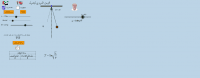
اضبط طول البندول \(L\) وزاوية الاهتزاز الكلية \(2\theta\) (كما في الأداة الأصلية) والكتلة \(M\)، واضغط «ابدأ» لتُترك الكرة وتعمل ساعة الإيقاف. تُحسب الدورة من عبور الكرة للوضع الرأسي، والزمن الدوري المقاس \(T=t/n\) لـ \(n\) دورة كاملة. غيّر الكتلة وراقب أن \(T\) لا يتغير، وغيّر الطول وراقب تغيره، ثم سجّل نقاط \((L,T^2)\): يظهر خط مستقيم ميله \(\dfrac{4\pi^2}{g}\). استخدم «السرعة ×4» لتختصر الوقت.
Set the length of the pendulum \(L\), the total swing angle \(2\theta\) (as in the original applet) and the mass \(M\), and press “Start”: the bob is released and the stopwatch runs. A cycle is counted from the crossings of the vertical position, and the measured period is \(T=t/n\) for \(n\) complete oscillations. Change the mass and see that \(T\) does not change, change the length and see how it changes, then record points \((L,T^2)\): a straight line appears with the slope \(\dfrac{4\pi^2}{g}\). Use “Speed ×4” to save time.
| تغييرChange | تأثيره في \(T\)Effect on \(T\) |
|---|---|
| مضاعفة الطول \(L\)doubling the length \(L\) | \(T\) تُضرب في \(\sqrt2\)\(T\) is multiplied by \(\sqrt2\) |
| زيادة الطول 4 مراتmaking the length 4 times longer | \(T\) يتضاعف\(T\) doubles |
| مضاعفة الكتلة \(M\)doubling the mass \(M\) | لا يتغيرno change |
| زيادة السعة (زوايا صغيرة)increasing the amplitude (small angles) | لا يتغير تقريبًاalmost no change |
| نقل البندول إلى القمر (\(g\) أصغر)taking the pendulum to the Moon (smaller \(g\)) | \(T\) أكبر\(T\) is larger |
💡 شرح إضافي: السعة الكبيرة وطريقة إيجاد \(g\) بدقة
💡 Extra explanation: a large amplitude and finding \(g\) accurately
عند زوايا كبيرة (مثل \(2\theta=90^\circ\)) يصبح \(\sin\theta\lt \theta\) فتضعف القوة المرجِعة ويزداد الزمن الدوري قليلًا: \(T\approx T_0\left(1+\dfrac{\theta^2}{16}\right)\) مع \(\theta\) بالراديان (حوالى \(4\%\) عند \(\theta=45^\circ\)). لذلك نقيس بزوايا صغيرة. ولإيجاد \(g\) نرسم \(T^2\) مع \(L\) لعدة أطوال فنحصل على خط مستقيم يمر بالأصل ميله \(\dfrac{4\pi^2}{g}\) ومنه \(g=\dfrac{4\pi^2}{\text{slope}}\)؛ وهذا أدق من حساب \(g\) من قياس واحد لأن الخطأ العشوائي يتوزع على عدة نقاط.
At large angles (such as \(2\theta=90^\circ\)) \(\sin\theta\lt \theta\) so the restoring force is weaker and the period is a little longer: \(T\approx T_0\left(1+\dfrac{\theta^2}{16}\right)\) with \(\theta\) in radians (about \(4\%\) at \(\theta=45^\circ\)). So we measure at small angles. To find \(g\) we plot \(T^2\) against \(L\) for several lengths and get a straight line through the origin with slope \(\dfrac{4\pi^2}{g}\), so \(g=\dfrac{4\pi^2}{\text{slope}}\); this is more accurate than computing \(g\) from one measurement because the random error is spread over several points.
✍️ أمثلة محلولة
✍️ Worked Examples
احسب الزمن الدوري لبندول طوله \(1.35\ \mathrm{m}\) (قيمة الأداة الأصلية).
Calculate the period of a pendulum \(1.35\ \mathrm{m}\) long (the value of the original applet).
ما طول البندول الذي زمنه الدوري \(2\ \mathrm{s}\) (البندول الثانوي)؟
What is the length of a pendulum whose period is \(2\ \mathrm{s}\) (the seconds pendulum)?
بندول طوله \(0.80\ \mathrm{m}\) أتم \(10\) دورات في \(18.0\ \mathrm{s}\). احسب \(g\).
A pendulum \(0.80\ \mathrm{m}\) long completed \(10\) oscillations in \(18.0\ \mathrm{s}\). Calculate \(g\).
ما الزمن الدوري لبندول طوله \(1\ \mathrm{m}\) على سطح القمر حيث \(g=1.62\ \mathrm{m/s^2}\)؟
What is the period of a \(1\ \mathrm{m}\) pendulum on the surface of the Moon where \(g=1.62\ \mathrm{m/s^2}\)?
إذا تضاعفت كتلة كرة البندول مع بقاء بقية القيم (زاوية صغيرة) فإن زمنه الدوري:
If the mass of the bob doubles with the other values fixed (small angle) the period:
إذا زاد طول البندول إلى أربعة أمثاله فإن زمنه الدوري:
If the length of the pendulum becomes four times larger its period:
ميل الخط البياني بين \(T^2\) (رأسي) و\(L\) (أفقي) يساوي:
The slope of the graph of \(T^2\) (vertical) against \(L\) (horizontal) equals:
لقياس الزمن الدوري بدقة نقيس زمن عدد من الدورات \(n\) ونقسم على \(n\) لأن:
To measure the period accurately we time a number of oscillations \(n\) and divide by \(n\) because:
📚 ملخص
📚 Summary
| المفهومConcept | القانونLaw |
|---|---|
| الزمن الدوريPeriod | \(T=\dfrac{t}{n}=2\pi\sqrt{\dfrac{L}{g}}\)\(T=\dfrac{t}{n}=2\pi\sqrt{\dfrac{L}{g}}\) |
| التمثيل الخطيLinear form | \(T^2=\dfrac{4\pi^2}{g}L\ ,\ g=\dfrac{4\pi^2}{\text{slope}}\)\(T^2=\dfrac{4\pi^2}{g}L\ ,\ g=\dfrac{4\pi^2}{\text{slope}}\) |
⚠️ أخطاء شائعة
⚠️ Common mistakes
- الاعتقاد بأن الكرة الأثقل تتأرجح أبطأ أو أسرع؛ الزمن الدوري لا يتوقف على الكتلة.Believing that a heavier bob swings slower or faster; the period does not depend on the mass.
- قياس الطول إلى أسفل الكرة بدل مركزها؛ الطول هو من نقطة التعليق إلى مركز الكرة.Measuring the length to the bottom of the bob instead of its centre; the length is from the pivot to the centre of the bob.
- استعمال زاوية كبيرة والتعويض في الصيغة التقريبية.Using a large angle and substituting in the approximate formula.
- حساب الزمن الدوري من نصف دورة أو من دورة واحدة فقط.Calculating the period from half a cycle or from one cycle only.
🔗 محاكيات GeoGebra للاستعانة بها عند اللزوم
🔗 GeoGebra Simulations to Use When Needed
اضغط «تشغيل» لتعمل المحاكاة هنا داخل الدرس؛ ويمكن للطالب الرجوع إليها لتجربة الفكرة بطريقة أخرى.
Press “Run” to run the simulation right here inside the lesson; the student can use it to try the idea in another way.