🎯 نواتج التعلم
🎯 Learning Outcomes
بعد هذه التجربة ستكون قادرًا على أن:
After this experiment you will be able to:
- تكتب معادلة موضع سيارة تتحرك بسرعة ثابتة \(x=x_0+vt\).Write the position equation of a car moving with constant velocity \(x=x_0+vt\).
- تجد زمن اللقاء وموضعه بمساواة المعادلتين \(x_1=x_2\).Find the time and the position of the meeting by equating the two equations \(x_1=x_2\).
- تفسّر تقاطع الخطين البيانيين في رسم الموضع مع الزمن وتعرف متى لا يلتقيان.Interpret the crossing of the two lines in the position–time graph and know when they do not meet.
- تحلّ مسألة سيارة متسارعة تلحق بأخرى بمعادلة تربيعية.Solve a problem of an accelerating car catching another with a quadratic equation.
🎬 شاهد الفيديو
🎬 Watch the Video
🚗 سيارتان على خط مستقيم
🚗 Two Cars on a Straight Line
نختار محورًا \(x\) على الطريق واتجاهًا موجبًا (مثلًا نحو اليمين)، ونحدّد موضع كل سيارة عند اللحظة \(t=0\) وسرعتها (إشارة موجبة إن تحركت في الاتجاه الموجب وسالبة إن عكسته). فإذا كانت السرعة ثابتة كان موضع كل سيارة معادلة من الدرجة الأولى في الزمن:
We choose an axis \(x\) along the road and a positive direction (for example to the right), and determine the position of each car at \(t=0\) and its velocity (a positive sign if it moves in the positive direction and a negative one if opposite). When the velocity is constant the position of each car is a first-degree equation in time:
📌 معادلتا الموضع
📌 The two position equations
\[x_1=x_{01}+v_1t\qquad,\qquad x_2=x_{02}+v_2t\]
🤝 متى وأين تلتقيان؟
🤝 When and Where Do They Meet?
تلتقي السيارتان عندما يتساوى موضعاهما \(x_1=x_2\) في اللحظة نفسها. نحلّ المعادلة لإيجاد الزمن \(t_m\)، ثم نعوّض به في أي من المعادلتين لإيجاد موضع اللقاء \(x_m\).
The cars meet when their positions are equal \(x_1=x_2\) at the same instant. We solve the equation for the time \(t_m\), then substitute it in either equation to find the meeting position \(x_m\).
📌 زمن اللقاء وموضعه
📌 The meeting time and position
\[x_{01}+v_1t_m=x_{02}+v_2t_m\ \Rightarrow\ t_m=\frac{x_{02}-x_{01}}{v_1-v_2}\]
\[x_m=x_{01}+v_1t_m\]
| الحالةCase | ماذا يحدث؟What happens? | على الرسم البيانيOn the graph |
|---|---|---|
| تتحركان نحو بعضهماMoving toward each other | تلتقيان بعد زمن قصير (السرعة النسبية كبيرة)They meet after a short time (large relative velocity) | خطان مائلان في اتجاهين متعاكسين يتقاطعانTwo lines of opposite slopes cross |
| الخلفية أسرع في الاتجاه نفسهThe rear one is faster, same direction | تلحق بالأمامية وتلتقيانIt catches up with the front one and they meet | الخط الأشد ميلًا يقطع الآخرThe steeper line crosses the other |
| السرعتان متساويتانEqual velocities | المسافة ثابتة فلا يلتقيانThe distance is constant so they never meet | خطان متوازيانTwo parallel lines |
| \(t_m\lt 0\)\(t_m\lt 0\) | كانتا ستلتقيان في الماضيThey would have met in the past | التقاطع قبل \(t=0\)The crossing is before \(t=0\) |
السرعة النسبية
The relative velocity
- \(v_1-v_2\) هي سرعة السيارة 1 كما تراها السيارة 2؛ وهي معدل تغيّر المسافة بينهما.\(v_1-v_2\) is the velocity of car 1 as seen from car 2; it is the rate at which the distance between them changes.
- الفرق في الموضع الابتدائي \(x_{02}-x_{01}\) مقسومًا عليها يعطي زمن اللقاء.The initial position difference \(x_{02}-x_{01}\) divided by it gives the meeting time.
🧪 تجربة 1: سيارتان بسرعتين ثابتتين: متى وأين تلتقيان؟
🧪 Experiment 1: Two Cars with Constant Velocities: When and Where Do They Meet?
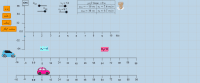
اضبط موضع كل سيارة وسرعتها (الإشارة السالبة تعني الحركة نحو اليسار) ثم اضغط «شغّل الحركة» أو حرّك شريط الزمن بنفسك، وراقب الخطين البيانيين للموضع مع الزمن ونقطة تقاطعهما (لحظة اللقاء وموضعه).
Set the position and the velocity of each car (a negative sign means motion to the left) then press “Start the motion” or move the time bar yourself, and watch the two position–time graph lines and their intersection point (the time and the position of the meeting).
سيارة 1 عند \(x_{01}=0\) بسرعة \(15\ \mathrm{m/s}\) وسيارة 2 عند \(x_{02}=100\ \mathrm m\) بسرعة \(-10\ \mathrm{m/s}\) (نحو السيارة 1). متى وأين تلتقيان؟
Car 1 at \(x_{01}=0\) with \(15\ \mathrm{m/s}\) and car 2 at \(x_{02}=100\ \mathrm m\) with \(-10\ \mathrm{m/s}\) (toward car 1). When and where do they meet?
سيارة 1 عند \(x=0\) بسرعة \(20\ \mathrm{m/s}\) تلاحق سيارة 2 عند \(x=120\ \mathrm m\) بسرعة \(14\ \mathrm{m/s}\) في الاتجاه نفسه. متى تلحق بها؟ وكم تقطع كل منهما؟
Car 1 at \(x=0\) with \(20\ \mathrm{m/s}\) chases car 2 at \(x=120\ \mathrm m\) with \(14\ \mathrm{m/s}\) in the same direction. When does it catch up with it? And how far does each one go?
سيارتان بالسرعة نفسها \(12\ \mathrm{m/s}\) في الاتجاه نفسه والمسافة بينهما \(50\ \mathrm m\). هل تلتقيان؟
Two cars with the same velocity \(12\ \mathrm{m/s}\) in the same direction and \(50\ \mathrm m\) apart. Do they meet?
⚡ سيارة متسارعة تلاحق سيارة منتظمة السرعة
⚡ An Accelerating Car Chasing a Car of Constant Velocity
إذا تحركت إحدى السيارتين بتسارع ثابت \(a\) فإن موضعها \(x=x_0+v_0t+\tfrac12at^2\) (قطع مكافئ في الرسم البياني). وشرط اللقاء نفسه \(x_1=x_2\) لكنه يعطي معادلة تربيعية في \(t\) قد يكون لها جذران موجبان (لقاءان) أو جذر واحد (مماس) أو لا جذر (لا لقاء).
If one of the cars moves with a constant acceleration \(a\) its position is \(x=x_0+v_0t+\tfrac12at^2\) (a parabola on the graph). The meeting condition is still \(x_1=x_2\) but it gives a quadratic equation in \(t\) which may have two positive roots (two meetings), one root (tangent) or none (no meeting).
📌 معادلة اللقاء
📌 The meeting equation
\[\tfrac12a\,t^2+(v_0-v)\,t-x_0=0\qquad t=\frac{-(v_0-v)\pm\sqrt{(v_0-v)^2+2ax_0}}{a}\]
🧪 تجربة 2: سيارة متسارعة تلاحق سيارة منتظمة السرعة
🧪 Experiment 2: An Accelerating Car Chasing a Car of Constant Velocity
السيارة الزرقاء تتحرك بسرعة ثابتة من موضع متقدّم، والحمراء تنطلق من \(x=0\) بسرعة ابتدائية وتسارع ثابت. غيّر القيم وراقب المنحنى (قطع مكافئ) والخط المستقيم: قد يتقاطعان مرتين أو مرة أو لا يتقاطعان.
The blue car moves with constant velocity from an advanced position, and the red car starts from \(x=0\) with an initial velocity and a constant acceleration. Change the values and watch the curve (a parabola) and the straight line: they may cross twice, once or never.
سيارة زرقاء بسرعة \(10\ \mathrm{m/s}\) تتقدّم \(60\ \mathrm m\) عن سيارة حمراء ساكنة. تنطلق الحمراء بتسارع \(3\ \mathrm{m/s^2}\). متى تلحق بها؟
A blue car at \(10\ \mathrm{m/s}\) is \(60\ \mathrm m\) ahead of a red car at rest. The red car starts with an acceleration of \(3\ \mathrm{m/s^2}\). When does it catch up with it?
عند لحظة لحاق السيارة المتسارعة بالأخرى تكون سرعتها اللحظية:
At the instant the accelerating car catches up with the other its instantaneous speed is:
⚠️ أخطاء شائعة
⚠️ Common Mistakes
تجنّب هذه الأخطاء
Avoid these mistakes
- إهمال إشارة السرعة عندما تتحرك السيارة عكس الاتجاه الموجب.Neglecting the sign of the velocity when the car moves against the positive direction.
- الخلط بين «زمن اللقاء» و«موضع اللقاء»: الأول بالثواني والثاني بالأمتار.Confusing the “meeting time” with the “meeting position”: the first is in seconds and the second in metres.
- الاكتفاء بمساواة السرعتين بدل مساواة الموضعين.Equating the velocities instead of the positions.
- اعتبار الزمن السالب لقاءً حقيقيًا: اللقاء يلزم أن يكون \(t\ge0\).Taking a negative time as a real meeting: a meeting must have \(t\ge0\).
📚 ملخص
📚 Summary
أهم ما تعلمناه
Key points
- سرعة ثابتة: \(x=x_0+vt\)، واللقاء عند \(x_1=x_2\): \(t_m=\dfrac{x_{02}-x_{01}}{v_1-v_2}\).Constant velocity: \(x=x_0+vt\), and the meeting is at \(x_1=x_2\): \(t_m=\dfrac{x_{02}-x_{01}}{v_1-v_2}\).
- على الرسم البياني اللقاء هو نقطة تقاطع الخطين؛ والخطان المتوازيان لا يلتقيان.On the graph the meeting is the crossing point of the two lines; parallel lines never meet.
- مع التسارع تظهر معادلة تربيعية بجذرين أو جذر أو بلا جذر.With acceleration a quadratic appears with two roots, one root or none.
🔗 محاكيات GeoGebra للاستعانة بها عند اللزوم
🔗 GeoGebra Simulations to Use When Needed
اضغط «تشغيل» لتعمل المحاكاة هنا داخل الدرس؛ ويمكن للطالب الرجوع إليها لتجربة الفكرة بطريقة أخرى.
Press “Run” to run the simulation right here inside the lesson; the student can use it to try the idea in another way.