🎯 نواتج التعلم
🎯 Learning Outcomes
بعد هذه التجربة ستكون قادرًا على أن:
After this experiment you will be able to:
- تفسّر الحث المتبادل بين ملفين، وتحسب القوة المحركة المستحثة في الثانوي.Explain mutual induction between two coils, and calculate the emf induced in the secondary.
- تستنتج علاقة الجهد بعدد اللفات في المحوّل المثالي.Derive the voltage–turns relation for an ideal transformer.
- تحسب التيار في كل ملف، وتتحقق من بقاء القدرة.Calculate the current in each coil, and verify that the power is conserved.
- تفسّر لماذا لا يعمل المحوّل مع التيار المستمر.Explain why a transformer does not work with direct current.
🎬 شاهد الفيديو
🎬 Watch the Video
🔍 الفكرة في صورة
🔍 The Idea in a Picture
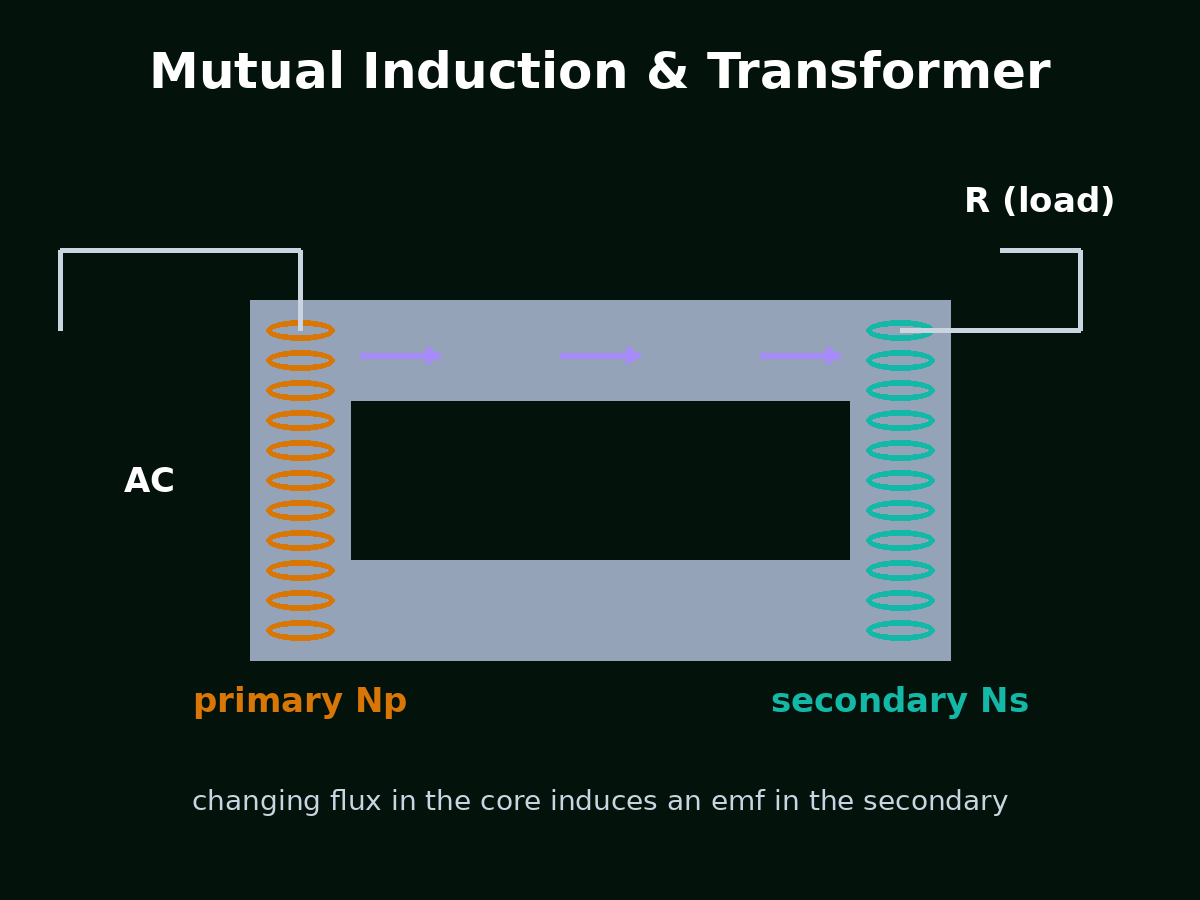
⚡ الحث المتبادل
⚡ Mutual induction
عندما يتغير التيار في ملف أولي يتغير التدفق المغناطيسي الذي يخترق ملفًا ثانويًا مجاورًا، فتُستحث فيه قوة محركة. وهذا هو الحث المتبادل.
When the current in a primary coil changes, the magnetic flux through a nearby secondary coil changes too, and an emf is induced in it. This is mutual induction.
📘 قوانين الحث المتبادل والمحوّل
📘 Laws of mutual induction and the transformer
\[\varepsilon_2=-M\,\dfrac{dI_1}{dt}\]
\[\dfrac{V_s}{V_p}=\dfrac{N_s}{N_p}\qquad\dfrac{I_p}{I_s}=\dfrac{N_s}{N_p}\qquad P_p=P_s\]
حيث \(M\) معامل الحث المتبادل، و\(N_p\) و\(N_s\) عددا لفات الملفين الأولي والثانوي. إذا كان \(N_s>N_p\) فالمحوّل رافع للجهد، وإذا كان \(N_s where \(M\) is the mutual inductance, and \(N_p\) and \(N_s\) are the numbers of turns of the primary and secondary coils. If \(N_s>N_p\) the transformer steps the voltage up; if \(N_s
💡 شرح إضافي: لماذا يعمل المحوّل بالتيار المتردد فقط؟
💡 Extra explanation: why does a transformer work only with alternating current?
الحث يحتاج إلى تغير في التدفق، والتغير يحتاج إلى تغير في التيار. التيار المستمر الثابت يُنتج تدفقًا ثابتًا، فلا تُستحث قوة محركة في الثانوي. أما التيار المتردد فيغيّر اتجاهه ومقداره باستمرار، فيبقى التدفق متغيرًا ويستمر الحث.
Induction needs a changing flux, and a changing flux needs a changing current. A steady DC current produces a steady flux, so no emf is induced in the secondary. Alternating current keeps changing its size and direction, so the flux keeps changing and induction continues.
💡 شرح إضافي: لماذا يقل التيار عندما يرتفع الجهد؟
💡 Extra explanation: why does the current fall when the voltage rises?
المحوّل المثالي لا يُنتج طاقة، لذلك تبقى القدرة ثابتة: \(P=VI\). إذا ارتفع الجهد في الثانوي بمقدار معين قلّ التيار بالمقدار نفسه تقريبًا. وهكذا يُكسب المحوّل جهدًا ويخسر تيارًا، وليس العكس.
An ideal transformer creates no energy, so the power stays constant: \(P=VI\). If the secondary voltage rises by some factor, the current falls by about the same factor. The transformer gains voltage and loses current, not the other way round.
🧪 التجربة التفاعلية: المحوّل في الحركة
🧪 Interactive Experiment: The Transformer in Motion
غيّر عدد لفات كل ملف وجهد المصدر والحمل، ولاحظ الجهد الثانوي والتيار. ثم اضغط «مصدر: مستمر» لترى أن التيار المستمر لا يُنتج جهدًا في الثانوي.
Change the turns of each coil, the source voltage and the load, and observe the secondary voltage and current. Then press “Source: DC” to see that direct current produces no voltage in the secondary.
ملاحظة: التدفق في النواة يُرسم بطريقة توضيحية، والقيم تُعرض للمحوّل المثالي.
Note: the flux in the core is drawn schematically, and the values are for the ideal transformer.
🔁 الحث المتبادل والمحوّل
🔁 Mutual induction and the transformer
✍️ أمثلة محلولة
✍️ Worked Examples
محوّل مثالي عدد لفات ملفه الأولي \(N_p=200\) وعدد لفات الثانوي \(N_s=1000\)، وجهد المصدر الأولي \(V_p=20\ \mathrm{V}\). احسب الجهد الثانوي، وهل هو رافع أم خافض؟
An ideal transformer has \(N_p=200\) primary turns and \(N_s=1000\) secondary turns, with a primary voltage \(V_p=20\ \mathrm{V}\). Find the secondary voltage, and state whether it is step-up or step-down.
في المثال السابق يُوصل بالملف الثانوي حمل مقاومته \(50\ \Omega\). احسب تيار الثانوي وتيار الأولي، ثم تحقق من تساوي القدرتين.
In the previous example a load of \(50\ \Omega\) is connected to the secondary. Find the secondary current and the primary current, then verify that the two powers are equal.
وُصل ملف أولي بمصدر تيار مستمر ثابت \(12\ \mathrm{V}\). ما الجهد المتولد في الملف الثانوي بعد مرور وقت طويل؟ ولماذا؟
A primary coil is connected to a steady \(12\ \mathrm{V}\) DC source. What is the voltage induced in the secondary after a long time? Why?
📚 ملخص
📚 Summary
| المفهومConcept | القانون أو النتيجةLaw or result |
|---|---|
| الحث المتبادلMutual induction | \(\varepsilon_2=-M\,dI_1/dt\) |
| الجهدVoltage | \(V_s/V_p=N_s/N_p\) |
| التيارCurrent | \(I_p/I_s=N_s/N_p\) |
| القدرةPower | \(P_p=P_s\)\(P_p=P_s\) |
| التيار المستمرDC | لا يعمل: التدفق ثابتdoes not work: the flux is steady |
⚠️ أخطاء شائعة
⚠️ Common mistakes
- الظن أن المحوّل يزيد الطاقة؛ هو يحوّل الجهد والتيار مع بقاء القدرة تقريبًا ثابتة.Thinking the transformer increases energy; it converts voltage and current while the power stays almost the same.
- قلب النسبة: الجهد يتناسب مع عدد اللفات مباشرة، والتيار عكسيًا.Inverting the ratio: the voltage is proportional to the number of turns, and the current is inversely proportional.
- توصيل محوّل بمصدر مستمر وتوقع جهد مستمر في الثانوي؛ لا يوجد حث مع التيار الثابت.Connecting a transformer to DC and expecting a steady output; there is no induction with a steady current.
- الخلط بين الحث المتبادل والحث الذاتي؛ الأول بين ملفين، والثاني داخل الملف نفسه.Confusing mutual induction with self-induction; the first is between two coils, the second is within one coil.
🧠 اختبر نفسك
🧠 Test Yourself
محوّل رافع للجهد. ماذا يحدث للتيار في الملف الثانوي مقارنة بالأولي؟
A step-up transformer. What happens to the current in the secondary compared with the primary?
لماذا لا يعمل المحوّل مع التيار المستمر الثابت؟
Why does a transformer not work with a steady direct current?
🔗 محاكيات GeoGebra للاستعانة بها عند اللزوم
🔗 GeoGebra Simulations to Use When Needed
اضغط «تشغيل» لتعمل المحاكاة هنا داخل الدرس؛ ويمكن للطالب الرجوع إليها لتجربة الفكرة بطريقة أخرى.
Press “Run” to run the simulation right here inside the lesson; the student can use it to try the idea in another way.