🎯 نواتج التعلم
🎯 Learning Outcomes
بعد هذه التجربة ستكون قادرًا على أن:
After this experiment you will be able to:
- تفسّر الحث الذاتي بأنه تولّد قوة محركة في الملف نفسه عند تغيّر التيار فيه.Explain self-induction as the emf produced in a coil itself when its current changes.
- تحسب القوة المحركة الذاتية: \(\varepsilon=-L\dfrac{di}{dt}\).Calculate the self-induced emf: \(\varepsilon=-L\dfrac{di}{dt}\).
- تحسب ثابت الزمن \(\tau=L/R\) وتستخدمه في تفسير نمو التيار وتناقصه.Calculate the time constant \(\tau=L/R\) and use it to explain the growth and decay of the current.
- تحسب الطاقة المخزنة في الملف: \(U=\tfrac12 Li^2\).Calculate the energy stored in the inductor: \(U=\tfrac12 Li^2\).
🎬 شاهد الفيديو
🎬 Watch the Video
🔍 الفكرة في صورة
🔍 The Idea in a Picture
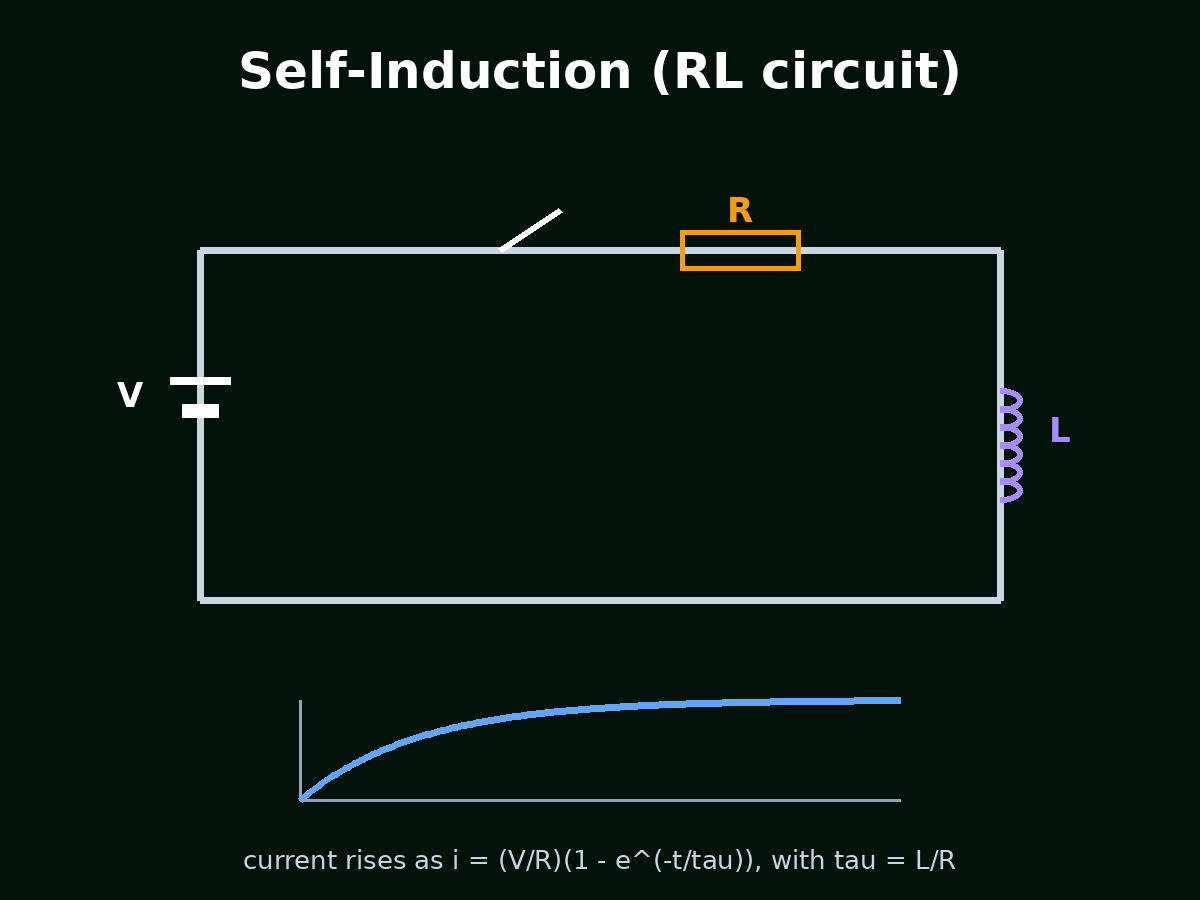
⚡ القوة المحركة الذاتية
⚡ The self-induced emf
عندما يتغير التيار في ملف يتغير التدفق المغناطيسي الذي يولّده الملف نفسه، فتتولد فيه قوة محركة تعاكس التغير. هذه الظاهرة هي الحث الذاتي، ويُسمى معامل الحث الذاتي \(L\) خاصية الملف التي تحدد مقدار هذه القوة.
When the current in a coil changes, the flux produced by the coil itself changes, and an emf is induced in it that opposes the change. This is self-induction, and the self-inductance \(L\) is the property of the coil that sets the size of this emf.
📘 قوانين الحث الذاتي
📘 Laws of self-induction
\[\varepsilon=-L\dfrac{di}{dt}\qquad \tau=\dfrac{L}{R}\qquad U=\tfrac12 Li^2\]
حيث \(L\) معامل الحث الذاتي بوحدة الهنري، و\(\tau\) ثابت الزمن، و\(U\) الطاقة المخزنة في المجال المغناطيسي للملف. الإشارة السالبة تعني أن القوة المحركة تعاكس التغير في التيار (قانون لنز).
where \(L\) is the self-inductance in henry, \(\tau\) is the time constant, and \(U\) is the energy stored in the magnetic field of the coil. The minus sign means the emf opposes the change in current (Lenz's law).
💡 شرح إضافي: لماذا لا يرتفع التيار فورًا عند غلق المفتاح؟
💡 Extra explanation: why doesn't the current rise instantly when the switch closes?
في الدائرة \(RL\) يحقق قانون كيرشوف: \(V=Ri+L\dfrac{di}{dt}\). عند الغلق يكون التيار صفرًا، فيكون \(\dfrac{di}{dt}\) كبيرًا، فتعاكس القوة المحركة الذاتية البطارية. ومع ارتفاع التيار يقل معدل تغيره، ويقترب التيار من القيمة النهائية \(V/R\) وفق \(i=\tfrac{V}{R}(1-e^{-t/\tau})\).
In an RL circuit Kirchhoff's law gives \(V=Ri+L\dfrac{di}{dt}\). At closing the current is zero, so \(\dfrac{di}{dt}\) is large and the self-induced emf opposes the battery. As the current rises its rate of change falls, and the current approaches \(V/R\) according to \(i=\tfrac{V}{R}(1-e^{-t/\tau})\).
💡 شرح إضافي: لماذا تظهر قوة كبيرة عند فتح المفتاح؟
💡 Extra explanation: why does a large emf appear when the switch opens?
عند الفتح يتناقص التيار بسرعة كبيرة فيكون \(\dfrac{di}{dt}\) كبيرًا، فتتولد قوة محركة ذاتية كبيرة تحاول إبقاء التيار. لهذا تظهر شرارة عند فتح دوائر تحتوي ملفات كبيرة، وتُستخدم دوائر حماية لتقليلها.
On opening the current falls quickly, so \(\dfrac{di}{dt}\) is large and a large self-induced emf appears that tries to keep the current flowing. This is why sparks appear when circuits with large coils are opened, and protection circuits are used to reduce them.
🧪 التجربة التفاعلية: دائرة RL
🧪 Interactive Experiment: The RL Circuit
اضغط «غلق المفتاح» وراقب التيار يرتفع تدريجيًا، والقوة المحركة الذاتية (البرتقالي) تعاكس البطارية في البداية ثم تتلاشى. ثم افتح المفتاح لترى التيار يتناقص وتظهر قوة كبيرة. غيّر L وR وV لترى أثرها في ثابت الزمن.
Close the switch and watch the current rise gradually, while the self-induced emf (orange) opposes the battery at first and then fades. Then open the switch to see the current fall and a large emf appear. Change L, R and V to see their effect on the time constant.
ملاحظة: الزمن يُعرض بالثانية، والمنحنى يُحسب من الحل الدقيق للمعادلة التفاضلية.
Note: time is shown in seconds, and the curve is computed from the exact solution of the differential equation.
⚡ دائرة RL: الحث الذاتي
⚡ RL circuit: self-induction
✍️ أمثلة محلولة
✍️ Worked Examples
ملف معامل حثه الذاتي \(0.5\ \mathrm{H}\) يمر فيه تيار يتغير من \(2\ \mathrm{A}\) إلى صفر خلال \(0.1\ \mathrm{s}\). احسب متوسط القوة المحركة الذاتية.
A coil of self-inductance \(0.5\ \mathrm{H}\) has its current change from \(2\ \mathrm{A}\) to zero in \(0.1\ \mathrm{s}\). Find the average self-induced emf.
دائرة RL فيها \(L=2\ \mathrm{H}\) و\(R=4\ \Omega\) ومصدر \(V=12\ \mathrm{V}\). احسب ثابت الزمن، والتيار النهائي، والتيار بعد زمن يساوي ثابت الزمن.
An RL circuit has \(L=2\ \mathrm{H}\), \(R=4\ \Omega\) and a \(12\ \mathrm{V}\) source. Find the time constant, the final current, and the current after one time constant.
في المثال السابق، احسب الطاقة المخزنة في الملف عندما يصل التيار إلى قيمته النهائية.
In the previous example, find the energy stored in the coil when the current reaches its final value.
📚 ملخص
📚 Summary
| المفهومConcept | القانون أو النتيجةLaw or result |
|---|---|
| القوة المحركة الذاتيةSelf-induced emf | \(\varepsilon=-L\,di/dt\) |
| نمو التيارGrowth of the current | \(i=\tfrac{V}{R}(1-e^{-t/\tau})\) |
| تناقص التيارDecay of the current | \(i=I_0e^{-t/\tau}\) |
| ثابت الزمنTime constant | \(\tau=L/R\) |
| الطاقة المخزنةStored energy | \(U=\tfrac12 Li^2\) |
⚠️ أخطاء شائعة
⚠️ Common mistakes
- الظن أن التيار يصل إلى قيمته النهائية فورًا؛ الزمن المطلوب يقدّره \(\tau\).Thinking the current reaches its final value instantly; the time needed is set by \(\tau\).
- الخلط بين الحث الذاتي والحث المتبادل؛ الأول داخل الملف نفسه، والثاني بين ملفين.Confusing self-induction with mutual induction; the first is within one coil, the second between two coils.
- نسيان الإشارة السالبة في \(\varepsilon=-L\,di/dt\)، فتُعكس اتجاه القوة المحركة.Forgetting the minus sign in \(\varepsilon=-L\,di/dt\), which reverses the direction of the emf.
- استخدام \(\tau=RL\) بدل \(\tau=L/R\).Using \(\tau=RL\) instead of \(\tau=L/R\).
🧠 اختبر نفسك
🧠 Test Yourself
عند غلق المفتاح في دائرة RL، ماذا تفعل القوة المحركة الذاتية؟
When the switch is closed in an RL circuit, what does the self-induced emf do?
بعد زمن يساوي ثابت الزمن \(\tau\) من غلق المفتاح، ما نسبة التيار إلى قيمته النهائية تقريبًا؟
After a time equal to the time constant \(\tau\) from closing the switch, what fraction of the final current is reached, approximately?
🔗 محاكاة GeoGebra للاستعانة بها عند اللزوم
🔗 GeoGebra Simulation to Use When Needed
اضغط «تشغيل» لتعمل المحاكاة هنا داخل الدرس؛ ويمكن للطالب الرجوع إليها لتجربة الفكرة بطريقة أخرى.
Press “Run” to run the simulation right here inside the lesson; the student can use it to try the idea in another way.