🎯 نواتج التعلم
🎯 Learning Outcomes
بعد هذه التجربة ستكون قادرًا على أن:
After this experiment you will be able to:
- تفرّق بين الاحتكاك السكوني والاحتكاك الحركي وتقرأ رسم قوة الاحتكاك مع القوة المؤثرة.Distinguish between the static and the kinetic friction and read the graph of the friction force against the applied force.
- تحدّد القيمة العظمى للاحتكاك السكوني \(f_{s,max}=\mu_sN\) والاحتكاك الحركي \(f_k=\mu_kN\).Find the maximum static friction \(f_{s,max}=\mu_sN\) and the kinetic friction \(f_k=\mu_kN\).
- تستنتج أن الاحتكاك يعتمد على القوة العمودية ونوع السطحين ولا يعتمد على مساحة التلامس.Deduce that the friction depends on the normal force and the kind of the two surfaces and does not depend on the area of contact.
🎬 شاهد الفيديو
🎬 Watch the Video
✋ قوة الاحتكاك
✋ The Friction Force
الاحتكاك قوة تقاوم انزلاق سطحين متلامسين أحدهما على الآخر وتكون موازية للسطحين. الاحتكاك السكوني \(f_s\) يؤثر والجسم ساكن ويساوي القوة المؤثرة تمامًا حتى حدّه الأعظم \(f_{s,max}=\mu_sN\)؛ وعندما تتجاوز القوة المؤثرة هذا الحد يبدأ الجسم بالحركة ويصبح الاحتكاك حركيًا \(f_k=\mu_kN\) وهو أصغر من \(f_{s,max}\) عادةً.
Friction is a force that opposes the sliding of two surfaces in contact over each other and it is parallel to the surfaces. The static friction \(f_s\) acts while the body is at rest and equals the applied force exactly up to its maximum \(f_{s,max}=\mu_sN\); when the applied force exceeds this limit the body starts to move and the friction becomes kinetic \(f_k=\mu_kN\) which is usually smaller than \(f_{s,max}\).
📘 القوانين
📘 The laws
\[f_s=F\ (F\le\mu_sN)\qquad f_{s,max}=\mu_sN\qquad f_k=\mu_kN\ (\lt \mu_sN)\]
\[N=mg\qquad a=\dfrac{F-f_k}{m}\ (F\gt \mu_sN)\]
💡 شرح إضافي: قراءة الرسم
💡 Extra explanation: reading the graph
- الجزء المائل من الرسم: خط ميله 1 (\(f_s=F\)) حتى القمة \(\mu_sN\).The sloped part of the graph: a line of slope 1 (\(f_s=F\)) up to the peak \(\mu_sN\).
- بعد القمة: يهبط الاحتكاك فجأة إلى \(\mu_kN\) ويبقى ثابتًا مهما زادت القوة (تزداد السرعة والتسارع).After the peak: the friction suddenly drops to \(\mu_kN\) and stays constant however much the force increases (the velocity and acceleration increase).
- الاحتكاك لا يعتمد على مساحة التلامس: وضع الصندوق على وجه أكبر أو أصغر يعطي القيمة نفسها (مع ثبات \(N\) ونوع السطح).The friction does not depend on the area of contact: putting the box on a larger or smaller face gives the same value (with a constant \(N\) and the same kind of surface).
- نستعمل \(g=9.8\ \mathrm{m/s^2}\) ومعاملات تقريبية للأسطح.We use \(g=9.8\ \mathrm{m/s^2}\) and approximate coefficients for the surfaces.
🧪 تجربة 1: زِد القوة تدريجيًا وارسم قوة الاحتكاك
🧪 Experiment 1: Increase the force gradually and plot the friction force
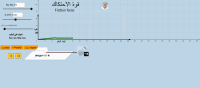
يُسحب الصندوق بقوة أفقية \(F\) تزيدها بنفسك بالمؤشر (لا شيء يتحرك قبل ذلك). ما دام \(F\le\mu_sN\) يبقى ساكنًا ويساوي الاحتكاك السكوني \(F\) تمامًا، فإذا تجاوزته تحرك الصندوق وهبط الاحتكاك إلى \(\mu_kN\). يُرسم الاحتكاك مع \(F\) تلقائيًا نقطةً نقطة عند تحريكك للمؤشر. اختر السطح والكتلة واضغط «ابدأ من جديد» لمسح الرسم.
The box is pulled by a horizontal force \(F\) that you increase yourself with the slider (nothing moves before that). As long as \(F\le\mu_sN\) it stays at rest and the static friction equals \(F\) exactly; if you exceed it the box moves and the friction drops to \(\mu_kN\). The friction is plotted against \(F\) point by point as you move the slider. Choose the surface and the mass and press “Start again” to clear the plot.
🧪 تجربة 2: حاسبة: السكوني والحركي
🧪 Experiment 2: Calculator: static and kinetic
مسألة جديدة في كل مرة (\(g=9.8\ \mathrm{m/s^2}\)). احسب القيم الثلاث ثم اضغط «صحّح».
A new problem every time (\(g=9.8\ \mathrm{m/s^2}\)). Calculate the three values and press “Check”.
🛠️ تطبيقات عملية
🛠️ Practical applications
- الإطارات والفرامل: يحتاج الاحتكاك السكوني لمنع انزلاق العجلة.Tyres and brakes: the static friction is needed to prevent the wheel from skidding.
- المشي: الاحتكاك السكوني بين الحذاء والأرض يدفعنا للأمام.Walking: the static friction between the shoe and the ground pushes us forward.
- التزلّج والتزييت: تقليل معامل الاحتكاك يسهّل الانزلاق.Skating and lubrication: decreasing the friction coefficient makes sliding easier.
✍️ أمثلة محلولة
✍️ Worked Examples
صندوق \(10\ \mathrm{kg}\) على سطح معاملاه \(\mu_s=0.5\) و\(\mu_k=0.3\) (\(g=9.8\)). احسب \(f_{s,max}\) و\(f_k\).
A \(10\ \mathrm{kg}\) box on a surface with \(\mu_s=0.5\) and \(\mu_k=0.3\) (\(g=9.8\)). Calculate \(f_{s,max}\) and \(f_k\).
للصندوق نفسه: ما الاحتكاك عندما تكون القوة المؤثرة \(30\ \mathrm{N}\)؟ وعندما تكون \(60\ \mathrm{N}\)؟ وما التسارع في الحالة الثانية؟
For the same box: what is the friction when the applied force is \(30\ \mathrm{N}\)? When it is \(60\ \mathrm{N}\)? What is the acceleration in the second case?
لو قُلبت العلبة على وجه أصغر مساحة (الكتلة نفسها). كيف يتغير الاحتكاك؟
If the box is turned on a face of smaller area (the same mass). How does the friction change?
سُحب جسم بقوة \(40\ \mathrm{N}\) فبدأ يتحرك بالكاد عندما تجاوزت القوة هذه القيمة وكانت \(N=80\ \mathrm{N}\). ما \(\mu_s\)؟
A body was pulled and it just started to move when the force exceeded \(40\ \mathrm{N}\) with \(N=80\ \mathrm{N}\). What is \(\mu_s\)?
الاحتكاك السكوني لجسم ساكن مسحوب بقوة أقل من الحد الأعظم يساوي:
The static friction on a body at rest pulled by a force below the maximum is equal to:
عند بدء الحركة يهبط الاحتكاك لأن:
When the motion starts the friction decreases because:
يعتمد الاحتكاك الحركي على:
The kinetic friction depends on:
إذا تضاعفت كتلة الصندوق فإن الاحتكاك الحركي:
If the mass of the box doubles the kinetic friction:
📚 ملخص
📚 Summary
| الحالةCase | الاحتكاكFriction |
|---|---|
| \(F\le\mu_sN\)\(F\le\mu_sN\) | \(f_s=F\)\(f_s=F\) |
| \(F\gt \mu_sN\)\(F\gt \mu_sN\) | \(f_k=\mu_kN\)\(f_k=\mu_kN\) |
| العلاقةRelation | \(\mu_k\lt \mu_s\)\(\mu_k\lt \mu_s\) |
⚠️ أخطاء شائعة
⚠️ Common mistakes
- الظن بأن الاحتكاك السكوني يساوي دائمًا \(\mu_sN\)؛ هو القيمة العظمى فقط.Thinking that the static friction always equals \(\mu_sN\); that is only its maximum.
- اعتبار الاحتكاك يزداد بزيادة مساحة التلامس.Considering that the friction increases with the area of contact.
- الخلط بين \(\mu_s\) و\(\mu_k\) عند حساب التسارع.Confusing \(\mu_s\) and \(\mu_k\) when calculating the acceleration.
🔗 محاكيات GeoGebra للاستعانة بها عند اللزوم
🔗 GeoGebra Simulations to Use When Needed
اضغط «تشغيل» لتعمل المحاكاة هنا داخل الدرس؛ ويمكن للطالب الرجوع إليها لتجربة الفكرة بطريقة أخرى.
Press “Run” to run the simulation right here inside the lesson; the student can use it to try the idea in another way.