🎯 نواتج التعلم
🎯 Learning Outcomes
بعد هذه التجربة ستكون قادرًا على أن:
After this experiment you will be able to:
- تذكر شرطي الاتزان التام للجسم الصلب: \(\Sigma F=0\) و\(\Sigma\tau=0\).State the two conditions of complete equilibrium of a rigid body: \(\Sigma F=0\) and \(\Sigma\tau=0\).
- تحسب عزم كل قوة وتجمعها جبريًا لتتحقق من الاتزان الدوراني.Calculate the torque of every force and add them algebraically to check the rotational equilibrium.
- تحسب قوة مجهولة أو موضعًا مجهولًا يحقق الاتزان، وتحسب رد فعل المحور.Find an unknown force or position that gives equilibrium, and find the reaction of the pivot.
- تفرّق بين الاتزان المستقر وغير المستقر والمتعادل.Distinguish stable, unstable and neutral equilibrium.
🎬 شاهد الفيديو
🎬 Watch the Video
⚖️ متى يكون الجسم متزنًا؟
⚖️ When is a Body in Equilibrium?
يكون الجسم الصلب في اتزان تام إذا لم يتغير لا انتقاله ولا دورانه، وهذا يتطلب شرطين معًا:
A rigid body is in complete equilibrium if neither its translation nor its rotation changes, which needs two conditions together:
📘 شرطا الاتزان
📘 The two conditions of equilibrium
\[\Sigma\vec F=0\quad(\text{translational equilibrium})\]
\[\Sigma\tau=0\quad(\text{rotational equilibrium})\]
حيث عزم كل قوة \(\tau=r\,F\sin\theta\)، ونعدّ العزم موجبًا إذا أدار الجسم عكس عقارب الساعة وسالبًا إذا أداره مع عقارب الساعة. في هذه التجربة الأثقال رأسية إلى الأسفل (\(\theta=90^\circ\)) فيكون \(\tau=-x\,F\) حيث \(x\) موضع الثقل بالنسبة للمحور (موجب يمينًا).
where the torque of each force is \(\tau=r\,F\sin\theta\), a torque being positive if it turns the body counter-clockwise and negative if clockwise. In this experiment the weights are vertical and downward (\(\theta=90^\circ\)) so \(\tau=-x\,F\) where \(x\) is the position of the weight relative to the pivot (positive to the right).
💡 شرح إضافي: ما معنى «متزن» بالضبط؟
💡 Extra explanation: what exactly does “balanced” mean?
الاتزان لا يعني أن القوى معدومة: على العارضة أثقال ورد فعل المحور، لكنها تُلغي بعضها اتجاهيًا (\(\Sigma F=0\)) وعزومها تُلغي بعضها (\(\Sigma\tau=0\)). كما أن \(\Sigma\tau=0\) لا تعني أن العارضة ساكنة بالضرورة؛ قد تدور بسرعة زاوية ثابتة (اتزان ديناميكي) لأن \(\Sigma\tau=I\alpha=0\) تعني فقط \(\alpha=0\). وفي التجربة تكون العارضة مهملة الكتلة والمحور في منتصفها فرد فعل المحور يساوي مجموع الأثقال: \(N=F_A+F_B+F_C\).
Equilibrium does not mean that the forces are absent: there are weights and the reaction of the pivot on the beam, but they cancel as vectors (\(\Sigma F=0\)) and their torques cancel (\(\Sigma\tau=0\)). Also \(\Sigma\tau=0\) does not necessarily mean the beam is at rest; it may turn at a constant angular speed (dynamic equilibrium) because \(\Sigma\tau=I\alpha=0\) means only \(\alpha=0\). In the experiment the beam is massless and the pivot is at its middle so the pivot reaction equals the sum of the weights: \(N=F_A+F_B+F_C\).
🧪 تجربة 1: اتزان عارضة تحت ثلاث قوى
🧪 Experiment 1: Equilibrium of a beam under three forces
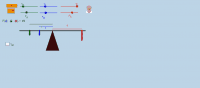
عارضة طولها \(20\ \mathrm{m}\) على محور دوران في منتصفها (تُهمل كتلتها). عُلّقت بها ثلاثة أثقال \(F_A\) و\(F_B\) و\(F_C\) (كل كرة تمثل \(1\ \mathrm{N}\)) في مواضع تحددها أنت (سالب = يسار المحور، موجب = يمينه). عزم كل ثقل \(\tau=-x\,F\) (الثقل الهابط على اليسار يعطي عزمًا موجبًا عكس عقارب الساعة). تتزن العارضة إذا كانت \(\Sigma\tau=0\). اضغط «بدء» فإن لم تكن متزنة دارت بتسارع زاوي \(\alpha=\dfrac{\Sigma\tau}{I}\) حيث \(I=\sum m\,x^2\) (اعتُبرت \(g=10\ \mathrm{m/s^2}\)) حتى تصل إلى حدّ الميلان \(25^\circ\).
A beam \(20\ \mathrm{m}\) long rests on a pivot at its middle (its mass is neglected). Three weights \(F_A\), \(F_B\) and \(F_C\) (each ball stands for \(1\ \mathrm{N}\)) hang at positions you choose (negative = left of the pivot, positive = right). The torque of each weight is \(\tau=-x\,F\) (a downward weight on the left gives a positive, counter-clockwise torque). The beam is in equilibrium if \(\Sigma\tau=0\). Press “Start”: if it is not balanced it turns with angular acceleration \(\alpha=\dfrac{\Sigma\tau}{I}\) where \(I=\sum m\,x^2\) (\(g=10\ \mathrm{m/s^2}\) was assumed) until it reaches the tilt limit \(25^\circ\).
جرّب الحالة الافتراضية (وهي القيم نفسها في أداة GeoGebra): \(\tau_A=3\times6=+18\)، \(\tau_B=-7\times6=-42\)، \(\tau_C=8\times3=+24\) فيكون \(\Sigma\tau=18-42+24=0\) فالعارضة متزنة. ثم غيّر ثقلًا واحدًا واضغط «بدء» لترى اتجاه الدوران، وعدّله بزر «اضبط \(F_B\) للاتزان».
Try the default case (the same values as in the GeoGebra applet): \(\tau_A=3\times6=+18\), \(\tau_B=-7\times6=-42\), \(\tau_C=8\times3=+24\) so \(\Sigma\tau=18-42+24=0\) and the beam is balanced. Then change one weight and press “Start” to see the direction of the rotation, and correct it with the “Set \(F_B\) for balance” button.
🔄 أنواع الاتزان
🔄 Kinds of Equilibrium
| النوعKind | إذا أُزيح قليلًاIf displaced slightly | مثالExample |
|---|---|---|
| مستقرstable | يعود إلى وضعه (مركز الثقل يرتفع)returns (the centre of gravity rises) | عارضة معلّقة من محور أعلى مركز ثقلهاa beam hung from a pivot above its centre of gravity |
| غير مستقرunstable | يبتعد أكثر (مركز الثقل ينخفض)moves farther away (the centre of gravity falls) | عارضة موضوعة على محور أسفل مركز ثقلهاa beam resting on a pivot below its centre of gravity |
| متعادل (لا مبالٍ)neutral | يبقى في الوضع الجديدstays in the new position | عجلة على محور يمرّ بمركز ثقلهاa wheel on an axle through its centre of gravity |
💡 شرح إضافي: لماذا العارضة في التجربة متعادلة؟
💡 Extra explanation: why is the beam in the experiment neutral?
المحور في التجربة يمرّ بمستوى العارضة وأثقالها تتعلق رأسيًا فعزم كل ثقل \(-xF\cos\varphi\) يتغير بالعامل نفسه \(\cos\varphi\) عند ميل العارضة بزاوية \(\varphi\)، فإذا كانت \(\Sigma\tau=0\) عند الأفقي بقيت صفرًا عند أي ميل: اتزان متعادل. جرّب «بدء» في حالة غير متزنة لترى أن العارضة تدور إلى حدّ الميلان بتسارع زاوي تقريبًا ثابت يقل بالعامل \(\cos\varphi\).
The pivot in the experiment lies in the plane of the beam and the weights hang vertically so the torque of each weight \(-xF\cos\varphi\) changes by the same factor \(\cos\varphi\) when the beam is tilted by an angle \(\varphi\); so if \(\Sigma\tau=0\) when horizontal it stays zero at any tilt: neutral equilibrium. Press “Start” in an unbalanced case to see that the beam turns to the tilt limit with an almost constant angular acceleration that decreases with the factor \(\cos\varphi\).
✍️ أمثلة محلولة
✍️ Worked Examples
عارضة محورها في منتصفها عُلّق عليها ثقل \(6\ \mathrm{N}\) على بُعد \(3\ \mathrm{m}\) يسار المحور (A) وثقل \(6\ \mathrm{N}\) على بُعد \(7\ \mathrm{m}\) يمينه (B) وثقل \(3\ \mathrm{N}\) على بُعد \(8\ \mathrm{m}\) يساره (C). هل العارضة متزنة؟ وما رد فعل المحور؟
A beam with its pivot at the middle carries a \(6\ \mathrm{N}\) weight \(3\ \mathrm{m}\) to the left of the pivot (A), a \(6\ \mathrm{N}\) weight \(7\ \mathrm{m}\) to its right (B) and a \(3\ \mathrm{N}\) weight \(8\ \mathrm{m}\) to its left (C). Is the beam balanced? What is the reaction of the pivot?
ثقل \(5\ \mathrm{N}\) على بُعد \(4\ \mathrm{m}\) يسار المحور وثقل \(8\ \mathrm{N}\) على بُعد \(5\ \mathrm{m}\) يمينه. ما الثقل الذي يجب تعليقه على بُعد \(2\ \mathrm{m}\) يسار المحور ليتزن النظام؟
A \(5\ \mathrm{N}\) weight is \(4\ \mathrm{m}\) left of the pivot and an \(8\ \mathrm{N}\) weight is \(5\ \mathrm{m}\) to its right. What weight must be hung \(2\ \mathrm{m}\) to the left of the pivot to balance the system?
في الحالة الأولى حذفنا الثقل C. احسب محصلة العزوم واتجاه الدوران، ثم التسارع الزاوي ابتدائيًا بأخذ \(g=10\ \mathrm{m/s^2}\) (الكتلة تُحسب من الوزن).
In the first case the weight C was removed. Calculate the net torque and the direction of rotation, then the initial angular acceleration taking \(g=10\ \mathrm{m/s^2}\) (the masses are found from the weights).
عارضة متزنة دورانيًا تعني أن:
A rotationally balanced beam means that:
ثقل \(10\ \mathrm{N}\) على بُعد \(2\ \mathrm{m}\) يسار المحور يتزن مع ثقل على بُعد \(4\ \mathrm{m}\) يمينه مقداره:
A \(10\ \mathrm{N}\) weight \(2\ \mathrm{m}\) to the left of the pivot balances a weight \(4\ \mathrm{m}\) to its right equal to:
رد فعل المحور على عارضة متزنة مهملة الكتلة تحمل ثقلين \(4\ \mathrm{N}\) و\(6\ \mathrm{N}\):
The reaction of the pivot on a balanced massless beam carrying weights of \(4\ \mathrm{N}\) and \(6\ \mathrm{N}\) is:
جسم يدور بسرعة زاوية ثابتة دون تغيّر. محصلة العزوم عليه:
A body turns with a constant angular speed. The net torque on it is:
📚 ملخص
📚 Summary
| المفهومConcept | القانونLaw |
|---|---|
| شرطا الاتزانEquilibrium conditions | \(\Sigma F=0\ ,\ \Sigma\tau=0\)\(\Sigma F=0\ ,\ \Sigma\tau=0\) |
| عزم ثقل رأسيTorque of a vertical weight | \(\tau=-xF\)\(\tau=-xF\) |
| رد فعل المحورReaction of the pivot | \(N=\sum F_{down}\)\(N=\sum F_{down}\) |
| الدوران غير المتزنUnbalanced rotation | \(\alpha=\dfrac{\Sigma\tau}{I}\)\(\alpha=\dfrac{\Sigma\tau}{I}\) |
⚠️ أخطاء شائعة
⚠️ Common mistakes
- الاكتفاء بـ \(\Sigma F=0\) والظن أنها تكفي للاتزان؛ العارضة قد تدور مع أن محصلة القوى صفر (زوج قوى).Relying on \(\Sigma F=0\) only; a beam may rotate although the net force is zero (a couple).
- نسيان الإشارات: الثقل على اليسار يعطي عزمًا موجبًا والثقل على اليمين سالبًا (عندما تكون الأثقال هابطة).Forgetting the signs: a weight on the left gives a positive torque and on the right a negative one (for downward weights).
- استخدام الأوزان فقط دون المسافات: العزم هو \(\)القوة × البعد.Using the weights only without the distances: the torque is force × distance.
- نسيان رد فعل المحور عند حساب \(\Sigma F=0\).Forgetting the reaction of the pivot in \(\Sigma F=0\).
🔗 محاكيات GeoGebra للاستعانة بها عند اللزوم
🔗 GeoGebra Simulations to Use When Needed
اضغط «تشغيل» لتعمل المحاكاة هنا داخل الدرس؛ ويمكن للطالب الرجوع إليها لتجربة الفكرة بطريقة أخرى.
Press “Run” to run the simulation right here inside the lesson; the student can use it to try the idea in another way.